









Koposov 2
A Ghostly Globular Cluster at the Edge of the Milky Way
Quick Reader
| Attribute | Details |
|---|---|
| Name | Koposov 2 |
| Type | Faint Globular Cluster |
| Constellation | Boötes |
| Distance from Earth | ~125,000 light-years |
| Diameter | ~25 light-years (approx.) |
| Apparent Magnitude | ~15.0 (extremely faint) |
| Discovery | 2007, by Sergey Koposov and collaborators (using SDSS data) |
| Associated Galaxy/Stream | Possibly part of the Sagittarius Stream or Milky Way halo |
| Metallicity | Very low (~[Fe/H] ≈ –2.0) |
| Age | ~12 billion years |
| Total Luminosity | ~3,000 L☉ (among the faintest known clusters) |
| Mass | ~10,000 M☉ (extremely low) |
| Scientific Importance | One of the faintest and least massive globular clusters known; key to understanding the outer halo and tidal disruption of clusters |
| Best Viewing Months | April to August (Northern Hemisphere) |
| Observation Tools | Requires large-aperture telescopes or deep imaging surveys (e.g., SDSS, Gaia, DES) |
Introduction — A Cluster at the Limits of Detection
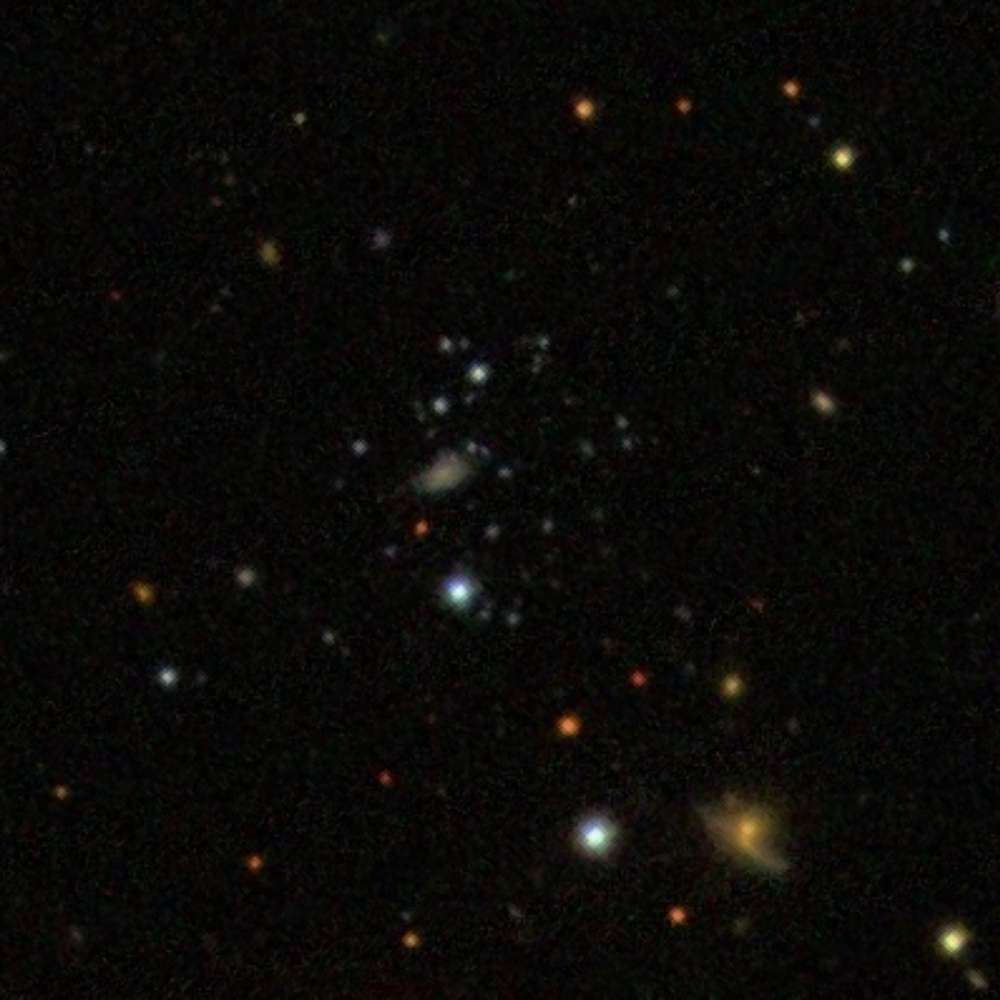
In the vast halo of our Milky Way lies a faint, ghostly cluster of ancient stars known as Koposov 2.
Barely visible even to modern telescopes, this system represents one of the most diffuse and least luminous globular clusters ever discovered.
At first glance, Koposov 2 appears insignificant — a dim sprinkling of stars far from the Galactic plane.
But for astronomers, it carries profound implications:
it may be one of the last surviving remnants of the Milky Way’s outer halo formation, offering clues to how small, fragile systems endure in the gravitational pull of a massive galaxy.
Discovered in 2007 by astronomer Sergey Koposov using data from the Sloan Digital Sky Survey (SDSS), Koposov 2 challenged the very definition of what a globular cluster could be.
Its extremely low brightness, loose structure, and remote position raise questions about whether it is a fading star cluster or the stripped core of a disrupted dwarf galaxy.
Discovery and Identification
1. The Sloan Digital Sky Survey Breakthrough
During the 2000s, large-scale digital sky surveys like SDSS began mapping millions of stars across the Milky Way.
Using automated detection algorithms, astronomers identified stellar overdensities — faint concentrations of stars that could signify previously unknown clusters or galaxies.
In 2007, Sergey Koposov and colleagues announced two such discoveries: Koposov 1 and Koposov 2, both located in the constellation Boötes and extremely faint.
These discoveries marked the emergence of a new class of “ultra-faint star clusters”, bridging the gap between classical globular clusters and dwarf galaxies.
2. Location and Environment
Koposov 2 resides about 125,000 light-years from Earth, deep in the Milky Way’s halo.
Its proximity to the Sagittarius tidal stream — the debris trail of the Sagittarius Dwarf Galaxy being shredded by the Milky Way — suggests a possible shared origin.
This association makes Koposov 2 scientifically valuable:
it could be a remnant cluster originally belonging to the Sagittarius Dwarf Galaxy, now orbiting independently after being stripped away.
Physical Characteristics — A Fragile Survivor
1. Faintness and Low Mass
With an absolute magnitude of Mv ≈ –1.0, Koposov 2 is so dim that it barely qualifies as a cluster.
For comparison:
Typical globular clusters like M13 or 47 Tucanae are about 10,000 times brighter.
Even the faintest dwarf galaxies outshine it by orders of magnitude.
Its stellar mass of roughly 10,000 solar masses indicates it contains only a few thousand stars — making it one of the least massive clusters known.
2. Loose Structure
Koposov 2’s stars are only weakly gravitationally bound, spread across a region about 25 light-years wide.
This diffuse appearance implies that the cluster may be slowly dissolving under the tidal forces of the Milky Way.
3. Metallicity and Age
Spectroscopic studies show the stars in Koposov 2 are metal-poor ([Fe/H] ≈ –2.0) and ancient, with an age of around 12 billion years.
This places its formation in the early universe, likely alongside the Milky Way itself.
The Tidal Disruption Hypothesis
Given its faintness and low density, astronomers believe Koposov 2 is in the final stages of tidal dissolution.
The Milky Way’s gravitational field continuously strips stars from such fragile systems, spreading them into elongated stellar streams across the halo.
Possible Scenarios
Dissolving Globular Cluster:
Koposov 2 may have formed within the Milky Way’s halo and is now gradually being destroyed by Galactic tides.Captured Satellite Remnant:
It might once have belonged to a dwarf galaxy, possibly the Sagittarius Dwarf, which was torn apart by the Milky Way — leaving Koposov 2 as its nuclear cluster remnant.Ultra-Faint Transition Object:
It could represent an intermediate class between classical clusters and ultra-faint dwarf galaxies — objects dominated by dark matter but with very few visible stars.
Comparison with Other Faint Halo Clusters
| Cluster | Distance (ly) | Absolute Magnitude (Mv) | Metallicity [Fe/H] | Possible Origin |
|---|---|---|---|---|
| Koposov 2 | ~125,000 | –1.0 | –2.0 | Sagittarius Stream? |
| Koposov 1 | ~150,000 | –2.0 | –1.9 | Milky Way halo |
| Segue 3 | ~95,000 | –0.9 | –1.7 | Outer halo cluster |
| Whiting 1 | ~85,000 | –2.4 | –1.5 | Sagittarius Dwarf remnant |
| AM 4 | ~80,000 | –1.8 | –1.7 | Possibly captured cluster |
Koposov 2 occupies the extreme end of this list — one of the faintest and most fragile clusters known, teetering between survival and disintegration.
Astronomical Importance
Though visually unimpressive, Koposov 2 plays a crucial role in modern astrophysics:
It helps trace the structure and dynamics of the Milky Way’s outer halo.
Its location near the Sagittarius Stream provides clues about galactic mergers and tidal stripping.
Its faintness helps refine the lower luminosity limit for bound star clusters.
It serves as a natural test case for stellar evolution in extremely low-density environments.
Because it may soon fade beyond detectability, Koposov 2 also offers a unique opportunity to study cluster dissolution in real time — a process that continually recycles stars into the Galactic halo.
Kinematics and Orbital Motion — A Wanderer in the Galactic Halo
Koposov 2’s orbit takes it deep into the outer halo of the Milky Way, where the galaxy’s gravitational grip weakens and tidal forces begin to dominate.
This region is populated by ancient stellar relics — clusters and debris from long-lost dwarf galaxies — and Koposov 2 fits perfectly within that environment.
1. Position and Distance
Located roughly 125,000 light-years from Earth (or about 40 kpc from the Galactic center), Koposov 2 lies beyond most of the Milky Way’s globular clusters.
Only a few, such as Palomar 3, NGC 2419, and Eridanus, reside at comparable or greater distances.
Its isolation implies that Koposov 2 has experienced minimal direct encounters with the dense Galactic disk — a key reason it has survived this long despite its fragile nature.
2. Orbital Parameters
Data from the Gaia mission and follow-up radial velocity studies suggest that:
Koposov 2 follows a highly elliptical orbit, oscillating between ~40 kpc and ~60 kpc from the Milky Way’s center.
Its orbital inclination is steep, placing it far from the Galactic plane.
The orbital period is estimated at ~1.2 billion years, meaning it completes only a few full orbits over the Milky Way’s lifetime.
This slow, wide orbit exposes Koposov 2 to gradual tidal stripping rather than violent disk crossings, explaining its current, barely bound condition.
The Role of Gaia and Deep Photometric Surveys
The discovery and study of Koposov 2 exemplify how modern surveys have revolutionized our understanding of the Milky Way’s outskirts.
1. Gaia’s Contribution
The Gaia spacecraft, launched by the European Space Agency, provides precise positions, proper motions, and brightness data for over a billion stars.
For Koposov 2, Gaia data:
Helped separate cluster members from foreground stars, revealing its true spatial extent.
Showed that cluster stars share a common proper motion, confirming its physical unity.
Detected signs of stellar escape, where faint stars trail off the cluster’s edge — evidence of tidal disruption.
2. Deep Imaging from DES and Pan-STARRS
Ground-based surveys like the Dark Energy Survey (DES) and Pan-STARRS have produced ultra-deep, wide-field images of the halo.
In these, Koposov 2 appears as a faint, diffuse patch — barely above the background noise — yet unmistakably distinct when analyzed statistically.
These data sets also reveal faint tidal tails extending several arcminutes outward, a clear sign that Koposov 2 is losing stars to the Milky Way’s gravitational field.
The Nature of Ultra-Faint Star Clusters
Koposov 2 belongs to a newly recognized class of objects known as ultra-faint globular clusters, discovered primarily in the 2000s and 2010s thanks to digital sky surveys.
1. Defining Characteristics
These clusters share several key traits:
Extremely low luminosity (Mv > –3)
Very low stellar density
Old and metal-poor stellar populations
Small physical sizes (~10–30 light-years)
High vulnerability to tidal disruption
Examples include Koposov 1, Segue 3, Muñoz 1, and Kim 2 — all discovered through deep photometric analysis.
They represent the faintest end of the cluster population, bridging the gap between traditional globular clusters and ultra-faint dwarf galaxies.
2. Why They Matter
Studying clusters like Koposov 2 helps astronomers:
Understand the minimum mass required for a cluster to survive in the Galactic halo.
Investigate how tidal forces and dark matter shape small stellar systems.
Trace the assembly history of the Milky Way, since many such clusters may be accreted remnants from dwarf galaxies.
These ultra-faint clusters serve as stellar fossils — the smallest building blocks of galactic structure that remain intact today.
Possible Origins of Koposov 2
The origin of Koposov 2 remains uncertain, but astronomers have proposed three main scenarios.
1. Native Halo Cluster
It may have formed directly within the Milky Way’s outer halo around 12 billion years ago, as part of the earliest generation of clusters.
Over time, stellar evaporation and weak gravitational binding led to its current faintness.
2. Captured from the Sagittarius Dwarf Galaxy
Given its location near the Sagittarius Stream, Koposov 2 may have been born within the Sagittarius Dwarf Spheroidal Galaxy.
As that galaxy was torn apart by the Milky Way’s gravity, Koposov 2 could have been stripped out, now orbiting independently along the same path.
This explanation aligns with its:
Low metallicity
Similar motion to stars in the Sagittarius Stream
Faintness consistent with stripped satellite nuclei
3. Transitional Object Between Cluster and Dwarf Galaxy
A more intriguing idea is that Koposov 2 represents a transitional system — a remnant with just enough stars to appear as a cluster but possibly still embedded in a tiny dark matter halo.
If so, it could blur the traditional line between globular cluster and ultra-faint dwarf galaxy.
Structural Features and Stellar Content
1. Size and Shape
Koposov 2 has a half-light radius of roughly 3 parsecs (10 light-years) and a total diameter of about 25 light-years.
It shows no clear central concentration, suggesting it’s near the end of its gravitational lifespan.
The outer regions display elongated contours, consistent with tidal stretching along its orbital path.
2. Stellar Composition
Photometric data show:
Predominantly old main-sequence and red-giant stars, aged ~12 Gyr.
Very few evolved stars or blue stragglers, indicating low total mass and limited internal interactions.
No evidence of gas or ongoing star formation.
Together, these findings confirm that Koposov 2 is an ancient, gas-free relic, formed early in the universe’s history.
Comparison — Koposov 2 vs Classical Clusters
| Property | Koposov 2 | M13 (Hercules) | 47 Tucanae |
|---|---|---|---|
| Type | Ultra-faint globular cluster | Classical globular cluster | Classical globular cluster |
| Absolute Magnitude (Mv) | –1.0 | –8.5 | –9.4 |
| Mass (M☉) | ~10⁴ | ~6×10⁵ | ~10⁶ |
| Age (Gyr) | ~12 | ~12 | ~11 |
| Metallicity [Fe/H] | –2.0 | –1.5 | –0.7 |
| Tidal State | Disrupting | Bound | Bound |
| Dark Matter Evidence | Possible | None | None |
Koposov 2’s extreme faintness and low mass make it one of the most fragile stellar systems orbiting the Milky Way — perhaps only decades away (in cosmic time) from total dissolution.
Future Evolution — A Cluster on the Brink of Disappearance
The fate of Koposov 2 seems almost certain — it is slowly dissolving into the Milky Way’s halo.
With such low mass and loose binding, it cannot resist the tidal forces acting upon it for much longer.
1. Ongoing Tidal Disruption
Observations suggest that Koposov 2 is already losing stars along its orbital path, forming faint tidal tails detectable only through deep photometric analysis.
Each pass near the Milky Way’s pericenter strips away more material, eroding the cluster’s structure.
In a few billion years (or possibly sooner), the cluster may:
Disperse completely, leaving only a stellar stream tracing its orbit, or
Merge into the nearby Sagittarius Stream, becoming indistinguishable from its stellar debris.
2. The Timescale of Dissolution
Simulations of low-mass clusters show that systems like Koposov 2 can survive only a few orbital periods before total evaporation.
Given its long orbital period (~1.2 billion years), it may persist for another 2–3 billion years at most — a short span in cosmic terms.
At that point, it will cease to exist as a bound cluster, becoming one more ghostly thread in the Milky Way’s stellar halo.
Koposov 2 and the Study of Galactic Archaeology
Despite its small size, Koposov 2 is immensely valuable to galactic archaeology — the science of decoding the Milky Way’s history through its oldest structures.
1. A Window into the Early Universe
Because Koposov 2’s stars are 12 billion years old and extremely metal-poor, they serve as fossil evidence of conditions shortly after the Big Bang.
Their chemical simplicity offers direct clues about the first generations of stars that enriched the universe with heavy elements.
2. Tracing the Milky Way’s Growth
The cluster’s position and orbit help scientists reconstruct how the Milky Way assembled its halo through mergers and accretion.
If Koposov 2 was originally part of the Sagittarius Dwarf Galaxy, it strengthens the case that our galaxy’s halo is built from disrupted satellites and their star clusters.
3. Testing the Boundaries of Star Cluster Survival
Koposov 2 pushes the limits of what can remain gravitationally bound in the Milky Way.
Studying such ultra-faint clusters helps astronomers understand:
The minimum mass required for long-term stability
How clusters dissolve under tidal stress and internal evaporation
The transition between globular clusters and dark-matter–dominated dwarfs
Koposov 2 and Dark Matter
An intriguing question surrounding ultra-faint systems like Koposov 2 is whether they are purely stellar or contain dark matter.
1. Theoretical Expectation
Classical globular clusters are not thought to host dark matter — their gravitational binding comes entirely from stars.
However, faint systems near the cluster–galaxy boundary (like Koposov 2 or Segue 3) may have formed within dark matter mini-halos in the early universe.
If even a small fraction of dark matter remains in Koposov 2, it could:
Explain how such a fragile system has survived tidal stripping, and
Provide rare, local evidence of dark matter retention on sub-galactic scales.
2. Observational Challenges
Testing this idea requires extremely precise measurements of:
Stellar velocities (to detect unseen gravitational influence), and
Tidal tails (to estimate total mass).
So far, the available data remain inconclusive — Koposov 2 could be a purely stellar fossil or a dark-matter-embedded relic, awaiting deeper spectroscopic confirmation.
Why Koposov 2 Matters in Modern Astronomy
Despite being nearly invisible to all but the largest telescopes, Koposov 2 is shaping how astronomers view the outer Milky Way and the limits of galactic structure.
Its importance lies in:
Redefining the lower limit of cluster formation — showing that bound systems can exist with only a few thousand stars.
Providing evidence for tidal evolution — a direct look at how small clusters dissolve into the halo.
Bridging two worlds — the classical globular cluster and the dwarf galaxy.
Offering clues to dark matter’s role in small-scale cosmic structures.
Every star in Koposov 2 carries data about early star formation, galactic cannibalism, and structural decay — fundamental processes that shaped the Milky Way we live in.
Comparison — Koposov 2 and Similar Halo Relics
| Object | Type | Distance (ly) | Status | Scientific Importance |
|---|---|---|---|---|
| Koposov 2 | Ultra-faint cluster | ~125,000 | Disrupting | Faintest known halo cluster; possible Sagittarius remnant |
| Koposov 1 | Ultra-faint cluster | ~150,000 | Stable | Similar origin; low luminosity twin |
| Segue 3 | Faint cluster | ~95,000 | Fading | Borderline cluster/dwarf system |
| Whiting 1 | Cluster (Sagittarius) | ~85,000 | Bound | Active tidal stripping evidence |
| NGC 2419 | Massive cluster | ~300,000 | Stable | Remote, high-mass outer halo analog |
This comparison highlights how Koposov 2 represents the most extreme end of cluster survival, offering a living case study in stellar fragility.
Frequently Asked Questions (FAQ)
Q1: Why is Koposov 2 so faint?
Because it contains only a few thousand low-mass stars and has lost most of its brighter members through tidal stripping and internal evaporation.
Q2: How was Koposov 2 discovered?
It was found in 2007 by Sergey Koposov and colleagues through the Sloan Digital Sky Survey (SDSS), using algorithms that detect faint stellar overdensities.
Q3: Is Koposov 2 part of the Sagittarius Stream?
Possibly. Its position and motion suggest a connection, but further velocity data are needed for confirmation.
Q4: Will Koposov 2 survive?
Not for long — simulations predict it will dissolve completely within a few billion years, adding its stars to the Milky Way’s halo.
Q5: Why is Koposov 2 important to study?
It helps astronomers understand the lower limits of cluster survival, the effects of tidal disruption, and the formation history of the Galactic halo.
Related Objects and Further Reading
Koposov 1: Its slightly brighter twin, discovered in the same survey.
Segue 3: Another ultra-faint cluster near the cluster–dwarf boundary.
Sagittarius Dwarf Galaxy: Possible parent system of Koposov 2.
NGC 2419: A massive, distant globular cluster — opposite end of the mass scale.
Milky Way Halo: The vast region where ancient clusters and stellar streams coexist.
Tidal Streams: Stellar trails formed from dissolving clusters like Koposov 2.
Final Thoughts
Koposov 2 may be faint, but its significance is profound.
It is one of the smallest, weakest, and most ancient star clusters still orbiting the Milky Way — a survivor from the universe’s early chapters.
Its stars whisper stories of formation under primitive conditions, millennia of tidal struggle, and an eventual surrender to the galaxy’s pull.
Though it will someday fade into invisibility, its legacy endures as one of the most delicate cosmic fossils ever found — proof that even the universe’s faintest lights can illuminate its deepest mysteries.