



Large Magellanic Cloud (LMC)
Our Galactic Neighbor and Stellar Laboratory
Quick Reader
| Attribute | Details |
|---|---|
| Name | Large Magellanic Cloud (LMC) |
| Type | Irregular Dwarf Galaxy (Barred Magellanic type) |
| Constellation | Dorado and Mensa |
| Distance from Earth | ~163,000 light-years |
| Diameter | ~14,000 light-years |
| Discovery | Known since antiquity (first recorded by Persian astronomers); named after Ferdinand Magellan (1519–1522) |
| Galaxy Group | Member of the Local Group; satellite of the Milky Way |
| Mass | ~1/20 of the Milky Way (~1×10¹⁰ M☉) |
| Star Formation Rate | High — one of the most active in the Local Group |
| Notable Regions | Tarantula Nebula (30 Doradus), SN 1987A remnant, LMC Bar |
| Companion | Small Magellanic Cloud (SMC) |
| Interaction | Gravitational and tidal interaction with Milky Way and SMC |
| Apparent Magnitude | ~0.9 (visible to naked eye from Southern Hemisphere) |
| Best Viewing Months | November to February |
| Observation Tools | Visible with binoculars; detailed study via Hubble, Gaia, JWST |
| Scientific Importance | Key laboratory for studying stellar evolution, supernovae, and galactic dynamics |
Introduction — A Galaxy Just Next Door
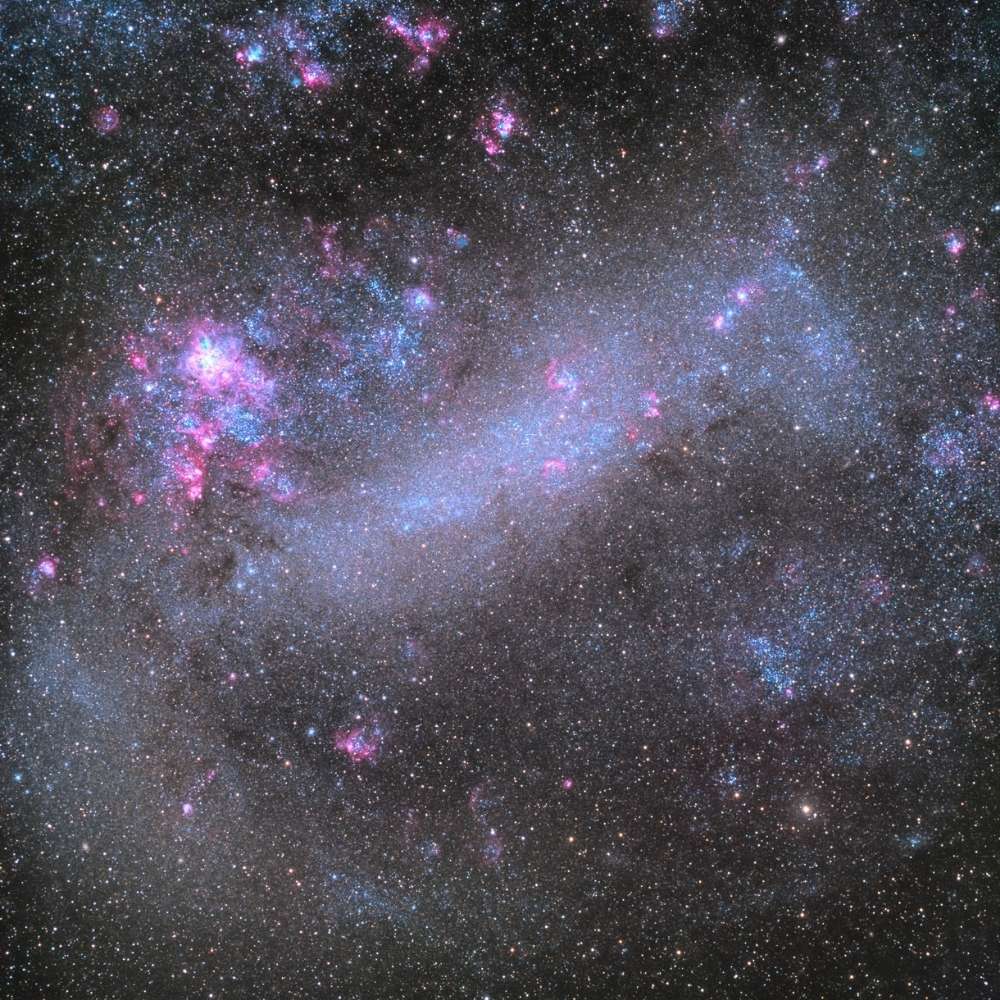
The Large Magellanic Cloud (LMC) is one of the closest and brightest galaxies visible from Earth — a cosmic neighbor that orbits the Milky Way and serves as a living laboratory for astrophysics.
Located about 163,000 light-years away in the constellations Dorado and Mensa, it appears as a faint, glowing patch in the southern night sky.
Although much smaller than the Milky Way, the LMC plays a giant role in modern astronomy. Its proximity allows telescopes to resolve individual stars, supernova remnants, and star-forming regions — making it a key target for understanding how galaxies form and evolve.
The LMC, together with its companion the Small Magellanic Cloud (SMC), is gravitationally bound to our galaxy, forming a mini-system within the Local Group. The pair are currently being drawn toward the Milky Way in a slow cosmic dance that will reshape all three galaxies in the far future.
Appearance and Structure — An Irregular Beauty
At first glance, the LMC looks like a distorted, asymmetric spiral, lacking the smooth shape of typical galaxies.
It belongs to a special class called Barred Magellanic Irregulars, showing both a central bar and fragmented spiral-like arms.
1. The Bar and Disk
At the center of the LMC lies a stellar bar — a dense, elongated region of older stars spanning about 4,000 light-years.
Surrounding it is a warped, rotating disk of gas and young stars, tilted about 35° relative to our line of sight.
The LMC’s disk shows:
Strong rotation (up to 80 km/s at the edges)
Pockets of active star formation
A faint spiral pattern distorted by gravitational interaction with the SMC and Milky Way
2. The Tarantula Nebula — The Heart of Creation
The Tarantula Nebula (30 Doradus), located in the northeastern part of the LMC, is the most active star-forming region in the entire Local Group.
It spans nearly 1,000 light-years and is home to:
R136, a supermassive cluster containing some of the most massive known stars
Clouds of ionized hydrogen glowing under intense radiation
Shock fronts and stellar winds that shape new generations of stars
If the Tarantula Nebula were as close as the Orion Nebula, it would cast visible shadows on Earth — a measure of its brightness and scale.
3. The Supernova of 1987A
On February 23, 1987, astronomers witnessed SN 1987A, the closest observed supernova since the invention of the telescope.
It occurred in the outskirts of the LMC and became one of the most studied stellar explosions in history.
Key facts:
The progenitor star was a blue supergiant named Sanduleak −69° 202.
The explosion released as much energy in a few seconds as the Sun emits in its lifetime.
Neutrinos from the event were detected on Earth — confirming theoretical models of core-collapse supernovae.
Today, SN 1987A’s expanding shockwave continues to illuminate surrounding gas, giving astronomers a time-lapse view of how supernova remnants evolve.
Chemical Composition and Star Formation
The LMC contains about 10% of the Milky Way’s metal content, making it a metal-poor galaxy.
This low metallicity environment mimics the early universe, allowing scientists to study star formation under primordial-like conditions.
Star Formation Highlights
Young clusters: Dozens of active star-forming regions within its disk and bar
H II regions: Large ionized gas clouds like the Tarantula Nebula
Giant molecular clouds: Cold hydrogen reservoirs where new stars are born
The LMC’s high star formation rate — about 0.2 to 0.3 solar masses per year — shows how tidal forces from the Milky Way and SMC trigger bursts of stellar activity.
The Magellanic Bridge and Stream — Traces of Interaction
One of the most fascinating features linking the LMC to its environment is the Magellanic Bridge, a stream of neutral hydrogen gas stretching between the LMC and SMC.
It was likely pulled out by their gravitational tug during a close encounter about 200 million years ago.
Beyond the Bridge lies the Magellanic Stream — a vast tail of gas and plasma stretching over 200° across the sky, trailing behind both Clouds as they orbit the Milky Way.
This stream provides key evidence for:
Ongoing mass transfer between galaxies
The Milky Way’s gravitational influence
The complex structure of galactic halos and tidal debris
Comparison with Neighboring Galaxies
| Feature | Large Magellanic Cloud | Small Magellanic Cloud | Milky Way |
|---|---|---|---|
| Type | Barred Irregular | Irregular Dwarf | Barred Spiral |
| Diameter | ~14,000 ly | ~7,000 ly | ~100,000 ly |
| Distance | ~163,000 ly | ~200,000 ly | — |
| Star Formation Rate | High | Moderate | Moderate |
| Metallicity | ~10% of Milky Way | ~5% | 100% (baseline) |
| Relationship | Satellite of Milky Way | Companion of LMC | Host galaxy |
The LMC’s intense star formation and gravitational link to the Milky Way make it a dynamic, evolving system — a smaller galaxy in the process of being reshaped by its larger companion.
Kinematics and Motion — A Galactic Companion in Motion
The Large Magellanic Cloud (LMC) is not a static neighbor — it’s a galaxy on the move.
Orbiting the Milky Way at a speed of about 320 km/s, the LMC follows a highly elliptical and possibly unbound trajectory, suggesting that it may be approaching the Milky Way for the first time in its history.
Proper Motion and Orbit
Data from the Hubble Space Telescope and Gaia mission have revealed that the LMC is:
Moving toward the Milky Way at ~260 km/s (radial velocity)
Traveling sideways across the sky at ~370 km/s (tangential velocity)
Possibly completing one orbital pass every 1.5–2 billion years, though its current trajectory suggests it may eventually merge with our galaxy.
This motion is not solitary. The Small Magellanic Cloud (SMC) follows alongside, gravitationally linked to the LMC — the two forming a binary dwarf system engaged in a slow gravitational waltz.
The LMC–SMC–Milky Way System — A Dynamic Triad
The gravitational interactions between these three galaxies have sculpted some of the most spectacular structures in the southern sky.
1. The Magellanic Bridge
The Bridge is a long filament of gas and young stars that physically connects the LMC and SMC.
Formed roughly 200 million years ago, it is a remnant of a close passage between the two galaxies.
Several young star clusters along the Bridge suggest that stars can form even in tidal debris, outside the main body of galaxies.
2. The Magellanic Stream
Trailing behind the Clouds is the Magellanic Stream, a ribbon of neutral and ionized hydrogen stretching over 200° across the sky — nearly halfway around Earth’s celestial sphere.
It traces the gravitational and hydrodynamic drag of the Milky Way’s halo on its satellite galaxies.
3. The Leading Arm
On the opposite side of the Stream lies the Leading Arm, gas pushed ahead of the LMC–SMC system as they move through the Milky Way’s halo.
Together, the Stream and Leading Arm help astronomers map the shape and density of the Milky Way’s dark matter halo.
Stellar Populations — A Window into Galactic Evolution
The LMC hosts a fascinating mix of old, intermediate, and young stellar populations, providing a full evolutionary spectrum of star formation.
1. The Ancient Population
Found mostly in globular clusters and the stellar halo.
These stars are 10–12 billion years old, formed when the LMC was still isolated.
Metal-poor, with compositions similar to early Milky Way stars.
2. Intermediate-Age Population
Dominates the bar region.
Contains stars aged 1–8 billion years, showing that the LMC experienced continuous star formation over cosmic time.
These populations indicate recurrent bursts of star formation, likely triggered by repeated interactions with the SMC.
3. Young Population
Concentrated in the spiral-like arms and star-forming regions like the Tarantula Nebula.
Includes massive O- and B-type stars, luminous supergiants, and active H II regions.
Represents the LMC’s most recent wave of star formation, within the past few hundred million years.
Globular Clusters and Stellar Associations
The LMC contains over 60 known globular and open clusters, serving as benchmarks for understanding stellar ages, metallicity, and dynamics.
Notable Clusters and Regions:
| Cluster/Region | Age (Approx.) | Description |
|---|---|---|
| NGC 1916 | ~12 Gyr | Ancient globular cluster, one of the oldest in the LMC |
| NGC 1835 | ~10 Gyr | Metal-poor cluster with dense stellar population |
| NGC 1866 | ~200 Myr | Young open cluster, rich in bright supergiants |
| R136 (in 30 Doradus) | ~1–2 Myr | Contains some of the most massive stars known |
| NGC 1978 | ~2 Gyr | Intermediate-age cluster showing rapid enrichment |
These clusters offer a chronological map of the LMC’s evolution, spanning from the early universe to the present epoch.
Supernovae and Stellar Death
The LMC is a natural supernova observatory, home to both ancient remnants and recent explosions.
The most famous is Supernova 1987A, but several others contribute to our understanding of stellar death and interstellar chemistry.
SN 1987A — A Milestone Event
Occurred in the Tarantula Nebula.
Provided the first direct neutrino detection from a supernova.
Enabled astronomers to study the formation of neutron stars and supernova rings in real time.
Older Supernova Remnants
N132D, N49, and DEM L71 are notable remnants showing how supernovae inject energy and heavy elements into the interstellar medium.
X-ray and radio imaging reveal shock waves, magnetic fields, and chemical enrichment patterns that shape the future generations of stars.
The LMC as a Galactic Laboratory
Because of its proximity and richness in features, the LMC is often called “the astrophysical classroom of the universe.”
It offers ideal conditions for studying:
Star formation mechanisms
Cluster evolution and dispersal
Supernova feedback and interstellar turbulence
Chemical evolution in low-metallicity environments
Galaxy interactions and tidal stripping
For example, Hubble and JWST observations of R136 in the Tarantula Nebula have revealed stars exceeding 200 solar masses, pushing the upper limit of known stellar formation.
Observation and Visibility from Earth
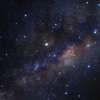
The LMC is easily visible from the Southern Hemisphere, appearing as a hazy patch in the night sky.
It is located near the southern celestial pole, between the constellations Dorado and Mensa.
Best Conditions for Observation
Latitude: South of 20°N (best in southern latitudes)
Season: November to February
Equipment: Naked eye, binoculars, or small telescope for basic observation; Hubble or large ground telescopes for structural studies
Even modest telescopes can resolve:
The bar and disk pattern
Bright nebulae like 30 Doradus
Star clusters such as NGC 1850 and NGC 1910
Future Evolution — The Coming Collision
The Large Magellanic Cloud (LMC) may look peaceful in the night sky, but it is heading toward a dramatic future.
Astronomers predict that within the next 1.5 to 3 billion years, the LMC will collide and merge with the Milky Way, creating waves of star formation and reshaping both galaxies.
The Gravitational Fate
The Milky Way’s gravity is gradually pulling the LMC closer, while the LMC’s own dark matter halo — surprisingly massive — adds complexity to their orbital dance.
Recent studies suggest that the LMC’s mass might be as high as 250 billion solar masses, roughly one-fourth the mass of our galaxy, enough to perturb the Milky Way’s disk and even shift its center of mass slightly.
When the two galaxies merge:
Their gas clouds will compress, igniting new generations of stars.
The LMC’s core may sink toward the Milky Way’s center, feeding the *supermassive black hole (Sagittarius A)**.
The resulting galaxy could look more like Andromeda (M31) — larger, brighter, and more complex.
LMC’s Role in Mapping Dark Matter
Because of its motion and gravitational effects, the LMC acts as a dark matter probe in our local universe.
By tracking its orbit and the response of the Milky Way’s stellar halo, astronomers can infer the shape, density, and distribution of our galaxy’s dark matter component.
Recent Gaia and Hubble measurements reveal that:
The LMC’s movement creates a wake in the Milky Way’s dark matter halo.
This wake distorts stellar streams like GD-1 and Orphan, offering clues to the dark halo’s structure.
These findings are essential for refining ΛCDM cosmological models (Lambda Cold Dark Matter theory).
In essence, the LMC is not only a nearby galaxy — it’s a gravitational laboratory helping us measure the invisible fabric of our own.
The LMC in the Broader Cosmic Context
Within the Local Group, the LMC ranks as the fourth largest member, after Andromeda (M31), the Milky Way, and the Triangulum Galaxy (M33).
Its interaction with the Milky Way and SMC reflects the hierarchical nature of galaxy formation, where large galaxies grow by accreting smaller companions.
Importance in Extragalactic Studies
Star Formation Template: The LMC’s regions like 30 Doradus serve as analogs for distant starburst galaxies.
Low-Metallicity Environments: Its chemical composition resembles early galaxies in the young universe.
Supernova and Stellar Evolution: SN 1987A continues to calibrate our understanding of stellar death and element recycling.
Calibration Standard: Because of its proximity, the LMC helps define the cosmic distance scale, serving as a key reference for Cepheid variable stars.
Scientific Legacy — The LMC as a Benchmark Galaxy
The Large Magellanic Cloud has been central to many astronomical breakthroughs. Here are some key milestones:
| Discovery | Year / Mission | Scientific Impact |
|---|---|---|
| Cepheid Variable Calibration | 1912–1930s | Defined relationship between luminosity and distance, refining cosmic scale |
| SN 1987A | 1987 | First modern supernova observed in real time |
| Tarantula Nebula Mapping | 1990–2020 | Revealed star formation at extreme scales |
| Gaia Motion Analysis | 2018–2025 | Refined orbital path and dark matter wake model |
| JWST Infrared Surveys | Ongoing | Mapping molecular clouds and stellar nurseries in unprecedented detail |
Through each stage of astronomical progress, the LMC has served as a bridge between the near and far universe — a nearby system that teaches us how galaxies billions of light-years away might behave.
Frequently Asked Questions (FAQ)
Q1: Why is the Large Magellanic Cloud irregular in shape?
Because it has been gravitationally disturbed by both the Milky Way and the Small Magellanic Cloud, causing its disk to warp and its spiral pattern to fragment.
Q2: Can we see the LMC with the naked eye?
Yes — from the Southern Hemisphere, it appears as a faint cloud-like patch near the southern celestial pole, visible even without a telescope under dark skies.
Q3: Is the LMC part of the Milky Way?
Not yet. It is a satellite galaxy gravitationally bound to the Milky Way, currently orbiting but gradually being pulled in.
Q4: How is the LMC used to measure distances in space?
Astronomers study Cepheid variable stars in the LMC — whose brightness changes predictably — to calibrate the cosmic distance ladder used for measuring galaxies across the universe.
Q5: What is the Tarantula Nebula’s significance?
It’s the largest known star-forming region in the Local Group and contains R136, a cluster with some of the most massive stars ever observed.
Related Objects and Further Reading
Small Magellanic Cloud (SMC): Companion dwarf galaxy interacting with the LMC.
Milky Way Galaxy: The host galaxy gravitationally influencing both Magellanic Clouds.
Tarantula Nebula (30 Doradus): Starburst region within the LMC.
SN 1987A: Supernova remnant offering a rare view of stellar death.
Magellanic Stream: Vast gaseous tail connecting the Clouds to the Milky Way halo.
Andromeda Galaxy (M31): The next major merger target of the Milky Way after the LMC.
Final Thoughts
The Large Magellanic Cloud is more than just a nearby satellite — it’s a cosmic archive of stellar evolution, galactic interaction, and chemical transformation.
From the brilliant glow of the Tarantula Nebula to the fading shell of SN 1987A, every corner of the LMC tells a different story about the forces that shape galaxies.
As it continues its slow spiral toward the Milky Way, the LMC reminds us that galaxies — like stars — have lifecycles.
And in its brilliant, irregular form, we find a living example of how gravity, time, and chaos combine to create cosmic beauty.