



LISA Pathfinder
Proving That We Can Listen to the Universe
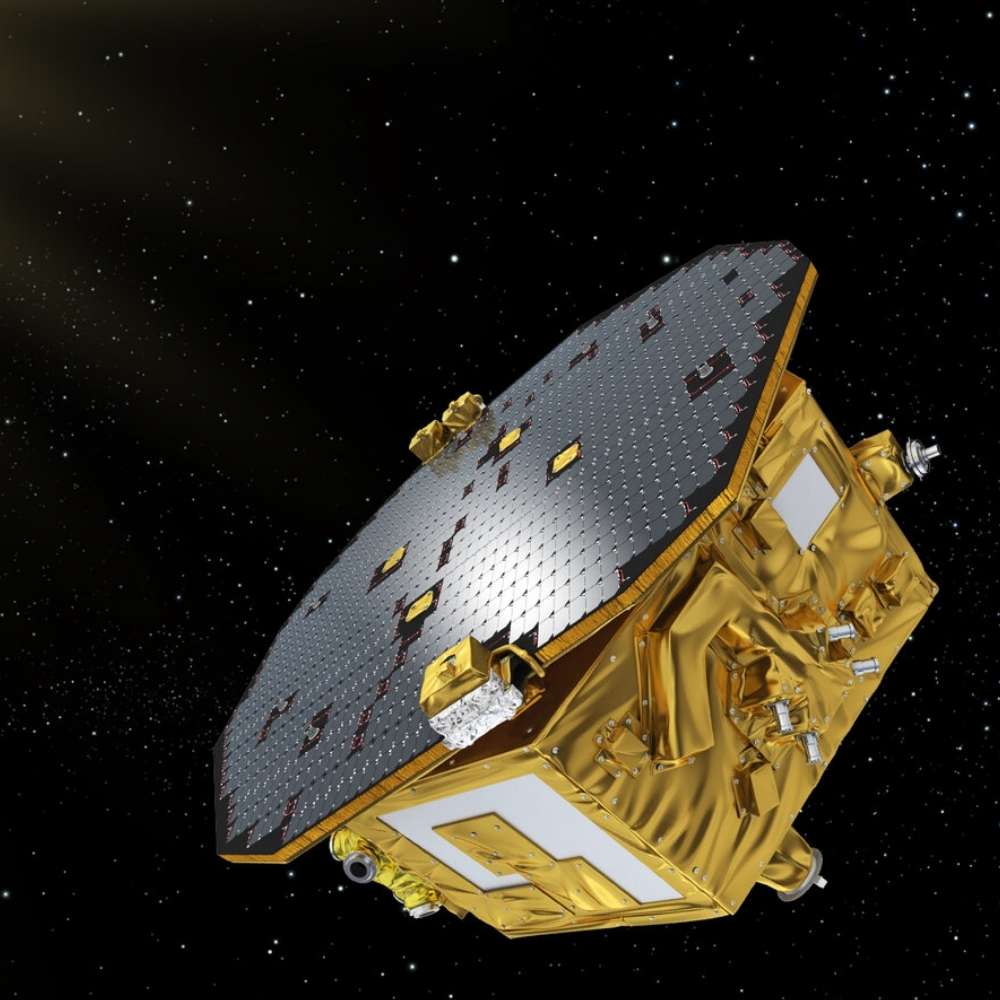
Quick Reader
| Attribute | Details |
|---|---|
| Mission Name | LISA Pathfinder |
| Full Name | Laser Interferometer Space Antenna Pathfinder |
| Mission Type | Gravitational-wave technology demonstrator |
| Operating Agency | ESA (European Space Agency) |
| Launch Date | 3 December 2015 |
| Launch Vehicle | Vega |
| Operational Orbit | Lissajous orbit around Sun–Earth L₁ |
| Mission Duration | 2015–2017 |
| Primary Goal | Test key technologies for space-based gravitational-wave detection |
| Key Achievement | Exceeded required sensitivity by orders of magnitude |
Why LISA Pathfinder Is Special
LISA Pathfinder did not search for gravitational waves. Instead, it proved that searching for them from space is physically possible.
By validating the most delicate measurement system ever flown, the mission laid the technological foundation for future observatories that will detect gravitational waves across the Universe.
Key Insight Snapshot
- Most precise free-fall experiment ever performed in space
- Demonstrated near-perfect gravitational isolation
- Validated laser interferometry at picometer-scale precision
- Essential precursor to the future LISA gravitational-wave mission
- Turned theoretical concepts into proven engineering reality
Introduction — Why Space-Based Gravitational Waves Matter
Gravitational waves are ripples in spacetime itself.
They are produced by:
Merging black holes
Colliding neutron stars
Supermassive black hole binaries
Extreme cosmic events invisible in light
Ground-based detectors like LIGO and Virgo can detect high-frequency gravitational waves—but they are blind to lower-frequency signals.
To detect those, humanity must go to space.
LISA Pathfinder existed to answer one crucial question:
Can we create a region of space quiet enough to measure distortions smaller than an atom?
What LISA Pathfinder Was — And Was Not
It is important to be precise.
LISA Pathfinder:
❌ Did not detect gravitational waves
❌ Was not an observatory
Instead, it:
✅ Tested core technologies
✅ Validated free-falling test masses
✅ Demonstrated extreme measurement precision
Its purpose was risk reduction, not discovery.
Without LISA Pathfinder, the future LISA mission would not be credible.
The Core Challenge — Perfect Free Fall
Gravitational-wave detection requires objects that follow pure spacetime motion, unaffected by:
Mechanical forces
Thermal expansion
Magnetic fields
Residual gas pressure
Spacecraft vibrations
LISA Pathfinder carried two gold–platinum test masses, designed to:
Float freely
Never touch anything
Respond only to gravity
Achieving this level of isolation was the mission’s central challenge.
Why Gold–Platinum Test Masses Were Used
The test masses were carefully engineered:
Gold–platinum alloy minimizes magnetic effects
Extremely uniform density
Resistant to corrosion and charging
Precisely machined cubes
Each test mass was placed inside a vacuum enclosure, shielded from almost every non-gravitational influence.
These were the most perfect free-falling objects ever created.
The Role of the Spacecraft — Following the Test Masses
In LISA Pathfinder, the spacecraft did not lead.
It followed.
Using a drag-free control system:
Sensors tracked the position of the test masses
Micro-thrusters adjusted the spacecraft position
The spacecraft shielded the masses from solar pressure
The result was a spacecraft that effectively disappeared from the experiment, allowing gravity to dominate.
Laser Interferometry — Measuring the Impossible
The distance between the two test masses was measured using laser interferometry.
This technique can detect changes in separation smaller than:
One picometer
Less than the size of an atom
LISA Pathfinder proved that:
Laser phase noise could be controlled
Thermal fluctuations could be minimized
Measurement stability exceeded requirements
This was a breakthrough in precision engineering.
Why Sun–Earth L₁ Was Chosen
LISA Pathfinder operated around Sun–Earth L₁, a region with:
Low gravitational disturbances
Stable thermal conditions
Minimal Earth interference
This environment was ideal for testing ultra-sensitive gravitational experiments without the noise present in Earth orbit.
What Success Looked Like
ESA set strict performance targets.
LISA Pathfinder did not just meet them—it exceeded them by a wide margin.
It demonstrated:
Lower-than-expected residual acceleration noise
Better-than-required stability
Long-duration operational reliability
In engineering terms, the mission was an overwhelming success.
Why LISA Pathfinder Changed Everything
Before LISA Pathfinder:
Space-based gravitational-wave detection was theoretical
After LISA Pathfinder:
It became an engineering fact
The mission closed the gap between physics and feasibility.
Drag-Free Control — Letting Gravity Take the Lead
The most radical idea behind LISA Pathfinder was this:
The spacecraft must not control the experiment.
The experiment must control the spacecraft.
This philosophy led to the development of drag-free control, a system so precise that it allowed the test masses to follow pure gravitational motion.
How Drag-Free Control Works
Sensors continuously measure the position of the free-falling test mass
Any external force (solar radiation, residual drag) pushes the spacecraft—not the mass
Micro-thrusters fire to move the spacecraft back into alignment
The test mass remains untouched, floating in near-perfect free fall
In effect, the spacecraft becomes a protective shell, chasing the test mass through space.
Micro-Newton Thrusters — Precision at an Unprecedented Scale
To make drag-free control possible, LISA Pathfinder used micro-Newton thrusters.
These thrusters could:
Produce forces smaller than the weight of a grain of sand
Adjust thrust smoothly and continuously
Operate with extremely low noise
This level of control had never been demonstrated in space before.
Without these thrusters, LISA Pathfinder’s mission would have failed.
Noise — The Enemy of Gravitational-Wave Detection
Every possible source of noise had to be identified, measured, and suppressed.
Major noise sources included:
Thermal fluctuations
Magnetic fields
Electrostatic charging
Residual gas molecules
Mechanical vibrations
LISA Pathfinder’s instruments allowed engineers to measure each noise contribution individually, something never achieved before.
This turned uncertainty into data.
The Central Measurement — Residual Acceleration Noise
The mission’s core performance metric was residual acceleration noise acting on the test masses.
ESA’s original requirement was already ambitious.
LISA Pathfinder achieved:
Residual forces several times smaller than required
Stability exceeding mission goals by orders of magnitude
Performance good enough for the full LISA mission
This result was the moment when gravitational-wave detection in space became technically proven.
Why This Was Harder Than Detecting Waves on Earth
Ground-based detectors like LIGO deal with:
Seismic noise
Atmospheric pressure changes
Human activity
In space, those disappear—but new challenges appear:
Solar radiation pressure
Spacecraft self-gravity
Charging from cosmic rays
LISA Pathfinder showed that these space-specific problems were manageable, not prohibitive.
From Pathfinder to LISA — What Was Learned
LISA Pathfinder directly influenced the final design of LISA.
Key lessons included:
Test-mass isolation is achievable
Laser interferometry is stable over long durations
Drag-free control can be maintained continuously
Noise budgets can be realistically met
The mission reduced risk so effectively that LISA moved from conceptual to scheduled.
Why the Mission Exceeded Expectations
LISA Pathfinder succeeded because:
Its goals were narrow and clearly defined
Engineering was prioritized over discovery
Extensive ground testing preceded launch
The mission avoided unnecessary complexity
This focus allowed the team to optimize for performance, not publicity.
A Silent Triumph
LISA Pathfinder made no dramatic announcements.
There were no headlines about cosmic collisions or spacetime ripples.
Yet among physicists and engineers, its success was recognized as transformational.
It proved that the Universe’s quietest signals could be heard—if we built instruments quiet enough.
Why the Mission Ended — Success, Not Failure
LISA Pathfinder did not end because something went wrong.
It ended because everything went right.
The mission was deliberately designed as a technology demonstrator, not a long-term observatory. Once all core objectives were achieved—and exceeded—there was no scientific reason to keep it operating.
By early 2017, LISA Pathfinder had:
Met all primary performance targets
Exceeded required sensitivity margins
Fully validated drag-free control and interferometry
At that point, continuing operations would not have added meaningful new value.
Ending the mission was a sign of completion, not limitation.
The Long-Term Legacy of LISA Pathfinder
LISA Pathfinder’s true legacy lies in what it unlocked.
Because of this mission:
Space-based gravitational-wave detection became feasible
The risk profile of the LISA mission dropped dramatically
Engineering uncertainty was replaced with measured performance
Gravitational-wave astronomy expanded beyond Earth
In practical terms, LISA Pathfinder transformed gravitational waves from a ground-based science into a Solar System–scale observatory concept.
From Pathfinder to LISA — A Direct Line
The upcoming LISA (Laser Interferometer Space Antenna) mission builds directly on Pathfinder’s results.
What changes with LISA:
Three spacecraft instead of one
Millions of kilometers of separation instead of centimeters
Detection of low-frequency gravitational waves
Sensitivity to supermassive black hole mergers
What stays the same:
Drag-free control philosophy
Free-falling test masses
Laser interferometry principles
LISA Pathfinder is not just a precursor—it is the proof of concept.
Why This Matters for Astronomy
Gravitational waves reveal phenomena invisible to light.
With space-based detection, astronomers will study:
Supermassive black hole binaries
Extreme mass-ratio inspirals
Galactic binaries in the Milky Way
Early-Universe gravitational backgrounds
These sources exist at frequencies Earth-based detectors cannot reach.
LISA Pathfinder made access to this hidden Universe possible.
Frequently Asked Questions
Did LISA Pathfinder detect gravitational waves?
No. It was never designed to detect gravitational waves. Its purpose was to test the technology required to detect them in future missions.
Why was such extreme precision necessary?
Gravitational waves stretch space by amounts far smaller than an atom. Detecting them requires near-perfect free fall and ultra-stable measurement systems.
Why not test this technology on Earth?
Earth’s gravity, seismic noise, and atmosphere make this level of isolation impossible. Space is the only viable environment.
Why Sun–Earth L₁ and not L₂?
L₁ offered a quiet gravitational and thermal environment suitable for a short-duration technology mission. The exact point was less important than stability and low disturbance.
Is LISA Pathfinder still in space?
The spacecraft was passivated after mission completion. Its scientific role ended, but its legacy continues through LISA.
Why LISA Pathfinder Is a Rare Kind of Mission
Most space missions aim to discover something new.
LISA Pathfinder aimed to prove something true.
It did not expand our astronomical catalog, but it expanded our capability. Without it, future discoveries would remain inaccessible—not because the Universe was silent, but because we lacked the means to listen.
LISA Pathfinder in the Universe Map Context
Within Universe Map, LISA Pathfinder connects directly to:
Gravitational waves
Space-based interferometry
Lagrange point missions
Precision measurement physics
The future of multi-messenger astronomy
It represents the moment when astronomy crossed from observation of light to observation of spacetime itself.
Final Perspective
LISA Pathfinder never observed a black hole merger.
It never recorded a cosmic collision.
It never announced a breakthrough discovery.
Yet it may be one of the most important space missions ever flown.
By proving that perfect free fall, ultra-quiet space, and picometer-scale measurements are achievable, LISA Pathfinder gave humanity a new sense. It taught us how to listen—not to light, but to the fabric of the Universe itself.
Sometimes, the most important discovery is not what we find,
but that we are finally capable of finding it.