







Lucy
Exploring the Fossils of Planet Formation
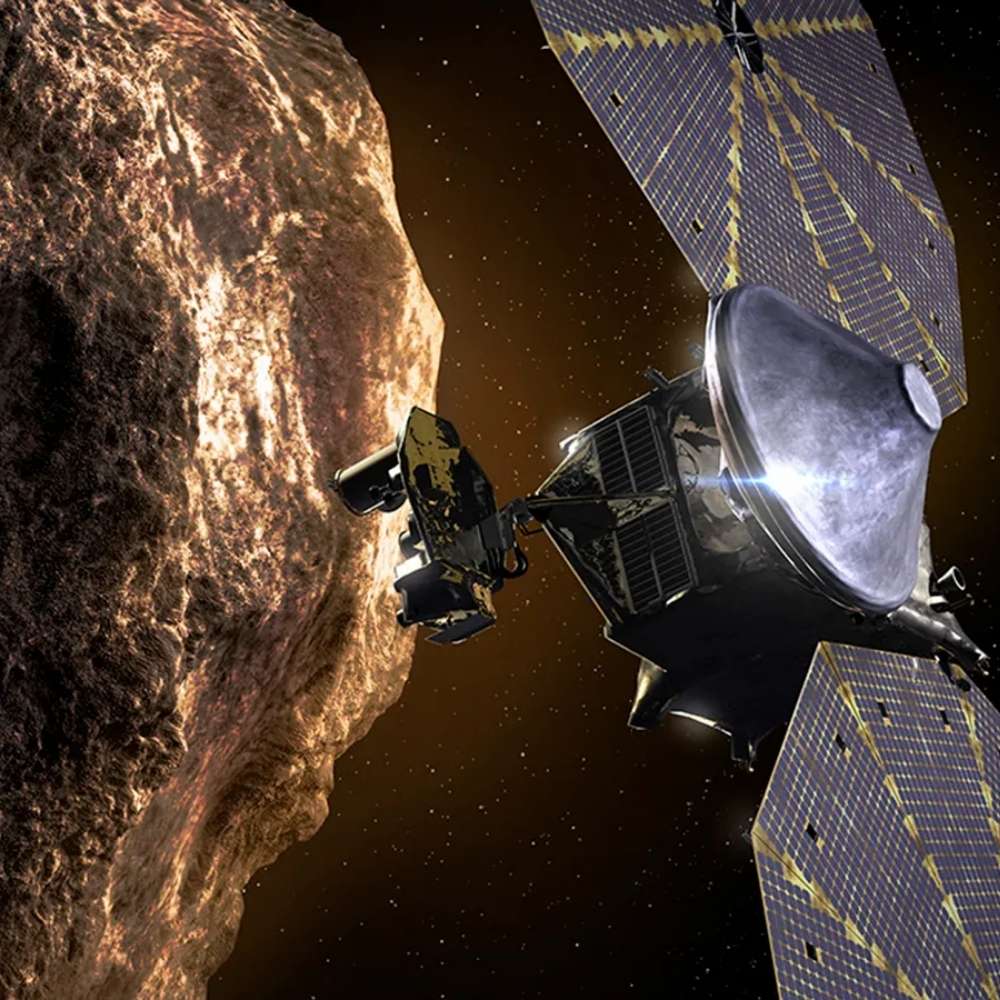
Quick Reader
| Attribute | Details |
|---|---|
| Mission Name | Lucy |
| Mission Type | Solar System exploration mission |
| Operating Agency | NASA |
| Launch Date | 16 October 2021 |
| Primary Targets | Jupiter Trojan asteroids (L4 & L5 groups) |
| Secondary Targets | Main-belt asteroid + multiple Trojan binaries |
| Mission Duration | ~12 years (planned) |
| Power Source | Solar arrays (largest ever used beyond Mars) |
| Flyby Method | High-speed close encounters |
| First Target Flyby | Asteroid 52246 Donaldjohanson (2025) |
| Trojan Flyby Period | 2027–2033 |
| Mission Status | Active |
Key Highlights
- First mission dedicated exclusively to Jupiter Trojan asteroids
- Explores both L4 (Greek) and L5 (Trojan) swarms
- Visits more asteroids than any previous space mission
- Studies objects that preserve pristine early Solar System conditions
- Named after the fossil that revolutionized understanding of human origins
Introduction — Why the Lucy Mission Matters
The early Solar System was chaotic, crowded, and violent.
Most of the evidence from that era has been erased—melted, reprocessed, or reshaped by billions of years of planetary evolution.
The Lucy mission was designed to study what remains.
Jupiter’s Trojan asteroids are often described as time capsules—primitive bodies trapped in stable orbits since the Solar System’s infancy. By visiting them directly, Lucy aims to answer a fundamental question:
How did the planets form, and why does the Solar System look the way it does today?
What Are Jupiter Trojans?
Jupiter Trojans are asteroids that share Jupiter’s orbit around the Sun, clustered around two stable regions known as Lagrange points:
L4 — leading Jupiter by 60° (Greek camp)
L5 — trailing Jupiter by 60° (Trojan camp)
These regions are gravitationally stable, allowing objects to remain there for billions of years.
Key characteristics:
Highly primitive composition
Diverse surface colors and densities
Likely formed across multiple regions of the early Solar System
Lucy is the first spacecraft ever sent to explore them up close.
Mission Name — Why “Lucy”?
The mission is named after Lucy, the famous 3.2-million-year-old hominin fossil discovered in Ethiopia.
The analogy is intentional:
The fossil Lucy revealed human evolutionary origins
The spacecraft Lucy aims to reveal planetary evolutionary origins
Just as the fossil rewrote our understanding of humanity’s past, the Lucy mission is expected to reshape theories of Solar System formation.
Mission Architecture — A Grand Tour Without Orbiting
Lucy is not an orbiter.
Instead, it performs a complex sequence of gravity assists and flybys, allowing it to visit many targets efficiently.
Key design features:
Multiple Earth gravity assists
Repeated crossings of the asteroid belt
High-speed encounters optimized for imaging and spectroscopy
A trajectory spanning billions of kilometers
This makes Lucy one of the most dynamically ambitious missions ever flown.
Lucy’s Target List — A Diverse Family of Asteroids
Lucy’s targets were chosen to represent the full diversity of Trojan populations.
Planned encounters include:
3548 Eurybates (binary system)
15094 Polymele
11351 Leucus
21900 Orus
617 Patroclus–Menoetius (equal-mass binary)
Each target offers clues about:
Composition differences
Collisional history
Internal structure
Formation environment
Together, they form a comparative dataset unmatched in asteroid science.
Scientific Goals of the Lucy Mission
Lucy’s core objectives include:
Determining Trojan surface compositions
Measuring mass and density
Studying cratering and geology
Investigating binary asteroid formation
Testing models of planetary migration
These goals directly address leading theories such as the Nice Model, which proposes that the giant planets migrated early in Solar System history.
Why Trojans Hold the Key to Planetary Migration
Modern models suggest that:
Jupiter did not form where it currently orbits
Giant planets moved significantly during early epochs
Small bodies were scattered and captured during this migration
Jupiter Trojans may be:
Captured remnants from multiple regions
Survivors of planetary reshuffling
Direct evidence of early gravitational chaos
Lucy’s observations will either validate or challenge these ideas.
Engineering Challenge — Solar Power Near Jupiter
Operating near Jupiter presents a major challenge: low sunlight.
Lucy solves this by using:
Two massive circular solar arrays
Ultra-efficient power management
Lightweight composite materials
These arrays are the largest solar panels ever flown for a deep-space mission, proving solar power is viable far beyond Mars.
Why Lucy Is a Landmark Mission
Lucy is important because it:
Explores a completely unvisited population
Links asteroid science with planet formation theory
Tests long-standing migration models
Expands deep-space solar-powered exploration
Creates a new framework for comparative asteroid studies
It is not just a mission to asteroids—it is a mission to the Solar System’s memory.
Lucy’s Scientific Payload — Seeing, Measuring, Understanding
Lucy carries a focused but powerful suite of instruments designed for fast, high-precision flybys. Every instrument is optimized to extract maximum science in the short encounter windows.
L’LORRI — High-Resolution Imaging System
Narrow-angle visible-light camera
Derived from New Horizons’ LORRI
Resolves surface features, craters, and boulders
Tracks rotation, shape, and geology
L’LORRI provides the detailed imagery needed to interpret each asteroid’s surface history.
L’Ralph — Color and Composition Mapper
L’Ralph combines two instruments:
MVIC (Multispectral Visible Imaging Camera)
LEISA (Infrared imaging spectrometer)
Together, they:
Map surface colors and compositional variations
Detect ices, organics, and minerals
Identify space-weathering effects
This instrument is central to solving the Trojan color diversity mystery.
L’TES — Thermal Emission Spectrometer
Measures surface temperature
Determines thermal inertia
Constrains grain size and regolith properties
Thermal data helps reveal whether Trojans are fluffy rubble piles or compact bodies.
Binary Trojans — A Unique Scientific Opportunity
One of Lucy’s most important targets is 617 Patroclus–Menoetius, a rare equal-mass binary system.
Why Binary Systems Matter
Binary Trojans allow scientists to:
Measure mass directly through orbital motion
Calculate bulk density accurately
Infer internal structure
Patroclus–Menoetius is thought to be:
Extremely low density
Possibly ice-rich
Formed gently, not by violent collision
This supports formation in the cold outer Solar System.
The Trojan Color Mystery
Jupiter Trojans fall into two broad color groups:
Red Trojans
Less-red (neutral) Trojans
Key questions Lucy addresses:
Are these groups compositionally different?
Did they form in different regions of the Solar System?
Are surface colors primordial or altered by space weathering?
Lucy’s multi-target design allows direct comparison under identical instrumentation—something telescopes alone cannot achieve.
Lucy and the Nice Model — Putting Theory to the Test
The Nice Model predicts that:
Jupiter migrated inward and outward
Small bodies were scattered across the Solar System
Some were captured at Lagrange points
Lucy tests this by checking whether:
Trojan compositions are diverse
Binary systems survived gentle capture
Objects resemble Kuiper Belt bodies
If Trojans show mixed origins, it strongly supports large-scale planetary migration.
Comparison with Other Asteroid Missions
Lucy complements, rather than duplicates, other missions.
| Mission | Primary Focus | Key Difference |
|---|---|---|
| NEAR Shoemaker | Single asteroid | Orbital study |
| OSIRIS-REx | Carbonaceous NEO | Sample return |
| Hayabusa2 | Rubble-pile asteroid | Sample return |
| Psyche | Metal-rich asteroid | Unique composition |
| Lucy | Trojan population | Multi-target flybys |
Lucy’s strength lies in comparative diversity, not prolonged study of a single body.
Encounter Strategy — High Speed, High Precision
Lucy flybys occur at velocities up to 9 km/s.
This requires:
Extremely accurate navigation
Pre-planned imaging sequences
Autonomous pointing corrections
Despite brief encounters, Lucy can collect:
Global shape models
Detailed regional imagery
Complete spectral datasets
The mission proves that flyby science, when done correctly, can rival orbital missions in impact.
Trojan Geology — What Lucy Is Looking For
Key surface features of interest include:
Crater populations and ages
Fractures and ridges
Boulder distributions
Surface layering
These features help reconstruct:
Collisional history
Internal strength
Thermal evolution
Even subtle geological differences between Trojans can reveal vastly different origins.
Why Lucy Is Scientifically Risky — and Powerful
Lucy is bold because:
Trojans are faint and distant
Targets are poorly characterized
Flybys offer no second chances
But this risk is precisely why the mission is transformative. Lucy explores a population that has remained untouched because it is difficult, not because it is unimportant.
Lucy’s Role in Planetary Science
Lucy sits at the intersection of:
Asteroid science
Planetary migration theory
Solar System origin studies
Its findings will influence:
Models of giant planet formation
Interpretation of exoplanet systems
Future mission planning
Lucy does not just study asteroids—it studies how planetary systems assemble.
Lucy’s Long Trajectory — A Mission Measured in Decades
Lucy’s flight path is one of the most intricate ever designed for a planetary mission.
Rather than heading directly to Jupiter, Lucy follows a looping, energy-efficient route shaped by gravity assists.
Key milestones:
2021 — Launch from Earth
2022–2025 — Earth gravity assists and asteroid belt crossing
2025 — Flyby of main-belt asteroid 52246 Donaldjohanson
2027–2028 — First encounters with L4 (Greek camp) Trojans
2031–2033 — Encounters with L5 (Trojan camp), including Patroclus–Menoetius
This trajectory allows Lucy to visit both Trojan swarms—something no other mission has ever attempted.
What Success Looks Like for the Lucy Mission
Lucy’s success is not defined by a single discovery, but by the pattern that emerges across many targets.
The mission will be considered transformative if it can:
Demonstrate compositional diversity among Trojans
Confirm whether Trojans formed in multiple Solar System regions
Accurately measure densities and internal structures
Link Trojan properties to planetary migration models
Even null results—such as unexpected uniformity—would be scientifically powerful, forcing a reevaluation of long-standing theories.
Will Lucy Answer All Questions?
No—and that is by design.
Lucy is a pathfinder mission. Its role is to:
Identify trends
Expose anomalies
Highlight new questions
Its findings will likely inspire:
Follow-up orbiters
Sample-return mission concepts
Expanded Trojan surveys
Lucy opens the door—it does not close the book.
Frequently Asked Questions (FAQ)
Why hasn’t anyone visited Jupiter Trojans before?
They are distant, faint, and widely spread, making missions technically challenging and costly.
Does Lucy orbit any asteroid?
No. All encounters are high-speed flybys.
Why use solar power so far from the Sun?
Advances in solar panel efficiency make it lighter and more reliable than nuclear alternatives for this mission class.
Is Lucy related to the Lucy fossil directly?
Only symbolically. Both represent discoveries about origins—biological and planetary.
Could Trojans contain ice?
Yes. Density and spectral data suggest some may be ice-rich beneath a dusty surface.
Lucy’s Broader Impact on Planetary Science
Lucy’s influence extends beyond Jupiter.
Its results will affect:
Models of early Solar System instability
Interpretation of Kuiper Belt objects
Understanding of exoplanetary debris disks
Future deep-space mission design
By studying stable small bodies, Lucy helps explain why planetary systems do not self-destruct during formation.
Lucy in the Universe Map Context
Within Universe Map, Lucy connects naturally to:
Jupiter Trojans
Lagrange points (L4 and L5)
Planetary migration models
The Nice Model
Oort Cloud and Kuiper Belt comparisons
Together, these topics reveal the architecture behind planetary order.
Final Perspective
Lucy is a mission about memory.
The Jupiter Trojans are not random debris—they are survivors from the Solar System’s most turbulent epoch. By visiting them, Lucy reads a record written before planets finished forming.
Just as the fossil Lucy changed how we understand human origins, the Lucy spacecraft may change how we understand planetary origins—showing that stability often hides a violent past.