











Luhman 16
The Closest Brown Dwarf Binary After Alpha Centauri
Quick Reader
| Attribute | Details |
|---|---|
| Name | Luhman 16 (Luhman 16AB) |
| Components | Luhman 16A (L-dwarf), Luhman 16B (T-dwarf) |
| Other Designations | WISE J104915.57–531906.1, WISE 1049–5319 |
| Object Type | Brown dwarf binary |
| Spectral Classes | L7.5 (A), T0.5 (B) |
| Constellation | Vela |
| Distance from Earth | ~6.5 light-years |
| Combined Mass | ~60–90 M♃ (Jupiter masses) |
| Individual Masses | ~30–50 M♃ each |
| Orbital Period | ~25 years |
| Separation | ~3 AU |
| Notable Features | Strong weather patterns, patchy clouds, brightness variability |
| Best Viewing Months | March to June (Southern Hemisphere) |
Introduction – A Nearby Binary of Failed Stars
Luhman 16 is the third-closest stellar system to the Sun after Alpha Centauri and Barnard’s Star, located only 6.5 light-years away. It is a binary brown dwarf system discovered in 2013 by astronomer Kevin Luhman using data from NASA’s WISE mission.
What makes Luhman 16 remarkable is that:
Both components are brown dwarfs
Both lie near the L/T spectral transition
Both exhibit dramatic atmospheric weather and variability
The system is close enough for direct imaging and detailed monitoring
Because of their proximity, Luhman 16A and Luhman 16B offer one of the clearest windows into the atmospheres, surfaces, and cloud structures of substellar objects.
Components of the System – Luhman 16A and Luhman 16B
The system consists of two brown dwarfs:
Luhman 16A
Spectral type: L7.5
Temperature: ~1,350 K
Atmosphere: Thick silicate and metal clouds
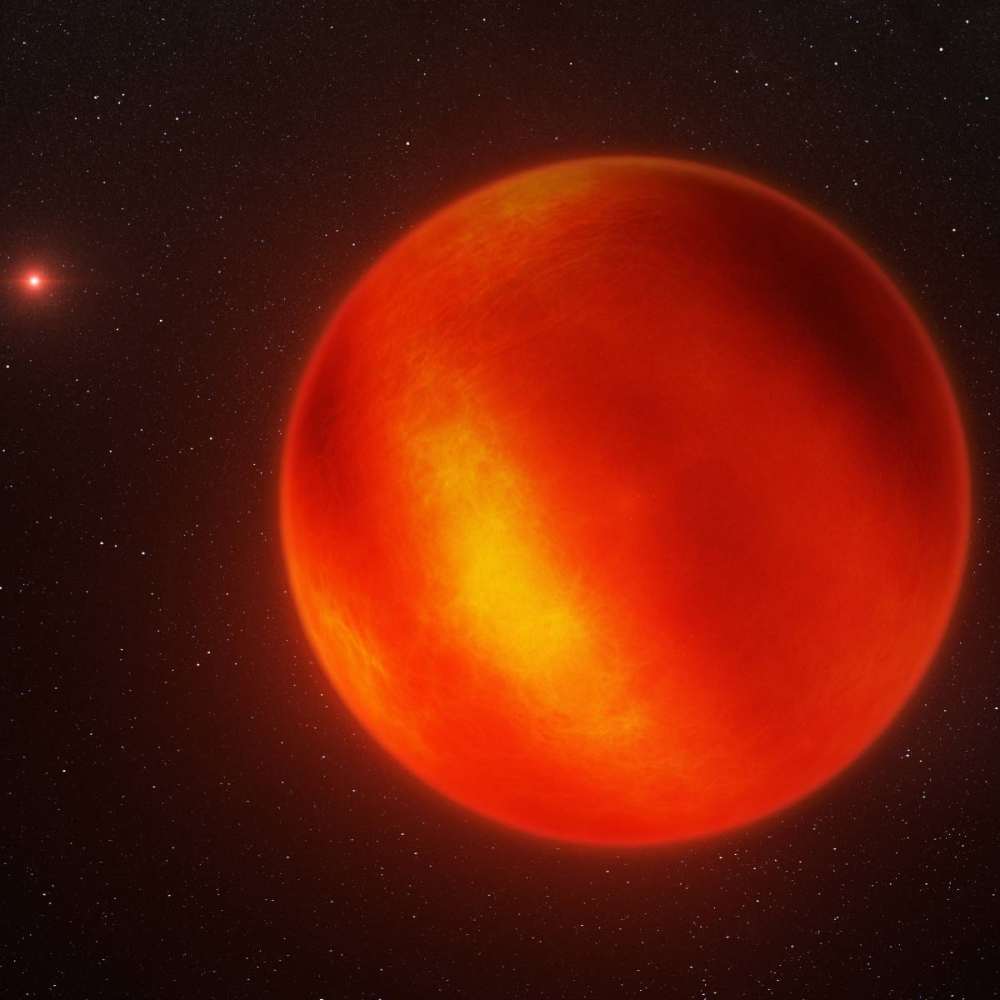
Appearance: Relatively bright, reddish-brown glow
Luhman 16B
Spectral type: T0.5
Temperature: ~1,200 K
Atmosphere: Thinning clouds with methane absorption
Appearance: Cooler, darker, mottled
Together, they demonstrate the L/T transition, a dramatic atmospheric change where hot silicate clouds break apart and sink below the photosphere.
This transition—one of the key mysteries in substellar atmospheric physics—is visible in real time within this nearby binary system.
Physical Characteristics – Planet-Sized But Star-Formed
Although massive compared to planets, both brown dwarfs are only about the size of Jupiter.
Key properties:
Radius similar to Jupiter
Mass between 30–50 Jupiter masses each
No hydrogen fusion
Only weak deuterium fusion (in their early history)
Emission dominated by near-infrared wavelengths
Their low temperatures produce atmospheres rich in:
Methane
Water vapor
Sodium and potassium gases
Silicate dust clouds
Because both are relatively cool and dim, monitoring them requires specialized infrared instruments.
The Habitability of Alpha Centauri B
Its habitable zone lies between approximately:
0.5 AU – 0.9 AU
This region is:
Stable over long timescales
Free from significant gravitational perturbations from Alpha Centauri A
Flooded with moderate, life-friendly radiation
Climate models suggest that an Earth-like world here could maintain:
Mild temperatures
Stable climate patterns
Strong atmospheric retention
Because of its quiet nature, Alpha Centauri B is considered one of the best stellar hosts for life in the Solar neighborhood.
Orbital Dynamics – A Tight, Slow Binary
Luhman 16A and 16B orbit each other at about 3 AU, similar to the distance between the Sun and the asteroid belt.
Orbital characteristics:
Period of ~25 years
Eccentric but gravitationally stable
Combined mass measurable via orbital motion
Ideal for improving brown dwarf mass-luminosity relations
This binary system is perfectly positioned for:
Precision orbital studies
Astrometric measurements
Searches for additional bodies
Already, small perturbations have suggested a possible third companion, though this remains uncertain.
Why Luhman 16 Is Critically Important
Because it is so close, bright in the infrared, and composed of two substellar objects, Luhman 16 provides:
A direct test of brown dwarf evolution models
A real-time view of atmospheric collapse during the L/T transition
Observational access to cloud physics beyond the Solar System
A near-perfect target for future telescopes like JWST and ELT
A benchmark system for comparing brown dwarfs with giant exoplanets
Few systems offer such a rich combination of proximity, brightness, and astrophysical importance.
Atmospheric Physics – A Rare View Into the L/T Transition
Luhman 16A and Luhman 16B sit at one of the most important boundaries in substellar evolution: the L/T transition.
What happens during the L/T transition?
Hot brown dwarfs (L-dwarfs) contain thick silicate and iron clouds
As they cool, these clouds break apart, forming holes and patchy layers
Methane absorption becomes stronger
Brightness decreases at some wavelengths but increases at others
Dramatic atmospheric variability emerges
Because Luhman 16A (L-dwarf) and Luhman 16B (T-dwarf) are at slightly different temperatures yet share the same age and composition, they form a natural experiment for comparison.
This allows astronomers to:
Track cloud formation
Observe cloud collapse and fragmentation
Study methane emergence in real time
Understand the physics that separate L-dwarfs from T-dwarfs
Rotational Modulation – Weather Patterns Revealed Through Brightness Changes
Luhman 16B exhibits some of the strongest known photometric variability of any brown dwarf.
Observations show:
Brightness changes every 4–5 hours
Irregular light curves
Multiple atmospheric layers rotating at different speeds
Turbulent storm-like structures
Cloud fragments drifting across the surface
This variability indicates a complex and dynamic weather system, similar to:
Jupiter’s belts and zones
Saturn’s storms
Brown dwarf vortices seen in other L/T dwarfs
Luhman 16B is effectively a giant exoplanet with visible weather that astronomers can observe over consecutive nights.
Temperature and Composition
Luhman 16A and B have temperatures between:
Luhman 16A: ~1,350 K
Luhman 16B: ~1,200 K
At these temperatures, the atmospheres likely contain:
Water vapor
Methane
Carbon monoxide
Sodium and potassium absorption lines
Silicate dust clouds
The combination of methane absorption and cloud fragmentation creates the dramatic brightness fluctuations observed.
Search for Additional Companions
Astrometric studies have detected small anomalies in the orbital motion of Luhman 16AB.
These anomalies suggest the possible presence of:
A third companion, likely planetary-mass
Orbiting at a few astronomical units
Producing subtle gravitational perturbations
While not confirmed, the possibility remains active.
If discovered, such a planet would be:
One of the closest exoplanets to Earth
Orbiting a brown dwarf binary
Potentially directly imageable in the infrared
Future telescopes such as JWST and ELT may resolve this question.
Importance for Exoplanet Studies
Luhman 16’s atmospheric behavior makes it a powerful comparative object for exoplanets, especially young, massive gas giants.
Why it matters:
Gas giant exoplanets share similar temperatures
Both contain silicate and metal clouds
Both show variability due to rotating weather systems
Direct imaging techniques used for Luhman 16 apply to giant exoplanets
Because it is so close and bright, astronomers use Luhman 16 to refine models used for:
Hot Jupiter atmospheres
Brown dwarf climate cycles
Cloud fragmentation
Thermal emission patterns
Luhman 16 helps bridge the scientific gap between stars and planets, improving our understanding of both.
Orbital Motion and Mass Measurements
Since Luhman 16AB is a resolvable binary, its orbital path provides a precise way to measure mass.
The orbit reveals:
Total system mass: ~60–90 Jupiter masses
Individual masses: ~30–50 Jupiter masses each
Well-defined gravitational interaction
A period of about 25 years
This is crucial because mass is one of the most difficult properties to determine in brown dwarfs.
Luhman 16AB therefore serves as a key calibration point for the mass–luminosity relationship in low-mass systems.
Comparison With Other Nearby Brown Dwarfs
| System | Distance | Type | Notable Feature |
|---|---|---|---|
| Luhman 16 | 6.5 ly | L7.5 + T0.5 | Strong weather variability |
| WISE 0855–0714 | 7.2 ly | Y-dwarf | Coldest known brown dwarf |
| Epsilon Indi Ba/Bb | 12 ly | T1 + T6 | Well-studied binary |
| Gliese 229B | 19 ly | T dwarf | First confirmed methane brown dwarf |
Luhman 16 remains the brightest and most easily studied of the nearby brown dwarf systems.
Long-Term Evolution – The Cooling Path of Substellar Objects
Luhman 16A and 16B, like all brown dwarfs, follow a simple evolutionary path:
Formation
They form like stars from collapsing gas clouds.
But their masses are too low to ignite sustained hydrogen fusion.
Early Deuterium Fusion
For the first few hundred million years, they may fuse small amounts of deuterium.
This provides limited energy but ends quickly.
Continuous Cooling
With no long-term fusion, they cool slowly over billions of years.
Their brightness and temperature steadily decline.
Final State
After trillions of years, they will become cold, dark, Jupiter-like bodies.
Brown dwarfs essentially fade into near invisibility.
Luhman 16 is currently in its mid-life stage as a warm substellar object, showcasing the L/T transition where cloud behavior changes dramatically.
Why Luhman 16 Is a Milestone System in Astronomy
Because of its proximity, Luhman 16 is a “gold standard” for brown dwarf science. It provides:
A benchmark system for atmospheric models
A real-time weather laboratory for substellar objects
High-resolution imaging opportunities
Direct mass measurements through orbital motion
Insight into giant exoplanet atmospheres
A test of cloud physics, methane chemistry, and vertical mixing
Its combination of closeness, brightness, and spectral diversity makes it one of the most studied brown dwarf systems in existence.
Potential for Future Discoveries
Several ongoing research questions make Luhman 16 an active field of study:
1. Does Luhman 16 have a third companion?
Astrometric hints suggest an unseen planetary-mass object may orbit the binary. Confirming this would:
Make it one of the closest planetary systems to Earth
Provide a unique exoplanet orbiting two brown dwarfs
Allow direct infrared imaging due to its proximity
2. How exactly does the L/T transition unfold?
Luhman 16 offers a rare opportunity to track:
Cloud disappearance
Methane onset
Depth of cloud layers
Vertical atmospheric mixing
3. What drives its strong brightness variations?
Cloud dynamics, rotation, and deeper atmospheric jets may all contribute.
Future telescopes like JWST, ELT, and Roman will likely produce breakthrough observations.
Frequently Asked Questions (FAQ)
Is Luhman 16 visible to the naked eye?
No. Even though it is very close, brown dwarfs emit mostly infrared light and appear extremely faint.
How big are Luhman 16A and B?
Both are roughly the size of Jupiter, though far more massive.
Are brown dwarfs like giant planets?
In some ways, yes. They share similar sizes and atmospheric compositions, but form like stars rather than planets.
Can Luhman 16 become a star?
No. Its mass is too low to ever initiate hydrogen fusion.
Why is Luhman 16B’s variability so important?
It allows astronomers to map weather patterns and cloud structures—like watching a rotating exoplanet in real time.
Related Objects and Comparative Study
Y-dwarfs (e.g., WISE 0855–0714) – even colder and more planet-like
Epsilon Indi Ba/Bb – a cooler T-dwarf binary
Jupiter & Saturn – the best Solar System analogs for cloudy gas giants
Hot Jupiters – exoplanets with strong atmospheric variability
Studying Luhman 16 helps refine models for all of these systems.
Final Thoughts
Luhman 16AB is one of the most extraordinary and scientifically valuable systems in the Solar neighborhood. Its closeness allows astronomers to study:
Cloud physics
Rotational weather patterns
Methane chemistry
Brown dwarf evolution
Binary dynamics
Atmospheric variability
Few objects outside the Solar System offer this level of detail and accessibility.
Because of its unique characteristics, Luhman 16 remains a cornerstone of modern substellar astronomy and a gateway to understanding both brown dwarfs and giant exoplanets.