







Luyten 726-8
A Close Red Dwarf Binary with an Explosive Flare Star
Quick Reader
| Attribute | Details |
|---|---|
| Name | Luyten 726-8 |
| Other Names | BL Ceti (Component A), UV Ceti (Component B) |
| System Type | Red dwarf binary |
| Star Types | M5.5 Ve (A) and M6 Ve (B) |
| Constellation | Cetus |
| Distance from Earth | ~8.73 light-years |
| Orbital Period | ~26.5 years |
| Separation | ~5.3 AU (varies by orbit) |
| Luminosities | A: ~0.0008 L☉, B: ~0.0005 L☉ |
| Masses | A: ~0.12 M☉, B: ~0.10 M☉ |
| Notable Feature | UV Ceti is one of the most violent flare stars known |
| System Class | Part of the “Local Flare Star Group” |
| Best Viewing Months | October to January |
Introduction – A Small but Remarkable Binary in Our Cosmic Neighborhood
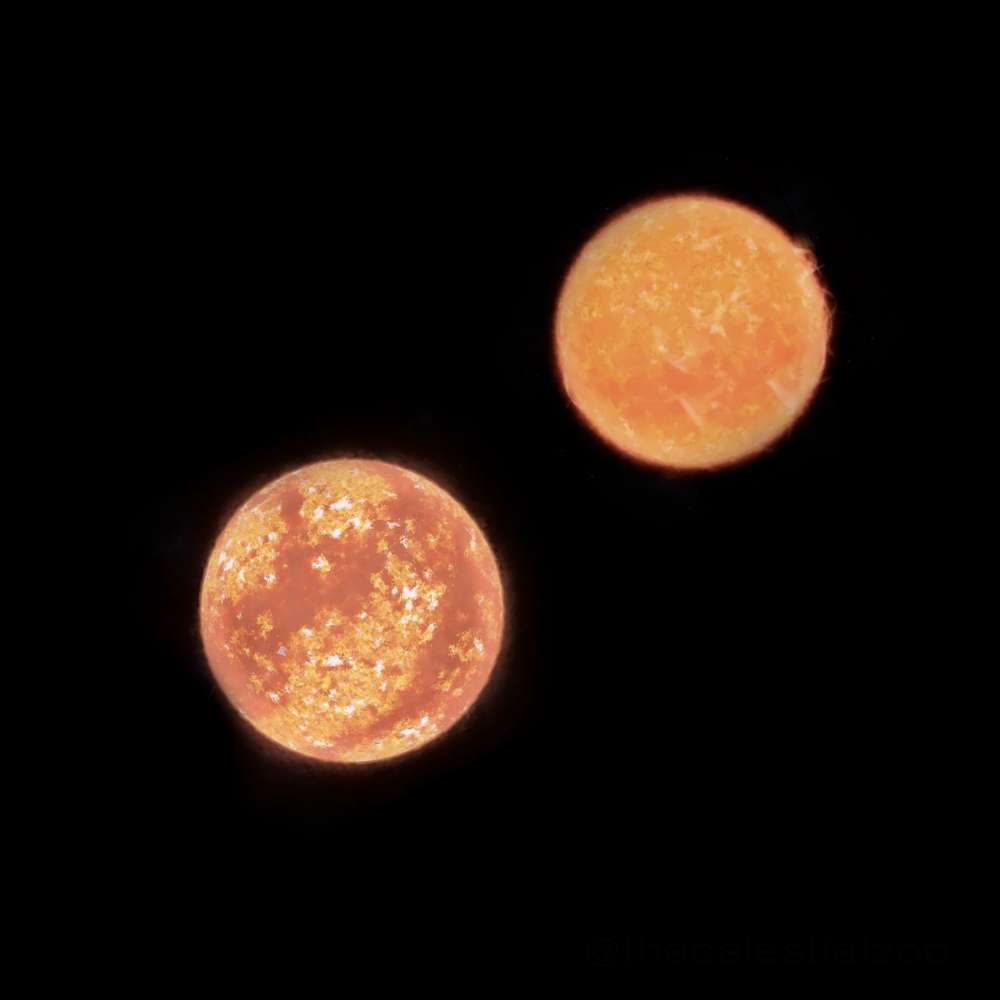
Luyten 726-8 is one of the closest stellar systems to Earth, located just 8.7 light-years away in the constellation Cetus. Although very faint to the naked eye, this system is of enormous scientific significance because it contains one of the most active flare stars in the sky: UV Ceti.
The system consists of two red dwarfs:
BL Ceti (Component A)
UV Ceti (Component B)
Both stars are small, cool, and faint, with luminosities less than 0.1% of the Sun’s. Yet despite their low luminosity, the system is famous for its explosive behavior. UV Ceti, the B component, undergoes dramatic flare events that can increase its brightness by hundreds of times in seconds.
Because Luyten 726-8 is so close to Earth, it provides a unique opportunity to study the magnetic activity, habitability challenges, and long-term evolution of red dwarf stars—the most common type of star in the Milky Way.
Physical Nature of Van Maanen’s Star
As a white dwarf, Van Maanen’s Star is incredibly dense and compact. Although its radius is comparable to Earth’s, it contains about two-thirds of the Sun’s mass. This density—hundreds of thousands of times that of water—creates physical conditions impossible in normal stars.
Its surface temperature of around 6,200 K makes it similar in temperature to the Sun, but because it is so small, its luminosity is a tiny fraction of solar output. To the naked eye, it is completely invisible.
The star’s atmosphere is helium-dominated, but surprisingly contains traces of heavier elements such as:
Magnesium
Iron
Calcium
These metals should sink rapidly in the intense gravity of a white dwarf, meaning they must have been recently accreted. Their presence identifies Van Maanen’s Star as a DZ-type, making it the closest known metal-polluted white dwarf.
Physical Characteristics of the Two Red Dwarfs
Red dwarfs are the smallest, coolest, and most numerous stars in the galaxy. Luyten 726-8’s components are classic representatives of this stellar class.
BL Ceti (A component)
Spectral class: M5.5 Ve
Mass: ~0.12 times the Sun
Luminosity: ~0.0008 L☉
Radius: Slightly larger than Jupiter
Behavior: Mildly active but overshadowed by its companion
UV Ceti (B component)
Spectral class: M6 Ve
Mass: ~0.10 times the Sun
Luminosity: ~0.0005 L☉
Radius: About 14% the Sun’s radius
Behavior: Extremely active flare star
The faintness of both stars makes them invisible without a telescope, but their proximity allows extremely detailed measurement of their orbits, magnetic fields, and flare cycles.
Orbital Dynamics of Luyten 726-8
The two stars orbit each other at an average distance of 5.3 AU, a little farther than the space between the Sun and Jupiter. However, the orbit is moderately eccentric, meaning:
At closest approach, the stars come within ~2 AU of each other
At furthest, they separate by ~8 AU
The orbital period is about 26.5 years.
This moderate distance allows each star to evolve peacefully without dramatic tidal distortion, but close enough that their magnetic fields may interact and influence each other’s activity.
UV Ceti – One of the Most Violent Flare Stars Ever Observed
The defining feature of the Luyten 726-8 system is the dramatic flare activity of UV Ceti (the B component).
UV Ceti is the prototype of the “UV Ceti-type flare stars”, the entire class of extremely active red dwarfs known for sudden, powerful eruptions.
What makes its flares remarkable?
Brightness can increase 100–1,000 times in seconds
Flares release enormous energy: up to 10^27 joules
Outbursts last minutes, sometimes longer
Magnetic reconnection events are the driving force
Emissions occur in radio, optical, ultraviolet, and X-ray wavelengths
UV Ceti is one of the few stars where such rapid changes can be observed in real time through telescopes.
These violent flares make habitability extremely difficult for any hypothetical planets in the system.
Why Do Red Dwarfs Like UV Ceti Produce Such Strong Flares?
Red dwarfs are fully convective stars—meaning their internal material circulates from core to surface. This allows:
Extremely strong magnetic fields
Rapid magnetic reconnection
Sudden, explosive release of stored magnetic energy
Additionally:
Their slow cooling gives them long lifetimes
Their magnetic behavior remains intense for billions of years
UV Ceti’s flares are not anomalies—they are part of a continuous activity cycle that has likely existed for most of the star’s lifetime.
Importance of Luyten 726-8 in Astrophysics
Luyten 726-8 is critical for understanding:
Stellar magnetism in low-mass stars
Habitability limits around red dwarfs
Energetic flare cycles and stellar winds
Orbital interactions between close red dwarf binaries
The long-term behavior of stars near the bottom of the main sequence
UV Ceti’s extreme behavior has made this faint system one of the most observed red-dwarf pairs in astronomy.
The Magnetic Activity Cycle of UV Ceti
UV Ceti is one of the most magnetically active red dwarfs in the solar neighborhood. Its fully convective interior allows magnetic fields to be generated throughout the entire star rather than in a separate shell, as in Sun-like stars.
Characteristics of its magnetic behavior:
Rapid growth and collapse of magnetic loops
Violent reconnection events that trigger massive flares
Persistent chromospheric and coronal activity
Intense radio bursts caused by relativistic electrons
X-ray flares comparable, in energy density, to solar superflares
Because UV Ceti rotates relatively quickly and has a deep convection zone, it maintains extremely strong magnetic fields that recharge rapidly after each flare.
This makes UV Ceti a prime example of how long-lived and energetic magnetic processes can be in low-mass stars.
How Flares Affect the Immediate Environment
UV Ceti’s flares eject energy and particles at levels far beyond anything produced by the Sun.
Consequences for the surrounding space:
1. High-energy radiation
Ultraviolet and X-ray bursts ionize surrounding gas and pose significant challenges to planetary atmospheres.
2. Stellar wind intensification
During flares, charged particles accelerate outward, influencing magnetic environments at large distances.
3. Potential atmospheric stripping
Any close-orbiting planets would likely lose their atmospheres unless shielded by powerful magnetic fields.
4. Dust and gas heating
Flares can strongly heat circumstellar material, affecting potential planet-forming disks or debris fields.
This violent environment indicates that even if planets existed in the system, sustaining life as we know it would be extremely difficult.
Differences Between BL Ceti and UV Ceti
Although both stars are red dwarfs and are similar in mass, their magnetic behaviors differ significantly.
BL Ceti (A component)
Less active
Flares are mild or rare
Cooler magnetic cycle
More stable brightness
Emits mostly steady infrared and optical light
UV Ceti (B component)
Extremely active flare star
Displays unpredictable, rapid outbursts
Brightness can spike dramatically
Emits strong radio, UV, and X-ray bursts
Prototype of the UV Ceti flare-star class
The contrast between the two stars makes the binary system a natural laboratory for studying how small differences in rotation, magnetic strength, or age lead to radically different behaviors.
Orbital Motion and Gravitational Interaction
The two stars orbit each other at an average distance of 5.3 AU, but both the separation and orientation change over their 26.5-year orbit.
The orbit reveals:
Moderate eccentricity (not perfectly circular)
Orbital speeds that vary depending on distance
Weak tidal effects because the stars are relatively far apart
Long-term stability due to large mass ratio similarity
Because the stars are small and low-mass, their gravitational influence at distance is weaker compared to systems like Sirius or Procyon. However, their mutual orbit is well-studied and contributes to understanding binary red dwarf dynamics.
Why Luyten 726-8 Is Important to Exoplanet Habitability Studies
The system is a key test case for evaluating whether red dwarfs can host stable, habitable planets.
Red dwarfs are common—over 75% of stars in the Milky Way—but their intense magnetic activity often poses habitability problems.
Luyten 726-8 demonstrates:
1. Frequent, intense flares
These can erode or sterilize planetary atmospheres.
2. Strong stellar winds
These push habitable zones outward, but red dwarfs emit very little visible light, making distant planets too cold.
3. Long-term activity
Red dwarfs remain active for billions of years, meaning even old stars can produce uninhabitable environments.
4. Binary effects
Gravitational interactions in a binary can destabilize orbits or limit where planets can exist.
Because this system is so close, it provides a real-world example of how difficult life would be in a flare-star environment.
Observational History
Luyten 726-8 has been monitored continuously since the early 20th century.
Important milestones:
1920s–1930s: Catalogued by Willem Luyten during his high-proper-motion surveys.
1948: UV Ceti displayed one of the first major observed stellar flares, establishing the class of UV Ceti-type stars.
Late 20th century: Observed extensively in radio and X-ray wavelengths.
Modern era: Monitored by space telescopes (Chandra, XMM-Newton, Swift) for flare activity.
Few nearby stars have such a long and detailed observational record.
Comparison with Other Nearby Flare Stars
| Star | Distance | Type | Activity Level |
|---|---|---|---|
| Proxima Centauri | ~4.24 ly | M5.5 Ve | Active flare star |
| Barnard’s Star | ~5.96 ly | M4 Ve | Occasional flares |
| Wolf 359 | ~7.8 ly | M6 Ve | Very active |
| Luyten 726-8 | ~8.73 ly | M5.5 + M6 Ve | One of the most extreme flare stars |
| AD Leo | ~16 ly | M3.5 Ve | Very active, well-studied |
UV Ceti stands out as one of the strongest individual flare stars among the nearby systems.
Long-Term Evolution of the Luyten 726-8 System
Red dwarfs are the longest-lived stars in the universe. Because they burn hydrogen extremely slowly, their lifetimes extend into the trillions of years—far longer than the current age of the cosmos.
What this means for Luyten 726-8:
Both BL Ceti and UV Ceti will remain active main-sequence stars for hundreds of billions to trillions of years.
They will gradually cool and dim, but so slowly that most of their evolution lies in the distant future.
UV Ceti’s flare activity may diminish with age, but its magnetic dynamo will remain functional for an extremely long time.
Neither star will become a red giant; instead, they will eventually transform into blue dwarfs (hypothetical future evolution stage) and cool into white dwarfs over unimaginably long timescales.
Because of their longevity, systems like Luyten 726-8 are believed to dominate the far future of the universe after larger stars have died out.
Habitability and Planetary Possibilities
Although Luyten 726-8 has no confirmed planets, scientists often use it as an example of why planets around active red dwarfs may struggle to support life.
Challenges for habitability:
Extreme flare activity
UV Ceti’s superflares would strip atmospheres or sterilize planetary surfaces.Tidal locking
Any habitable-zone planets would likely be tidally locked, causing harsh climate contrasts.High UV and X-ray flux
Persistent ultraviolet radiation makes surface life difficult.Binary dynamics
The gravitational influence of the companion star may destabilize orbits within the habitable zone.
Despite these challenges, some astronomers argue that subsurface oceans or thick-atmosphere worlds might still be possible around red dwarfs—though not likely in this specific system.
Scientific Importance of UV Ceti-Type Flare Stars
UV Ceti (the B component) is the prototype of an entire class of eruptive stars known as UV Ceti-type flare stars. The system’s name is used to classify thousands of similar stars across the galaxy.
Why UV Ceti stars matter:
They help astronomers understand magnetic field generation in fully convective stars.
They show how quickly energy can be released through magnetic reconnection.
They provide insight into stellar atmospheres at very low masses.
They challenge assumptions about exoplanet habitability around red dwarfs.
They represent the most common type of star in the Milky Way—making their behavior crucial to understanding the galaxy as a whole.
The Luyten 726-8 system remains one of the most monitored flare-star systems because it is both nearby and violently active.
Frequently Asked Questions (FAQ)
Why is UV Ceti so much more active than BL Ceti?
Slight differences in rotation and magnetic field strength lead to huge differences in flare behavior. UV Ceti rotates faster and maintains a stronger magnetic dynamo.
Can we see Luyten 726-8 with the naked eye?
No. Both stars are far too faint, requiring a telescope.
Is Luyten 726-8 dangerous to Earth?
No. Even powerful flares from red dwarfs at 8.7 light-years pose no direct harm to us.
Could planets exist in this system?
Possibly, but stability and atmospheric retention would be major challenges due to the binary nature and intense flare activity.
Is UV Ceti still the most active known flare star?
It remains one of the most iconic and well-studied, though many newly discovered flare stars rival its intensity.
Related Stars and Comparative Study
Proxima Centauri – Another nearby flare star hosting an exoplanet
Wolf 359 – Highly active red dwarf near the Sun
Ross 154 – Known for recurring, large flares
AD Leonis (AD Leo) – One of the strongest flare stars in the solar neighborhood
TZ Arietis – Another classic UV Ceti-type flare star
Comparing these stars helps astronomers develop a broader understanding of magnetism and stellar evolution in low-mass stars.
Final Thoughts
Luyten 726-8 may be faint and unassuming to the eye, but it is one of the most dynamic and scientifically valuable star systems near the Sun. Its combination of:
a close binary orbit,
two low-mass red dwarfs, and
the extreme flare activity of UV Ceti
creates a natural astrophysical laboratory for studying magnetism, stellar winds, and the environments of small stars.
As the prototype for UV Ceti-type stars, this system has shaped much of what we know about flare stars and will continue to be a cornerstone for research into the physics of the smallest and most numerous stars in our galaxy.