






M110
The Elliptical Satellite of the Andromeda Galaxy
Quick Reader
| Attribute | Details |
|---|---|
| Name | Messier 110 (M110), also known as NGC 205 |
| Type | Dwarf Elliptical Galaxy (dE5 pec) |
| Parent Galaxy | Andromeda Galaxy (M31) |
| Constellation | Andromeda |
| Distance from Earth | ~2.69 million light-years |
| Apparent Magnitude | 8.0 |
| Diameter | ~15,000 light-years |
| Discovered By | Charles Messier (1773) |
| Stellar Population | Predominantly old stars with young central component |
| Star Formation | Low but ongoing in the nucleus |
| Supermassive Black Hole | Possible intermediate-mass (~2–3 million M☉, not confirmed) |
| Group | Local Group (Andromeda Subgroup) |
| Best Viewing Time | October–January |
| Telescope Requirement | Visible in binoculars and small telescopes near M31 |
Introduction — A Modest Neighbor with a Complex Past
In the shadow of the grand Andromeda Galaxy (M31) lies its quiet yet fascinating companion — Messier 110 (M110).
Though small compared to Andromeda’s vast spiral structure, M110 tells a powerful story about galactic evolution, star formation, and satellite interaction.
It is one of two major elliptical companions of M31 (the other being M32), and together they form a miniature system orbiting the largest galaxy in the Local Group.
Unlike M32’s compact, stripped appearance, M110 retains traces of its outer halo, faint gas, and even recent star formation in its central regions — a rare feature for an elliptical galaxy.
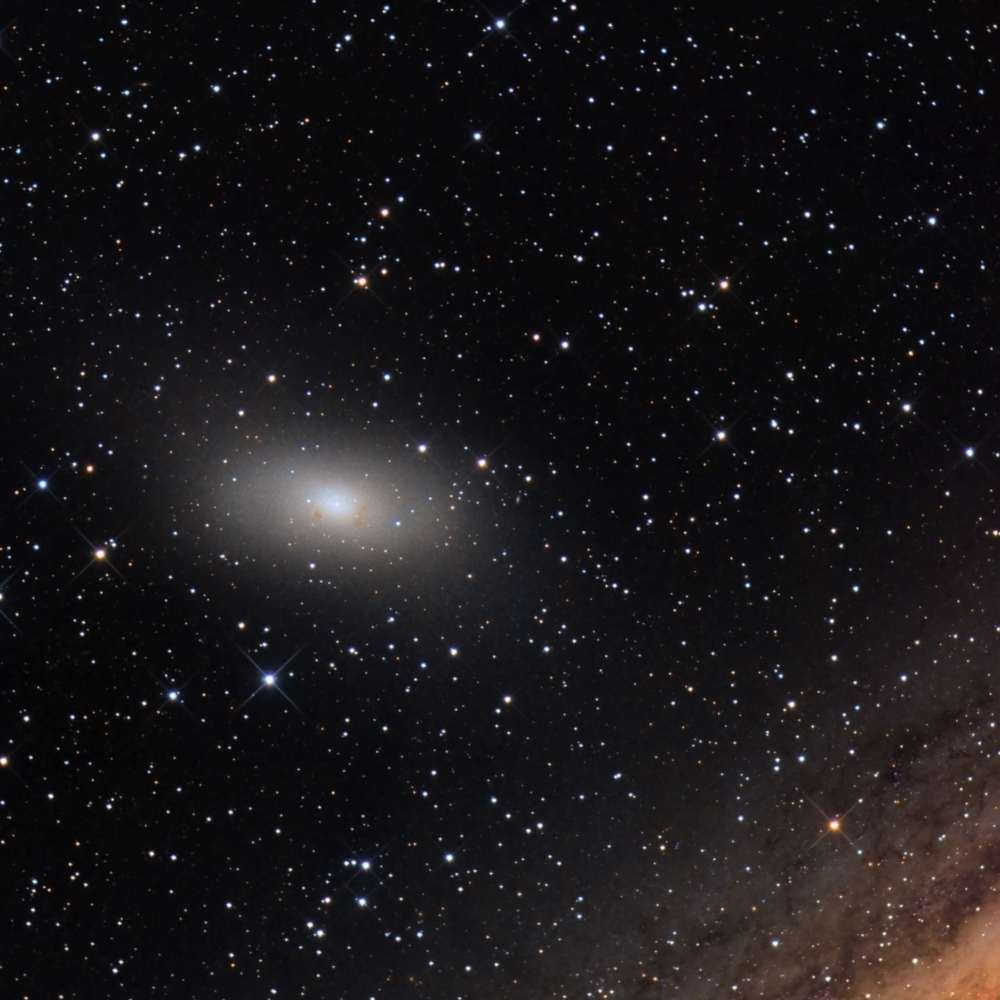
At first glance, M110 seems simple — a soft, oval glow beside Andromeda’s disk. But inside that quiet light lies a record of multiple encounters, rejuvenation, and gradual transformation that continues even today.
Structure and Classification — Dwarf Elliptical with a Twist
M110 is classified as a dE5 pec galaxy — a peculiar dwarf elliptical that shows structural irregularities not usually seen in classic ellipticals.
Key Morphological Features
Shape: Elongated, smooth, and featureless at first sight, but with faint irregularities near the core.
Size: Roughly 15,000 light-years across — small compared to large ellipticals but large for a dwarf.
Central Region: Contains dust lanes and patches of young stars — evidence of recent star formation.
Outer Halo: Faint and diffuse, blending into Andromeda’s extended halo.
These irregularities make M110 an intermediate case between dwarf ellipticals and transitional systems that still retain traces of disk or gas components.
Relationship with the Andromeda Galaxy (M31)
M110 orbits Andromeda as one of its most massive satellites, forming part of the Andromeda Subgroup within the Local Group.
Orbital Characteristics
Projected Distance from M31’s Core: ~150,000 light-years.
Relative Velocity: ~–30 km/s (approaching).
Orbital Period: Estimated at several billion years.
Evidence from stellar streams and numerical models suggests that M110 may have experienced close encounters with M31 in the past, possibly losing gas and outer stars through tidal stripping.
Such interactions likely shaped its current elliptical form — transforming a once disk-shaped galaxy into the smooth spheroid we see today.
Stellar Populations — A Mixed Generation of Stars
Unlike purely old dwarf ellipticals, M110 shows a complex star formation history.
Stellar Composition Overview
| Population | Approx. Age | Key Characteristics |
|---|---|---|
| Old Population | 8–12 billion years | Dominant, metal-poor halo stars (Population II) |
| Intermediate Population | 2–5 billion years | Prominent near the core; mild rejuvenation |
| Young Stars | <500 million years | Confined to the nucleus, showing weak current star formation |
Metallicity and Color Gradient
- Central stars are metal-rich ([Fe/H] ≈ –0.4).
- Outer halo stars are metal-poor ([Fe/H] ≈ –1.3).
This gradient hints at multiple enrichment episodes, possibly triggered by gas inflow or mergers during Andromeda’s tidal interactions.
Thus, M110 stands out as one of the few dwarf ellipticals that never truly died — it still forms stars on a small scale today.
Gas and Dust — Unexpected Remnants in an Elliptical
Most elliptical galaxies have long since lost their interstellar gas and dust, but M110 defies this rule.
Infrared and ultraviolet surveys show faint traces of both, concentrated near its core.
Key Observations
Dust Patches: Visible in high-resolution Hubble images — subtle but real.
Cold Gas Content: Estimated hydrogen mass of ~10⁶ M☉, low but nonzero.
Infrared Emission: Detected by Spitzer and WISE, indicating ongoing low-level star formation.
These findings suggest that M110 retained a small fraction of its original gas, possibly shielded during earlier stripping events, and continues to recycle material within its nucleus.
A Bridge Between Galaxy Types
M110’s combination of elliptical shape, residual gas, and mixed-age stars makes it a transitional object — bridging the gap between:
Dwarf ellipticals (dE): Smooth, old, gas-poor systems.
Dwarf irregulars (dIrr): Younger, gas-rich, and actively star-forming.
This hybrid nature supports the theory that some dwarf irregulars evolve into ellipticals through tidal interactions and gas loss — a process still unfolding within the Local Group.
Internal Kinematics — Motion Within a Miniature Galaxy
Despite its relatively small size, M110 (NGC 205) displays surprisingly complex internal dynamics.
While many dwarf ellipticals rotate slowly or not at all, M110 shows measurable rotational motion, hinting that it once had a disk-like structure before being transformed by Andromeda’s gravity.
Kinematic Highlights
Maximum Rotational Velocity: ~20–30 km/s
Velocity Dispersion: ~25–30 km/s
Mass Estimate: ~3×10⁹ M☉ (stellar + dark matter combined)
Rotation Axis: Slightly misaligned with its photometric major axis — possibly a relic of past tidal interaction.
This weak but noticeable rotation suggests that M110 may have originated as a dwarf spiral or irregular galaxy, later reshaped into an elliptical through tidal heating and mass loss during close encounters with M31.
Dark Matter and Mass Distribution
Like most dwarf galaxies, M110 contains a significant amount of dark matter, which helps maintain its structure despite tidal stresses.
Key Findings
The total mass-to-light ratio (M/L) ranges between 8–12, consistent with other dwarf ellipticals.
The inner 1 kpc is dominated by stellar mass, while the outskirts are dark matter–dominated.
Velocity dispersion modeling shows that M110 is dynamically stable — its dark matter halo protects it from complete tidal destruction.
Such stability makes M110 a valuable nearby example for studying how dark matter halos evolve in galaxies affected by larger neighbors.
Evidence of Tidal Interaction — Scars of Andromeda’s Gravity
The relationship between M110 and M31 (Andromeda) is one of cosmic intimacy and subtle violence.
Over billions of years, gravitational tides from Andromeda have stretched, stripped, and reshaped M110’s structure — leaving behind visible and dynamical scars.
Observational Clues
Asymmetric Halo: Deep imaging reveals faint tidal tails extending northwest of M110, possibly remnants of past stripping events.
Distorted Isophotes: The outer brightness contours of M110 are slightly warped — evidence of gravitational perturbation.
Stellar Streams Around M31: Some of the streams in Andromeda’s halo may contain stars originally stripped from M110 during earlier orbits.
Simulation Support
Modern N-body simulations reproduce M110’s current shape by assuming:
A disk-dominated progenitor,
A close encounter with M31 about 2–3 billion years ago,
Loss of up to 70% of its original mass through tidal stripping.
In essence, M110 is what remains of a once-larger galaxy — the skeletal core of a system slowly digested by Andromeda.
Star Formation — A Galaxy That Refuses to Die
One of M110’s most remarkable traits is that it still forms stars, albeit at a low rate.
For an elliptical galaxy, this is rare and suggests recent infall or internal recycling of gas.
Observational Evidence
Hubble Space Telescope (HST) images reveal blue star clusters and asymmetrical dust lanes near the nucleus.
GALEX ultraviolet data confirm the presence of young stellar populations (<300 Myr).
Infrared signatures from Spitzer show ongoing dust heating by young stars.
Estimated Star Formation Rate (SFR)
~0.001 M☉/year — extremely low, but significant for a dwarf elliptical.
This means M110 is not truly “dead” — it’s quietly rejuvenating, sustaining slow star formation from recycled stellar ejecta or residual gas left after past interactions.
Chemical Abundances — A Tale of Gradual Enrichment
Spectroscopic surveys of M110’s stars reveal a metallicity spread from [Fe/H] ≈ –1.5 in the outer halo to about –0.4 near the core.
Key Insights
Inner Region: Metal-rich, younger stars from secondary star formation bursts.
Outer Region: Older, metal-poor halo remnants from the galaxy’s early phase.
Alpha Elements: Enhanced ratios (Mg, Ca, Si) in older stars suggest early enrichment by Type II supernovae.
This layered enrichment pattern indicates that M110 underwent at least two major star formation epochs — first rapidly, then more slowly after tidal gas inflow from M31.
A Tale of Two Satellites — M110 vs. M32
Though both are satellites of Andromeda, M32 and M110 represent opposite outcomes of galactic interaction.
| Property | M32 | M110 |
|---|---|---|
| Morphology | Compact Elliptical (cE2) | Dwarf Elliptical (dE5 pec) |
| Diameter | ~8,000 ly | ~15,000 ly |
| Surface Brightness | Very high | Low to moderate |
| Star Formation | Inactive (“red and dead”) | Ongoing, low-level |
| Tidal History | Heavily stripped core | Partially stripped, halo intact |
| Gas and Dust | None | Present (central dust patches) |
Together, these two galaxies illustrate the diversity of outcomes for satellites interacting with massive hosts — one completely stripped and compacted, the other partly stripped but still evolving.
The Central Region — Possible Intermediate-Mass Black Hole
High-resolution stellar dynamics suggest that M110’s nucleus may host an intermediate-mass black hole (IMBH) — though the evidence remains tentative.
Observational Clues
Central velocity dispersion peak (~35 km/s) hints at a compact central mass.
The inferred black hole mass, if present, is around 2–3 million solar masses — similar to M32’s SMBH.
No active emission detected — the object is currently dormant.
If confirmed, M110 would become one of the nearest known galaxies with an IMBH, providing critical insights into how such black holes grow in small systems before merging into supermassive ones.
Role in the Local Group — A Quiet but Crucial Member
Within the Local Group of galaxies, M110 (NGC 205) plays a small yet meaningful role.
As a dwarf elliptical companion of Andromeda, it offers astronomers a living example of how galactic interactions shape smaller systems — and how those systems, in turn, influence their larger hosts.
Position in the Local Group Hierarchy
Primary Host: Andromeda Galaxy (M31)
Companions: M32, NGC 147, NGC 185, M33 (Triangulum Galaxy, distant cousin)
Group Role: Inner satellite — within Andromeda’s gravitational halo.
Together with M32, M110 helps trace the extent and structure of Andromeda’s dark matter halo.
By measuring its orbit and velocity, astronomers can better estimate Andromeda’s total mass, now thought to be around 1.5 trillion solar masses.
M110’s continuing slow star formation also enriches the intra-group medium with gas and dust — microscopic, but symbolically part of the Local Group’s recycling ecosystem.
Evolutionary History — From Disk to Dwarf Elliptical
Simulations and spectral analysis strongly suggest that M110 was not always an elliptical galaxy. It may once have been a dwarf disk or irregular, later transformed by Andromeda’s gravitational and tidal forces.
Likely Evolutionary Stages
| Phase | Approx. Timeframe | Key Events |
|---|---|---|
| Initial Formation | ~12 billion years ago | Birth as a small gas-rich irregular/disk galaxy. |
| First Encounter with M31 | ~5–7 billion years ago | Gas stripping begins; loss of angular momentum. |
| Major Tidal Interaction | ~2–3 billion years ago | Structural heating transforms it into an elliptical. |
| Present Phase | Ongoing | Residual star formation and slow orbital decay. |
This gradual evolution highlights how environmental effects, rather than internal processes alone, can define a galaxy’s ultimate fate.
The Andromeda–M110 Connection — A Dance of Gravity
M110’s long-term relationship with Andromeda (M31) is one of mutual influence.
Although M31’s gravitational power dominates, M110’s repeated passages have left subtle imprints on its host.
Possible Effects on Andromeda
Star Formation Trigger: Each close passage may have sent shock waves through M31’s gas disk, stimulating bursts of star formation.
Stellar Streams: M110’s tidal debris could contribute to Andromeda’s stellar halo substructures.
Dark Matter Clues: Tracking M110’s orbit refines models of Andromeda’s dark matter halo shape — whether spherical, oblate, or triaxial.
In essence, M110 acts as a gravitational test particle in the Andromeda system, helping decode its complex internal structure.
Observing M110 — A Subtle Jewel Beside a Giant
For astronomers and astrophotographers, M110 offers one of the most beautiful sights in the northern sky — a gentle elliptical glow near the blazing core of Andromeda.
How to Observe
Location: Just northwest of M31’s bright nucleus.
Visibility: Easily seen in binoculars as a faint oval patch (magnitude ~8.0).
Best Time: Late autumn (October–January) when Andromeda is high overhead.
Large Telescopes: Reveal its elliptical core and subtle brightness gradient.
In long-exposure images, M110’s smooth shape contrasts strikingly with M31’s dusty spiral arms — a calm companion beside a cosmic storm.
Frequently Asked Questions (FAQ)
Q1: What type of galaxy is M110?
M110 is a dwarf elliptical galaxy (dE5 pec) — smooth, faint, and slightly elongated, with traces of residual dust and young stars.
Q2: Is M110 part of the Andromeda Galaxy?
Yes. M110 is gravitationally bound to Andromeda and orbits it as a satellite galaxy.
Q3: Does M110 still form stars?
Yes, though at a very low rate (~0.001 solar masses per year). This makes it unusual among elliptical galaxies, most of which are entirely inactive.
Q4: How is M110 different from M32?
M32 is a compact elliptical, extremely dense and fully stripped of gas, while M110 is larger, fainter, and still contains some dust and gas.
Q5: Will M110 eventually merge with Andromeda?
Probably yes. Over billions of years, M110’s orbit will decay through dynamical friction, eventually merging into Andromeda’s outer bulge.
Q6: Can amateur astronomers see M110?
Yes! Even small telescopes or binoculars under dark skies can show M110 as a small fuzzy oval near the Andromeda Galaxy’s edge.
Related Objects and Further Reading
Andromeda Galaxy (M31): The parent galaxy, and the most massive in the Local Group.
M32 (NGC 221): A compact elliptical sibling, tightly bound to M31.
NGC 147 & NGC 185: Two other dwarf ellipticals in Andromeda’s extended system.
Triangulum Galaxy (M33): A spiral galaxy loosely associated with the Andromeda subgroup.
Final Thoughts
Though overshadowed by its colossal neighbor, M110 plays a vital role in our understanding of galaxy transformation and interaction.
It bridges the gap between living and dying galaxies — still forming stars, yet fading into the quiet simplicity of an elliptical form.
M110 is a survivor — not a relic, but a living archive of galactic evolution in miniature.
Its soft light, just beside Andromeda’s brilliance, reminds us that in the cosmos, even the smallest companions carry grand stories — tales of creation, collision, and cosmic endurance that echo across the Local Group.