





M32
he Compact Companion of the Andromeda Galaxy
Quick Reader
| Attribute | Details |
|---|---|
| Name | Messier 32 (M32), also known as NGC 221 |
| Type | Compact Elliptical Galaxy (cE2) |
| Parent System | Satellite of the Andromeda Galaxy (M31) |
| Constellation | Andromeda |
| Distance from Earth | ~2.65 million light-years |
| Apparent Magnitude | 8.1 |
| Diameter | ~8,000 light-years |
| Discovered By | Guillaume Le Gentil (1749); cataloged by Charles Messier (1764) |
| Stellar Population | Mostly old, metal-rich stars (Population II) |
| Supermassive Black Hole | ~3 million M☉ (similar to Milky Way’s Sagittarius A*) |
| Group | Local Group (Andromeda Subgroup) |
| Best Viewing Time | September–January |
| Telescope Requirement | Visible in small telescopes or binoculars near Andromeda |
Introduction — A Galaxy Within a Galaxy’s Shadow
Amid the radiant expanse of the Andromeda Galaxy (M31) lies a much smaller yet profoundly significant neighbor — Messier 32 (M32).
Though overshadowed by its massive parent, M32 is one of the closest elliptical galaxies to Earth and an archetype for an entire class of compact galaxies found across the universe.
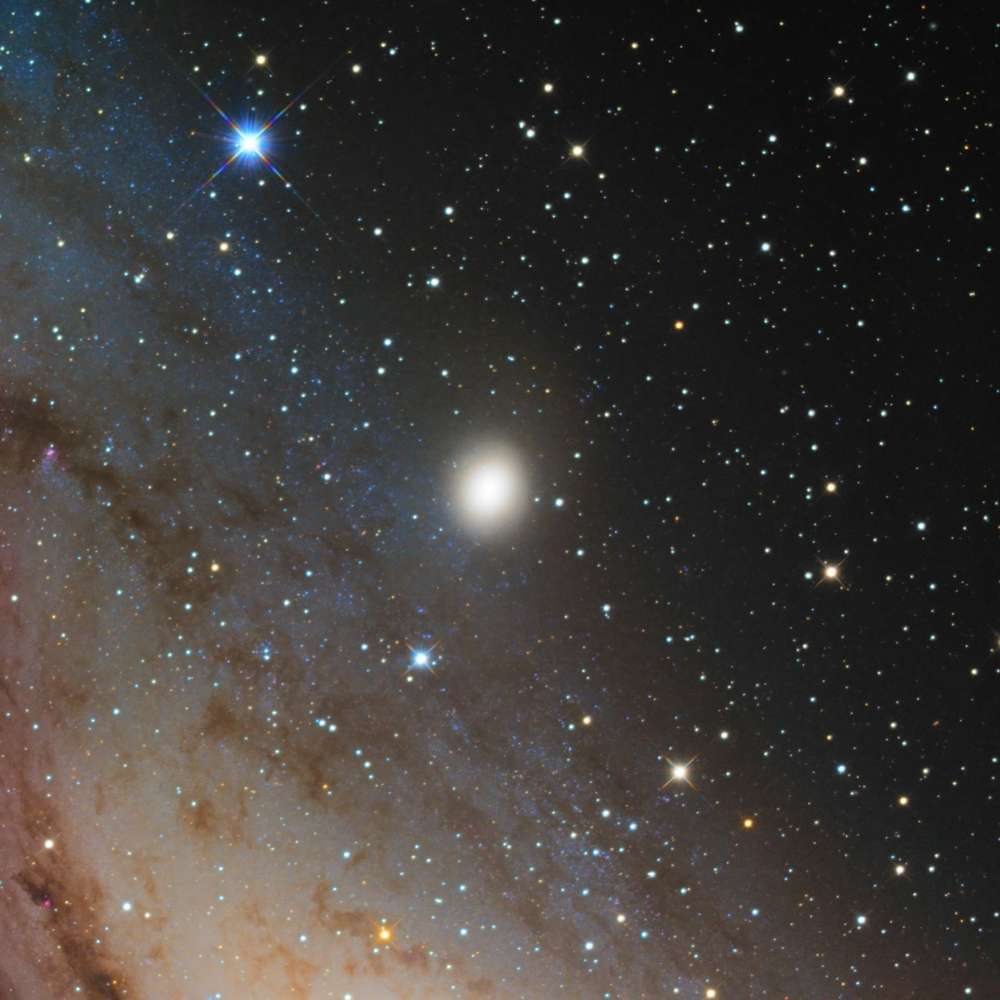
At first glance, M32 appears as a bright, round patch just south of Andromeda’s core. But this modest-looking satellite holds extraordinary secrets — a supermassive black hole, billions of old stars, and a violent history of galactic interaction and stripping that shaped its compact form.
Structure and Classification — The Prototype Compact Elliptical
M32 is classified as a compact elliptical galaxy (cE2) — a rare type known for its small size, high surface brightness, and dense stellar population.
It is the prototype of this class, inspiring the study of compact ellipticals in clusters such as Virgo and Fornax.
Key Structural Properties
Size: Only ~8,000 light-years across (one-tenth the Milky Way’s diameter).
Shape: Nearly round with a smooth, featureless brightness profile.
Core Density: Among the highest stellar densities in the Local Group.
Surface Brightness: Extremely high for its size — the reason it was once mistaken for a bright nebula.
M32’s compact form likely didn’t arise naturally. Instead, it is thought to be the stripped remnant of a larger spiral or elliptical galaxy, its outer stars torn away by tidal forces from the much larger Andromeda Galaxy.
Tidal History — Sculpted by Andromeda’s Gravity
The story of M32 is a story of survival.
Billions of years ago, it may have been a full-sized galaxy orbiting near Andromeda. Over time, Andromeda’s immense gravitational pull stripped away its outer halo, disk, and gas, leaving behind only the dense core — what we now see as M32.
Evidence Supporting Tidal Stripping
Outer Disk Truncation: No extended halo or spiral features remain.
Star Population: Largely old stars, with almost no new star formation — gas has long been removed.
Simulation Matches: Galaxy models show that M32-like systems naturally emerge from minor mergers or satellite disruption events.
This process is sometimes called “galactic cannibalism”, where large galaxies consume their smaller companions, incorporating their material into vast stellar halos — such as Andromeda’s own faint outer shell.
Stellar Populations — Ancient, Metal-Rich Survivors
Spectroscopic observations show that M32’s stars are predominantly ancient (8–12 billion years old) and relatively metal-rich compared to typical dwarf galaxies.
This metallicity suggests that before its stripping, M32 was massive enough to recycle stellar material through multiple generations of star formation.
Key Components
Core Stars: Mostly red giants and subgiants.
Younger Sub-Populations: A minor fraction (~10%) of intermediate-age stars (~2–5 billion years old).
Absence of Gas and Dust: Indicates star formation ceased long ago — the galaxy is now fully “red and dead.”
In short, M32 is a fossilized remnant of a once-active galaxy, now quietly glowing with the light of aging stars.
The Central Black Hole — Small Galaxy, Big Engine
Despite its modest size, M32 harbors a supermassive black hole (SMBH) of roughly 3 million solar masses, comparable to the one at the Milky Way’s center.
Observational Evidence
Hubble Space Telescope spectroscopy revealed rapid stellar motions near the core, indicating the gravitational pull of a compact massive object.
The measured stellar velocity dispersion (~75 km/s) aligns with the M–σ relation followed by larger galaxies, confirming that M32’s black hole formed through normal galactic processes, not anomalies.
This discovery made M32 an important benchmark for understanding black hole scaling relations in galaxies of all sizes.
Appearance in the Sky — A Hidden Jewel Beside a Giant
For amateur astronomers, M32 can be easily spotted beside the Andromeda Galaxy’s bright nucleus.
It lies just south of M31’s core and appears as a small, round, bright patch — unmistakably distinct from background stars.
Observing Tips
Equipment: 50mm binoculars or small telescopes can reveal it as a fuzzy glow.
Visibility: Excellent in dark skies; hard to distinguish under light pollution due to Andromeda’s brightness.
Larger Apertures (≥6 inch): Resolve the bright compact nucleus and subtle gradient of brightness outward.
Through long-exposure astrophotography, M32 glows like a pearl beside a spiral, its smooth ellipse contrasting sharply with Andromeda’s intricate dust lanes.
Internal Dynamics — The Dense Heart of a Stripped Galaxy
M32 may look calm and featureless through a telescope, but inside it is a region of intense gravitational activity.
Every cubic light-year near its center contains thousands of stars — moving at enormous speeds under the pull of its supermassive black hole and dense stellar core.
Stellar Motion and Velocity Dispersion
Central Velocity Dispersion: ~75–90 km/s, unusually high for its small size.
Orbital Pattern: Stars move in random elliptical paths rather than ordered rotation — typical for elliptical galaxies.
Dynamical Mass: Estimated at ~3×10⁹ M☉, concentrated within only 2,000 light-years.
This dense structure explains M32’s exceptionally high surface brightness, which once puzzled astronomers — it’s essentially a galactic core without its outer envelope.
Gravitational Stability
Despite its proximity to Andromeda, M32’s compactness protects it from tidal disruption.
Its stars are bound so tightly that Andromeda’s pull can strip only its outermost layers, leaving the central spheroid intact.
Thus, M32 stands as a survivor of galactic evolution — reshaped but not destroyed.
Interaction with Andromeda — A History Written in Tides
M32’s relationship with the Andromeda Galaxy (M31) is both intimate and violent.
For billions of years, it has orbited Andromeda, its path carrying it through the galaxy’s halo and disk — leaving behind subtle traces of its gravitational encounters.
Signs of Past Encounters
Andromeda’s Distorted Disk:
Infrared and optical surveys show ripples and star streams in M31’s outer regions — possibly caused by M32’s past close passages.Stellar Streams in the Halo:
Tidal debris found near Andromeda may include stars stripped from M32 during earlier interactions.Simulated Collision Models:
Computational models show that M32’s compact size and metallicity fit perfectly with a “stripped spiral bulge” origin — once part of a larger system that lost most of its mass to Andromeda’s gravity.
Orbital Characteristics
Current Distance from M31’s Core: ~25,000 light-years (projected).
Relative Velocity: ~100–150 km/s.
Orbit Type: Likely elliptical and decaying slowly due to dynamical friction.
Over time, M32 may spiral even closer, contributing additional material to Andromeda’s central halo — continuing a slow merger-in-progress.
Stellar Populations — The Fossil Record of M32’s Past
Spectroscopic mapping by Hubble and ground-based telescopes has revealed that M32’s stars belong to two distinct age groups:
| Population | Age (approx.) | Characteristics | Metallicity |
|---|---|---|---|
| Old Population | 8–12 billion years | Dominant, red giants and subgiants | Metal-rich ([Fe/H] ≈ 0) |
| Intermediate Population | 2–5 billion years | Fainter component of younger stars | Slightly sub-solar ([Fe/H] ≈ –0.2) |
This mixture indicates that M32 retained some gas after its first stripping event and formed a secondary generation of stars, likely triggered by tidal compression during close passages with Andromeda.
Lack of Ongoing Star Formation
- No cold gas or dust detected (HI < 10⁵ M☉).
- No emission lines or UV signatures typical of active star-forming galaxies.
- Stellar feedback and Andromeda’s tidal influence likely cleared remaining gas billions of years ago.
Today, M32 shines as a galaxy of pure starlight — no nebulae, no gas, only the echoes of its ancient formation.
A Benchmark for Compact Ellipticals
M32 serves as the prototype for an entire galaxy class known as compact ellipticals (cE) — small, dense galaxies found near massive hosts in clusters and groups.
Astronomers studying galaxies like NGC 4486B (near M87) or M59-UCD3 (in Virgo) trace their properties directly back to M32 as the model example.
Shared Traits of Compact Ellipticals
Formed by tidal stripping of larger galaxies.
Contain old, metal-rich stars.
Have high central densities and small radii.
Often orbit near giant galaxies, mirroring the M32–M31 relationship.
In this sense, M32 is not just Andromeda’s companion — it is a template for galaxy transformation across the cosmos.
Black Hole–Bulge Connection — The M–σ Relation
The discovery of a 3 million solar mass black hole in M32’s core solidified its role in shaping one of astronomy’s key scaling laws — the M–σ relation, which links a galaxy’s black hole mass to the velocity dispersion of its bulge.
Key Findings
Despite M32’s small size, its black hole fits perfectly on the same relation followed by giant ellipticals and spirals.
This shows that black hole growth scales with bulge formation, even in stripped systems.
It implies that M32’s central black hole predates its stripping — a relic of its larger, original self.
In essence, M32 confirms that galactic nuclei remember their origins long after the rest of the galaxy has been lost.
Comparison with Other Compact Systems
| Property | M32 | NGC 4486B | M59-UCD3 | Milky Way Bulge |
|---|---|---|---|---|
| Type | Compact Elliptical | Compact Elliptical | Ultra-Compact Dwarf | Barred Bulge |
| Host | Andromeda (M31) | M87 (Virgo Cluster) | M59 (Virgo Cluster) | — |
| Diameter | ~8,000 ly | ~5,000 ly | ~300 ly | ~15,000 ly |
| SMBH Mass | ~3×10⁶ M☉ | ~6×10⁸ M☉ | ~5×10⁶ M☉ | ~4×10⁶ M☉ |
| Metallicity | Solar | Super-solar | Slightly sub-solar | Solar |
This table highlights M32’s intermediate nature — more massive and evolved than a dwarf galaxy, yet stripped to the point of compact minimalism.
Evolutionary Fate — Toward a Merger with Andromeda
The destiny of M32 is tightly intertwined with that of its colossal parent, the Andromeda Galaxy (M31).
Though M32 currently orbits Andromeda at a projected distance of ~25,000 light-years, gravitational models suggest it is slowly spiraling inward — pulled ever closer by the invisible hand of dynamical friction.
The Future Path
Orbital Decay: M32 loses orbital energy each time it passes through Andromeda’s halo.
Timeframe: Simulations predict that within several billion years, M32 may be fully assimilated into M31’s bulge.
Result: M32’s dense stars will merge with Andromeda’s core, contributing to the central stellar population and possibly fueling its supermassive black hole.
This process mirrors a universal theme of galactic evolution — small systems merging with large ones to build ever more massive galaxies.
When Andromeda and the Milky Way eventually collide (about 4–5 billion years from now), M32’s remains will likely be part of the newly formed Milkomeda Galaxy’s inner bulge.
The Role of M32 in Andromeda’s Evolution
While M32 is small, its gravitational interactions have left visible fingerprints on Andromeda’s structure.
Observational Clues
Ring-like Features in Andromeda’s Disk:
Infrared surveys from the Spitzer Space Telescope reveal concentric star-forming rings that may have been triggered by M32’s passage through M31’s disk.Halo Substructures:
Faint stellar streams in Andromeda’s outskirts may include debris stripped from M32 during past close encounters.Gas Redistribution:
Tidal interactions may have helped funnel gas inward, feeding Andromeda’s central bulge and sustaining past star formation episodes.
In this way, M32 is both a victim and contributor — stripped by Andromeda’s gravity but simultaneously helping shape its host’s internal evolution.
Lessons from M32 — Compact Galaxies and Galactic Cannibalism
The story of M32 reveals the hidden violence behind cosmic beauty.
Galaxies grow not peacefully, but through the slow consumption of their smaller neighbors.
Compact ellipticals like M32 are the skeletal remains of those events, their dense cores surviving long after the rest has been torn away.
Scientific Insights from M32
Galaxy Transformation: Demonstrates how large spirals can be reduced to compact ellipticals via tidal stripping.
Black Hole Scaling Laws: Confirms that even small, stripped galaxies retain central black holes that follow universal mass–velocity relations.
Stellar Population History: Offers a record of multiple star-formation epochs influenced by mergers and interactions.
Cosmic Recycling: Shows how matter lost from one galaxy can seed star formation in another.
Thus, M32 is not just a companion — it’s a case study in galactic survival, evolution, and rebirth.
Frequently Asked Questions (FAQ)
Q1: Is M32 part of the Andromeda Galaxy?
Yes. M32 is a satellite galaxy gravitationally bound to Andromeda (M31), orbiting within its halo at a distance of roughly 25,000 light-years.
Q2: How big is M32 compared to the Milky Way?
M32’s diameter is only about 8,000 light-years, compared to the Milky Way’s ~105,000 light-years. Despite its small size, M32 contains around 3 billion stars, tightly packed into a dense spheroid.
Q3: Does M32 have a black hole?
Yes. It harbors a supermassive black hole of about 3 million solar masses, confirmed through stellar motion measurements.
Q4: How was M32 formed?
Astronomers believe M32 is the remnant core of a larger galaxy that was tidally stripped by Andromeda’s gravity billions of years ago.
Q5: Can we see M32 with a telescope?
Absolutely. Even small telescopes or binoculars reveal M32 as a small, bright patch just south of Andromeda’s core. In astrophotography, it stands out as a soft oval glow against M31’s vast disk.
Q6: What will happen to M32 in the future?
Eventually, M32 is expected to merge fully with Andromeda, contributing its stars and black hole to M31’s nucleus.
Related Galaxies and Further Reading
Andromeda Galaxy (M31): The parent system of M32, largest galaxy in the Local Group.
M110 (NGC 205): Another Andromeda satellite — a dwarf elliptical showing similar evolutionary processes.
NGC 4486B: Compact elliptical companion of M87, Virgo Cluster — similar to M32’s morphology.
Milky Way Bulge: A nearby analogue for understanding stellar density and black hole scaling.
Final Thoughts
The M32 Galaxy may be small, but it tells a grand story — a story of creation, destruction, and endurance on galactic scales.
Born as a full-sized system, it was stripped bare by Andromeda’s gravity, yet it survives as a brilliant fossil of the Local Group’s turbulent history.
Within its compact glow lie billions of ancient stars, a central black hole, and the memories of cosmic collisions that shaped our corner of the universe.
When Andromeda and the Milky Way merge in the far future, the legacy of M32 will live on — its stars shining quietly at the heart of a new galaxy, a reminder that even in destruction, the universe never truly forgets its past.