






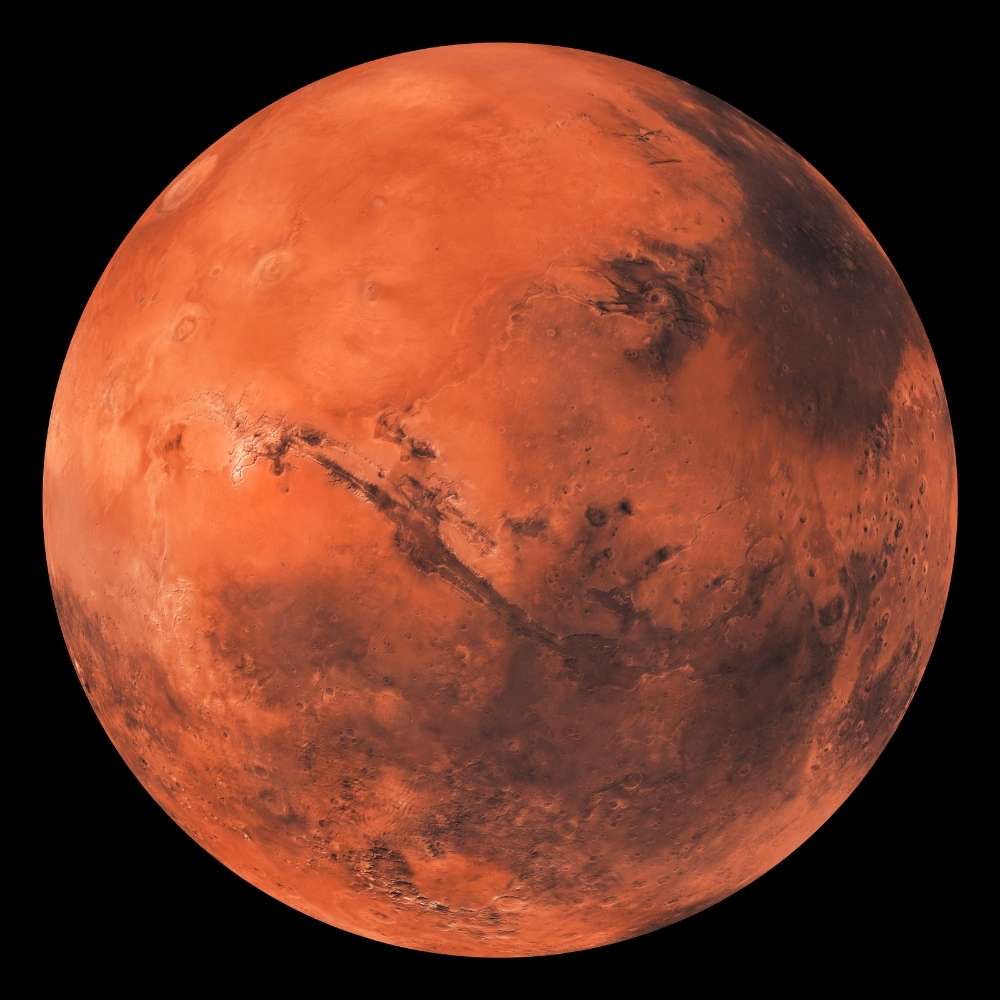
Mars
The Planet That Almost Became a Second Earth
Quick Reader
| Attribute | Details |
|---|---|
| Object Name | Mars |
| Object Type | Terrestrial planet |
| Position | 4th planet from the Sun |
| Mean Distance from Sun | ~228 million km (1.52 AU) |
| Diameter | ~6,779 km |
| Mass | ~10.7% of Earth |
| Gravity | ~38% of Earth |
| Rotation Period | ~24.6 hours |
| Orbital Period | ~687 Earth days |
| Axial Tilt | ~25.2° |
| Atmosphere | Thin (CO₂-dominated) |
| Surface Temperature | −125°C to +20°C |
| Moons | Phobos, Deimos |
| Notable Features | Olympus Mons, Valles Marineris |
| Past Water Evidence | Strong (ancient rivers, lakes) |
Key Points
- Mars is the most Earth-like planet in the Solar System
- It once had liquid water on its surface
- Today it is cold, dry, and thin-atmosphered
- Mars preserves early planetary history better than Earth
- It is the primary target in the search for past life
Introduction – A World of Lost Potential
Mars was not always the frozen desert we see today.
Billions of years ago, Mars had:
Flowing rivers
Long-lived lakes
Possibly shallow oceans
A thicker atmosphere
In many ways, early Mars resembled early Earth.
Yet today, Mars is barren.
Understanding why Mars failed where Earth succeeded is one of the central questions of planetary science. Mars is not just a neighboring planet—it is a natural experiment in planetary evolution.
What Is Mars?
Mars is a rocky terrestrial planet, composed primarily of silicate rock and metal, much like Earth.
It has:
A solid crust
A mantle
A metallic core
However, Mars is significantly smaller and lighter than Earth, and this difference shaped its entire destiny.
Mars sits near the inner edge of the Solar System’s habitable zone, a location that once allowed liquid water to exist—but only temporarily.
Size Matters – Why Mars Is a “Small Planet”
Mars is often described as Earth’s sibling, but it is closer to being Earth’s undersized cousin.
Key consequences of Mars’s small size:
Faster internal cooling
Weaker gravity
Difficulty retaining atmosphere
Early loss of magnetic field
These factors combined to shut down Mars’s long-term habitability.
Mars crossed some planetary thresholds—but not enough.
The Martian Surface – A Geological Time Capsule
Unlike Earth, Mars lacks:
Plate tectonics
Active erosion by oceans
Widespread volcanism today
As a result, its surface preserves features billions of years old.
Major surface features include:
Olympus Mons – the largest volcano in the Solar System
Valles Marineris – a canyon system longer than Earth’s continents
Vast lava plains
Ancient river channels
Mars is not geologically dead—it is geologically archived.
Why Mars Is Red
Mars’s iconic red color comes from iron oxide—rust.
Over time:
Iron-rich rocks reacted with oxygen
Likely aided by ancient water
Producing fine reddish dust
This dust covers much of the surface, giving Mars its global reddish appearance.
Mars is red not because it is hot—but because it oxidized long ago.
Evidence of Ancient Water
One of the strongest reasons Mars fascinates scientists is the overwhelming evidence that it once had liquid water.
Key indicators include:
Valley networks resembling river systems
Delta structures similar to Earth’s lakes
Sedimentary rock layers
Minerals that only form in water
Rovers have confirmed that water was stable and persistent, not fleeting.
Mars was not briefly wet.
It was wet for millions of years.
Climate of Early Mars – Warm Enough, Long Enough
Early Mars benefited from several favorable conditions:
Higher internal heat
A thicker atmosphere
Stronger greenhouse effect
These allowed:
Surface temperatures above freezing
Rain and runoff
Standing bodies of water
However, this window did not last.
Mars began to lose its atmosphere and heat relatively early in its history.
Distance from Earth and Travel Time to Mars
The distance between Earth and Mars is not constant because both planets orbit the Sun at different speeds and on different paths. As a result, the separation between them changes continuously over time.
At their closest approach, when Earth and Mars are aligned on the same side of the Sun, the distance can shrink to about 54.6 million kilometers. At their farthest, when the two planets are on opposite sides of the Sun, the distance can exceed 400 million kilometers. On average, Mars lies roughly 225 million kilometers away from Earth.
Travel time to Mars depends on orbital alignment, spacecraft speed, and mission design. Most missions use a fuel-efficient curved path known as a Hohmann transfer orbit, which follows a long arc around the Sun rather than a direct straight line.
Using this method, spacecraft typically take 6 to 9 months to reach Mars, with an average travel time of about 7 months. Nearly all successful Mars missions—including robotic rovers and orbiters—have followed this trajectory due to its balance between fuel efficiency and mission reliability.
Mars vs Earth – The First Contrast
| Feature | Mars | Earth |
|---|---|---|
| Size | Smaller | Larger |
| Atmosphere | Thin | Thick |
| Magnetic Field | Lost early | Long-lived |
| Surface Water | Ancient | Persistent |
| Tectonics | None | Active |
Mars shows what happens when a planet almost reaches Earth-like conditions—but falls short.
Why Mars Matters So Much
Mars matters because it:
Preserves early planetary conditions
Shows how habitability can fail
Helps define the limits of Earth-like worlds
Is accessible for robotic and future human exploration
Mars is not just another planet.
It is a warning, a record, and a possibility.
Inside Mars – A Planet That Cooled Too Fast
Mars began its life with the basic ingredients of a terrestrial planet: a metallic core, a rocky mantle, and a solid crust. But unlike Earth, Mars was too small to stay hot for long.
Current models suggest Mars has:
A core composed of iron, sulfur, and lighter elements
A mantle that once supported widespread volcanism
A thick, ancient crust that locked heat inside early on
Because Mars has only about one-tenth the mass of Earth, it lost internal heat much faster. This rapid cooling set off a chain reaction that would ultimately decide the planet’s fate.
Mars did not fail because it was flawed.
It failed because it cooled too soon.
The Martian Core – Active Once, Quiet Now
Early in its history, Mars’s core was hot and dynamic.
This allowed:
Convection within the molten core
Generation of a global magnetic field
Protection of the atmosphere from solar wind
However, as the core cooled:
Convection weakened
The magnetic dynamo shut down
Mars lost its global magnetic shield
This transition likely occurred within the first billion years of Mars’s history—far earlier than on Earth.
Once the magnetic field disappeared, Mars became exposed.
The Lost Magnetic Field – A Critical Turning Point
Mars once had a magnetic field similar in function (though weaker) to Earth’s.
Evidence includes:
Magnetized ancient crustal rocks
Strong remnant magnetism in the southern highlands
Patterns consistent with early dynamo activity
But unlike Earth’s magnetic field, Mars’s was short-lived.
Without a magnetic shield:
Solar wind could interact directly with the atmosphere
Charged particles stripped gases away
Atmospheric loss accelerated
This single event marked the beginning of Mars’s irreversible decline.
Atmospheric Escape – How Mars Lost Its Air
Once unprotected, Mars’s atmosphere began to leak into space.
Key escape mechanisms included:
Solar wind stripping – energetic particles physically removing gas
Thermal escape – lighter gases drifting away
Sputtering – atmospheric atoms knocked into space by collisions
NASA’s MAVEN mission has directly observed these processes in action.
Over time:
Carbon dioxide was lost
Water vapor dissociated
Hydrogen escaped permanently
Mars did not lose its atmosphere overnight.
It lost it grain by grain, year by year.
Climate Collapse – From Warm to Frozen
As atmospheric pressure dropped:
The greenhouse effect weakened
Surface temperatures fell
Liquid water became unstable
Lakes evaporated or froze.
Rivers dried up.
Rain stopped falling.
Eventually:
Water retreated underground or into ice
Surface habitability ended
Mars entered a cold, arid state
This transition likely occurred over hundreds of millions of years, not suddenly.
Mars did not die violently.
It slowly faded.
Volcanism on Mars – Bigger, Longer, but Isolated
Mars hosts the largest volcanoes in the Solar System, including Olympus Mons.
Why Mars produced such enormous volcanoes:
No plate tectonics to move the crust
Hotspots remained fixed
Lava piled up over millions of years
However, volcanism was:
Regional, not global
Unable to recycle atmosphere effectively
Insufficient to restart climate stability
Volcanoes alone could not save Mars once its core and magnetic field shut down.
Why Mars Has No Plate Tectonics
Plate tectonics require:
Sufficient internal heat
A flexible lithosphere
Ongoing mantle convection
Mars lacked all three for long enough.
Without plate tectonics:
Carbon cycling stopped
Atmosphere could not be regulated
Climate feedback loops failed
Earth survived because it recycles.
Mars failed because it froze in place.
The Southern Highlands vs Northern Lowlands
Mars shows a striking global dichotomy.
Southern Highlands
Older
Heavily cratered
Strong remnant magnetism
Northern Lowlands
Younger
Smoother
Possible ancient ocean basin
This contrast suggests:
Early crust formation differences
Possible massive impacts
Long-lived geological asymmetry
Mars’s surface is not uniform—it records multiple evolutionary chapters.
What Mars’s Collapse Teaches Us
Mars demonstrates that:
Habitability is fragile
Size determines longevity
Magnetic fields matter
Atmospheres are not guaranteed
A planet can be Earth-like in composition and still fail to remain Earth-like in outcome.
Mars crossed many thresholds—but missed one critical line: long-term internal activity.
Water on Mars Today – Where Did It All Go?
Mars no longer has rivers or lakes on its surface, but water did not vanish completely.
Today, water exists on Mars in three main forms:
Polar ice caps (water ice and frozen CO₂)
Subsurface ice buried beneath soil and rock
Hydrated minerals locked inside ancient rocks
Radar observations and lander data show that Mars holds enough water ice to cover the planet in a global ocean tens of meters deep—if it were all melted and redistributed.
Mars is dry on the surface, not empty.
The Polar Ice Caps – Seasonal and Permanent
Mars has two polar ice caps with different characteristics.
North Polar Cap
Dominated by water ice
Covered seasonally by frozen carbon dioxide
Layered structure records climate cycles
South Polar Cap
Thicker permanent CO₂ ice layer
Water ice buried below
More extreme seasonal variation
These layered deposits act like climate archives, preserving records of Mars’s orbital changes over millions of years.
Subsurface Ice – A Hidden Reservoir
One of the most important discoveries of recent decades is the widespread presence of near-surface ice across Mars.
Key findings include:
Ice just centimeters below the surface at mid-latitudes
Ice-rich regions confirmed by neutron spectroscopy
Glacial-like features preserved under dust
This ice is especially significant because it lies outside the polar regions, increasing its relevance for both science and future exploration.
Mars may appear dry—but just beneath the dust, water is waiting.
Brines and Salts – Liquid Water’s Last Refuge
Pure liquid water cannot remain stable on Mars’s surface today.
However, salty water (brines) may occasionally exist.
Salts lower the freezing point of water, allowing:
Temporary liquid phases
Thin films of moisture
Short-lived flows under specific conditions
Some surface features, once interpreted as flowing water streaks, are now debated. Even so, the possibility of transient brines remains scientifically important.
Where there is brine, there is chemical energy—and potentially biology.
Could Life Have Existed on Mars?
This question lies at the heart of Mars exploration.
Early Mars had:
Liquid water
Energy sources (volcanism, impacts)
A thicker atmosphere
Stable surface environments
These conditions are similar to those under which life emerged on Earth.
If life arose on Mars, it would most likely have been:
Microbial
Simple
Subsurface or aquatic
Mars may not have hosted complex life—but it may have hosted life at all, and that alone would be revolutionary.
Biosignatures – What Scientists Are Looking For
Mars missions are not searching for living organisms directly.
They search for biosignatures—chemical or structural evidence of past life.
These include:
Organic molecules
Specific isotopic ratios
Mineral structures formed by biology
Patterns inconsistent with non-biological processes
The challenge is not finding organics—it is determining how they formed.
Mars preserves ancient environments better than Earth, making it a prime target for this search.
Why Subsurface Life Is a Serious Possibility
If life ever existed on Mars, the surface became hostile too quickly for long-term survival.
The subsurface offers protection from:
Radiation
Temperature extremes
Atmospheric loss
On Earth, microbial life thrives kilometers underground.
On Mars, similar niches could exist—or could have existed—for extended periods.
Mars may be sterile today, but its subsurface was once a refuge.
Mars Rovers – Reading the Planet’s Memory
Each Mars rover is designed to answer a specific chapter of the planet’s story.
Key missions include:
Spirit & Opportunity – proved ancient water activity
Curiosity – confirmed long-lived habitable environments
Perseverance – searching for biosignatures and caching samples
These rovers do not roam randomly. They are sent to geologically strategic locations, chosen to maximize scientific return.
Mars is being read layer by layer.
Sample Return – The Next Critical Step
One of the most important future goals is bringing Mars samples to Earth.
Why this matters:
Earth laboratories are far more capable than rovers
Complex analyses require large instruments
Definitive biosignature testing is not possible remotely
If returned samples contain evidence of past life, it would be one of the most important discoveries in human history.
Mars is not just being explored—it is being prepared for judgment.
What Mars Teaches Us About Life in the Universe
Mars shows that:
Habitable conditions can be temporary
Life-friendly planets can fail
Earth’s success was not guaranteed
This has direct implications for exoplanet studies.
Finding Earth-sized planets is not enough.
We must find planets that remain active, protected, and stable for billions of years.
Mars is a cautionary example written in stone.
The Future of Mars – A Cold but Stable World
Mars’s major transformations are already behind it.
Unlike Earth, Mars no longer has the internal energy required to drive large-scale geological or climatic change. Its core is mostly inactive, its atmosphere thin, and its surface environment harsh.
Over the next billions of years, Mars is expected to:
Remain cold and dry
Lose small amounts of atmosphere to space
Preserve surface features with minimal erosion
Experience only localized geological activity
Mars is not evolving toward habitability—it is locked into stability through inactivity.
Could Mars Ever Become Habitable Again?
Naturally, no.
Mars lacks:
A strong magnetic field
Sufficient gravity to retain a thick atmosphere
Internal heat to sustain long-term climate regulation
Even if Mars were warmed temporarily, its atmosphere would gradually escape again. Habitability requires continuous planetary processes, not one-time changes.
Mars’s failure was not temporary—it was structural.
Terraforming Mars – Science Fiction or Science?
Terraforming Mars is often discussed, but the physical challenges are immense.
Theoretical proposals include:
Releasing CO₂ trapped in polar caps and soil
Importing volatiles from comets or icy moons
Artificially warming the planet
However, even optimistic models show that:
Mars lacks enough accessible CO₂
Atmospheric pressure would remain far below Earth levels
Any thickened atmosphere would slowly escape
Terraforming Mars into an Earth-like world is beyond realistic technological reach, even for advanced civilizations.
Mars can be modified—but not transformed.
Human Exploration – Why Mars Still Matters
Despite these limits, Mars remains the most realistic target for human exploration beyond the Moon.
Key advantages include:
Relatively accessible distance
Day length similar to Earth’s
Abundant water ice for fuel and life support
Geological diversity
Human missions to Mars would not be about making it Earth-like.
They would be about learning to survive on non-Earth worlds.
Mars is a training ground, not a destination for planetary rebirth.
Living on Mars – Underground, Not on the Surface
If humans live on Mars in the future, it will likely be:
Underground or inside shielded habitats
Protected from radiation
Dependent on artificial life-support systems
Surface conditions are too hostile for unprotected life.
Mars will not be colonized like a new continent.
It will be occupied like an extreme outpost.
Mars as a Scientific Archive
Mars’s greatest value may not be its future—but its past.
Because it lacks plate tectonics and widespread erosion, Mars preserves:
Ancient climates
Early atmospheric conditions
Records of planetary failure
In many ways, Mars is more informative than Earth, whose active geology erases early history.
Mars allows scientists to study how Earth-like planets can lose habitability—and why Earth did not.
Mars and the Search for Life Beyond Earth
Even if Mars is lifeless today, its role in astrobiology is central.
If life never arose on Mars despite favorable early conditions, it suggests:
Life is rare
Or requires very specific circumstances
If life did arise and later went extinct, it suggests:
Life may be common
But survival is fragile
Either outcome reshapes our understanding of life in the universe.
Mars is not just a planet—it is a test case.
Mars in the Context of the Solar System
Mars occupies a unique position:
Too small to stay active
Too large to be a simple asteroid
Too close to the Sun to retain volatiles long-term
It sits at the boundary between success and failure.
Related Universe Map topics include:
Earth
Venus
Planetary habitability
Atmospheric escape
Magnetic fields
Together, these worlds show that small differences in size and timing can lead to radically different outcomes.
Frequently Asked Questions (FAQ)
Was Mars ever truly Earth-like?
Yes, in limited ways. It had liquid water, a thicker atmosphere, and potentially habitable environments—but not for as long as Earth.
Is there water on Mars today?
Yes, mostly as ice and hydrated minerals, with possible transient brines.
Could Mars support life today?
Surface life is extremely unlikely. Subsurface microbial life remains a theoretical possibility.
Will humans live on Mars permanently?
Possibly, but only with advanced technology and artificial habitats.
Why didn’t Mars become another Earth?
Because it cooled too fast, lost its magnetic field, and could not retain its atmosphere.
Final Perspective
Mars is a planet of missed chances.
It came close—closer than any other world in the Solar System—to becoming Earth-like. It had water, energy, and time. But it lacked one critical trait: endurance.
Where Earth remained active, Mars fell silent.
Where Earth recycled, Mars preserved.
Where Earth thrived, Mars remembered.
Mars teaches us that habitability is not a moment—it is a long-term commitment by a planet to stay alive.
In that lesson, Mars may be the most important planet of all.