






Mercury
The Extreme Planet Closest to the Sun
Quick Reader
| Attribute | Details |
|---|---|
| Object Type | Terrestrial planet |
| Position | Innermost planet of the Solar System |
| Average Distance from Sun | ~0.39 AU |
| Orbital Period | ~88 Earth days |
| Rotation Period | ~59 Earth days |
| Solar Day Length | ~176 Earth days |
| Mean Radius | ~2,440 km |
| Diameter | ~4,880 km |
| Mass | ~5.5% of Earth |
| Density | ~5.43 g/cm³ (very high) |
| Core Size | ~85% of planetary radius |
| Core Composition | Iron-rich (partially molten) |
| Magnetic Field | Weak but global |
| Atmosphere | No true atmosphere (exosphere only) |
| Surface Temperature | ~–180°C to +430°C |
| Surface Age | Very old (heavily cratered) |
| Water Ice | Present in permanently shadowed polar craters |
Key Highlights
- Smallest planet in the Solar System
- Possesses the largest core relative to size of any planet
- Experiences the most extreme temperature range
- Has a global magnetic field despite slow rotation
- Contains water ice at the poles—surprisingly close to the Sun
- Preserves some of the oldest planetary surfaces
Introduction – The Planet of Extremes
Mercury is often overlooked.
Small, airless, and difficult to observe from Earth, it lacks the visual drama of Mars or the grandeur of Jupiter. Yet scientifically, Mercury is one of the most extreme and revealing planets in the Solar System.
It orbits closest to the Sun, yet holds ice.
It rotates slowly, yet generates a magnetic field.
It is small, yet dominated by an enormous metallic core.
Mercury is not a simple rock—it is a planetary paradox.
Mercury’s Orbit – Fast, Eccentric, and Unusual
Mercury’s orbit is unlike that of any other planet.
Key orbital traits:
Fastest orbital speed in the Solar System
Highly elliptical orbit
Large variation in distance from the Sun
This eccentricity causes:
Strong tidal stresses
Uneven solar heating
Long solar days despite short years
Mercury’s unique 3:2 spin–orbit resonance means it rotates three times for every two orbits—producing some of the strangest day–night cycles known.
A Day on Mercury – Longer Than Its Year
One Mercury solar day lasts:
176 Earth days
This occurs because:
Mercury rotates slowly
Its orbital speed changes significantly
Rotation and revolution interact in complex ways
As a result:
Daytime lasts months
Nighttime lasts months
Surface materials undergo extreme thermal stress
No other planet experiences such prolonged heating and cooling cycles.
Surface Conditions – Fire and Ice on One World
Mercury experiences the largest temperature range of any planet.
At the equator:
Daytime temperatures exceed 430°C
Nighttime temperatures plunge below –180°C
Yet at the poles:
Permanently shadowed craters never see sunlight
Temperatures remain cold enough to trap ice
Radar and spacecraft data confirm:
Water ice mixed with organic compounds
Ice stability over billions of years
Mercury shows that distance from the Sun alone does not determine surface conditions.
A Cratered World – Preserving Early Solar System History
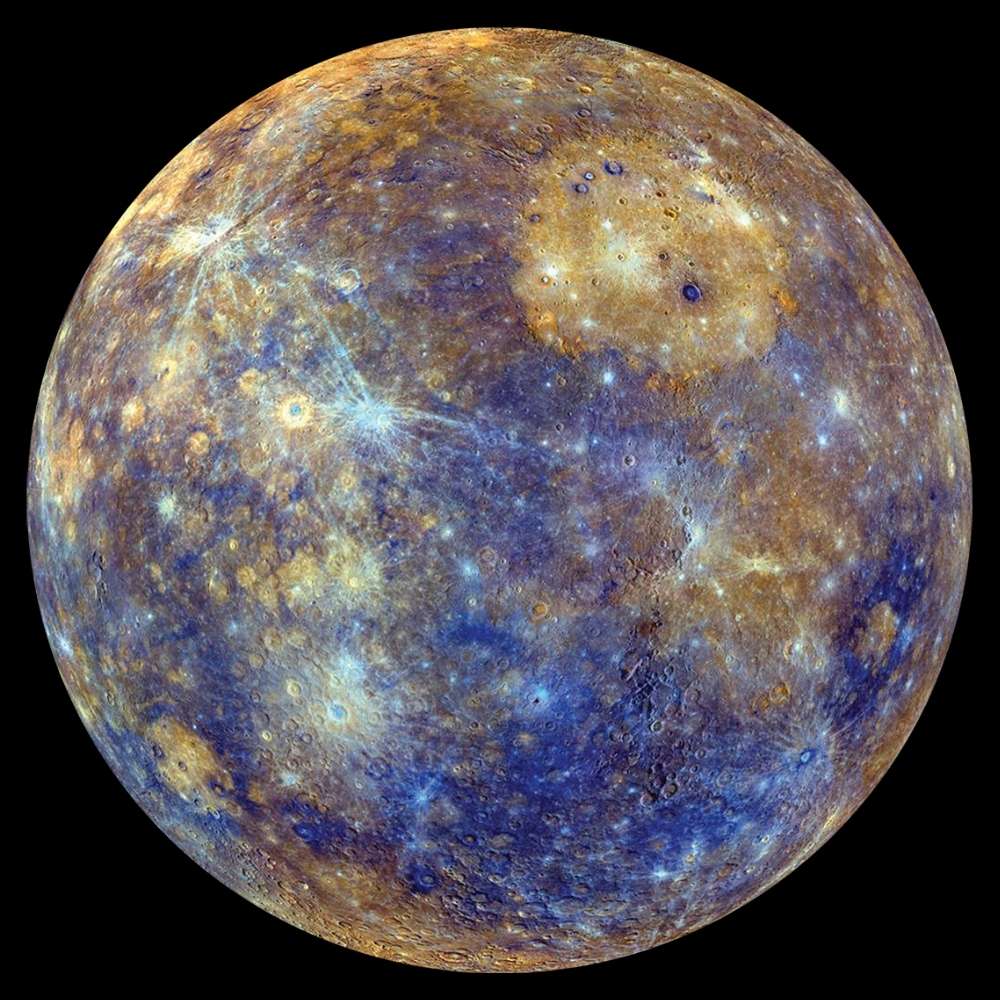
Mercury’s surface is heavily cratered, similar to the Moon.
This indicates:
Minimal atmospheric erosion
Limited geological resurfacing
Ancient surface preservation
Major features include:
Vast impact basins (e.g., Caloris Basin)
Overlapping craters from early bombardment
Smooth plains formed by ancient volcanism
Mercury’s surface acts as a geological time capsule.
Volcanism Without Plate Tectonics
Despite its small size, Mercury experienced widespread volcanism early in its history.
Evidence includes:
Lava-flooded plains
Buried craters
Large volcanic deposits
Unlike Earth:
No plate tectonics
No ongoing volcanism
Volcanism ended billions of years ago
Mercury cooled rapidly, locking its surface in place.
Why Mercury’s Interior Is So Strange
Mercury’s most defining feature lies beneath its surface.
Its core is enormous—far larger than expected for a planet of its size.
Consequences include:
High overall density
Thin rocky mantle
Global magnetic field
Planetary contraction over time
Mercury is more metal than rock, making it structurally unique among terrestrial planets.
Why Mercury Matters
Mercury challenges fundamental assumptions.
It helps scientists understand:
How planets form under extreme solar conditions
How metallic cores evolve
Why some planets retain magnetic fields
How early Solar System impacts shaped worlds
Mercury is not an outlier—it is a boundary case that defines planetary possibilities.
Inside Mercury – A Planet Dominated by Metal
Mercury’s most unusual characteristic is invisible from space:
its enormous iron-rich core.
Measurements from spacecraft tracking and rotational dynamics show that:
The core extends to ~85% of Mercury’s radius
The rocky mantle is extremely thin
The crust is thinner still
No other terrestrial planet comes close to this metal-to-rock ratio.
Why Is Mercury’s Core So Large?
Several hypotheses have been proposed:
Giant impact stripping: A massive early collision removed much of Mercury’s mantle
Solar proximity effects: Intense early solar heat prevented lighter materials from condensing
Chemical sorting in the protoplanetary disk: Metal-rich material preferentially accreted near the Sun
Current evidence suggests a combination of these processes rather than a single cause.
Mercury is not just small—it is selectively dense.
A Magnetic Field That Should Not Exist
Despite its slow rotation and small size, Mercury has a global magnetic field.
This was unexpected.
Key properties:
Field strength ~1% of Earth’s
Dipole-like structure
Slightly offset from the planet’s center
For a magnetic field to exist, a planet needs:
A molten, electrically conductive core
Internal convection
Sufficient rotation
Mercury meets these requirements in a barely sufficient way—making its magnetic field weak, but persistent.
This makes Mercury the smallest magnetized planet known.
Global Contraction – A Planet That Shrunk
As Mercury cooled, its massive core contracted.
The result is one of the planet’s most distinctive surface features:
lobate scarps.
These are:
Kilometer-high cliffs
Hundreds of kilometers long
Distributed globally
They formed when:
The planet’s interior shrank
The crust compressed and fractured
The surface buckled inward
Mercury has shrunk by several kilometers in radius over its lifetime.
It is the clearest example of a contracting planet.
Caloris Basin – A Shock That Shaped a World
One of Mercury’s most dramatic features is the Caloris Basin.
Key facts:
Diameter ~1,550 km
One of the largest impact basins in the Solar System
Formed early in Mercury’s history
Consequences of the impact:
Shock waves traveled through the planet
Fractures formed on the opposite side (antipodal terrain)
Volcanic flooding followed later
Caloris reveals how deeply impacts can affect entire planetary interiors, not just surfaces.
Mercury’s Crust – Thin, Ancient, and Preserved
Mercury’s crust tells a story of early activity followed by long silence.
Characteristics include:
Extensive impact cratering
Smooth volcanic plains
Minimal resurfacing in the last ~3 billion years
Unlike Earth:
No plate tectonics
No erosion by wind or water
No recycling of crust
This makes Mercury’s surface a direct record of early Solar System conditions.
Mercury vs Earth vs Moon – A Terrestrial Comparison
Comparative Planetary Context
| Feature | Mercury | Earth | Moon |
|---|---|---|---|
| Mean Radius | ~2,440 km | ~6,371 km | ~1,737 km |
| Core Fraction | Extremely large | Moderate | Small |
| Magnetic Field | Weak, global | Strong, global | None today |
| Atmosphere | Exosphere only | Thick, active | None |
| Geological Activity | Ancient | Ongoing | Mostly ancient |
This comparison shows that Mercury is not a scaled-down Earth.
It followed a fundamentally different evolutionary path.
Why Mercury Is a Stress Test for Planet Formation Models
Mercury challenges standard assumptions:
Why did it retain so much metal?
Why did it not lose its magnetic field early?
Why did volcanism last as long as it did?
Any successful model of terrestrial planet formation must explain Mercury—not treat it as an exception.
Mercury is where theories are forced to prove themselves.
Mercury’s Exosphere – An Atmosphere That Barely Exists
Mercury has no true atmosphere.
Instead, it possesses an exosphere—a sparse cloud of atoms constantly lost to space and continuously replenished.
Key characteristics:
Composed of sodium, potassium, oxygen, hydrogen, helium, and calcium
Extremely thin—particles rarely collide
Highly variable, changing with time of day and solar activity
Sources of Mercury’s exosphere include:
Solar wind sputtering
Micrometeoroid impacts
Thermal desorption from the surface
Mercury’s “air” is not stable—it is event-driven.
Space Weathering at Its Extreme Limit
No planet experiences solar exposure like Mercury.
Consequences include:
Intense solar radiation
Strong solar wind interaction
Rapid surface alteration
Effects on the surface:
Darkening of regolith
Chemical modification of minerals
Release of surface atoms into the exosphere
Mercury represents the most extreme space-weathered environment among the terrestrial planets.
MESSENGER – Rewriting Mercury’s Story
NASA’s MESSENGER mission transformed Mercury from a mystery into a well-characterized world.
Major discoveries:
Confirmation of widespread ancient volcanism
Detection of polar water ice
Detailed mapping of the magnetic field
Evidence of global contraction
Unexpected surface chemistry
Before MESSENGER, Mercury was assumed to be Moon-like.
After MESSENGER, it was revealed as planetary and complex.
BepiColombo – The Next Chapter
The joint ESA–JAXA BepiColombo mission is expanding on MESSENGER’s findings.
Key goals include:
High-precision measurements of Mercury’s gravity field
Detailed analysis of the magnetic field and core dynamics
Long-term monitoring of the exosphere
Testing theories of relativistic gravity near the Sun
BepiColombo will refine our understanding of:
Core state and composition
Interior dynamics
Solar–planet interactions
Mercury remains an active scientific frontier.
The Long-Term Future of Mercury
Mercury’s future is shaped by its proximity to the Sun.
Over billions of years:
Tidal interactions will continue to modify its orbit
The Sun’s expansion into a red giant will engulf Mercury
The planet will eventually be destroyed or absorbed
Mercury’s lifespan is finite—but its scientific value is not.
Frequently Asked Questions (FAQ)
Is Mercury the hottest planet?
No. Venus is hotter overall, but Mercury has the greatest temperature extremes.
Why does Mercury have ice despite being so close to the Sun?
Because permanently shadowed polar craters never receive sunlight.
Does Mercury have seasons?
Not in the Earth sense. Its axial tilt is extremely small.
Can Mercury support life?
No. It lacks stable water, atmosphere, and energy balance.
Why is Mercury hard to observe from Earth?
It stays close to the Sun in the sky, making observation difficult.
Mercury in the Context of Terrestrial Planets
Mercury completes the spectrum of rocky worlds.
It shows:
The minimum size for sustaining a magnetic field
The extreme outcome of solar proximity
How planetary composition alters evolution
Without Mercury, models of terrestrial planets would be incomplete.
Final Perspective
Mercury is a planet stripped to its essentials.
Metal dominates rock.
Radiation dominates climate.
Gravity dominates structure.
It is not a failed Earth—it is a successful extreme. A planet forged under intense conditions that preserved its history rather than erasing it.
Mercury reminds us that planetary diversity is not accidental.
It is the result of where, when, and how a world forms.