







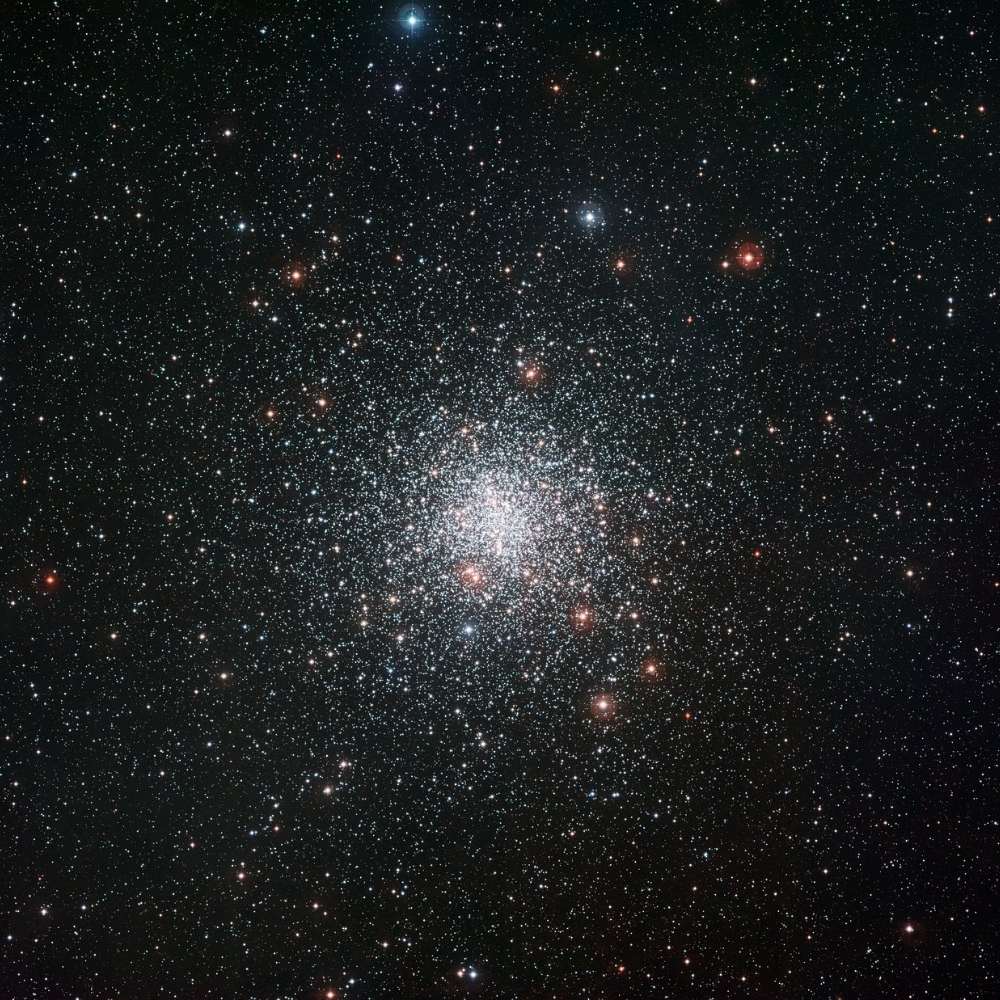
Messier 4 (M4)
The Closest Globular Cluster to Earth
Quick Reader
| Attribute | Details |
|---|---|
| Name | Messier 4 (M4) |
| Alternative Designation | NGC 6121 |
| Type | Globular Cluster |
| Constellation | Scorpius |
| Distance from Earth | ~7,200 light-years |
| Diameter | ~75 light-years |
| Apparent Magnitude | 5.6 (visible to the naked eye in dark skies) |
| Mass | ~1.2 × 10⁵ solar masses |
| Number of Stars | ~100,000 |
| Age | ~12.2 billion years |
| Metallicity | [Fe/H] ≈ –1.1 (moderately metal-poor) |
| Discovery | 1746 by Philippe Loys de Chéseaux; later catalogued by Charles Messier (1764) |
| Best Viewing Months | May to August |
| Observation Tools | Visible through binoculars; detailed studies with Hubble, Gaia, and VLT |
| Scientific Importance | Nearest globular cluster to Earth; hosts ancient white dwarfs and millisecond pulsars; provides insights into early star formation and galactic evolution |
Introduction — Our Closest Ancient Neighbor
Nestled in the bright constellation Scorpius, the Messier 4 globular cluster (M4) is a sparkling relic from the early universe — and remarkably, it’s the closest globular cluster to Earth.
At just 7,200 light-years away, it allows astronomers to study the fine details of an ancient stellar population that formed more than 12 billion years ago.
Through even a small telescope, M4 appears as a compact, misty sphere near the bright red supergiant Antares. But beneath that glow lies an extraordinary world of dense stellar evolution, where aging stars, white dwarfs, and exotic pulsars coexist in a delicate gravitational balance.
This cluster has become a cornerstone of galactic archaeology, offering unparalleled insight into how the Milky Way’s halo — and its earliest stars — came to be.
Physical Structure and Location
1. Proximity and Size
At roughly 7,200 light-years, M4 is the closest globular cluster known to our solar system — more than four times nearer than clusters like M13 or M80.
Its apparent diameter spans about 26 arcminutes, making it visible even through small telescopes or binoculars as a hazy, spherical glow.
2. Cluster Core and Density
M4 is less densely packed than clusters like M80 or M15, giving it a looser, more open structure.
Its stars are concentrated toward the center but still show individual resolution through moderate telescopes — a rare feature for a globular cluster.
3. Orbit Around the Milky Way
M4 orbits the Milky Way at a distance of ~5.9 kiloparsecs (about 19,000 light-years) from the Galactic Center.
It travels on an elongated, retrograde orbit, suggesting that it may have originated outside the Milky Way — possibly captured during the early accretion of smaller galaxies.
This unusual orbit contributes to its slightly flattened shape, caused by tidal interactions during repeated passes through the Galactic disk.
Stellar Populations — Tracing 12 Billion Years of History
1. Age and Metallicity
At ~12.2 billion years old, M4’s stars are among the oldest known in the galaxy.
Its metallicity ([Fe/H] ≈ –1.1) is higher than that of extremely metal-poor clusters like M15 (–2.3), suggesting that M4 formed after the first wave of star formation enriched the Milky Way with heavier elements.
2. White Dwarfs — The Faintest Fossils
Hubble Space Telescope observations of M4 revealed an extensive population of white dwarfs, the dead remnants of once-bright stars.
These white dwarfs serve as cosmic clocks, allowing astronomers to determine the cluster’s precise age by measuring how much they’ve cooled.
A landmark 2004 Hubble study showed that the faintest white dwarfs in M4 are 12.7 ± 0.7 billion years old — making M4 one of the oldest directly dated stellar systems in the entire universe.
3. Main Sequence and Giant Branch
The cluster’s color–magnitude diagram reveals:
A tight main sequence of long-lived, low-mass stars
A moderately populated red giant branch
A prominent horizontal branch, including both blue and red horizontal-branch stars — evidence of multiple stellar generations
These diverse stellar phases make M4 an ideal subject for testing theoretical models of stellar evolution.
Exotic Residents — Pulsars and Binary Systems
1. Millisecond Pulsars
M4 contains at least two known millisecond pulsars, including the famous PSR B1620–26 — a neutron star with one of the most unusual companions ever discovered.
Orbiting it are:
A white dwarf, and
A planet roughly 2.5 times the mass of Jupiter, making it one of the first exoplanets ever found beyond our solar system.
Nicknamed “the Genesis Planet”, it is estimated to be 13 billion years old, possibly the oldest known planet in the universe.
This discovery was groundbreaking — showing that planet formation began within the first billion years after the Big Bang.
2. Binary and Variable Stars
M4’s dense stellar environment fosters binary interactions, though it’s far less collisionally active than dense clusters like M80.
It hosts:
Numerous RR Lyrae variables, which pulsate rhythmically and serve as distance indicators
A few contact binaries, where stars share a common envelope
These variable stars help refine distance measurements and test models of mass transfer and binary evolution.
The Dust and Extinction Challenge
M4 lies in front of the bright region of the Milky Way’s bulge, close to the line of sight toward the Scorpius–Ophiuchus dark cloud complex.
As a result, its light suffers significant extinction due to interstellar dust.
Astronomers use reddening correction (E(B–V) ≈ 0.37) to account for this dimming effect when analyzing the cluster’s true brightness and color.
Infrared observations — from instruments like Spitzer and Gaia — have helped overcome these obstacles, revealing clear details of the cluster’s core and faint white dwarfs.
Comparison with Other Nearby Globular Clusters
| Cluster | Distance (ly) | Apparent Mag. | Metallicity [Fe/H] | Density | Special Feature |
|---|---|---|---|---|---|
| M4 (NGC 6121) | 7,200 | 5.6 | –1.1 | Low | Closest globular cluster; ancient white dwarfs |
| M22 (NGC 6656) | 10,400 | 5.1 | –1.7 | Moderate | Brightest in Sagittarius region |
| NGC 6397 | 7,800 | 6.7 | –2.0 | High | Nearest post-core-collapse cluster |
| M80 (NGC 6093) | 32,600 | 7.3 | –1.7 | Very High | Densest known; rich in blue stragglers |
| Omega Centauri | 15,800 | 3.7 | –1.5 (varies) | Very High | Possible remnant dwarf galaxy core |
Among them, M4 stands out for its accessibility and proximity, making it an ideal test case for high-precision photometry and parallax-based distance calibration using Gaia data.
Kinematics and Orbital Dynamics — The Motion of a Galactic Fossil
The orbit of Messier 4 (M4) around the Milky Way tells a story as ancient as the galaxy itself.
Unlike most globular clusters that follow circular orbits within the Galactic halo, M4’s trajectory is highly elongated, suggesting a complex migratory history possibly involving capture from another galactic fragment.
1. Galactic Orbit
Data from the Gaia DR3 mission reveal that:
M4 follows an eccentric, retrograde orbit, meaning it moves opposite to the general rotation of the Milky Way’s disk.
Its perigalacticon (closest approach) is about 5,000 light-years from the Galactic center,
While its apogalacticon (farthest point) extends beyond 30,000 light-years.
The full orbital period is roughly 200 million years.
Each orbit drags the cluster through the dense regions of the Galactic disk and bulge, exposing it to strong tidal forces that slowly strip away outer stars.
This long, looping path may explain M4’s loose outer halo and occasional detection of tidal tails — faint trails of escaping stars being drawn into the Milky Way’s gravitational field.
Internal Dynamics — Stability Through Ancient Balance
Despite its many encounters with the Milky Way’s gravitational tides, M4 has remained remarkably intact.
Its structure reflects billions of years of internal dynamical equilibrium, shaped by energy exchange between its stars and binaries.
1. Density and Relaxation
M4’s central density is moderate — significantly lower than dense systems like M80 or M15 — but still high enough to keep it gravitationally bound.
Because of this:
M4 has not undergone full core collapse.
It remains in a quasi-stable, relaxed state where stellar velocities and gravitational potential are balanced.
The two-body relaxation time in its core is about 400 million years, meaning it has completed dozens of relaxation cycles since its formation.
2. Mass Segregation
Like other ancient clusters, M4 has undergone mass segregation, where heavier stars and stellar remnants drift inward while lighter stars migrate outward.
This process results in:
A central population dominated by white dwarfs, neutron stars, and red giants
An outer region filled with low-mass main-sequence stars gradually escaping into the Galactic halo
This internal stratification makes M4 a textbook example of dynamical aging in a globular cluster.
The White Dwarf Cooling Sequence — Measuring Cosmic Time
Perhaps the most important scientific contribution of M4 lies in its white dwarf population.
Astronomers use these faint stellar remnants as cosmic chronometers to measure the age of the universe itself.
1. The Hubble Breakthrough
In 2004, Hubble Space Telescope observations of M4’s core detected hundreds of faint white dwarfs — the end states of stars that exhausted their nuclear fuel billions of years ago.
By measuring their luminosity function (how brightness decreases with age), researchers determined:
Age of M4’s white dwarfs: 12.7 ± 0.7 billion years
This measurement provided an independent lower limit to the age of the universe, perfectly consistent with estimates from cosmic microwave background radiation.
2. Cooling and Cluster Evolution
White dwarfs cool predictably over time.
By comparing their brightness in M4 to theoretical models, astronomers can reconstruct:
The cluster’s star formation timeline, and
The initial mass function (distribution of star masses at birth).
The results show that M4’s star formation occurred rapidly — within just a few hundred million years — and ceased completely about 12 billion years ago.
Binary Systems and Pulsars — The Dynamical Heartbeat of M4
1. Millisecond Pulsar PSR B1620–26
The most famous resident of M4 is PSR B1620–26, a millisecond pulsar in a three-body system that includes a white dwarf and a planet.
System Components:
Neutron Star: Rotates every 11 milliseconds, emitting regular radio pulses.
White Dwarf Companion: About 0.3 solar masses, orbiting the pulsar every 191 days.
Planetary Companion: Roughly 2.5 Jupiter masses, orbiting both objects every 100 years.
Nicknamed the “Genesis Planet System,” this trio is about 13 billion years old, making it older than most galaxies — and potentially the oldest planetary system known.
The discovery shattered assumptions about planet formation, proving that planetary systems existed even in the universe’s first billion years.
2. Other Exotic Binaries
In addition to the pulsar system, M4 hosts:
RR Lyrae variables, which pulsate regularly and serve as distance indicators.
Contact binaries, where two stars share a common envelope.
Detached binaries, some of which may evolve into cataclysmic variables or X-ray binaries.
These diverse systems demonstrate how binary evolution can reshape the dynamics of an entire cluster over time.
M4’s Role in Galactic Chronology
Because of its proximity and detailed observational data, M4 is a calibration anchor for numerous astronomical measurements:
Distance Scale: RR Lyrae stars and parallax data from Gaia refine absolute distance estimates to <1% accuracy.
Cluster Age Scale: White dwarf cooling ages serve as benchmarks for all globular cluster age determinations.
Galactic Model Calibration: M4’s motion and metallicity provide constraints for models of the Milky Way’s gravitational potential and halo evolution.
Thus, M4 is not just a nearby cluster — it is a reference point for the cosmic clock, helping to synchronize our understanding of the universe’s timeline.
Interaction with the Milky Way Disk
As M4 passes through the Milky Way’s disk approximately every 100–120 million years, it endures tidal shocks that heat and disturb its outer layers.
However, its relatively low density prevents catastrophic disruption.
These periodic crossings:
Remove stars from the periphery,
Create diffuse stellar halos, and
Possibly trigger stellar collisions and binary formation in the core through gravitational perturbations.
These cyclical interactions explain why M4 remains dynamically active — despite being one of the most ancient clusters known.
Comparison — M4 and Other Halo Relics
| Cluster | Distance (ly) | Age (Gyr) | Metallicity [Fe/H] | Core State | Special Feature |
|---|---|---|---|---|---|
| M4 (NGC 6121) | 7,200 | 12.2 | –1.1 | Stable | Nearest cluster; white dwarf age dating |
| M80 (NGC 6093) | 32,600 | 12.5 | –1.7 | Post-collapse | High blue-straggler density |
| NGC 6397 | 7,800 | 13.4 | –2.0 | Collapsed | Nearest dense core-collapse cluster |
| 47 Tucanae (NGC 104) | 15,000 | 11.8 | –0.7 | Stable | Rich in pulsars and X-ray binaries |
| Omega Centauri (NGC 5139) | 15,800 | 12.0 | –1.5 | Extended | Possible remnant dwarf galaxy nucleus |
M4’s combination of proximity, stability, and stellar diversity makes it a key reference point among these ancient systems.
M4 as a Key to Cosmic History
Because Messier 4 (M4) lies only about 7,200 light-years away, it serves as a time capsule of the early universe.
Its age, metallicity, and stellar composition show how the Milky Way’s first generations of stars formed, aged, and recycled matter into later populations.
1. Chemical Traces of the First Stars
Spectroscopic studies from the VLT and Keck Observatory show that M4’s stars contain small but measurable amounts of oxygen, magnesium, and silicon.
These elements—products of Type II supernovae—indicate that M4’s gas was enriched by the very first massive stars.
By comparing these abundances with those of halo field stars, astronomers confirm that M4 formed within the first billion years after the Big Bang.
2. Building the Milky Way Halo
M4’s orbit and metallicity suggest that it belongs to the inner halo population.
It may have originated inside one of the Milky Way’s earliest protogalactic fragments that later merged to form the main halo.
This makes M4 a surviving relic of the galactic building-block era, when small clusters and dwarf galaxies coalesced into the Milky Way.
Planetary Systems and Early Cosmic Environments
The discovery of the 13-billion-year-old planet orbiting pulsar PSR B1620–26 demonstrates that planets can form even in metal-poor environments.
This challenges the long-held idea that heavy elements are required for planet formation.
It implies that planetary systems—and potentially habitable worlds—could have existed when the universe was still young and primitive.
Such findings link M4 not only to stellar evolution but also to the origins of planetary systems across cosmic time.
Future Evolution — The Fate of M4
1. Tidal Dissolution
Each time M4 crosses the Galactic disk, the Milky Way’s gravity strips a few more stars from its outer regions.
Over billions of years this process will:
Stretch M4 into tidal tails, and
Gradually mix its stars into the halo background.
Simulations predict that in about 6–8 billion years, M4 may lose enough mass to disintegrate completely—its remnants becoming part of the diffuse stellar halo.
2. End-State Composition
As massive stars die, the cluster’s population will become dominated by:
White dwarfs cooling silently in the dark,
A few neutron stars and millisecond pulsars, and
Long-lived red dwarfs orbiting at the outskirts.
Even when invisible to the naked eye, M4’s stellar fossils will continue orbiting the Milky Way, silently preserving the memory of its ancient origins.
Scientific Legacy
1. A Benchmark for Stellar Ages
M4’s white-dwarf sequence remains one of the most accurate stellar clocks ever measured.
Its results have been used to calibrate:
The ages of other globular clusters,
The timeline of the Milky Way, and
The cosmic age scale itself, confirming that the universe is about 13.8 billion years old.
2. A Laboratory for Long-Term Evolution
Because M4 is nearby, it provides astronomers with a chance to resolve individual stars across every stage of evolution—from hydrogen-burning dwarfs to cooling remnants—using Hubble, Gaia, and JWST.
It serves as the standard reference cluster for testing stellar models and the physics of dense stellar systems.
Comparison — M4 and Other Local Ancient Clusters
| Cluster | Distance (ly) | Age (Gyr) | Metallicity [Fe/H] | Key Discovery |
|---|---|---|---|---|
| M4 (NGC 6121) | 7,200 | 12.2 | –1.1 | Oldest known planetary system (PSR B1620–26) |
| NGC 6397 | 7,800 | 13.4 | –2.0 | Nearest core-collapse cluster |
| 47 Tucanae | 15,000 | 11.8 | –0.7 | Dense pulsar population |
| M22 (NGC 6656) | 10,400 | 12.0 | –1.7 | Multiple stellar populations |
| M80 (NGC 6093) | 32,600 | 12.5 | –1.7 | Extremely dense core; nova 1860 |
Among these, M4 is unmatched in proximity and detail, making it the most thoroughly examined fossil cluster of the Milky Way.
Frequently Asked Questions (FAQ)
Q1: Why is M4 important?
Because it’s the closest and one of the oldest globular clusters, M4 acts as a benchmark for studying stellar evolution, distance scaling, and the age of the universe.
Q2: How can I observe M4?
Look near Antares in the constellation Scorpius; in dark skies, it appears as a faint misty spot even with binoculars.
Q3: Does M4 still form new stars?
No. Star formation ended billions of years ago; all gas has been expelled by supernova winds.
Q4: What is PSR B1620–26?
A triple system inside M4 consisting of a millisecond pulsar, a white dwarf, and an ancient planet—sometimes called the “Genesis Planet.”
Q5: Will M4 ever merge with the Milky Way?
In a sense, yes. Over time its stars will drift into the Galactic halo, merging gravitationally but losing their clustered identity.
Related Objects and Further Reading
M80 (NGC 6093): A nearby dense cluster rich in blue stragglers.
NGC 6397: Another nearby globular cluster, slightly older and denser.
47 Tucanae: Bright southern globular cluster packed with pulsars.
Omega Centauri: The largest globular cluster, possibly a former dwarf-galaxy core.
Sagittarius Dwarf Galaxy: A disrupted satellite supplying similar ancient clusters to the halo.
Final Thoughts
Messier 4 is far more than a glittering patch beside Antares—it is a living relic of cosmic history.
Its stars were already ancient when the Sun was born, and within its faint glow lie answers to questions about the age of the universe, the formation of planets, and the evolution of the Milky Way itself.
As astronomers continue to probe its depths with Gaia and JWST, M4 will remain a guiding reference—proof that even in the quiet outskirts of the night sky, the earliest chapters of creation still shine.