









New Horizons
Humanity’s First Mission to Pluto and the Kuiper Belt
Quick Reader
| Attribute | Details |
|---|---|
| Name | New Horizons |
| Mission Type | Planetary flyby → Kuiper Belt exploration |
| Launch Date | January 19, 2006 |
| Launch Site | Cape Canaveral, Florida |
| Operator | NASA / Johns Hopkins APL |
| Primary Target | Pluto system |
| Pluto Flyby | July 14, 2015 |
| Secondary Target | Arrokoth (2014 MU69) |
| Arrokoth Flyby | January 1, 2019 |
| Current Status | Active (extended Kuiper Belt mission) |
| Power Source | Radioisotope Thermoelectric Generator (RTG) |
| Historic First | First close-up study of Pluto and Kuiper Belt object |
Introduction – The Mission That Changed Pluto Forever
For decades, Pluto was little more than a blurry dot at the edge of the Solar System. Astronomers debated its status, speculated about its surface, and argued over its classification—but no spacecraft had ever visited it.
That changed with New Horizons.
Launched in 2006, New Horizons was designed to do something no mission had attempted before: reach Pluto in less than a decade, fly past it at incredible speed, and then continue onward into the Kuiper Belt to explore the Solar System’s most ancient remnants.
When New Horizons finally reached Pluto in 2015, it didn’t just answer questions—it rewrote the textbooks.
Why New Horizons Was Necessary
Before New Horizons, Pluto was known primarily through:
Telescope observations
Light curves and occultations
Indirect measurements
Key unknowns included:
Surface composition
Geological activity
Atmospheric structure
Moon system complexity
Pluto’s demotion to dwarf planet status in 2006 made the mission even more important—not less. Scientists needed real data to understand whether Pluto was truly just another icy remnant or a complex world in its own right.
New Horizons was built to deliver that truth.
Mission Design – Speed Above All Else
Reaching Pluto quickly was the central challenge.
Pluto is extremely distant:
~30–50 AU from the Sun
Orbital period: 248 years
To reach it within a reasonable timeframe, New Horizons was engineered for maximum speed.
Launch Achievements
Fastest spacecraft ever launched from Earth
Achieved Earth-escape velocity in under 9 hours
Reached the Moon’s orbit in just 9 hours
This speed came at a cost: New Horizons could not slow down. It would have only one chance to collect data during a high-speed flyby.
Gravity Assist at Jupiter – A Critical Boost
In 2007, New Horizons performed a gravity assist flyby of Jupiter.
This maneuver:
Increased its speed by ~4 km/s
Shortened the travel time to Pluto
Provided an opportunity to test instruments
Bonus Science at Jupiter
Studied Jupiter’s atmosphere
Observed volcanic activity on Io
Analyzed Jupiter’s magnetosphere
This flyby validated the spacecraft’s systems and provided valuable planetary science along the way.
The Spacecraft – Compact, Tough, and Efficient
New Horizons was built to survive:
Extreme cold
Weak sunlight
Long communication delays
Key Design Features
RTG power source
Redundant systems
Radiation-hardened electronics
Autonomous fault protection
Despite its small size, New Horizons carried seven sophisticated scientific instruments, optimized for rapid data collection.
Scientific Payload – Seeing the Unseen
New Horizons’ instruments were carefully selected to maximize scientific return during a brief encounter.
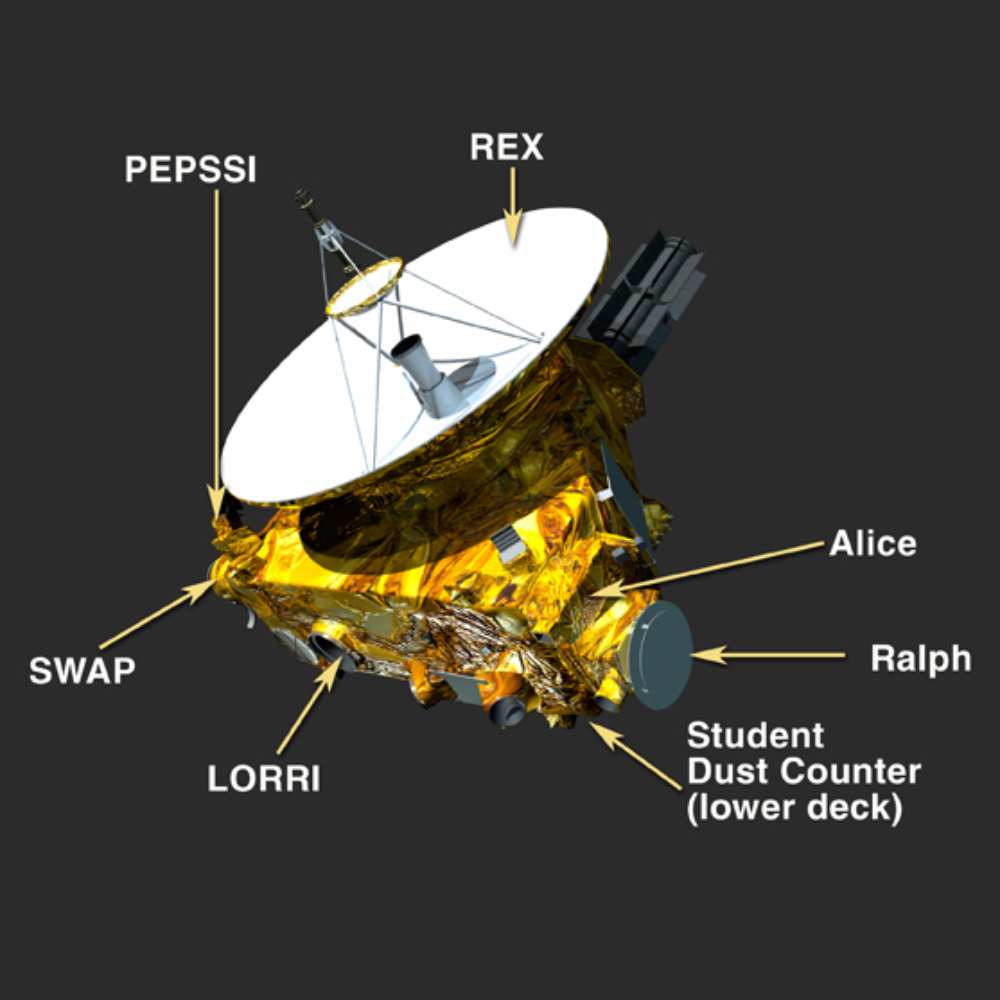
Key Instruments
LORRI – High-resolution imaging
Ralph – Color imaging and spectroscopy
Alice – Ultraviolet spectrometer
REX – Radio science experiment
SWAP – Solar wind analyzer
PEPSSI – Energetic particle detector
SDC – Student-built dust counter
Together, these instruments allowed New Horizons to study geology, chemistry, atmosphere, and space environment in unprecedented detail.
Approaching Pluto – A Countdown Decades in the Making
As New Horizons closed in on Pluto in early 2015, anticipation grew worldwide.
Key moments included:
Detection of Pluto’s atmosphere
Discovery of haze layers
Identification of complex surface features
Even before closest approach, it was clear that Pluto was far more active and complex than expected.
Why New Horizons Matters Before Pluto
Even before reaching its main target, New Horizons had already achieved something remarkable:
Proved fast, long-distance missions are possible
Demonstrated sustained operations in deep space
Paved the way for future Kuiper Belt exploration
But Pluto would soon elevate the mission from impressive to historic.
The Pluto Flyby – July 14, 2015
On July 14, 2015, New Horizons made its closest approach to Pluto at a distance of about 12,500 km. Traveling at roughly 14 km/s, the spacecraft had only a few hours to collect the majority of its data.
There would be no second pass.
During this brief window, New Horizons transformed Pluto from a distant point of light into a richly detailed world with mountains, plains, glaciers, and an atmosphere.
Pluto Revealed – A Geologically Active World
Before the flyby, most scientists expected Pluto to be cold, inert, and heavily cratered. What New Horizons found was the opposite.
Sputnik Planitia – The Heart of Pluto
One of the most striking discoveries was Sputnik Planitia, a vast, heart-shaped basin filled with nitrogen, carbon monoxide, and methane ice.
Key features:
Size comparable to Texas
Surface age less than 10 million years
Actively resurfaced by ice convection
This region showed that Pluto is geologically active today, despite its small size and distance from the Sun.
Mountains Made of Ice
New Horizons discovered mountain ranges rising 3–4 km high.
These mountains are composed primarily of water ice, which behaves like rock at Pluto’s frigid temperatures.
Implications:
Pluto has a strong, rigid crust
Internal structure supports significant topography
Geological processes persisted long after formation
Such features were completely unexpected on a dwarf planet.
Evidence for a Subsurface Ocean
Several lines of evidence suggest Pluto may harbor a subsurface ocean beneath its icy crust.
Supporting clues include:
Sputnik Planitia’s position near Pluto’s tidal axis
Lack of compressional features around the basin
Long-term geological activity
If confirmed, this would make Pluto one of the most distant known ocean worlds.
Pluto’s Atmosphere – Thin but Complex
New Horizons found that Pluto possesses a layered, hazy atmosphere extending hundreds of kilometers above the surface.
Atmospheric composition:
Nitrogen (dominant)
Methane
Carbon monoxide
Key discoveries:
Blue atmospheric haze caused by photochemical reactions
Temperature structure colder than expected
Atmosphere actively escaping into space
Pluto’s atmosphere behaves more like a living system than a static gas envelope.
The Pluto Moon System – More Than Charon
Before New Horizons, Pluto was known to have five moons. The flyby revealed their diversity in unprecedented detail.
Charon – A World of Its Own
Charon is half the size of Pluto and forms a binary system.
Discoveries include:
Vast canyons and tectonic fractures
Evidence of ancient cryovolcanism
Water-ice–dominated surface
Charon’s features suggest a dramatic internal history, possibly involving a subsurface ocean in the past.
Small Moons – Chaos and Rotation
The smaller moons—Styx, Nix, Kerberos, and Hydra—were found to be:
Highly irregular in shape
Rapidly rotating
Chaotically tumbling
These moons challenge classical models of satellite formation and dynamics.
Why Pluto Changed Planetary Science
The Pluto flyby forced a fundamental reassessment of small planetary bodies.
New Horizons showed that:
Size does not determine complexity
Dwarf planets can be geologically active
Atmospheres can exist far from the Sun
Kuiper Belt objects are diverse and dynamic
Pluto emerged not as a leftover relic, but as a complex planetary world.
Data Return – Patience Required
Because of extreme distance and low data rates, New Horizons took over 16 months to transmit all Pluto data back to Earth.
Data rate:
~1–2 kbps
Signal travel time: ~4.5 hours one way
This slow return required meticulous planning and patience—but the scientific payoff was immense.
Preparing for the Kuiper Belt
Even before Pluto data finished downloading, New Horizons set its sights on a new target.
Mission planners selected a small Kuiper Belt object—2014 MU69, later named Arrokoth—for a second historic encounter.
This would allow scientists to study a primordial object untouched since the Solar System’s formation.
Arrokoth – A Pristine Relic from the Solar System’s Birth
On January 1, 2019, New Horizons completed its second historic flyby, passing a small Kuiper Belt object known at the time as 2014 MU69, later officially named Arrokoth.
This encounter was even more extraordinary than Pluto—not because Arrokoth is large or active, but because it is ancient and untouched.
Why Arrokoth Matters
Distance from Sun: ~44 AU
Size: ~36 km long
Shape: Contact binary (“snowman-like”)
Surface age: ~4.5 billion years
Arrokoth is one of the most primitive objects ever explored, preserving conditions from the earliest days of planetary formation.
A Gentle Birth, Not a Violent One
Arrokoth’s shape revealed a critical insight into how planets form.
Key observations:
Two lobes gently fused together
No signs of high-energy collision
Extremely smooth merger boundary
This indicates that Arrokoth formed through low-velocity accretion, not catastrophic impacts.
This finding directly supports modern models in which:
Dust and pebbles slowly clump together
Planetesimals grow gently
Early Solar System formation was calm in some regions
Arrokoth showed us what planets looked like before collisions reshaped them.
Color, Composition, and Chemistry
Arrokoth’s surface is:
Deep red in color
Rich in complex organic compounds
Coated with radiation-processed materials (tholins)
This chemistry suggests that the building blocks of life were present in the outer Solar System from the very beginning.
Arrokoth is not alive—but it preserves the chemical inventory that later contributed to planetary systems.
New Horizons Today – Still Exploring
As of now, New Horizons continues to operate in the Kuiper Belt, far beyond Pluto.
Current Mission Goals
Measure dust density in the outer Solar System
Study the solar wind at extreme distances
Observe distant Kuiper Belt objects remotely
Map the heliosphere from a unique vantage point
New Horizons is the farthest active spacecraft after Voyager 1 and 2.
How Long Will New Horizons Keep Operating?
Powered by an RTG, New Horizons has a finite lifespan.
Expected timeline:
Full operations into the late 2020s
Reduced operations into the early 2030s
Eventual silence due to power loss
Even after contact ends, New Horizons will continue drifting through the Kuiper Belt—an enduring artifact of exploration.
Frequently Asked Questions (FAQ)
Is New Horizons still active?
Yes. It remains operational and continues collecting data from the Kuiper Belt.
Why didn’t New Horizons orbit Pluto?
It was traveling too fast to slow down. The mission was designed as a flyby to reach Pluto quickly.
Is Pluto still a planet?
Pluto is classified as a dwarf planet, but New Horizons showed it is a complex planetary world.
Will New Horizons visit another object?
No confirmed targets remain, but distant observations may continue.
Is New Horizons the farthest spacecraft?
No. Voyager 1 and 2 are farther, but New Horizons is the most recent deep-space explorer.
New Horizons’ Legacy in Planetary Science
New Horizons fundamentally changed how we understand the outer Solar System.
It proved that:
Dwarf planets can be geologically alive
Kuiper Belt objects are diverse
Planet formation can be gentle, not violent
Exploration beyond Neptune is both possible and transformative
It turned abstract theory into direct observation.
Related Topics for Universe Map
Pluto
Charon
Kuiper Belt
Arrokoth (2014 MU69)
Dwarf Planets
Voyager Missions
Pioneer Missions
Together, these topics form the narrative of humanity’s expansion into the Solar System’s frontier.
Final Perspective
New Horizons was not just a mission to Pluto—it was a mission to the beginning of the Solar System.
By revealing Pluto’s living geology and Arrokoth’s primordial structure, New Horizons connected the Solar System’s past and present in a single journey.
It showed us that even at the edge of the Sun’s domain, worlds are complex, histories are deep, and discovery is far from over.
New Horizons did exactly what its name promised—it gave humanity a new horizon.