




NGC 1300
The Grand Design Barred Spiral Galaxy
Quick Reader
| Attribute | Details |
|---|---|
| Name | NGC 1300 |
| Type | Barred Spiral Galaxy (SB(s)bc) |
| Constellation | Eridanus |
| Distance from Earth | ~61–70 million light-years |
| Apparent Magnitude | ~11.4 |
| Diameter | ~110,000 light-years (comparable to Milky Way) |
| Discovered By | John Frederick William Herschel, 1835 |
| Notable Feature | Grand-design spiral structure with a spectacular central bar and nuclear ring |
| Cluster/Group Membership | Part of the Eridanus Cluster |
| Orientation | Nearly face-on |
| Star Formation Activity | Moderate, concentrated in arms and central ring |
| Supermassive Black Hole | Estimated several million solar masses (central nucleus) |
| Best Viewing Time | December–February (Eridanus high in the sky) |
| Telescope Requirement | Medium to large amateur telescopes; Hubble images show full structure |
Introduction — A Perfect Example of Galactic Symmetry
Among all the barred spiral galaxies ever observed, NGC 1300 stands out as one of the most elegant and structurally perfect.
Located roughly 61 million light-years away in the constellation Eridanus, this galaxy exemplifies what astronomers call a “grand-design spiral” — a galaxy whose arms are not fragmented or chaotic, but beautifully organized, symmetric, and sweeping.
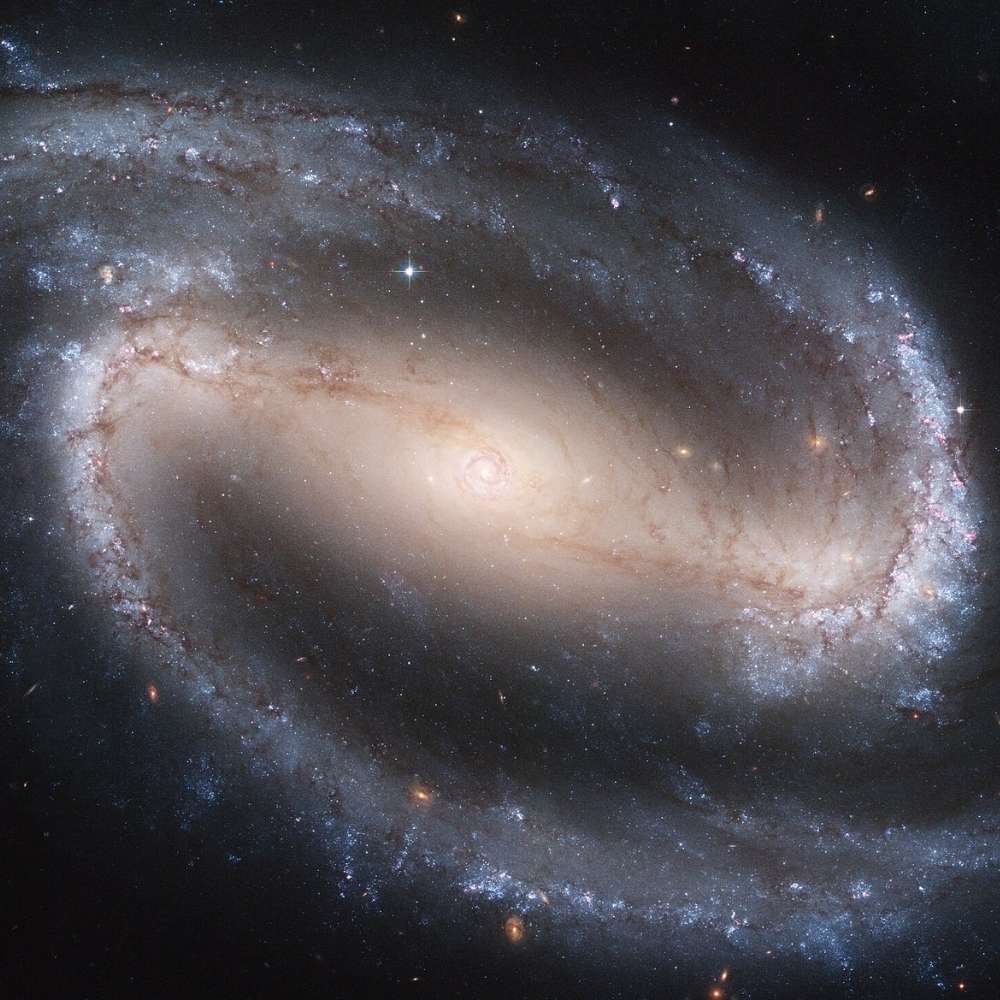
When the Hubble Space Telescope captured its iconic image in the early 2000s, NGC 1300 quickly became a reference point for how textbook spiral galaxies look in reality — detailed arms, dark dust lanes, blue clusters of newborn stars, and a golden bulge glowing at the core.
But what makes NGC 1300 extraordinary is not only its beauty — it’s also its complex bar-driven dynamics, its miniature spiral system at the nucleus, and its importance in understanding how spiral arms form and evolve in galaxies like our Milky Way.
The Bar and the Arms — Engines of Galactic Motion
At the heart of NGC 1300 lies a massive stellar bar, stretching nearly 20,000 light-years across the center. This bar acts as a gravitational engine, funneling gas inward toward the nucleus and driving the galaxy’s internal evolution.
The Central Bar
Made of densely packed old stars.
Rotates as a rigid structure, influencing the motion of gas and stars throughout the disk.
Plays a crucial role in redistributing angular momentum, leading to spiral arm formation and central gas inflow.
The Spiral Arms
Two major arms emerge cleanly from the ends of the bar, wrapping gracefully around the core.
Composed of bright young blue stars, glowing H II regions, and dark dust lanes tracing density waves.
Each arm is nearly mirror-symmetric — a hallmark of “grand design” galaxies, in contrast to flocculent (patchy) spirals.
The Nucleus — A Galaxy Within a Galaxy
Perhaps the most fascinating feature of NGC 1300 is its nuclear region.
High-resolution Hubble Space Telescope images revealed that the inner region of the bar harbors a miniature spiral pattern — essentially, a small spiral galaxy structure nested inside the main one.
This nuclear spiral spans only a few thousand light-years and is believed to channel interstellar gas toward the galaxy’s central supermassive black hole.
It provides direct visual evidence that barred galaxies can feed their black holes by guiding gas along nested spiral arms.
Scientists suspect this mechanism may also explain active galactic nuclei (AGN) fueling in other galaxies — even though NGC 1300 itself currently shows no strong AGN activity.
Color and Composition — A Story Written in Light
Like many grand spirals, NGC 1300 tells its evolutionary story through color:
Blue arms — rich in O- and B-type stars, representing ongoing star formation.
Dark brown dust lanes — dense molecular gas where new stars are born.
Golden central bulge — older stellar population, rich in metal content.
Infrared imaging confirms strong dust emission, while ultraviolet data highlights young star clusters tracing the arm structure.
Spectroscopy further indicates abundant ionized gas in the arms, while the nucleus shows only mild emission lines — consistent with a low-activity or dormant black hole.
Galactic Environment — Member of the Eridanus Cluster
NGC 1300 resides within the Eridanus Cluster, a loose but significant assembly of galaxies located roughly 60–70 million light-years away.
This cluster is home to hundreds of galaxies, spanning various types — ellipticals, lenticulars, and spirals — each interacting weakly through gravitational tides.
While NGC 1300 is not currently interacting strongly with any nearby neighbor, its environment still exerts subtle gravitational influences that may maintain the bar and spiral structure over long timescales.
Its position in the southern sky, near the celestial equator, also makes it a prime target for both northern and southern hemisphere telescopes, adding to its fame among astrophotographers and professional observatories alike.
Observing NGC 1300 — From Earth to Hubble
NGC 1300’s nearly face-on orientation gives astronomers a clear view of its intricate pattern.
However, at magnitude 11.4, it’s just beyond naked-eye visibility.
Amateur Observation Tips
Telescope: 6–10 inch or larger aperture recommended.
Sky Conditions: Dark rural skies required.
Appearance: Faint oval patch with hints of spiral structure in large amateur telescopes.
Professional Observation
Hubble’s WFPC2 (Wide Field Planetary Camera 2) captured its detailed image in multiple filters, revealing fine dust filaments, stellar populations, and the nuclear spiral.
Radio and infrared surveys have mapped gas and dust distribution, confirming the bar’s influence on gas flow.
Bar Dynamics — The Heartbeat of NGC 1300
The defining feature of NGC 1300 is its spectacular central bar, a stellar bridge that extends across the galactic nucleus and connects directly to the spiral arms.
This bar isn’t merely decorative — it’s a dynamical engine that shapes the entire galaxy’s evolution.
How the Bar Controls Motion
Bars form when instabilities in a rotating disk cause stars and gas to realign into elongated orbits.
In NGC 1300, the bar’s gravity dominates the inner regions, creating resonances — zones where orbital periods of stars and gas align in harmonic ratios with the bar’s rotation.
Inner Lindblad Resonance (ILR): Traps gas near the nucleus and gives rise to the nuclear spiral seen in Hubble images.
Corotation Resonance: The point where the bar’s pattern speed matches the orbital speed of stars and gas — shaping where spiral arms begin.
Outer Lindblad Resonance (OLR): Marks the boundary where spiral density waves fade.
Through these resonances, the bar acts as a cosmic conveyor belt, funneling gas inward, compressing it, and triggering waves of star formation.
The Nuclear Spiral — A Galaxy Within a Galaxy
At the very heart of NGC 1300, astronomers discovered a miniature spiral structure less than 3,000 light-years across — one of the most famous examples of a nuclear spiral in any galaxy.
High-resolution Hubble images show two faint, tightly wound spiral arms encircling a dusty nucleus.
This tiny spiral likely traces gas streaming toward a central supermassive black hole, providing a nearby laboratory for AGN fueling mechanisms.
Key Insights from the Nuclear Spiral
Scale Connection: The large-scale bar drives gas inward, while the small spiral channels it further down to the galactic core.
Black Hole Feeding: Even if the black hole is currently dormant, this inward flow shows how galaxies prepare for AGN phases.
Feedback Loop: Once the black hole ignites, energetic feedback can heat or expel gas — temporarily halting further accretion.
Thus, NGC 1300 demonstrates both the feeding and regulation processes that govern galactic centers.
Star Formation — Life Along the Arms
Starburst Pockets and Dusty Ribbons
NGC 1300’s spiral arms sparkle with young, blue stars, revealing active star-forming regions (H II regions).
Dense dust lanes, tracing the spiral shocks, mark where interstellar gas clouds are compressed — a prelude to stellar birth.
Spectral imaging in Hα, infrared, and ultraviolet reveals:
Hot, massive stars (young clusters) along the inner ridges of the arms.
Cold dust concentrated in the bar and leading edges of the arms.
Ionized gas shells expanding from clusters only a few million years old.
While not as extreme as a starburst galaxy, NGC 1300 maintains a steady, self-regulating rate of star formation — balancing gas inflow and consumption.
Stellar Populations and Color Gradient
The color variation across NGC 1300 gives clues to its history:
| Region | Dominant Color | Stellar Population | Approximate Age |
|---|---|---|---|
| Central Bulge | Golden-yellow | Old, metal-rich stars | >5 billion years |
| Bar | Slightly yellow, dust-mixed | Intermediate-age stars | 1–5 billion years |
| Spiral Arms | Blue with dark lanes | Young, hot stars + star-forming regions | <100 million years |
| Outskirts | Faint blue | Older disk stars, declining gas density | — |
This color gradient reflects inside-out galaxy growth, where older stars dominate the center, and new stars form progressively farther out.
Gas, Dust, and Hidden Mass — The Dark Side of NGC 1300
Even in its luminous beauty, most of NGC 1300’s mass is invisible.
Radio and infrared surveys reveal large reservoirs of neutral hydrogen (H I) and molecular gas (CO) distributed through the disk — the raw material for future star formation.
However, when astronomers calculate the galaxy’s rotation curve, they find it remains flat far beyond the visible disk — clear evidence of a dark matter halo enclosing the entire system.
Observational Summary
HI Mapping: Disk rotation extends beyond the visible spiral arms.
CO Mapping: Dense molecular clumps align with bar and arm structures.
Mass Distribution: Visible matter explains only ~15% of total gravitational pull.
This dark matter halo stabilizes the disk, allowing the graceful spiral pattern to persist for hundreds of millions of years without disruption.
NGC 1300 vs. the Milky Way
| Feature | NGC 1300 | Milky Way |
|---|---|---|
| Type | Barred Spiral (SBbc) | Barred Spiral (SBbc) |
| Diameter | ~110,000 ly | ~105,000 ly |
| Bar Length | ~20,000 ly | ~27,000 ly |
| Distance from Earth | 61–70 million ly | — (we live inside it) |
| Star Formation | Moderate, symmetric | Moderate, patchy |
| Nuclear Activity | Dormant | Mild (Sagittarius A*) |
| Orientation | Face-on | Edge-on (from our view) |
The resemblance is striking: both galaxies share similar classifications and structures, yet NGC 1300’s face-on orientation gives us the external perspective we’ll never have of our own galaxy.
Gravitational Harmony — A Stable Cosmic Dance
Despite its complex bar and active star formation, NGC 1300 appears dynamically stable.
Simulations show that its bar-driven density waves maintain coherence for hundreds of millions of years — neither collapsing nor winding up completely.
This balance between gravitational torque, dark matter support, and gas feedback allows the galaxy to retain its shape — a textbook demonstration of long-term spiral stability.
The Central Black Hole — Quiet Power in a Grand Design
At the heart of NGC 1300, beyond the glowing nuclear spiral and golden bulge, lies a supermassive black hole (SMBH).
Unlike the violent quasars of the distant universe, this black hole is currently dormant — no strong jets, no blazing accretion disk — yet its gravitational influence silently shapes the entire nucleus.
Evidence from Observations
Hubble Space Telescope spectroscopy (STIS) measured the rotation of ionized gas near the nucleus, suggesting a central mass of a few million solar masses.
The observed gas velocities match models of a supermassive black hole embedded within a rotating disk of dust and gas.
Infrared data reveal faint dust heating, possibly from residual accretion or star formation in the inner 500 light-years.
Why It Matters
NGC 1300’s black hole represents a key evolutionary stage — a massive but inactive nucleus that may have once been active millions of years ago.
Studying such systems helps astronomers connect the dots between active galactic nuclei (AGN) and quiescent galaxies like our Milky Way.
In other words, NGC 1300 offers a glimpse into how galactic centers evolve after their active phase ends — when the black hole sleeps, but the galaxy keeps turning.
Role Within the Eridanus Cluster
NGC 1300 resides within the Eridanus Cluster, a loose group of several hundred galaxies spanning nearly 10 million light-years.
Unlike dense clusters such as Virgo or Coma, Eridanus is dynamically young — its members are still slowly assembling through gravity.
Environmental Influence
Low-density environment: Fewer interactions, preserving NGC 1300’s clean spiral arms.
Weak tidal forces: Allow long-term bar stability.
Intragroup gas: Provides minimal stripping; star formation remains undisturbed.
Thus, NGC 1300’s environment acts as a cosmic cradle, allowing the galaxy’s symmetric beauty to survive for billions of years without major mergers or disruptions.
Galactic Evolution — Lessons from NGC 1300
NGC 1300 stands as one of the clearest demonstrations of how structure, motion, and gravity work together to build order out of chaos.
Its bar drives inward flow, its spiral arms create ongoing star formation, and its dormant core awaits future ignition.
From this balance, astronomers learn how galaxies evolve from gas-rich, dynamic systems to mature, structured spirals with calm centers and aging stellar populations.
Key Takeaways
Bars shape destiny: They regulate gas flow, star formation, and central mass growth.
Spiral density waves endure: They are not transient — they can persist for cosmic timescales.
Black holes evolve quietly: Even inactive, they anchor galactic structure.
Environment matters: Isolation can preserve form; collisions can destroy it.
Frequently Asked Questions (FAQ)
Q1: Why is NGC 1300 called a “grand design” spiral?
Because its spiral arms are continuous, symmetric, and well-defined — not fragmented or irregular. This level of symmetry is rare among spiral galaxies and demonstrates the steady influence of bar-driven density waves.
Q2: How far away is NGC 1300?
Approximately 61–70 million light-years away, within the Eridanus Cluster. The exact value depends on the distance scale used for the cluster.
Q3: Does NGC 1300 have a black hole like the Milky Way?
Yes. Observations confirm the presence of a supermassive black hole in its core, likely containing several million solar masses — similar in scale to Sagittarius A* at our Galaxy’s center.
Q4: Can amateur astronomers see NGC 1300?
Yes, with large telescopes (8–10 inches or more) under dark skies. It appears as a faint oval patch, but the detailed spiral pattern is only visible in long-exposure astrophotography or professional images.
Q5: What makes NGC 1300 special among barred spirals?
Its perfect symmetry, its visible nuclear spiral (a “galaxy within a galaxy”), and its face-on orientation make it one of the most photogenic and scientifically valuable barred spirals in the nearby universe.
Related Objects and Further Reading
NGC 1365 — Another grand barred spiral with an active nucleus.
NGC 3351 (M95) — Smaller barred spiral showing similar inner-ring structure.
Milky Way — Our own barred spiral, seen edge-on from within.
Eridanus Cluster — The larger galactic neighborhood that hosts NGC 1300.
Final Thoughts
NGC 1300 represents a cosmic ideal — a galaxy where structure and symmetry reach near perfection.
From its sweeping arms to its quiet nucleus, it embodies the harmony between gravity, motion, and time.
While other galaxies collide, distort, or fade, NGC 1300 reminds us that the universe is capable of creating order as well as chaos.
Every image of this galaxy — whether from Hubble or a small telescope — reveals not only stellar beauty but the mathematical rhythm of cosmic evolution itself.