









NGC 2419
The Intergalactic Wanderer of the Milky Way Halo
Quick Reader
| Attribute | Details |
|---|---|
| Name | NGC 2419 (The Intergalactic Wanderer) |
| Object Type | Globular Cluster |
| Constellation | Lynx |
| Distance from Earth | ~300,000 light-years |
| Apparent Magnitude | 9.0 |
| Diameter | ~260 light-years |
| Absolute Magnitude | –9.4 |
| Discovered By | William Herschel, 1788 |
| Host Galaxy | Milky Way (outer halo) |
| Galactocentric Distance | ~275,000 light-years from Galactic Center |
| Metallicity ([Fe/H]) | –2.1 (metal-poor, ancient population) |
| Estimated Age | ~12.3 billion years |
| Mass | ~900,000 M☉ |
| Nickname | “Intergalactic Wanderer” (appears far outside the Milky Way’s main body) |
| Best Viewing Time | December–March (Northern Hemisphere) |
| Telescope Requirement | 8-inch or larger for core resolution |
Introduction — The Star Cluster That Lives on the Edge
In the quiet constellation of Lynx, far beyond the familiar star clouds of our Galaxy, lies one of the most remote members of the Milky Way — NGC 2419, the “Intergalactic Wanderer.”
At nearly 300,000 light-years away, it sits farther out than almost any other known globular cluster.
For decades, astronomers believed it might not even belong to the Milky Way — that it was perhaps a rogue cluster drifting between galaxies.
Although we now know it is gravitationally bound to our Galaxy, its extreme distance and isolation still make it a cosmic loner — a fossil relic from the universe’s earliest days.
What Is NGC 2419?
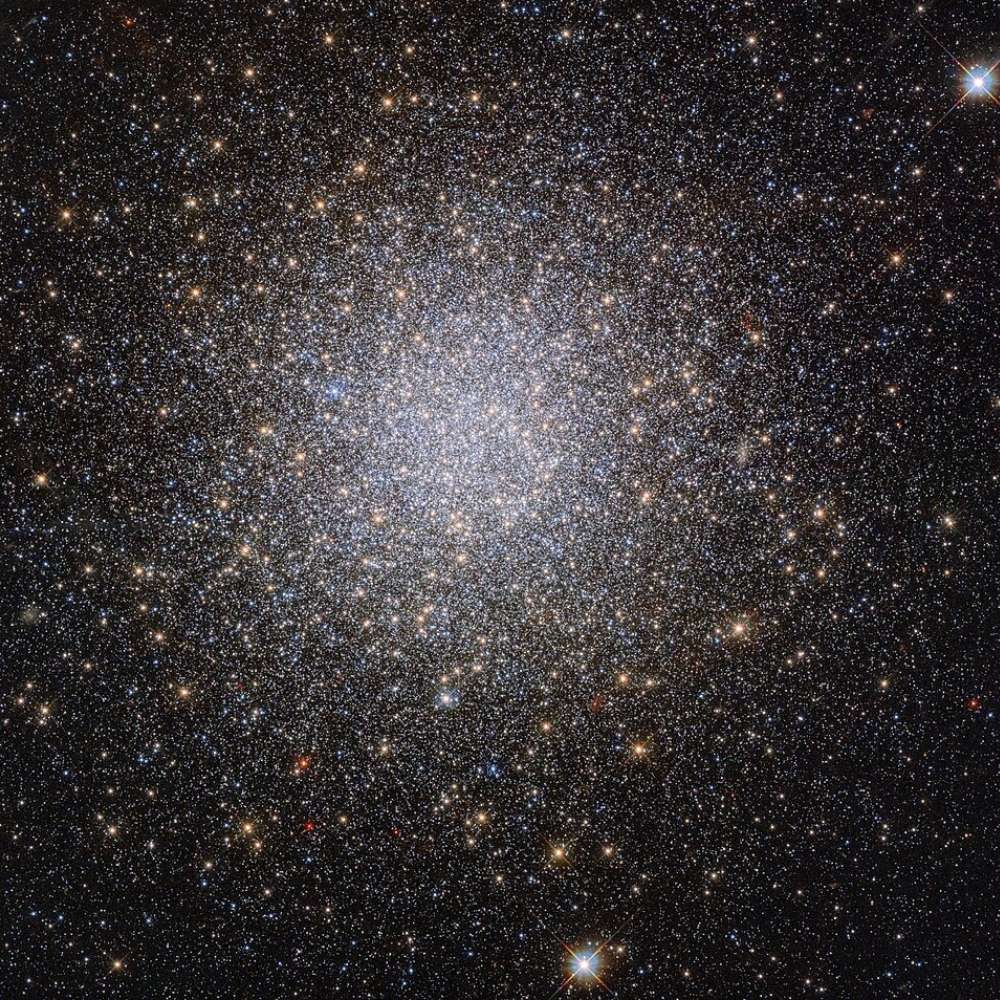
NGC 2419 is a globular cluster — a densely packed spherical collection of ancient stars orbiting the Milky Way’s outskirts.
Unlike open clusters found in the galactic disk, globular clusters are old, massive, and gravitationally self-bound, containing hundreds of thousands to millions of stars.
Key Characteristics
Old and Metal-Poor: Its stars are rich in hydrogen and helium but deficient in heavier elements, indicating it formed early in the Milky Way’s history.
Massive and Bright: Despite its distance, it shines with a total luminosity nearly equal to some dwarf galaxies.
Symmetric Structure: Compact, spherical, and well-defined even from 300,000 light-years away.
Because of these features, some astronomers suspect that NGC 2419 may once have been the core of a small galaxy that was long ago absorbed by the Milky Way.
The Intergalactic Wanderer — Why the Name?
When first measured, NGC 2419 appeared to be located beyond the Milky Way’s gravitational influence, leading to the nickname “The Intergalactic Wanderer.”
At the time, no other known cluster was so far from the Galactic Center.
Although later studies confirmed it is gravitationally bound to the Milky Way, its orbit is extremely extended — carrying it out to the Galaxy’s outer halo and back over a period of roughly 3 billion years.
Orbital Highlights
Orbit Type: Highly elliptical
Apogalactic Distance: ~300,000 light-years
Perigalactic Distance: ~50,000 light-years
Orbital Period: ~3 Gyr (billion years)
This immense orbit means that for most of its life, NGC 2419 drifts in near-isolation, almost like a galaxy of its own.
Stellar Population — Ancient Lights in the Darkness
NGC 2419 is among the oldest known globular clusters, with an estimated age of around 12.3 billion years, nearly as old as the universe itself.
Its stars are mostly Population II, meaning they formed when the universe had very few heavy elements.
Stellar Components
Main Sequence and Red Giants: Well-defined in the color–magnitude diagram, typical of ancient clusters.
Blue Stragglers: A small population of anomalously bright, blue stars — likely the result of stellar mergers or mass transfer in binaries.
Variable Stars: Includes numerous RR Lyrae variables, used for precise distance and age measurements.
Because it is both ancient and remote, NGC 2419 serves as a benchmark for galactic formation studies, offering clues about the early assembly of the Milky Way’s halo.
The Mystery of Its Origin — Cluster or Dwarf Galaxy Core?
NGC 2419’s extreme luminosity and size set it apart from ordinary clusters.
Some researchers propose it might be the remnant core of a small dwarf galaxy that the Milky Way cannibalized long ago.
Supporting Evidence
Unusual Chemical Composition: Unlike most globular clusters, NGC 2419 shows multiple stellar populations with varying calcium and magnesium abundances.
High Mass-to-Light Ratio: Suggests the presence of dark matter or remnants of a galactic nucleus.
Outer Halo Position: Its isolation matches the locations of other known dwarf galaxy remnants.
If true, NGC 2419 would not just be a cluster — but the stripped heart of a galaxy swallowed by our own billions of years ago.
Appearance and Observation
Visually, NGC 2419 is faint but rewarding for deep-sky observers.
At magnitude 9, it is within reach of small telescopes, though its distance gives it a compact appearance resembling a fuzzy star.
Observing Tips
Coordinates: RA 07h 38m, Dec +38° 53′
Visibility: Best from Northern latitudes in winter
Telescope Size:
6-inch: faint, starlike glow
10-inch: small granular core visible
16-inch or larger: partial resolution of individual stars
Filters: Use low to medium magnification to appreciate the faint halo.
Through long-exposure astrophotography, the cluster reveals thousands of densely packed golden stars, shimmering like a miniature galaxy suspended in darkness.
Orbital Dynamics — A Traveler Through the Galactic Halo
The motion of NGC 2419 through the Milky Way halo is both elegant and extreme.
Unlike most globular clusters that orbit relatively close to the Galactic Center, NGC 2419 follows a long, elliptical orbit that carries it hundreds of thousands of light-years into intergalactic space before returning again.
The Orbit of a Loner
Distance Range: ~50,000 to ~300,000 light-years from the Galactic Center.
Orbital Period: ~3 billion years — meaning it completes only a few orbits in the age of the universe.
Velocity: ~20–30 km/s (relative to the Galaxy’s center).
Tidal Influence: Minimal; the Milky Way’s gravity at this distance is weak, allowing NGC 2419 to remain largely undisturbed.
Because of this remoteness, NGC 2419 acts as a living probe of the outer Galactic potential, allowing astronomers to test dark matter distribution models in the Milky Way’s far halo.
Halo Context — A Boundary Between Galaxy and Void
The Milky Way’s stellar halo extends well beyond its visible disk, blending gradually into intergalactic space.
NGC 2419 orbits near the very edge of this region, serving as one of the outermost gravitational beacons still bound to our Galaxy.
Why It Matters
Studying NGC 2419 helps astronomers:
Define the true size of the Milky Way’s gravitational domain.
Estimate total galactic mass, including dark matter in the halo.
Understand the origins of halo stars and globular clusters.
Because it lies so far from the dense Galactic disk, NGC 2419 remains unaffected by internal processes like supernova shocks or spiral arm perturbations — making it a pure fossil of early galactic evolution.
Chemical Abundance — Traces of an Ancient Past
Spectroscopic analyses of NGC 2419’s stars reveal that it is not chemically uniform, unlike most globular clusters.
This discovery shocked astronomers, as such diversity usually occurs in dwarf galaxies rather than in single stellar populations.
Chemical Signatures
Metallicity ([Fe/H]): –2.1 — extremely low, indicating a very old population.
Calcium Spread: Some stars show unusual calcium enhancements not seen in typical clusters.
Magnesium–Potassium Anti-correlation: A peculiar pattern where stars rich in magnesium are poor in potassium, and vice versa — a signature rarely seen elsewhere.
These anomalies suggest that NGC 2419 experienced multiple episodes of star formation, with enriched gas from earlier generations seeding later ones — much like a small galaxy rather than a simple cluster.
Multi-Generation Cluster — A Rare Galactic Fossil
Typical globular clusters form all their stars in a short burst.
But NGC 2419 tells a different story: its stars show evidence of two or more generations, separated by significant chemical differences.
Implications of Multi-Generational Structure
Self-Enrichment: Early stars polluted the cluster’s gas with heavy elements before the next generation formed.
Retention of Gas: Its deep gravitational potential allowed it to hold onto gas long enough to form new stars.
Massive Progenitor: Suggests NGC 2419 was originally much larger, possibly the nucleus of a dwarf galaxy stripped of its outer stars.
This evolutionary path links NGC 2419 to other galactic core remnants, such as Omega Centauri and M54, both thought to be former dwarf galaxy centers now orbiting the Milky Way.
Clues from Stellar Kinematics
Recent high-resolution studies using Gaia and Hubble Space Telescope proper motions have mapped the internal motions of stars within NGC 2419.
Findings
Velocity Dispersion: ~4.1 km/s — consistent with a massive, tightly bound cluster.
Mass-to-Light Ratio: Slightly elevated, hinting at dark remnants (white dwarfs, neutron stars, or even faint dark matter contribution).
No Tidal Elongation: The cluster remains round, showing no signs of tidal stripping.
Together, these results imply that NGC 2419 is dynamically stable — not a decaying remnant, but a long-lived survivor from the dawn of our Galaxy.
The Role of Dark Matter — Testing the Invisible Halo
Because NGC 2419 lies in the farthest reaches of the Milky Way’s halo, it serves as a natural test particle for studying the Galaxy’s dark matter profile.
Key Research Insights
Its orbit helps constrain how far the Milky Way’s dark matter halo extends.
Its velocity dispersion can test competing models of gravity, such as Modified Newtonian Dynamics (MOND) versus Cold Dark Matter (CDM).
Observations suggest no significant dark matter inside the cluster itself, reinforcing that the dark halo is a global galactic structure, not a local one.
Thus, NGC 2419 provides vital data linking visible stellar dynamics to the invisible mass framework that defines the Milky Way’s gravitational boundary.
Age and Formation — A Survivor from the First Epochs
The age of NGC 2419, estimated at 12.3 billion years, places it among the first structures to form after the Big Bang. It likely originated during the early collapse phase of the Milky Way’s proto-halo, or perhaps even as part of a smaller dwarf system later assimilated.
Formation Scenarios
| Hypothesis | Description | Supporting Evidence |
|---|---|---|
| In-Situ Formation | Formed in the early outer halo of the Milky Way | Orbital stability, metallicity typical of halo clusters |
| Accreted Origin | Captured nucleus of an ancient dwarf galaxy | Multiple stellar populations, chemical anomalies |
| Hybrid Scenario | Initially independent cluster later caught in Milky Way halo | Both chemical and kinematic indicators |
Whichever origin is true, NGC 2419 stands as one of the most ancient stellar relics orbiting our Galaxy — a silent messenger from a time when the universe was young, dense, and dark.
Astrophysical Importance — A Living Fossil of Galactic Evolution
NGC 2419 is more than a remote star cluster — it is a cosmic time capsule, preserving the conditions of the early universe.
Its isolation, stability, and ancient age make it an ideal target for understanding how galaxies and star clusters formed during the first few billion years after the Big Bang.
Why It Matters
Benchmark for Outer Halo Studies:
Its location allows astronomers to trace the extent and structure of the Milky Way’s gravitational halo.Chemical Evolution Model:
The cluster’s diverse stellar populations help refine theories of early stellar nucleosynthesis and self-enrichment.Dark Matter Testing Ground:
Its dynamics provide real-world constraints on dark matter density at the Galaxy’s outermost boundary.Dwarf Galaxy Connection:
It bridges the evolutionary gap between massive globular clusters and the nuclei of disrupted dwarf galaxies.
In short, NGC 2419 represents the interface between star cluster and galaxy formation, an ancient survivor that helps astronomers test cosmological models on small scales.
Comparing NGC 2419 with Other Halo Clusters
The Milky Way contains more than 150 known globular clusters, but few are as remote or massive as NGC 2419. When compared to others, it occupies a unique category — both chemically and dynamically.
| Cluster | Distance from Galactic Center | Type | Notable Features |
|---|---|---|---|
| NGC 2419 | ~275,000 ly | Remote, massive | Multi-population, extremely luminous |
| Omega Centauri (NGC 5139) | ~18,000 ly | Dwarf nucleus remnant | Complex metallicity spread |
| M54 (NGC 6715) | ~90,000 ly | Sagittarius dwarf nucleus | Part of a galaxy being accreted |
| Palomar 3 | ~90,000 ly | Outer-halo, diffuse | Sparse, low-luminosity |
| Palomar 14 | ~150,000 ly | Outer-halo, faint | Very low density, extended structure |
While Omega Centauri and M54 show strong evidence of being former galaxy cores, NGC 2419 remains more enigmatic — massive like a core, yet symmetric like a true globular cluster.
The View from Earth — Beauty in the Darkness
Visual Impression
Through a telescope, NGC 2419 appears as a faint, compact, silvery glow — a distant island of light floating in the dark ocean of intergalactic space.
Its remoteness makes it one of the most challenging and rewarding globular clusters for deep-sky observers.
With long-exposure astrophotography, it transforms into a breathtaking sight:
thousands of tightly packed golden stars fading outward into a diffuse halo, surrounded by the infinite blackness of the outer Galactic frontier.
Observing Summary
Best Season: Winter (December–March)
Constellation: Lynx
Visibility: Faint in small scopes; magnificent in large apertures (≥12 inch)
Imaging: Long exposure reveals dense core and symmetric halo structure
The experience of viewing NGC 2419 connects observers directly with one of the oldest surviving structures in our Galaxy.
Relationship to the Milky Way — Bound but Distant
Despite its nickname, NGC 2419 is not intergalactic, but its orbit places it right at the threshold of the Milky Way’s gravitational influence.
It remains firmly bound, yet orbits so far out that it spends eons in virtual isolation.
This delicate balance highlights a deeper truth about the Galaxy:
its influence stretches far beyond the visible stars and dust, held together by the invisible hand of dark matter.
NGC 2419 thus stands as both a sentinel of the Galactic frontier and a witness to cosmic history.
Frequently Asked Questions (FAQ)
Q1: Why is NGC 2419 called “The Intergalactic Wanderer”?
Because of its immense distance from the Milky Way’s center — nearly 300,000 light-years — early astronomers thought it might drift between galaxies. It was later confirmed to be part of the Milky Way’s outer halo.
Q2: How old is it?
Approximately 12.3 billion years, making it nearly as old as the universe itself.
Q3: Could NGC 2419 be a dwarf galaxy remnant?
Possibly. Its multiple stellar populations and high mass-to-light ratio suggest it may once have been the core of a small galaxy consumed by the Milky Way.
Q4: Is NGC 2419 visible with amateur telescopes?
Yes, but it’s faint. It appears as a small hazy patch through a 6–8 inch telescope under dark skies, while larger telescopes (≥12 inch) begin to resolve its core stars.
Q5: Does NGC 2419 contain dark matter?
No significant evidence suggests dark matter within the cluster itself, but its orbital motion helps measure dark matter distribution in the Milky Way’s outer halo.
elated Objects and Further Reading
Omega Centauri (NGC 5139): The largest and brightest globular cluster, likely a stripped dwarf galaxy core.
M54 (NGC 6715): The central cluster of the Sagittarius Dwarf Galaxy.
Palomar 14: A diffuse outer-halo cluster similar in distance but much less massive.
Sagittarius Stream: Tidal debris from an accreted dwarf system, possible analog to NGC 2419’s past.
Final Thoughts
NGC 2419 is one of the most remote, massive, and mysterious globular clusters in the Milky Way — a cosmic relic orbiting the edge of our galactic realm.
Its ancient stars, enormous orbit, and complex chemistry make it a living record of galactic archaeology.
For astronomers, it represents a window into the universe’s formative era — when the first galaxies were taking shape and star clusters like NGC 2419 began to illuminate the cosmic dawn.
Suspended between galaxy and void, the Intergalactic Wanderer reminds us that even in the farthest reaches of space, the fingerprints of creation still shine.