







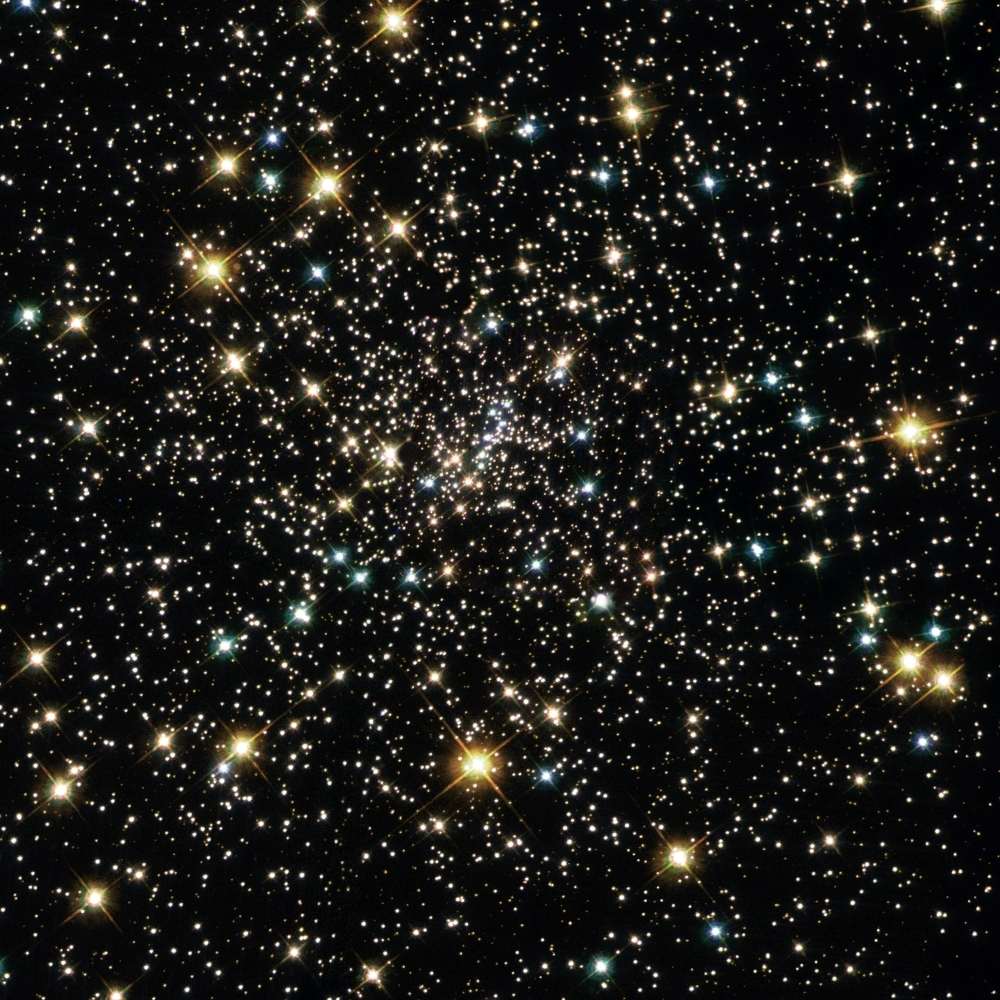
NGC 6397
One of the Nearest Ancient Globular Clusters
Quick Reader
| Attribute | Details |
|---|---|
| Name | NGC 6397 |
| Type | Globular Cluster |
| Constellation | Ara |
| Distance from Earth | ~7,800 light-years |
| Distance from Galactic Center | ~6,000 light-years |
| Apparent Magnitude | 5.7 (visible to naked eye in dark skies) |
| Diameter | ~75 light-years |
| Age | ~13.4 billion years |
| Metallicity ([Fe/H]) | –2.0 (very metal-poor) |
| Discovered By | Nicolas Louis de Lacaille (1751) |
| Core Collapse Status | Core-collapsed cluster |
| Special Feature | One of the closest globular clusters to Earth |
| Best Viewing Time | June–September (Southern Hemisphere) |
| Observation Type | Easily visible in small telescopes and binoculars |
Introduction — A Window into the Early Universe
NGC 6397 is not just another globular cluster — it’s one of the closest and oldest star clusters known, lying a mere 7,800 light-years away in the southern constellation Ara.
This ancient cluster contains hundreds of thousands of stars tightly bound by gravity, forming a dense spherical system that has existed since the dawn of the Milky Way.
Because of its proximity and age (around 13.4 billion years), NGC 6397 serves as a cosmic laboratory for studying the formation, evolution, and death of stars — from red giants to white dwarfs and neutron stars.
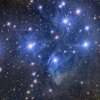
When observed through a telescope, it appears as a brilliant ball of light, gradually brightening toward the center — a visual hallmark of a core-collapsed globular cluster.
Discovery and Visibility — A Naked-Eye Ancient Jewel
NGC 6397 was discovered in 1751 by the French astronomer Nicolas Louis de Lacaille, during his observations from South Africa.
It is one of the few globular clusters visible to the naked eye under dark skies — shining faintly like a tiny smudge near the Milky Way’s dense band in Ara.
Observing Highlights
Naked Eye: Visible as a faint spot under rural skies.
Binoculars: Appears as a soft round glow.
Small Telescope (3–6 inch): Reveals a granular texture.
Large Telescope: Resolves thousands of tiny stars, tightly packed toward the center.
Its apparent magnitude of 5.7 makes it a favorite among amateur astronomers in the Southern Hemisphere, best viewed during winter months (June to September).
Structure and Morphology — The Core of Collapse
NGC 6397 is a core-collapsed cluster, meaning its central region has become extremely dense as stars migrate inward due to gravitational interactions over billions of years.
Physical Characteristics
| Property | Value | Description |
|---|---|---|
| Core Radius | ~0.05 pc (~0.16 ly) | Exceptionally small and dense |
| Half-light Radius | ~2.9 pc (~9.5 ly) | Compact, luminous central region |
| Concentration | Very high | Classic “core-collapse” morphology |
| Total Luminosity | ~2×10⁵ L☉ | Bright despite low metallicity |
At the cluster’s heart, stars are separated by only a fraction of a light-year, making the environment so crowded that stellar collisions and binary interactions are common.
Stellar Population — Ancient, Metal-Poor Survivors
Most stars in NGC 6397 belong to Population II, the oldest generation of stars formed shortly after the Big Bang.
They are metal-poor ([Fe/H] ≈ –2.0), meaning they contain very few elements heavier than hydrogen or helium.
Composition Breakdown
Red Giants: Evolved old stars nearing the end of their lives.
Main Sequence Stars: Low-mass stars, still burning hydrogen after billions of years.
White Dwarfs: Stellar remnants from earlier generations.
Neutron Stars & X-ray Binaries: Evidence of past supernova activity.
In 2010, Hubble Space Telescope (HST) observations confirmed that NGC 6397 hosts one of the clearest white dwarf cooling sequences ever detected — allowing astronomers to directly measure its age at ~13.4 billion years, nearly as old as the universe itself.
Core Dynamics — The Physics of Crowding
Inside NGC 6397, the stellar density reaches astonishing levels — more than 10⁵ stars per cubic parsec in the core.
This density leads to frequent stellar interactions, binary formation, and core collapse — the process where heavier stars sink inward, pushing lighter stars outward.
Dynamic Processes
Mass Segregation: Massive stars drift to the center; lighter ones move outward.
Binary Interactions: Close binaries form through gravitational capture, stabilizing the cluster against complete collapse.
Stellar Collisions: Produce blue stragglers — unusually young, hot stars formed by stellar mergers.
Core Oscillation: Some simulations suggest the cluster may undergo periodic re-expansion after partial collapse.
This dynamic equilibrium makes NGC 6397 a natural lab for studying gravitational thermodynamics on a galactic scale.
Scientific Importance — A Benchmark Cluster
Because of its proximity, age, and clarity, NGC 6397 is a cornerstone in globular cluster research.
Major Contributions
White Dwarf Chronology: Provided one of the first direct methods to estimate the universe’s age using cooling sequences.
Stellar Evolution Models: Served as a calibration point for low-metallicity stellar evolution.
Dynamics and Core Collapse Studies: Helped model gravitational relaxation in dense stellar systems.
Binary Star Populations: Supplied key insights into binary evolution in crowded environments.
For astrophysicists, studying NGC 6397 is like observing a fossilized cross-section of early galactic history — frozen in light.
Internal Kinematics — The Motion of a Living Fossil
Deep within the heart of NGC 6397, gravity reigns supreme.
This ancient globular cluster is a fully relaxed system, meaning that after billions of years, the orbits of its stars have been redistributed into a stable equilibrium governed by mutual gravitational interactions.
Kinematic Characteristics
Velocity Dispersion: ~5 km/s — relatively low, consistent with its small mass (~2.5×10⁵ M☉).
Mass Segregation: Heavy stars and binaries have sunk toward the core, while lighter stars populate the outskirts.
Orbital Structure: The cluster follows a mildly elliptical orbit around the Milky Way, passing near the Galactic plane roughly every 100 million years.
Tidal Radius: ~30 pc (~100 light-years), defined by the Milky Way’s gravitational boundary.
Each galactic passage strips a few peripheral stars, slowly eroding the cluster’s outer layers. Yet, its compact, high-density core ensures long-term survival — a sign of extreme dynamical maturity.
Blue Stragglers — Reborn Stars in an Ancient System
Among NGC 6397’s most intriguing stellar inhabitants are the blue stragglers — stars that appear younger and hotter than the rest of the cluster’s population.
Their existence puzzled astronomers for decades until observations confirmed that they are products of stellar mergers or mass transfer in binary systems.
Formation Mechanisms
Stellar Collisions: In the crowded core, stars occasionally collide and merge, forming a single, rejuvenated, more massive star.
Binary Mass Transfer: In binary systems, material from one star flows onto the other, effectively “resetting” its stellar clock.
Observational Evidence
Hubble photometry shows dozens of blue stragglers concentrated near the core.
Their spatial distribution follows the region of highest stellar interaction rate, supporting a collisional origin.
Thus, NGC 6397’s blue stragglers are cosmic paradoxes — ancient by birth, but young in appearance, formed by the cluster’s own internal chaos.
Exotic Stellar Populations — Neutron Stars, Binaries, and Cataclysms
NGC 6397 is a treasure trove of exotic stellar objects, each revealing a different stage of stellar evolution.
1. Neutron Stars and X-ray Sources
Observations by Chandra X-ray Observatory detected numerous faint X-ray sources concentrated in the cluster’s core.
These sources correspond to low-mass X-ray binaries (LMXBs), millisecond pulsars, and cataclysmic variables (CVs).
Their presence confirms that stellar remnants are retained efficiently by the cluster’s strong gravitational potential.
2. Cataclysmic Variables
These are binary systems where a white dwarf accretes material from a companion star, producing periodic outbursts of X-ray and optical light.
NGC 6397 contains several well-documented examples, monitored regularly by Hubble and Chandra.
3. Millisecond Pulsars
Radio surveys have identified candidate pulsars spinning hundreds of times per second — neutron stars re-energized through accretion.
They serve as precise clocks for studying gravitational interactions and magnetic evolution in dense clusters.
The Hidden Heart — Evidence for an Intermediate-Mass Black Hole
A major question surrounding dense globular clusters like NGC 6397 is whether they harbor intermediate-mass black holes (IMBHs) — the “missing link” between stellar-mass and supermassive black holes.
The Debate
For decades, astronomers suspected that NGC 6397 might contain a central black hole of around 1,000–2,000 solar masses, based on its density and velocity profile.
However, high-precision Hubble and Gaia observations in 2021 revealed something unexpected:
Instead of a single black hole, the data suggested a swarm of dark remnants — white dwarfs, neutron stars, and small black holes — collectively mimicking the gravitational influence of an IMBH.
Key Findings (Vitral & Mamon, 2021 – A&A Journal)
The inner stellar motion could be explained by a diffuse cluster of stellar remnants totaling ~1,000–2,000 M☉.
No evidence for a single dominant black hole.
The findings indicate that mass segregation and stellar remnants dominate the cluster’s gravity rather than a central massive object.
In short, NGC 6397 might not host a black hole at its core — but a dark cluster of ghosts, silently shaping its inner dynamics.
Stellar Evolution Pathways — The Complete Life Cycle in One Cluster
NGC 6397 contains stars at nearly every stage of stellar evolution, making it one of the most complete natural testbeds for astrophysical models.
| Evolutionary Stage | Representative Population | Notes |
|---|---|---|
| Main Sequence | Low-mass stars (<0.8 M☉) | Still fusing hydrogen after 13 billion years |
| Red Giants | Evolved stars | Bright, reddish members defining the cluster’s color-magnitude diagram |
| Horizontal Branch | Helium-burning phase | Spread affected by metallicity and age |
| White Dwarfs | Oldest remnants | Used for precise age dating through cooling sequence |
| Neutron Stars | Former massive stars | Detected via X-rays and pulsar signals |
From birth to death, NGC 6397 preserves the entire stellar life cycle within its compact volume — a self-contained miniature cosmos.
Galactic Orbit — A Nomadic Ancient Traveler
NGC 6397’s orbit around the Milky Way takes it through multiple galactic regions, shaping its long-term survival.
Orbital Properties
Perigalacticon (Closest Approach): ~3,000 light-years from Galactic Center.
Apogalacticon (Farthest Point): ~8,000 light-years.
Orbital Plane: Slightly inclined relative to the Galactic disk.
Period: ~100 million years.
Each orbit subjects the cluster to tidal shocks from the Galactic disk and bulge — gradually stripping stars from its outskirts, contributing to the faint tidal tails observed extending beyond its nominal radius.
These streams provide clues about both the cluster’s past orbits and the Milky Way’s gravitational potential.
Scientific Significance — A Blueprint of Stellar and Galactic Evolution
NGC 6397 is not just a nearby star cluster — it is one of the most scientifically valuable globular clusters ever studied.
Its proximity, low extinction, and advanced dynamical age allow astronomers to test theories of stellar evolution, gravitational dynamics, and Galactic archaeology with unparalleled precision.
Why NGC 6397 Matters
Benchmark for Stellar Lifetimes
Its proximity allowed Hubble to resolve individual stars down to the faintest white dwarfs, directly measuring stellar aging rates.
The resulting “white dwarf cooling sequence” provided one of the most precise age estimates for any stellar population — about 13.4 billion years, consistent with the universe’s earliest epochs.
Model for Core Collapse
NGC 6397 is a textbook example of a core-collapsed cluster, demonstrating the long-term evolution of dense stellar systems through two-body relaxation.
The cluster offers direct observational data for N-body simulations of cluster stability and core oscillations.
Natural Laboratory for Binary and Exotic Stars
It hosts a large number of binaries, blue stragglers, pulsars, and cataclysmic variables — key to understanding how close stellar encounters affect star formation and evolution.
Probing the Galactic Halo
Its metallicity and orbital path make NGC 6397 a tracer of the Milky Way’s oldest halo components, providing clues to how the Galaxy assembled from primordial fragments.
In short, NGC 6397 serves as a cornerstone for understanding both stellar physics and the Milky Way’s earliest history.
Comparison with Other Nearby Globular Clusters
| Cluster | Distance (ly) | Metallicity ([Fe/H]) | Core Status | Notable Features |
|---|---|---|---|---|
| NGC 6397 | ~7,800 | –2.0 | Core-collapsed | One of the nearest; white dwarf age calibration |
| 47 Tucanae (NGC 104) | ~13,000 | –0.7 | Non-collapsed | Bright, metal-rich, dense southern cluster |
| M4 (NGC 6121) | ~7,200 | –1.1 | Core-collapsed | Closest cluster; contains millisecond pulsar |
| Omega Centauri (NGC 5139) | ~15,800 | –1.5 (multi-population) | Non-collapsed | Possible remnant of a dwarf galaxy core |
| M22 (NGC 6656) | ~10,500 | –1.7 | Mildly concentrated | Contains planetary nebula and dust lane |
Compared with these, NGC 6397 stands out as a pure, metal-poor fossil cluster, undisturbed by multiple populations or external mergers — a clean window into the primordial Milky Way.
Cosmological Context — A Survivor from the Dawn
With an age exceeding 13 billion years, NGC 6397 likely formed during the first wave of star cluster formation that accompanied the Milky Way’s initial collapse.
Its stars predate the Galactic disk and bulge, meaning this cluster preserves the original chemistry of the proto-Galaxy.
Cosmological Implications
The low metallicity indicates formation from gas enriched by only the first generations of supernovae (Population III stars).
Its dynamical evolution shows how small stellar systems survive tidal forces over cosmic timescales.
It bridges the gap between modern globular clusters and the earliest bound stellar associations that seeded galaxy formation.
In essence, NGC 6397 is a living fossil of the universe’s youth, orbiting quietly in the Milky Way’s halo — a survivor from a time when the cosmos was only a few hundred million years old.
Observing NGC 6397 — Ancient Light Within Reach
NGC 6397’s brightness and proximity make it one of the most accessible globular clusters for observers.
Observation Tips
Best Location: Constellation Ara, visible from Southern Hemisphere.
Naked-Eye Visibility: Under dark skies, faintly visible as a tiny hazy spot.
Binoculars (10×50): Easily resolves as a soft ball of light.
Small Telescope (4–6 inch): Individual stars begin to appear.
Large Telescope (>10 inch): Core resolves into hundreds of pinpoint stars.
Through a telescope, NGC 6397 appears like a silver swarm of ancient suns, glittering across the night sky — a breathtaking reminder of how far back our universe’s story truly goes.
Frequently Asked Questions (FAQ)
Q1: How old is NGC 6397?
Approximately 13.4 billion years, making it nearly as old as the universe itself.
Q2: Why is it called “core-collapsed”?
Because the stars in its center have migrated inward over time, creating an extremely dense, compact core with a sharp brightness peak.
Q3: Does NGC 6397 contain a black hole?
It likely hosts many small black holes and neutron stars rather than one large central black hole — forming a “dark cluster” at its heart.
Q4: Can it be seen without a telescope?
Yes, in very dark skies of the Southern Hemisphere, it’s faintly visible to the naked eye.
Q5: What does its low metallicity tell us?
It means NGC 6397’s stars formed early in the universe, before heavy elements became common — confirming its status as a first-generation Galactic relic.
Related Objects and Further Reading
M4 (NGC 6121): The closest known globular cluster, similar in density and age.
Omega Centauri (NGC 5139): The most massive cluster in the Milky Way, possibly a stripped dwarf galaxy core.
47 Tucanae (NGC 104): Bright southern cluster, contrasting in metallicity and age with NGC 6397.
Terzan 1: Another dense, obscured bulge cluster studied for early Galactic formation.
Final Thoughts
Few cosmic objects connect us to the dawn of the universe as powerfully as NGC 6397.
It is both a relic and a witness — a survivor from an era when the Milky Way was just beginning to form.
Each star within it has lived for billions of years, shining since before Earth, the Sun, or even the Solar System existed.
In its shimmering core, we glimpse not only the history of our Galaxy but the persistence of cosmic order — the idea that even across 13 billion years, light can endure.