









Nix
The Chaotic Moon of Pluto
Quick Reader
| Attribute | Details |
|---|---|
| Name | Nix |
| Type | Natural satellite (moon) |
| Parent Body | Pluto |
| Discovery Year | 2005 |
| Discoverers | Hubble Space Telescope team |
| Orbital System | Pluto–Charon binary |
| Mean Diameter | ~49 km |
| Shape | Highly irregular |
| Orbital Distance | ~48,700 km from Pluto |
| Orbital Period | ~25 days |
| Rotation | Chaotic (tumbling) |
| Surface Composition | Water ice |
| Albedo | Relatively high |
| Naming Origin | Greek mythology (goddess of night) |
Introduction – A Moon That Refuses to Spin Normally
Among Pluto’s five known moons, Nix stands out not because of its size, but because of its behavior.
Nix does not rotate smoothly like Earth’s Moon. Instead, it tumbles chaotically, spinning unpredictably as it orbits the Pluto–Charon system. This strange motion makes Nix one of the most dynamically fascinating small moons in the Solar System.
Discovered in 2005, the same year that Pluto’s planetary status was being debated, Nix helped reveal that Pluto is not a lonely dwarf planet—but the center of a complex and dynamic moon system.
Discovery of Nix – Expanding Pluto’s Family
Nix was discovered using images from the Hubble Space Telescope, alongside another small moon, Hydra.
Before 2005:
Only Charon was known
Pluto was thought to have a simple satellite system
The discovery of Nix and Hydra changed that picture completely.
Key Discovery Details
Year: 2005
Instrument: Hubble Space Telescope
Method: Repeated imaging and motion tracking
Their detection proved that Pluto’s gravitational environment was far richer than previously believed.
Naming and Mythological Meaning
Nix is named after Nyx, the Greek goddess of night.
Why the spelling “Nix”?
To avoid confusion with asteroid Nyx
To maintain naming consistency
The name fits Pluto’s underworld theme:
Pluto → Roman god of the underworld
Charon → ferryman of the dead
Nix → goddess of darkness
Together, the names form a cohesive mythological system.
Orbit – Dancing Around a Binary World
Unlike moons that orbit a single dominant planet, Nix orbits the barycenter of the Pluto–Charon system.
Orbital Characteristics
Orbital distance: ~48,700 km
Orbital period: ~25 days
Nearly circular orbit
Slightly inclined relative to Charon’s orbit
Because Pluto and Charon are comparable in size, Nix does not orbit Pluto alone—it moves in a complex gravitational environment shaped by two central masses.
Size and Shape – A Cosmic Fragment
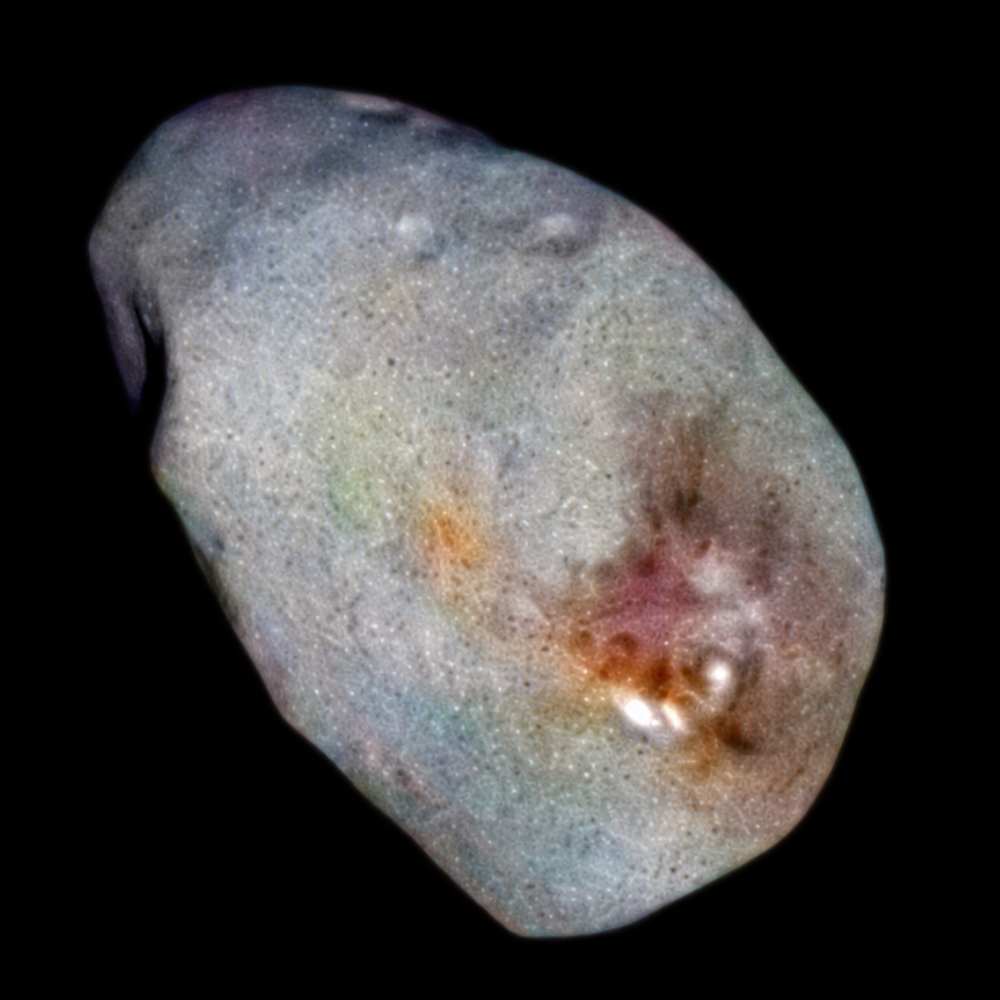
Nix is small and irregular, resembling a lumpy fragment rather than a spherical moon.
Key traits:
Mean diameter ~49 km
Elongated, asymmetric shape
Low gravity
Its shape suggests:
No internal differentiation
No geological reshaping
Preservation of primordial structure
Nix is likely a rubble-like remnant from a violent past.
Surface Composition – Bright Ice in the Darkness
Despite its small size, Nix has a relatively bright surface.
Spectral data from New Horizons revealed:
Dominance of water ice
Lack of volatile ices like methane or nitrogen
Minimal dark organic coatings
This brightness is surprising for such a small body and suggests that Nix’s surface has been refreshed or preserved over time.
Rotation – One of the Most Chaotic Moons Known
Nix does not have a stable rotation axis.
Instead, it:
Spins rapidly
Changes orientation unpredictably
Exhibits chaotic tumbling
Why Is Nix’s Rotation Chaotic?
Extremely weak gravity
Irregular shape
Strong gravitational influence from both Pluto and Charon
This makes Nix a textbook example of chaotic rotation in celestial mechanics.
How Nix Likely Formed
The leading formation model links Nix directly to the Pluto–Charon collision.
Giant Impact Hypothesis
A massive collision formed Charon
Debris spread into orbit
Smaller fragments accreted into moons like Nix and Hydra
This explains:
Similar surface composition across moons
Coplanar orbits
Small, irregular shapes
Nix is essentially a fossil fragment of Pluto’s violent early history.
Why Nix Is Scientifically Important
Nix matters because it helps scientists understand:
Moon formation around binary systems
Chaotic rotation dynamics
Post-impact debris evolution
Stability of small moons
Studying Nix provides insight not only into Pluto, but into binary planet systems across the universe.
Nix Compared with Pluto’s Other Small Moons
Pluto has four small moons in addition to Charon: Styx, Nix, Kerberos, and Hydra. While they share a common origin, Nix occupies a unique position in terms of size, brightness, and dynamical behavior.
Nix vs Hydra
Hydra is slightly larger and more elongated
Hydra orbits farther from the Pluto–Charon barycenter
Both exhibit chaotic rotation
Both have bright, water-ice–dominated surfaces
Hydra appears more elongated, while Nix is comparatively compact, but dynamically they behave in similar ways.
Nix vs Styx
Styx is the smallest known moon in the system
Styx has an even weaker gravitational binding
Nix is larger and more stable over long timescales
Styx may be more susceptible to orbital evolution, whereas Nix occupies a more secure dynamical zone.
Nix vs Kerberos
Kerberos is darker than Nix
Kerberos has a lower albedo and irregular shape
Nix’s higher reflectivity remains unexplained
The contrast between Nix and Kerberos suggests different surface histories, despite likely forming from the same debris disk.
Insights from New Horizons
The New Horizons flyby in 2015 provided the first close-up views of Nix, transforming it from a point of light into a real geological object.
Key Observations
Irregular, blocky shape
Bright surface dominated by water ice
No visible signs of resurfacing or tectonics
Absence of large craters (possibly due to limited resolution)
New Horizons confirmed that Nix is a primordial remnant, not an active or evolving world.
Why Is Nix So Bright?
One of the most puzzling aspects of Nix is its high albedo.
Possible explanations include:
Surface dominated by clean water ice
Limited exposure to darkening organic material
Low collision rate in Pluto’s distant environment
Unlike Kuiper Belt objects exposed to heavy radiation and impacts, Nix may have remained relatively pristine.
Another possibility is that small impacts continually expose fresh ice, preventing long-term darkening.
Orbital Resonances – A Delicate Balance
Pluto’s small moons are locked in a complex system of near-resonant orbits.
Approximate resonance chain:
Styx: ~3:1 with Charon
Nix: ~4:1
Kerberos: ~5:1
Hydra: ~6:1
While not perfectly resonant, this pattern indicates a shared dynamical history, likely shaped during early orbital migration after the Pluto–Charon impact.
These resonances help stabilize the moons over billions of years.
Why Chaotic Rotation Persists
Unlike large moons, Nix has never become tidally locked.
Reasons include:
Small size and low gravity
Highly irregular shape
Constant torque from both Pluto and Charon
As a result:
Nix’s rotation axis shifts over time
Spin rate varies
Orientation becomes unpredictable
This makes Nix a natural laboratory for studying nonlinear rotational dynamics.
Is Nix Geologically Dead?
Yes—by all current evidence.
Nix shows:
No atmosphere
No internal heat source
No tectonic or cryovolcanic features
Its surface likely preserves conditions dating back to the early Solar System, modified only by slow space weathering.
Long-Term Orbital Stability
Despite its chaotic rotation, Nix’s orbit is stable on very long timescales.
Simulations suggest:
Nix will remain bound to Pluto for billions of years
Orbital changes are slow and subtle
The Pluto–Charon binary provides long-term confinement
This stability is remarkable given the system’s complexity.
Why Nix Matters Beyond Pluto
Studying Nix helps astronomers understand:
Moon formation around binary bodies
Debris disk evolution after giant impacts
Chaotic rotation in small celestial objects
Stability of multi-moon systems
These insights apply not only to Pluto, but also to:
Binary asteroids
Exoplanet moon systems
Circumbinary disks around stars
The Future of Nix
Nix is a small, fragile object, but its future is surprisingly stable.
Long-Term Evolution
Nix will continue orbiting the Pluto–Charon barycenter
Its chaotic rotation will persist indefinitely
Surface changes will be extremely slow
Because Pluto lies far from the Sun, external forces such as tidal decay or atmospheric drag are essentially nonexistent. Nix’s environment is cold, quiet, and dynamically isolated.
Will Nix Ever Become Tidally Locked?
Highly unlikely.
For tidal locking to occur, a moon must:
Have sufficient mass
Experience strong tidal forces
Lose rotational energy efficiently
Nix fails all three conditions.
Its:
Small size
Irregular shape
Distance from Pluto–Charon
…ensure that its rotation remains chaotic rather than synchronized.
Could Nix Break Apart?
There is no evidence that Nix is currently at risk of fragmentation.
Tidal stresses are weak
Orbital path avoids major resonances
Collision probability is extremely low
Unless disrupted by a rare major impact, Nix is expected to remain intact for billions of years.
Frequently Asked Questions (FAQ)
Is Nix bigger than Charon?
No. Charon is vastly larger and forms a binary system with Pluto. Nix is a small fragment by comparison.
Why does Nix tumble instead of spinning smoothly?
Because it is small, irregular, and influenced by the gravity of both Pluto and Charon.
Does Nix have an atmosphere?
No. Its gravity is far too weak to retain any gas.
Can Nix be seen from Earth?
No. It is far too small and faint to be observed with Earth-based telescopes.
Is Nix unique?
Nix is one of the best-known examples of chaotic rotation, but similar behavior may exist in other small moons and asteroids.
Nix’s Role in Planetary Science
Nix represents an extreme outcome of planetary formation.
It shows that:
Giant impacts create complex debris systems
Small moons can survive in chaotic environments
Rotation can remain unpredictable indefinitely
By studying Nix, scientists gain insight into how order and chaos coexist in celestial mechanics.
Related Topics for Universe Map
Pluto
Charon
Hydra
Styx
Kerberos
Kuiper Belt
Binary Planet Systems
Together, these topics illustrate the richness of Pluto’s miniature planetary system.
Final Perspective
Nix may be small, dark, and distant—but it is anything but simple.
Its unpredictable spin, icy surface, and stable orbit around a binary world make it a perfect example of how complexity arises even in the most remote corners of the Solar System.
In the quiet darkness beyond Neptune, Nix continues its endless tumble—silently preserving the story of Pluto’s violent birth and the dynamic balance that followed.