







Omega Centauri
The Giant Among Globular Clusters
Quick Reader
| Attribute | Details |
|---|---|
| Name | Omega Centauri (NGC 5139) |
| Type | Globular Cluster (possibly a stripped dwarf galaxy core) |
| Constellation | Centaurus |
| Distance from Earth | ~15,800 light-years |
| Diameter | ~150 light-years |
| Apparent Magnitude | ~3.7 (visible to the naked eye) |
| Mass | ~4 million solar masses |
| Number of Stars | ~10 million |
| Age | ~12 billion years |
| Metallicity Range | –2.0 to –0.6 (diverse stellar populations) |
| Discovery | Known since antiquity; cataloged by Edmond Halley in 1677 |
| Best Viewing Months | March to July (Southern Hemisphere) |
| Observation Tools | Visible with binoculars; detailed view via Hubble, Gaia, and VLT |
| Scientific Importance | Largest and most massive globular cluster in the Milky Way; possible remnant core of a dwarf galaxy |
Introduction — A Cluster That Defies Definition
Among the hundreds of globular clusters orbiting the Milky Way, Omega Centauri (NGC 5139) stands apart as an extraordinary outlier.
It’s not only the largest and brightest globular cluster in our galaxy but also one of the most massive stellar systems in the Local Group.
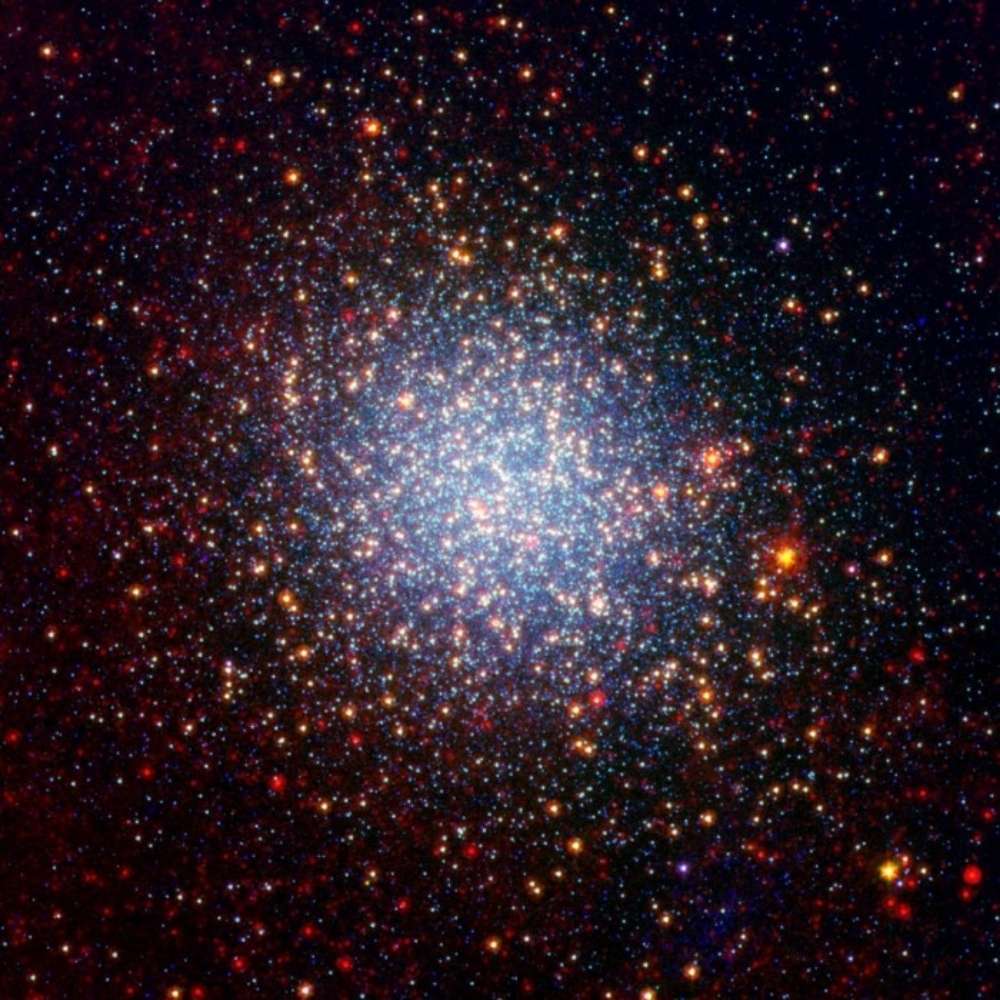
Containing roughly 10 million stars packed into a sphere only 150 light-years wide, Omega Centauri shines as a golden halo in the constellation Centaurus, visible even to the naked eye from dark southern skies.
But what truly makes this object remarkable is its mystery:
It behaves less like a typical globular cluster and more like the fossil core of a small galaxy — one that the Milky Way may have devoured billions of years ago.
Historical Background — From Star to Cluster to Mystery
Omega Centauri has been known since ancient times.
The Greek astronomer Ptolemy listed it as a single star in the 2nd century CE, while Edmond Halley was the first to recognize it as a nebula in 1677.
It wasn’t until 1830, with the advent of larger telescopes, that astronomers realized it was a cluster of countless stars.
Its brightness and apparent size (over 36 arcminutes across, larger than the Moon’s apparent diameter) make it one of the most spectacular non-galactic objects visible from Earth.
Later, 20th-century spectroscopy and modern space telescopes revealed something astonishing — Omega Centauri isn’t homogeneous like most clusters.
It contains multiple generations of stars with varying metallicities, suggesting a complex formation history unlike any other globular cluster.
Structure and Composition — A Stellar City in Motion
Omega Centauri is a densely packed stellar sphere, gravitationally bound and rotating slowly around its axis.
Its internal structure is layered, both physically and chemically.
1. Core and Density
At its center lies a region with extreme stellar crowding — roughly one star per 0.1 cubic light-year.
This density is so high that stars occasionally interact gravitationally or even collide, producing exotic systems like blue stragglers and millisecond pulsars.
2. Multiple Stellar Populations
Unlike ordinary clusters, which form in a single burst, Omega Centauri hosts at least five distinct stellar populations differing in both age and metallicity.
This implies:
Extended star formation over hundreds of millions of years
Continuous chemical enrichment from supernovae and stellar winds
A total metallicity range from [Fe/H] = –2.0 to –0.6
Such complexity is unheard of in normal globular clusters — another clue pointing to its possible galactic origin.
3. Shape and Rotation
Omega Centauri is slightly flattened, rotating at about 7 km/s.
This flattening could result from:
Its enormous mass, causing internal rotation
Past tidal interactions with the Milky Way
The presence of a central massive black hole, influencing stellar dynamics
Possible Central Black Hole
One of the most debated questions about Omega Centauri is whether it harbors a central intermediate-mass black hole (IMBH).
Observations from the Hubble Space Telescope and Gemini Observatory suggest a dark mass of about 40,000–50,000 solar masses at its core — far greater than expected for a typical cluster.
If confirmed, this would strengthen the theory that Omega Centauri is the remnant nucleus of a dwarf galaxy whose outer stars were stripped away by the Milky Way’s gravity billions of years ago.
Stellar Populations — Diversity in Age and Chemistry
1. The Oldest Stars
Age: ~12–13 billion years
Composition: Metal-poor, similar to early halo stars of the Milky Way
Represents the original population before chemical enrichment
2. Intermediate Populations
Age: 10–11 billion years
Moderate metallicity
Formed from gas recycled by earlier generations of stars
3. Youngest Populations
Age: ~9 billion years
Metal-rich and helium-enhanced
Possibly formed when the cluster’s progenitor galaxy was still forming stars
The spread in chemical composition and stellar ages indicates that Omega Centauri retained gas long enough to form new stars, unlike normal clusters that lose gas quickly after formation.
Dynamic Features — A Mini Galaxy in the Milky Way’s Halo
The cluster’s massive gravity well and internal rotation give rise to complex orbital motions.
Data from Gaia DR3 reveals that:
Stars in Omega Centauri follow multiple orbital families, including both circular and radial trajectories.
The cluster as a whole moves around the Milky Way in a retrograde orbit, opposite the galaxy’s rotation.
Its halo contains stellar streams, likely remnants of tidal stripping during its ancient merger.
These features suggest Omega Centauri is more than just a globular cluster — it’s a surviving galactic core, silently orbiting within our halo.
Comparisons with Other Massive Clusters
| Cluster | Mass (M☉) | Stars (approx.) | Special Feature |
|---|---|---|---|
| Omega Centauri (NGC 5139) | ~4 million | ~10 million | Multiple populations; possible black hole |
| 47 Tucanae (NGC 104) | ~1 million | ~2 million | High density, uniform metallicity |
| M54 (NGC 6715) | ~2 million | ~4 million | Nucleus of the Sagittarius Dwarf Galaxy |
| NGC 2419 | ~900,000 | ~1 million | “Intergalactic wanderer”; outer halo object |
Among these, Omega Centauri and M54 share striking similarities — both are believed to be remnant galactic nuclei, providing key insights into the Milky Way’s accretion history.
Origins — A Globular Cluster or a Stripped Galaxy Core?
Omega Centauri’s true identity has long puzzled astronomers.
While it’s officially classified as a globular cluster, its enormous mass, chemical diversity, and multiple stellar populations suggest a far more complex history.
The most accepted theory today is that Omega Centauri is the stripped core of a dwarf galaxy that the Milky Way absorbed billions of years ago.
1. Chemical and Stellar Evidence
Unlike most globular clusters that formed all their stars in a single burst, Omega Centauri contains:
At least five generations of stars with different ages and metallicities
A wide metallicity range from [Fe/H] = –2.0 to –0.6, implying prolonged star formation
Enhanced helium and nitrogen abundances in some subpopulations
These characteristics are identical to those seen in dwarf galaxies such as the Sagittarius Dwarf Spheroidal and Fornax Dwarf, not in normal clusters.
This indicates that Omega Centauri once had enough gravity to retain supernova ejecta and recycle gas to form new stars — a capability beyond that of typical clusters.
2. Structural and Dynamical Clues
Omega Centauri’s flattened shape and internal rotation also point to a galactic origin.
Normal globular clusters show little or no rotation, but this one spins at about 7 km/s — consistent with the remnant core of a rotating galaxy.
Moreover:
Its orbit around the Milky Way is retrograde, opposite to the Galactic disk’s rotation.
The cluster’s outer halo is slightly elongated and shows hints of tidal debris — remnants of its outer layers stripped away during past encounters.
All this supports the scenario that Omega Centauri is the leftover nucleus of a dwarf galaxy whose stars were absorbed into the Milky Way’s halo.
The Stripped Dwarf Galaxy Hypothesis
1. The Merged Past
According to this hypothesis:
Omega Centauri began as a small satellite galaxy about 12 billion years ago.
During a close encounter, the Milky Way’s gravity stripped away its outer stars, leaving behind the dense central core.
Over time, the remnant settled into its current orbit within the Milky Way’s halo.
Simulations of tidal disruption show that dwarf galaxies can leave behind dense, spherical cores almost identical to what we see in Omega Centauri.
2. Supporting Comparisons
Another known example of this process is M54 (NGC 6715) — the nucleus of the Sagittarius Dwarf Galaxy, currently being assimilated by the Milky Way.
Both M54 and Omega Centauri share:
High mass and brightness
Multiple stellar populations
Possible central black holes
Thus, Omega Centauri might represent an earlier version of the same process — a galactic core long ago stripped bare.
The Central Black Hole Debate
A major argument for the stripped-galaxy theory is the possible existence of an intermediate-mass black hole (IMBH) in Omega Centauri’s center.
Observations using Hubble Space Telescope, Gemini South, and ESO’s VLT have revealed:
A sharp increase in stellar velocity dispersion near the core.
A central dark mass estimated at ~40,000–50,000 solar masses.
X-ray and radio emissions consistent with weak accretion activity.
If confirmed, this IMBH would be the largest known black hole in any globular cluster, aligning perfectly with expectations for a dwarf galaxy nucleus.
However, some astronomers propose alternative explanations — such as stellar remnants or orbital crowding — meaning the debate remains open.
Star Formation History and Chemical Evolution
1. Extended Formation Period
Analysis of stellar populations suggests that Omega Centauri’s stars formed over a period of 500 million to 2 billion years — far longer than the few million years typical for normal clusters.
During this time:
First-generation stars enriched the cluster with heavy elements.
Supernova ejecta mixed with residual gas.
Second and third generations of stars formed with progressively higher metallicity.
This prolonged star formation indicates that the cluster retained gas efficiently — possible only for systems with deep gravitational wells, like small galaxies.
2. Multiple Stellar Generations
Each generation within Omega Centauri displays distinct chemical “fingerprints.”
For example:
Older populations show low oxygen and iron.
Intermediate stars show enhanced nitrogen and sodium.
Younger stars contain higher metallicity and helium, suggesting self-enrichment through stellar feedback.
This chemical diversity is a key reason why Omega Centauri is often labeled a “transition object” — part cluster, part galaxy.
Kinematics — Motion and Orbital Path Around the Milky Way
Data from Gaia DR3 reveals that Omega Centauri:
Orbits the Milky Way at an average distance of 17,000 light-years, ranging between 6,000 and 25,000 light-years during its path.
Follows a retrograde, inclined orbit, tilted roughly 30° to the Galactic plane.
Passes through the Galactic disk roughly every 120 million years, enduring strong tidal forces.
These periodic interactions likely stripped away many of its outermost stars, spreading them into the Milky Way’s halo.
Indeed, astronomers have detected stellar streams that may be remnants of its original dwarf galaxy host.
Exotic Objects Within Omega Centauri
Because of its dense stellar environment, Omega Centauri is home to many exotic astronomical systems, including:
Blue Stragglers: Stars that appear younger and bluer than expected, likely formed by mergers or mass transfer.
Millisecond Pulsars: Rapidly rotating neutron stars spun up by accreting material from companions.
X-ray Binaries: Compact star systems emitting X-rays as one object feeds on another.
Variable Stars (RR Lyrae & Type II Cepheids): Used for distance measurement and evolutionary modeling.
These diverse populations make Omega Centauri a microcosm of stellar evolution — from ancient red giants to collapsing remnants.
Role in the Milky Way’s Accretion History
The Milky Way has grown over time by assimilating smaller galaxies, and Omega Centauri likely represents one of the earliest captured remnants.
By studying its orbit, metallicity, and stellar makeup, astronomers reconstruct the history of how our galaxy evolved from repeated mergers.
Recent cosmological simulations (EAGLE, FIRE-2) show that:
Clusters like Omega Centauri form naturally as nuclei of early dwarf galaxies.
Over billions of years, their outer regions are stripped, leaving behind compact relics.
These remnants survive as “fossil cores,” orbiting larger galaxies — precisely what we observe today.
Modern Significance — A Living Fossil of Galactic Evolution
Omega Centauri is not just a cluster; it is a cosmic relic — a surviving witness to the Milky Way’s formative years.
It represents a snapshot of galactic assembly, where small, self-contained systems merged to build the large spirals we see today.
Because of its proximity and brightness, Omega Centauri offers a rare opportunity to study the processes of galaxy formation and destruction up close.
It provides direct evidence that the Milky Way’s halo was built from smaller galaxies that were cannibalized over billions of years.
Omega Centauri as a Link Between Clusters and Galaxies
Astronomers now classify Omega Centauri as part of a continuum between classical globular clusters and dwarf galaxies. It shares traits with both:
| Property | Globular Cluster | Dwarf Galaxy Core | Omega Centauri |
|---|---|---|---|
| Mass Range | 10⁵–10⁶ M☉ | 10⁷–10⁹ M☉ | ~4 × 10⁶ M☉ |
| Star Formation History | Single burst | Multiple epochs | Multiple epochs |
| Metallicity Spread | Narrow | Broad | Broad |
| Dark Matter Presence | None | Significant | Possibly small amount |
| Central Black Hole | Rare | Common | Probable (~4×10⁴ M☉) |
Omega Centauri’s hybrid characteristics make it a missing link between star clusters and dwarf galaxies — a key object for understanding how galaxies evolve through hierarchical merging.
Connection to Ultra-Compact Dwarfs (UCDs)
Modern research has identified Ultra-Compact Dwarfs (UCDs) — dense stellar systems lying between globular clusters and small galaxies — in galaxy clusters like Virgo and Fornax.
Interestingly, Omega Centauri’s:
Size,
Mass, and
Multiple populations
match those of many UCDs, suggesting they might share a common origin.
If UCDs are indeed nuclei of stripped dwarf galaxies, then Omega Centauri is the nearest UCD analog, orbiting within the Milky Way itself.
This realization transforms Omega Centauri from a mere cluster into a local example of a universal process — the stripping and survival of galactic cores.
Ongoing Research and Observations
Omega Centauri remains one of the most studied objects in astrophysics, observed across every wavelength from radio to gamma rays.
Recent missions like Gaia, JWST, and ESO’s Very Large Telescope (VLT) continue to refine our understanding of its dynamics, composition, and evolutionary history.
Key Modern Findings
Gaia DR3 Data (2022–2025): Revealed complex internal kinematics, stellar streams, and orbital substructures.
JWST Imaging: Resolved faint, low-mass stars and brown dwarfs, improving the cluster’s mass function estimates.
VLT Spectroscopy: Provided high-resolution metallicity maps confirming multiple stellar generations.
X-ray and Radio Studies: Searched for accretion signals from the suspected intermediate-mass black hole.
Each of these findings strengthens the picture of Omega Centauri as an ancient galactic remnant, rather than a conventional cluster.
Stellar Archaeology — Lessons from Omega Centauri
Omega Centauri has become a cornerstone of a new scientific field known as galactic archaeology — the study of fossil systems to reconstruct the formation of large galaxies.
Through it, astronomers have learned that:
The Milky Way grew hierarchically, consuming dozens of smaller galaxies like Omega Centauri.
Globular clusters are not all identical — some, like this one, are “survivor cores.”
Chemical diversity reveals multi-phase star formation even in ancient epochs.
Intermediate-mass black holes may form naturally in dense, early galactic nuclei.
Every star within Omega Centauri tells a story — of birth in a long-lost galaxy, survival through cosmic collisions, and eventual integration into the Milky Way’s halo.
Comparison with Other Galactic Relics
| Object | Type | Relation to Milky Way | Significance |
|---|---|---|---|
| Omega Centauri (NGC 5139) | Globular / Dwarf Core | Orbiting within halo | Most massive and complex cluster; possible stripped galaxy |
| M54 (NGC 6715) | Nucleus of Sagittarius Dwarf | Currently merging | Active example of accretion in progress |
| 47 Tucanae (NGC 104) | Classical Globular Cluster | Stable halo orbit | High density, single population |
| NGC 2419 | Outer Halo Cluster | ~300,000 ly from Earth | Extremely distant, low metallicity |
| Ultra-Compact Dwarfs (Virgo, Fornax) | Stripped Cores | External | Parallels Omega Centauri in structure |
These comparisons confirm that Omega Centauri is not an anomaly — it’s part of a universal pattern of galactic recycling that shapes the cosmos.
Frequently Asked Questions (FAQ)
Q1: Can Omega Centauri be seen with the naked eye?
Yes. From the Southern Hemisphere, it appears as a bright fuzzy star below Spica, best viewed from March to July under dark skies.
Q2: How many stars are in Omega Centauri?
Approximately 10 million, ranging from old red giants to young blue stragglers.
Q3: Is there a black hole inside Omega Centauri?
Evidence suggests a possible intermediate-mass black hole (~40,000–50,000 M☉), but its existence is not yet fully confirmed.
Q4: Why is Omega Centauri unique among globular clusters?
Because it contains multiple stellar populations, broad metallicity ranges, and internal rotation — all signs of a former dwarf galaxy core.
Q5: What is its ultimate fate?
Over billions of years, Omega Centauri will likely spiral toward the Galactic center due to dynamical friction and merge completely into the Milky Way’s inner halo.
Related Objects and Further Reading
M54 (NGC 6715): The active nucleus of the Sagittarius Dwarf Galaxy — a present-day analog.
47 Tucanae (NGC 104): A massive, classical globular cluster with uniform composition.
Sagittarius Dwarf Galaxy: Currently merging with the Milky Way.
Ultra-Compact Dwarfs: External analogs of stripped galaxy cores, similar to Omega Centauri.
Milky Way Halo: The extended region populated by ancient globulars and stellar debris from past mergers.
Final Thoughts
Omega Centauri stands as a cosmic monument to survival.
It has endured since the earliest epochs of the universe, witnessing the birth of galaxies, the death of stars, and the relentless flow of cosmic time.
What began as a humble dwarf galaxy may now live on as a glittering cluster of 10 million suns — orbiting silently in the Milky Way’s halo, carrying within it the memory of another world.
For astronomers, it remains one of the most valuable nearby laboratories for unraveling how galaxies grow, collide, and evolve.
In Omega Centauri, we see the past of the universe — still shining, still teaching, still alive.