




Omega Nebula
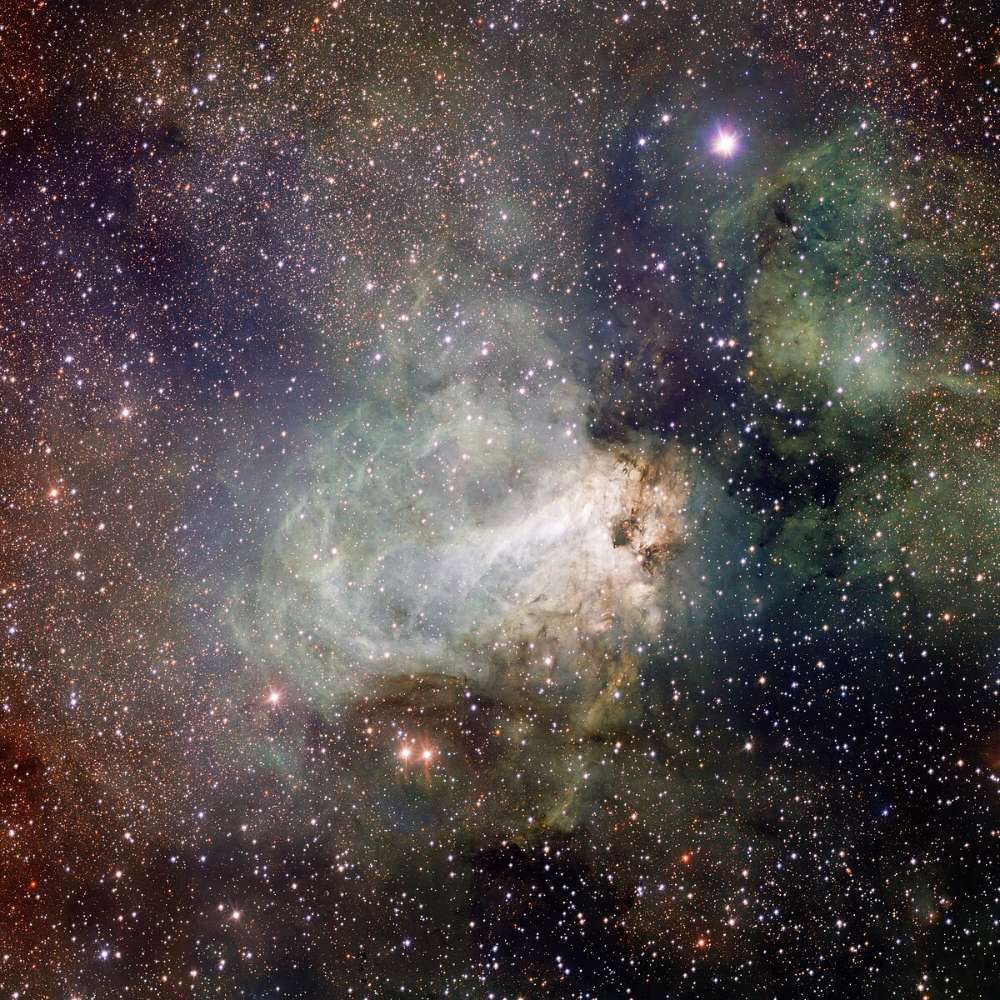
The Swan of the Milky Way
Quick Reader
| Attribute | Details |
|---|---|
| Name | Omega Nebula, Swan Nebula, Messier 17, M17 |
| Object Type | Emission nebula, H II region, star-forming region |
| Constellation | Sagittarius |
| Distance | ~5,000–6,000 light-years |
| Size | ~15 light-years across (visible core); full complex spans ~40+ light-years |
| Apparent Magnitude | ~6 (visible with small telescopes) |
| Dominant Features | Pink-red ionized hydrogen clouds, bright stellar nursery, dark dust lanes |
| Central Engine | Young massive stars from the NGC 6618 cluster |
| Notable Characteristics | One of the brightest and most active star-forming regions in the Milky Way |
| Best Wavelengths | Optical, infrared, radio (reveals embedded protostars) |
| Best Viewing Season | June–August (Milky Way core season) |
Introduction – A Stellar Nursery Sculpted by Radiation
Among the many glowing clouds of gas and dust in the constellation Sagittarius, the Omega Nebula stands out as one of the brightest and most dramatic. Known by several names—including the Swan Nebula, Checkmark Nebula, and Lobster Nebula—this vast emission nebula is an active H II region where newborn stars are shaping and illuminating their environment.
Located roughly 5,000–6,000 light-years away, the Omega Nebula is part of the Milky Way’s Sagittarius Arm, a region rich in stellar nurseries, molecular clouds, and massive star clusters. Its glowing gas, dark dust lanes, and deeply embedded young stars make it a cornerstone object for understanding how massive stars form and evolve in our galaxy.
Astronomers estimate that the Omega Nebula contains thousands of solar masses of gas and houses some of the youngest and hottest stars in the galactic neighborhood. These stars produce intense ultraviolet radiation that energizes hydrogen gas, causing the nebula’s characteristic red glow.
Why Is It Called the Omega Nebula?
The nebula’s distinctive shape has inspired many interpretations:
Some observers see the Greek letter Ω (Omega) in its curved, glowing structure.
Others notice a swan gliding through water, with the dark lanes representing the bird’s neck and body.
It has also been compared to a checkmark, a fish hook, or a flowing stream.
The name “Omega Nebula” stuck in astronomy literature, while “Swan Nebula” became popular in the astrophotography community.
Regardless of interpretation, the nebula’s shape reflects a combination of glowing hydrogen clouds and thick, ribbon-like dust structures sculpted by shockwaves and stellar winds.
Structure of the Omega Nebula
The Omega Nebula is not just a pretty glowing cloud—it is a complex three-dimensional environment with several key components.
The Ionized Hydrogen Region (H II Zone)
This is the bright pink-red area that dominates photographs.
Here:
Intense ultraviolet light from massive O-type and B-type stars ionizes the surrounding hydrogen.
As the gas recombines, it emits the characteristic H-alpha glow.
This region forms the “body” of the Omega/Swan structure.
Within this region lie shock fronts, expanding bubbles, and radiation-carved cavities—evidence of intense stellar activity.
The Dark Dust Lanes
One of the nebula’s most striking features is its intricate network of dark, obscuring dust, which:
Silhouettes sharply against the glowing regions
Forms shapes that define the “neck” and “wing” of the swan
Hides embedded protostars and young stellar objects
Infrared observations show that these dusty regions contain dense molecular clumps where stars continue to form.
Molecular Clouds and Star-Forming Cores
Surrounding the bright nebula is a much larger, colder complex of:
Molecular hydrogen
Carbon monoxide clouds
Dense pre-stellar cores
In these zones, stars are in the earliest stages of collapse—some only detectable in radio or infrared wavelengths.
The Embedded Star Cluster NGC 6618
At the heart of the nebula lies a young, massive star cluster known as NGC 6618, which:
Contains dozens of extremely hot, massive stars
Includes several O-type stars that dominate the nebula’s energy output
Is only about 1 million years old, making it one of the youngest clusters visible from Earth
Without these stars, the Omega Nebula would not glow—it would remain a dark, cold cloud.
Physical Characteristics of the Omega Nebula
Size and Scale
The brightest central region spans roughly 15 light-years, but the full nebular complex—including faint outer gas—extends 40 or more light-years. This makes it:
Larger than the Orion Nebula
Comparable in scale to the Eagle Nebula
One of the largest H II regions accessible to amateur telescopes
Composition
Like most emission nebulae, the Omega Nebula is primarily composed of:
Hydrogen (dominant)
Helium
Small amounts of oxygen, sulfur, nitrogen
Interstellar dust grains
Spectroscopy reveals strong emission lines from:
Hydrogen-alpha
Oxygen III
Sulfur II
These lines help astronomers determine temperature, density, and chemical composition.
Temperature and Radiation
The ionized gas in the region is extremely hot:
Average H II region temperature: ~10,000 K
Embedded young stars: ~35,000–40,000 K
Shock fronts can reach even higher temperatures
The intense radiation from these hot stars is constantly reshaping the nebula’s architecture.
Star Formation in the Omega Nebula
One of the Most Active Stellar Nurseries in the Milky Way
The Omega Nebula is undergoing rapid and vigorous star formation, including:
Protostars
Young Stellar Objects (YSOs)
Herbig–Haro objects
Massive star clusters in early stages
Infrared telescopes like Spitzer and JWST reveal dozens of dusty stars hidden in the dark lanes.
Triggered Star Formation
The nebula shows clear signs of triggered star formation, where:
Shockwaves from earlier generations of stars compress nearby gas.
Compressed gas collapses into dense clumps.
New stars form at the edges of expanding bubbles.
This cyclical process ensures long-term star formation across the region.
Why the Omega Nebula Is Important for Astronomy
The Omega Nebula provides insights into:
The physics of massive star formation
The interaction of radiation with molecular gas
The evolution of H II regions
How young clusters influence their environment
Because of its proximity and brightness, it serves as a laboratory for studying:
Stellar winds
Radiation pressure
Gas collapse
Feedback mechanisms
Photoionization processes
It is one of the best objects for bridging the gap between local star-forming science (like the Orion Nebula) and more massive, distant H II regions seen in other galaxies.
Formation and Evolution of the Omega Nebula
The Omega Nebula is not just a static cloud—it is the result of millions of years of interactions between gravity, gas, dust, and radiation. Understanding how it formed helps astronomers map the life cycle of massive stars within the Milky Way.
Origins in a Giant Molecular Cloud
The nebula originated inside a giant molecular cloud (GMC) composed largely of cold hydrogen and dust. These enormous clouds serve as the birthplace of new stars. Over time:
Regions within the cloud began to collapse under their own gravity.
As collapse accelerated, dense clumps formed, eventually becoming protostars.
Intense stellar winds, radiation, and supernova shockwaves from earlier stars likely triggered additional waves of collapse.
This chain of triggered collapse is why the Omega Nebula shows multiple generations of stars at different evolutionary stages.
Collapse into the NGC 6618 Cluster
At the core of the nebula lies the young star cluster NGC 6618. Its formation marked a dramatic turning point:
Several massive O-type and B-type stars ignited.
Their ultraviolet radiation carved out cavities in the surrounding cloud.
Stellar winds pushed dust outward, creating sculpted shapes and dark lanes.
Expanding ionized bubbles glowed intensely as hydrogen became excited and emitted light.
The glowing Omega-shaped region we see today is largely the result of these massive stars shaping their environment.
The Role of High-Mass Stars in Sculpting the Nebula
Massive stars profoundly influence the appearance and evolution of the Omega Nebula. Their energy output is extreme — a single O-type star emits more light than tens of thousands of suns.
Ultraviolet Radiation and Ionization
Energy from hot stars:
Strips electrons from hydrogen atoms (ionization)
Powers the glowing H-alpha emission across the nebula
Heats the surrounding gas to about 10,000 K
Creates pressure differences that push against the colder molecular cloud
This radiation-driven pressure sculpts the nebula into its characteristic curved shape.
Stellar Winds and Shock Fronts
Massive stars produce powerful winds that:
Travel at thousands of kilometers per second
Create expanding cavities and shells
Compress nearby gas, triggering pockets of new star formation
Carve the intricate dark dust shapes seen in images
These winds are the main reason the nebula has a distinct “neck” and “body.”
Influence of Potential Supernova Events
Though no supernova remnant has been definitively identified within M17, astronomers believe:
One or more massive predecessors of the current cluster may already have exploded.
Shockwaves from such events would accelerate gas compression.
This would contribute to the current burst of star formation.
The nebula is therefore a multi-generational star factory, continually shaped by each new wave of massive stars.
Gas and Dust Dynamics Inside the Nebula
The Omega Nebula contains complex flows of gas and dust that reveal how active the region is. Multi-wavelength observations give a clearer picture.
Optical View
Optical telescopes show:
The bright H II region, glowing red from hydrogen
Sharp dust lanes silhouetted against bright gas
Areas of intense star formation
Ionization fronts where radiation meets dense gas
This is the iconic “Swan” or “Omega” shape familiar from astrophotography.
Infrared View
Infrared telescopes such as Spitzer and JWST reveal:
Embedded protostars hidden in dust
Warm dust structures
Pillars, knots, and compact star-forming cores
Accretion disks around young stars
Infrared imaging shows the true depth of star formation activity.
Radio View
Radio observations, especially carbon monoxide (CO) emission, map:
Cold molecular hydrogen clouds
Dense regions poised to collapse into new stars
Filamentary structures invisible in optical wavelength
The radio map extends far beyond the bright nebula and reveals the “raw material” envelope surrounding M17.
Comparison with Other Major H II Regions
The Omega Nebula is often compared with several famous star-forming regions. Each has similarities and unique features.
Omega Nebula vs. Eagle Nebula (M16)
| Feature | Omega Nebula | Eagle Nebula |
|---|---|---|
| Star Formation | Extremely active | Active but localized (Pillars) |
| Brightness | Higher | Moderate |
| Structure | Broad, flowing cloud | Narrow pillars and dense columns |
| Cluster | NGC 6618 | NGC 6611 |
The Eagle Nebula is more famous due to the “Pillars of Creation,” but M17 is more massive and energetic overall.
Omega Nebula vs. Lagoon Nebula (M8)
Both are bright emission nebulae in Sagittarius
Omega is denser and more compact
Lagoon covers a larger physical area
Omega has stronger ultraviolet radiation from its core cluster
Omega Nebula vs. Orion Nebula (M42)
Orion is the closest major H II region to Earth
Omega is far more massive and luminous
Orion enables close-up study of star formation
Omega provides insight into massive cluster formation
Summary
The Omega Nebula stands out because:
It combines enormous energy output,
Multiple stellar generations,
Complex gas dynamics, and
A visually iconic structure
among the most photogenic and scientifically valuable H II regions.
The NGC 6618 Cluster: The Heart of the Nebula
Located near the brightest glowing region of M17, NGC 6618 is the engine powering the nebula. Key facts include:
Age and Composition
Roughly 1 million years old, making it extremely young
Contains several massive O-type stars
Also includes hundreds of lower-mass stars
Many stars are still forming and hidden in dust
Energy Output
The cluster emits enormous quantities of UV radiation
This radiation ionizes the surrounding hydrogen cloud
Winds from the most massive stars carve channels into the dust
Effects on the Nebula
Illuminates the entire Omega structure
Drives shock waves that trigger new star formation
Maintains the bright H II region that defines M17
Without NGC 6618, the Omega Nebula would not have its characteristic glow.
Star Formation Trigger Mechanisms
Star formation in the Omega Nebula is not random — it follows identifiable physical processes.
Radiation-Driven Implosion
UV photons heat and compress outer layers of dust clumps.
Under enough pressure, these clumps collapse into new stars.
Collect-and-Collapse Model
Expanding bubbles of ionized gas sweep up surrounding matter.
This matter collects into a dense shell that eventually collapses.
Feedback Loop
Massive stars form → they emit winds and radiation → new stars form along outer edges → process continues.
This feedback creates a cascade of multiple star-forming waves across M17.
Unresolved Mysteries and Scientific Significance
Despite being one of the most studied H II regions in the Milky Way, the Omega Nebula still contains unsolved mysteries that challenge astronomers. Its complex internal structure, intense radiation field, and rapid star formation make it a laboratory for understanding how massive stars influence their environments.
How Did the Nebula’s Distinct Shape Form?
The curved, flowing “swan-like” shape is the result of:
Directional radiation pressure
Asymmetric gas density
Early stellar winds shaping dust clouds
But the exact process that produced the nebula’s iconic appearance is still debated. Simulations attempt to recreate its shape, but none fully capture the symmetry and brightness gradients seen in high-resolution images.
Why Are Some Protostars So Deeply Embedded?
Infrared surveys reveal dozens of dusty protostars hidden inside the nebula’s dark lanes. These stars:
Should theoretically have shed more of their envelopes by now
Are located near intense radiation sources
Appear unusually insulated from external UV light
This suggests unknown shielding mechanisms or unusually dense dust structures.
Are There Undetected Massive Stars?
The cluster NGC 6618 contains several O-type stars, but some infrared-bright points appear to be:
Very young massive stars still forming
Possibly as large as early-type O stars
Completely hidden behind dust clouds
These objects affect the nebula’s energy balance but remain poorly studied.
The Future of the Nebula
Astronomers expect:
The nebula to continue glowing for a few million more years
Massive stars to eventually go supernova
Shockwaves to transform the region again
The current cluster to disperse into the Milky Way over tens of millions of years
The Omega Nebula is therefore a temporary but spectacular stage in the life cycle of a galactic molecular cloud.
The Omega Nebula in the Milky Way Context
Location in the Galaxy
The nebula lies within the Sagittarius–Carina Arm, one of the Milky Way’s major spiral arms rich in:
Giant molecular clouds
Dense star clusters
Bright nebulae
This region also contains:
The Lagoon Nebula (M8)
The Trifid Nebula (M20)
The Eagle Nebula (M16)
The Sagittarius Star Cloud
Together, these star-forming complexes create a stretch of sky known as the Milky Way Core Zone, visible most prominently during June–August.
Contribution to Galactic Structure
The Omega Nebula is one of the primary H II regions mapping the:
Spiral arm’s gas distribution
Star formation rate
Chemical composition gradient across the galaxy
It acts as a tracer for astronomers studying:
Spiral arm geometry
Galactic rotation
Starburst pockets within the Milky Way
How to Observe the Omega Nebula
Even though it is massive and bright, the nebula requires the right equipment and sky conditions to appreciate fully.
Naked Eye and Binoculars
Appears as a faint, elongated glow under very dark skies
Best viewed in rural locations with minimal light pollution
Binoculars (10×50 or 15×70) reveal a soft glowing patch with slight shape hints
Small Telescopes (4–6 inches)
The Omega structure begins to emerge
Dark lanes may be visible with good contrast
Filters like UHC or O-III dramatically improve visibility
Medium to Large Telescopes (8–16 inches)
Shows internal structure
Dark dust regions become clearer
Nebula appears “alive” with texture and shape
Astrophotography
Long-exposure images reveal:
Deep red hydrogen emission
Blue-green oxygen regions
Sharp, twisting dust lanes
It is one of the most photographed nebulae in the Milky Way due to its dramatic color and structure.
Frequently Asked Questions (FAQ)
Why is the Omega Nebula so bright?
Because it contains several massive O-type stars whose ultraviolet radiation ionizes a large cloud of hydrogen gas. The nebula is one of the most efficient H II regions at converting stellar energy into visible emission.
Is the Omega Nebula still forming stars?
Yes. The nebula hosts dozens of active star-forming regions, including:
Protostars
Jets
Pillars
Dense pre-stellar cores
Infrared images clearly show clusters of embedded stars still in formation.
How old is the nebula?
The main cluster (NGC 6618) is only around 1 million years old, making the nebula extremely young by cosmic standards.
Will the stars in the nebula eventually disperse?
Yes. Over 10–20 million years, the stars in NGC 6618 will drift apart and mix into the Milky Way’s stellar population. The nebula itself will disperse even sooner as radiation and winds push the gas outward.
Can the Omega Nebula be seen without a telescope?
Under very dark skies, the nebula appears as a small faint patch. However, to see its iconic shape, a telescope or long-exposure photograph is required.
Final Scientific Overview
The Omega Nebula (M17) stands as one of the Milky Way’s most active and visually compelling star-forming regions. With a glowing H II region powered by some of the youngest and most massive stars in our galaxy, it presents an extraordinary window into:
The early stages of massive star formation
The effects of stellar radiation and winds on surrounding gas
The dynamics of hydrogen clouds in spiral arms
The sculpting of interstellar dust into complex structures
Its beauty comes not from static perfection but from a living, evolving battle between gravity, radiation, and time. Every star formed here contributes to the broader story of galactic evolution.