









Oort Cloud
The Solar System’s Distant Ice Frontier
Quick Reader
| Attribute | Details |
|---|---|
| Name | Alpha Centauri B |
| System | Alpha Centauri (Triple Star System) |
| Other Designations | α Cen B, HD 128621, HR 5461, Gliese 559 B |
| Star Type | Main-sequence (solar-type) |
| Spectral Class | K1 V |
| Constellation | Centaurus |
| Distance from Earth | ~4.37 light-years |
| Mass | ~0.91 M☉ |
| Radius | ~0.86 R☉ |
| Luminosity | ~0.50 L☉ |
| Temperature | ~5,260 K |
| Metallicity | Slightly higher than the Sun’s |
| Notable Features | Potential exoplanet signals (contested), stable zone for habitability |
| Companion Stars | Alpha Centauri A (G2 V), Proxima Centauri (M5.5 V) |
| Best Viewing Months | April to June (Southern Hemisphere) |
Introduction – The Solar System’s Invisible Outer Bubble
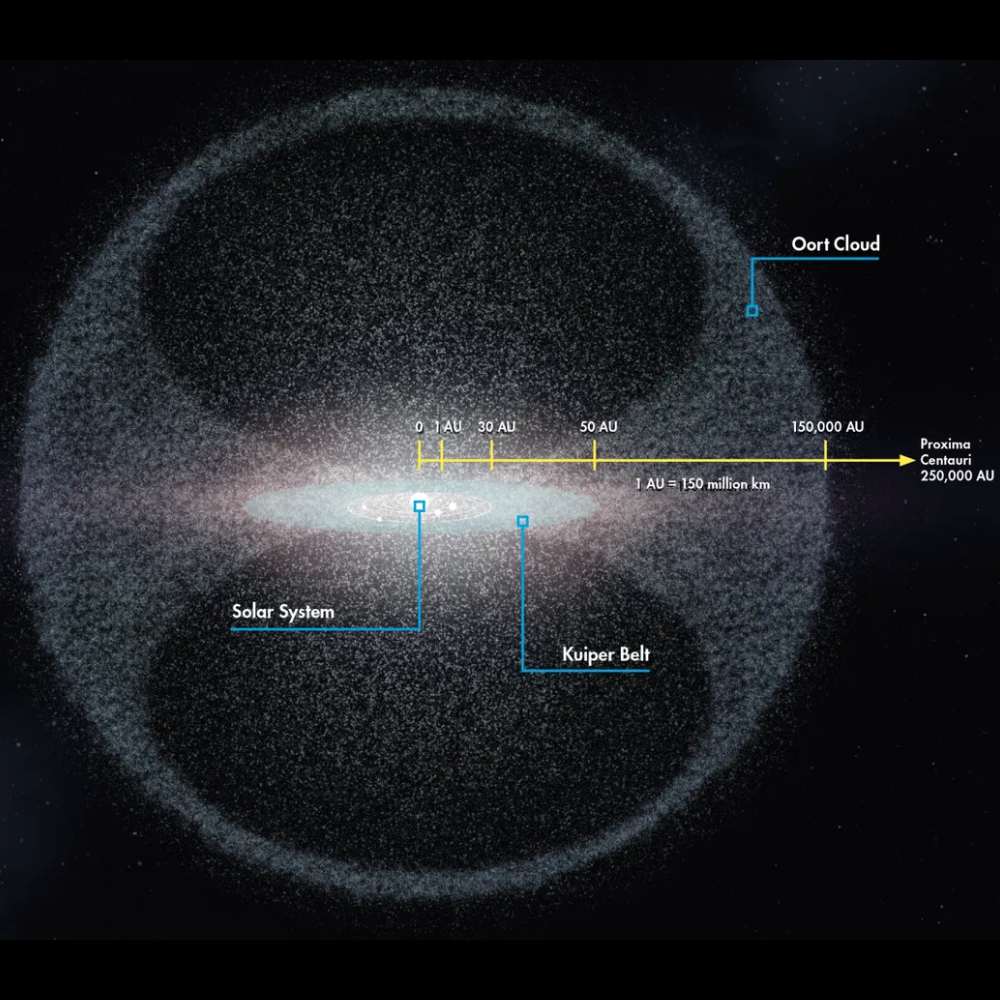
The Oort Cloud is the most distant and mysterious region of the Solar System—an enormous sphere of icy bodies extending almost halfway to the nearest stars. It is the final frontier of the Sun’s gravitational influence, containing trillions of frozen worlds left over from the formation of the planets.
Although no spacecraft has reached the Oort Cloud and no object has been directly observed, its existence is supported by the orbits of long-period comets, which arrive from random directions and travel on vast, elongated trajectories.
The Oort Cloud represents the Solar System’s original building blocks, preserved for 4.6 billion years in a deep-freeze vault far beyond the planets.
Structure – A Two-Part, Planet-Sized Shell
The Oort Cloud likely consists of two major components:
1. The Inner Oort Cloud (Hills Cloud)
Begins around ~2,000–5,000 AU
More disk-like or torus-shaped
Contains hundreds of billions of icy bodies
Orbits more tightly bound to the Sun
2. The Outer Oort Cloud
Extends from ~20,000 AU to ~100,000 AU
A spherical halo surrounding the entire Solar System
Contains trillions of cometary nuclei
Easily perturbed by passing stars and galactic tides
The entire structure may contain enough material to form multiple Earth-sized planets—if the ice were combined.
What the Oort Cloud Is Made Of
Oort Cloud objects are similar to comets:
Water ice
Frozen methane
Frozen ammonia
Carbon compounds
Organic-rich dust
Silicate cores
These bodies are primitive remnants from the early Solar System, preserved in near-absolute darkness and extreme cold—temperatures only a few degrees above absolute zero.
Because they formed closer to the young Sun and were later scattered outward, they provide direct clues about the Solar System’s earliest chemistry.
How the Oort Cloud Formed – The Solar System’s Violent Childhood
The most widely accepted model describes a turbulent history:
Stage 1 – Formation near the giant planets
During the early Solar System, countless icy planetesimals formed near:
Jupiter
Saturn
Uranus
Neptune
Gravitational interactions with these planets flung many objects outward.
Stage 2 – Scattering into the outer Solar System
Some were ejected entirely, but others slowed down through interactions with:
The Sun
The galactic tide
Passing stars
These objects settled into distant, stable orbits.
Stage 3 – The Cloud becomes spherical
Over millions of years, gravitational nudges from the Milky Way reshaped the population into the nearly spherical Oort Cloud we infer today.
A second possibility suggests that a portion of Oort Cloud objects may be captured from nearby star systems in the Sun’s birth cluster—making part of the cloud truly extrasolar.
Why We Think the Oort Cloud Exists – Evidence from Comets
Although we cannot observe it directly, long-period comets provide strong evidence.
Features of these comets include:
Approach from any direction (not just along the ecliptic)
Extremely elongated orbits
Orbital periods of thousands to millions of years
Perihelion near the Sun but apohelion extending tens of thousands of AU
Only a distant, spherical reservoir can explain such randomly oriented orbits.
The Oort Cloud is the only model consistent with these characteristics.
Why We Think the Oort Cloud Exists – Evidence from Comets
Although we cannot observe it directly, long-period comets provide strong evidence.
Features of these comets include:
Approach from any direction (not just along the ecliptic)
Extremely elongated orbits
Orbital periods of thousands to millions of years
Perihelion near the Sun but apohelion extending tens of thousands of AU
Only a distant, spherical reservoir can explain such randomly oriented orbits.
The Oort Cloud is the only model consistent with these characteristics.
The Journey of a Long-Period Comet – From Deep Freeze to Sunlight
When an object in the Oort Cloud is disturbed—by a passing star, galactic tides, or even dark matter streams—it may begin a long inward journey.
The process typically follows these steps:
Initial Perturbation
A small gravitational nudge changes the orbit.
The object begins falling slowly toward the inner Solar System.
Acceleration Toward the Sun
Gravity increases as the body approaches the planetary region.
The orbit becomes a long, stretched ellipse.
Active Comet Phase
When the comet reaches ~5 AU, solar heating begins.
Ice sublimates into gas.
Dust and vapor form a coma and tail.
Perihelion Passage
The comet makes its closest approach to the Sun.
Some disintegrate; others survive.
Return to the Deep Cloud
If not captured or perturbed again, the comet travels back outward.
A full orbit may take thousands to millions of years.
Every long-period or “new” comet that enters the inner Solar System is a physical sample from the Oort Cloud—a preserved fragment of planetary history.
Hills Cloud – The Dense Inner Core of the Oort Cloud
Inside the outer Oort Cloud lies a denser, more compact region known as the Hills Cloud.
Key characteristics:
Starts around ~2,000 AU
Extends to ~20,000 AU
Holds significantly more mass than the outer cloud
Contains tightly bound cometary nuclei
More stable against stellar perturbations
Why it is important:
Acts as a long-term reservoir feeding the outer Oort Cloud
Likely contains trillions of icy objects
Serves as the innermost zone of the Sun’s frozen halo
The Hills Cloud may be the dominant region of the entire Oort Cloud.
The Oort Cloud and Passing Stars – A Delicate Balance
Because the Oort Cloud is so far from the Sun, it is easily influenced by nearby stars.
Effects of stellar encounters:
Slight pushes can send objects inward as comets
Some stars may strip Oort Cloud objects entirely
Others may add foreign cometary bodies from their own outer clouds
Over 4.6 billion years, countless passing stars have reshaped the cloud
Notable future influence:
Gliese 710, a star currently heading toward the Solar System
Will pass within ~10,000 AU in ~1.3 million years
Expected to send millions of comets inward
Possibly triggering episodes of heavy comet influx
The Oort Cloud is not a static structure—it evolves continuously under the influence of the galaxy.
Could the Oort Cloud Contain Captured Extrasolar Objects?
Yes. It is very likely.
During the Sun’s formation in a dense stellar nursery:
Other young stars passed very close
Their outer planetesimal disks overlapped with the early Sun’s
Some objects may have been gravitationally captured
The Oort Cloud might host interstellar fossils
This means some Oort Cloud objects could be:
Born around completely different stars
Older or younger than the Solar System
Made of unusual chemical compositions
The Oort Cloud could therefore preserve material from multiple ancient star systems.
The Outer Limit – Where the Sun’s Gravity Ends
The Oort Cloud marks the edge of the Sun’s gravitational dominance.
Approximate boundaries:
Inner edge: ~2,000 AU
Outer edge: ~100,000 AU (≈ 1.6 light-years)
Limit of Solar control: ~120,000–150,000 AU
Beyond this region:
Surrounding stars begin to exert stronger gravitational pull
Objects may drift into interstellar space
The boundary forms a transitional region between the Solar System and the galaxy
The Oort Cloud is, effectively, the Solar System’s cosmic frontier.
Why We Still Haven’t Detected an Oort Cloud Object Directly
There are several reasons:
Enormous distance
Extremely low temperatures (few Kelvin)
Almost no reflected sunlight
Small size of most objects (1–10 km)
Wide dispersal over huge volumes of space
Even the largest telescopes cannot yet detect such faint bodies.
Future missions using:
Deep infrared detection
Hypertelescopes
Laser-optical interferometry
may finally reveal direct Oort Cloud objects—but not for decades.
The Oort Cloud’s Role in Earth’s History
Although the Oort Cloud sits unimaginably far away, it occasionally sends long-period comets into the inner Solar System. These comets have played a dramatic role in Earth’s geological and biological past.
Possible influences include:
Delivery of water during early Earth formation
Delivery of organic molecules that may have seeded early life
Occasional comet impacts triggering extinction events
Resurfacing Earth with extraterrestrial materials
Because Oort Cloud comets are chemically primitive, they preserve:
The Solar System’s original ices
Early volatile elements
Carbon-rich compounds
Clues to the pre-planetary nebula
Every long-period comet that approaches Earth is essentially a messenger from the dawn of the Solar System.
Could a Rogue Planet or Star Disturb the Oort Cloud?
Yes. The Oort Cloud is extremely sensitive to gravitational disturbances.
Objects that could significantly disrupt it include:
1. Passing stars
A close enough encounter (within a few thousand AU) could:
Send millions of comets inward
Reshape the cloud
Strip part of the cloud away
2. Rogue planets
A drifting planet-sized body passing near the cloud could gravitationally scatter cometary objects.
3. Molecular clouds
The Solar System occasionally passes through dense regions of the galaxy, altering Oort Cloud dynamics.
4. Hypothetical dark objects
Models suggest that:
Dark matter clumps
Invisible substellar bodies
Primordial black holes
could theoretically influence the cloud, generating comet showers.
These comet showers may correlate with periods of increased impacts on Earth.
The Oort Cloud and Interstellar Space – A Transitional Frontier
At its farthest edges, the Oort Cloud overlaps with the gravitational territories of neighboring stars.
This region is not empty—it is a dynamic boundary where:
Solar gravity weakens
Galactic tides dominate
Nearby stars exert comparable influence
Because of this, the Oort Cloud:
Acts as a “buffer zone” between our Solar System and the Milky Way
May exchange bodies with other stars
Contains debris shaped by both stellar and galactic forces
It is the Solar System’s gateway to interstellar space.
Could Life Ever Develop on Oort Cloud Objects?
While extremely unlikely, some theoretical discussions explore:
Subsurface oceans heated by radioactive decay
Thick insulating ice layers
Long-term chemical evolution
But Oort Cloud objects are:
Too small
Too cold
Too isolated
to support anything resembling Earthlike life.
However, they may preserve organic molecules that contribute to life’s early chemistry on planetary surfaces.
Frequently Asked Questions (FAQ)
Has any spacecraft reached the Oort Cloud?
No. Even Voyager 1 and 2 are still tens of thousands of years away from reaching it.
Can telescopes see Oort Cloud objects directly?
Not yet. They are too faint and too distant for current instruments.
Why do comets come from all directions?
Because the Oort Cloud forms a spherical shell around the Solar System.
Is the Oort Cloud part of interstellar space?
It lies within the Sun’s gravitational influence but extends close to interstellar space.
How long does it take for a comet to fall from the Oort Cloud to the Sun?
Anywhere from hundreds of thousands to millions of years.
Related Regions in the Solar System
To understand the Oort Cloud fully, compare it with closer icy reservoirs:
Kuiper Belt – a flattened disk beyond Neptune, source of short-period comets
Scattered Disk – highly eccentric, icy bodies extending outward from the Kuiper Belt
Hills Cloud – dense inner region of the Oort Cloud
Heliopause – boundary of the Sun’s solar wind, far inside the Oort Cloud
Together, these regions form the structural backbone of the Solar System’s outer architecture.
Final Thoughts
The Oort Cloud is the Solar System’s most mysterious and remote component—a vast icy sphere that:
Preserves the earliest materials of the Solar System
Sends comets into the inner planetary region
Interacts with the galaxy’s gravitational forces
Marks the Sun’s outermost gravitational boundary
Connects our Solar System to the broader Milky Way
Although invisible with today’s telescopes, the Oort Cloud remains a cornerstone of planetary science, cosmochemistry, and our understanding of how the Solar System works on the largest scales.
Science is only beginning to uncover its secrets.
Future missions and advanced infrared technologies may one day reveal this hidden, frozen halo surrounding our Sun.