




Oumuamua
The First Known Interstellar Visitor
Quick Reader
| Attribute | Details |
|---|---|
| Official Designation | 1I/ʻOumuamua |
| Classification | Interstellar object |
| Discovery Date | October 19, 2017 |
| Discoverer | Pan-STARRS 1 telescope |
| Discovery Location | Hawaiʻi |
| Origin | Outside the Solar System |
| Closest Approach to Sun | ~0.25 AU |
| Closest Approach to Earth | ~0.16 AU |
| Velocity | ~26 km/s relative to the Sun |
| Shape | Highly elongated or flattened (uncertain) |
| Coma | None detected |
| Tail | None detected |
| Naming Origin | Hawaiian language (“scout” / “messenger”) |
Introduction – A Visitor That Should Not Have Been There
For centuries, astronomy assumed a simple truth:
everything we see in the Solar System belongs here.
That assumption collapsed in 2017.
When astronomers detected a fast-moving object on a sharply hyperbolic trajectory—clearly not bound to the Sun—it became instantly obvious that this was something entirely new. The object was later named ʻOumuamua, meaning “a messenger from afar arriving first.”
ʻOumuamua was not a comet.
It was not an asteroid.
It was the first known object from another star system ever observed passing through our Solar System.
Its brief appearance forced scientists to confront a deeper reality:
interstellar space is not empty—and planetary systems constantly exchange material.
Discovery – A Moment That Changed Planetary Science
ʻOumuamua was discovered on October 19, 2017, by the Pan-STARRS 1 telescope in Hawaiʻi. At first glance, it appeared to be a small, faint asteroid. But orbital calculations quickly revealed something extraordinary.
What Made ʻOumuamua Different
Its trajectory was hyperbolic, not elliptical
Its speed exceeded Solar System escape velocity
It was already leaving the Solar System when discovered
This meant one thing:
ʻOumuamua did not originate from the Sun.
It was already on its way out—giving astronomers only weeks to observe it before it faded into interstellar darkness.
Why ʻOumuamua Was So Important Immediately
Before ʻOumuamua, interstellar objects were theoretical.
Astronomers expected that:
Planetary systems eject debris
Interstellar space should contain rogue objects
Some should occasionally pass through other systems
But expectation is not evidence.
ʻOumuamua became the first direct proof that:
Planetary systems exchange solid material
Interstellar debris is common
The Solar System is not isolated
This single object confirmed decades of theoretical work in planetary formation and dynamical evolution.
The Trajectory That Could Not Be Ignored
ʻOumuamua’s orbit was unlike anything seen before.
Key Orbital Characteristics
Eccentricity: ~1.2 (greater than 1 = unbound)
Inbound direction: near the Solar apex
Outbound path: permanently leaving the Sun
No known Solar System process can produce such an orbit naturally.
This trajectory alone was enough to classify ʻOumuamua as interstellar, even before its physical properties were studied.
A Shape That Defied Expectations
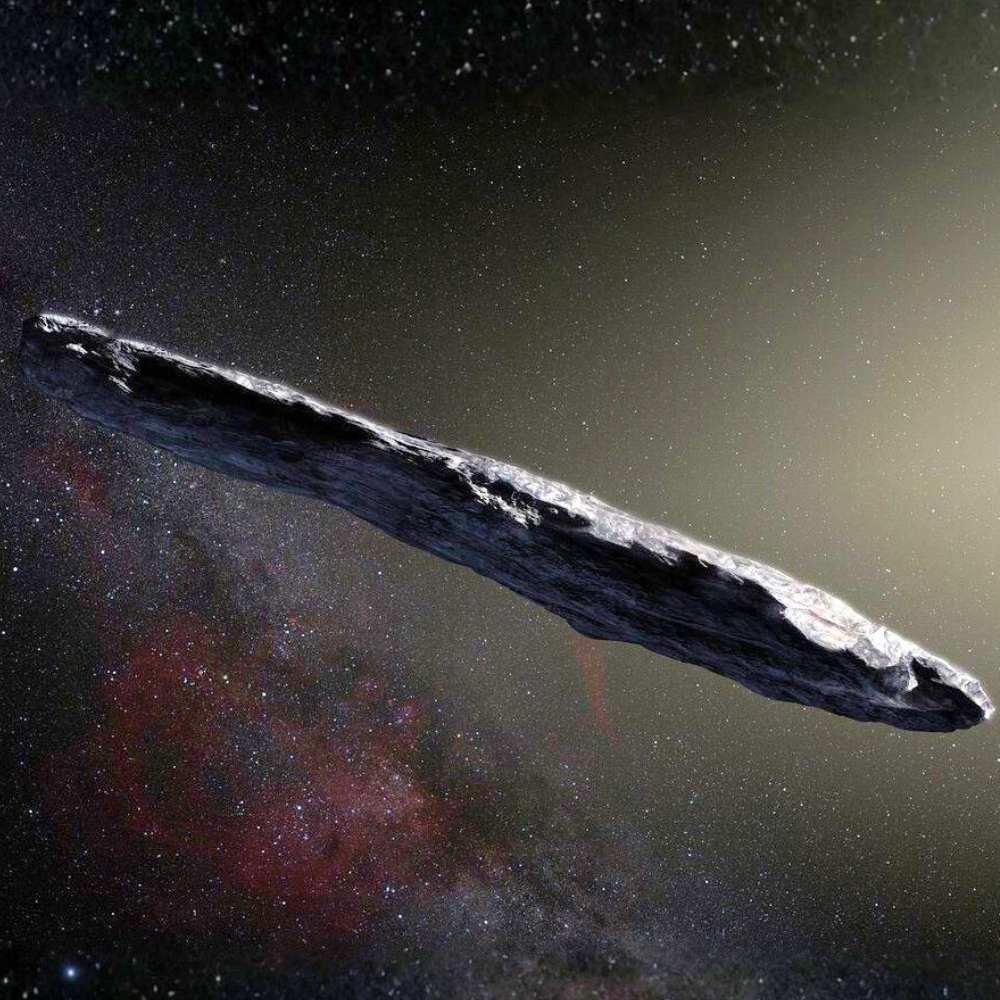
As astronomers analyzed changes in ʻOumuamua’s brightness, they noticed dramatic fluctuations—far more extreme than typical asteroids.
This implied an extraordinary shape.
Two leading interpretations emerged:
A cigar-like object, up to 10 times longer than wide
Or an extremely thin, pancake-like shape
Either way, ʻOumuamua appeared far more elongated than any known asteroid or comet.
This immediately raised questions:
How could such a shape form?
Could it survive interstellar travel?
Does this imply exotic formation environments?
No consensus exists even today.
No Coma, No Tail – And Yet, It Accelerated
Perhaps the most puzzling discovery came later.
As ʻOumuamua left the inner Solar System, precise tracking revealed non-gravitational acceleration—it was speeding up slightly more than gravity alone could explain.
Normally, this happens when:
Ice sublimates
Gas jets push a comet forward
But ʻOumuamua showed:
No visible coma
No detectable tail
No typical cometary gases
This contradiction sits at the heart of the ʻOumuamua mystery.
Early Interpretations – Asteroid or Comet?
At first, scientists tried to fit ʻOumuamua into familiar categories.
Asteroid Hypothesis
Supported by lack of visible outgassing
Challenged by non-gravitational acceleration
Comet Hypothesis
Supported by acceleration
Challenged by absence of coma or dust
Neither explanation fully worked.
ʻOumuamua appeared to be something new, or at least something rare.
Why ʻOumuamua Is Not “Just Another Object”
ʻOumuamua matters because it represents an entirely new class of astronomical object:
Interstellar solid bodies
Products of other planetary systems
Physical samples of alien stellar environments
For the first time, humanity observed material from another star system without leaving home.
That alone places ʻOumuamua among the most important astronomical discoveries of the 21st century.
Scientific Tension – When Data Outpaces Theory
ʻOumuamua exposed a critical reality in modern astronomy:
| Our models of small-body formation were built entirely on Solar System examples.
ʻOumuamua showed that:
Other systems may produce very different debris
Our classifications may be incomplete
Nature is not obligated to match our expectations
This tension is not a failure—it is how science advances.
Why ʻOumuamua Fits Perfectly in Universe Map
ʻOumuamua connects multiple high-level topics:
Planetary system formation
Small body physics
Interstellar medium
Kuiper Belt and Oort Cloud comparisons
Future interstellar exploration
It acts as a bridge object, linking Solar System science with galactic dynamics.
The Central Mystery – Why ʻOumuamua Did Not Behave Like Anything We Knew
By late 2017, astronomers agreed on one thing:
ʻOumuamua was interstellar.
But beyond that, almost everything else was uncertain.
The object combined properties that should not coexist:
No visible coma or tail
Yet measurable non-gravitational acceleration
Extreme shape
Rapid, tumbling rotation
Very small size
This combination forced scientists to move beyond traditional categories and explore new physical models.
The Non-Gravitational Acceleration Problem
Precise tracking of ʻOumuamua’s trajectory revealed that gravity alone could not explain its motion. The object experienced a small but statistically significant extra push as it moved away from the Sun.
Why This Was So Important
Acceleration usually implies outgassing
Outgassing normally produces a visible coma
ʻOumuamua showed none
This ruled out ordinary water-ice sublimation, the mechanism behind classical comets.
The question became:
What can cause acceleration without leaving visible traces?c
Hypothesis 1 – Hydrogen Iceberg (The Leading Natural Model)
One of the most influential explanations proposes that ʻOumuamua was made largely of solid molecular hydrogen (H₂).
How This Model Works
Hydrogen ice sublimates at very low temperatures
Sublimation produces thrust without dust
Hydrogen gas is nearly invisible
This would explain:
The acceleration
The lack of coma
The clean appearance
Why It’s Controversial
Solid hydrogen ice is extremely fragile
It is unclear whether such objects can form and survive
No confirmed hydrogen-ice bodies are known
This model is elegant, but it pushes the limits of what we believe can exist naturally.
Hypothesis 2 – Nitrogen Ice Fragment (Pluto-Like Origin)
Another widely discussed model suggests ʻOumuamua was a fragment of nitrogen ice, chipped off an exo-Pluto-like world.
Supporting Arguments
Nitrogen ice sublimates without dust
Explains acceleration naturally
Accounts for reflective surface
Consistent with Pluto-like crusts
In this scenario:
A large icy exoplanet experienced a massive impact
Nitrogen-rich surface material was ejected
The fragment wandered interstellar space
This hypothesis connects ʻOumuamua directly to Kuiper Belt–like processes in other star systems.
Hypothesis 3 – Extreme Porosity (“Cosmic Fluffy Aggregate”)
Some researchers propose that ʻOumuamua was a highly porous object, with very low density.
Key Features
Large surface area
Low mass
Radiation pressure could cause acceleration
In this model:
Sunlight itself provides the push
No gas or dust is required
Limitations
Requires extreme porosity
Structural survival over interstellar distances is uncertain
Still, this idea expands how we think about small-body structures.
Hypothesis 4 – Artificial Origin (Why It Was Discussed)
The most controversial hypothesis suggested that ʻOumuamua might be artificial, such as a lightsail or probe.
This idea gained attention because:
Radiation pressure could explain acceleration
Shape seemed unusual
Lack of outgassing puzzled researchers
Why Scientists Largely Reject This
No evidence of control or communication
Natural explanations exist, even if exotic
Extraordinary claims require extraordinary evidence
Importantly, the discussion itself was not unscientific—
it reflected how unexpected ʻOumuamua truly was.
Why the Debate Was Inevitable
ʻOumuamua arrived with two major constraints:
It was detected late, already leaving the Solar System
Observation time was extremely limited
This forced scientists to:
Work with incomplete data
Test multiple competing models
Accept uncertainty
Rather than a weakness, this is a real example of science in motion.
What ʻOumuamua Tells Us About Other Star Systems
Regardless of its exact composition, ʻOumuamua reveals something profound:
Planetary systems routinely eject solid material
Interstellar space contains countless such objects
The Solar System is constantly being crossed by alien debris
This implies that:
Every star system samples others over time
Material exchange is a galactic process
Our Solar System is not chemically isolated
ʻOumuamua was not special because it was unique—
but because it was the first one we noticed.
Why We Missed Interstellar Objects Before
ʻOumuamua was only discovered because:
Modern sky surveys scan continuously
Detection algorithms improved
Astronomers knew what to look for
It is now estimated that:
Several interstellar objects pass through the Solar System every year
Most go unnoticed
ʻOumuamua likely represents a vast, unseen population.
The Shift It Forced in Astronomy
After ʻOumuamua:
“Interstellar object” became a real category
Search strategies changed
Missions began to be proposed
The discovery directly influenced:
Detection pipelines
Survey priorities
Concepts for rapid-response spacecraft
ʻOumuamua did not just raise questions—it changed how we search the sky.
Context Within Universe Map
ʻOumuamua sits at the intersection of:
Kuiper Belt physics
Oort Cloud theory
Exoplanetary debris disks
Galactic dynamics
It is the missing link between:
Solar System small bodies
Extrasolar planetary systems
This makes it a cornerstone object for Universe Map’s cosmic connectivity theme.
ʻOumuamua’s Fate – Gone Forever
ʻOumuamua has already left the Solar System.
After its brief passage through the inner regions in 2017, it continued on a hyperbolic escape trajectory, accelerating away from the Sun and fading beyond the reach of even the largest telescopes.
Key points about its fate:
It will never return
It is now moving through interstellar space
It will wander the Milky Way for hundreds of millions to billions of years
ʻOumuamua did not come to stay. It came to pass through—and in doing so, it left behind questions far larger than itself.
ʻOumuamua vs 2I/Borisov – Why They Are Not the Same
In 2019, a second interstellar object, 2I/Borisov, was discovered. This allowed scientists to compare two visitors from beyond the Solar System.
| Feature | ʻOumuamua | 2I/Borisov |
|---|---|---|
| Discovery Year | 2017 | 2019 |
| Appearance | No coma or tail | Clear cometary coma |
| Acceleration | Non-gravitational | Comet-like outgassing |
| Shape | Extreme / unusual | Typical comet nucleus |
| Interpretation | Exotic or rare | Familiar interstellar comet |
This comparison clarified something critical:
ʻOumuamua is not representative of all interstellar objects.
Instead, it likely represents a rare or extreme subset—possibly fragments of planetary crusts or unusual formation environments.
What ʻOumuamua Changed Permanently
Before 2017:
Interstellar objects were hypothetical
Detection strategies were passive
After ʻOumuamua:
Interstellar objects became a new observational field
Surveys actively search for hyperbolic trajectories
Detection pipelines were redesigned
ʻOumuamua forced astronomy to expand its classification system.
The Next Interstellar Visitor Is Already on the Way
Based on modern models, scientists now estimate:
Several interstellar objects pass through the Solar System every year
Most are too small or faint to detect
Improved surveys will soon find many more
Upcoming facilities like the Vera C. Rubin Observatory (LSST) are expected to detect:
Dozens of interstellar objects per year
Some early enough for long-term study
ʻOumuamua was the first—but it will not be the last.
Can We Intercept the Next One?
One of the most exciting outcomes of ʻOumuamua’s discovery is the idea of rapid-response missions.
Proposed Concepts
Fast-launch interceptors
Solar sail–assisted spacecraft
Pre-positioned probes in heliocentric orbit
The goal:
Reach an interstellar object while it is still inbound
Study it up close
Analyze material from another star system directly
Such a mission would represent a new era in planetary science.
Why ʻOumuamua Matters Beyond Astronomy
ʻOumuamua’s significance goes beyond orbits and equations.
It shows that:
Planetary systems are not isolated
Material exchange occurs on a galactic scale
The building blocks of planets travel between stars
This has implications for:
Planet formation theory
Chemical mixing in the galaxy
The distribution of organic material
In a very real sense, ʻOumuamua was a physical messenger from another stellar neighborhood.
Frequently Asked Questions (FAQ)
Was ʻOumuamua an alien spacecraft?
There is no evidence that ʻOumuamua was artificial. All observed properties can be explained by natural—though unusual—physical models.
Why didn’t we send a spacecraft to ʻOumuamua?
It was discovered too late and was already moving away at extremely high speed.
Are interstellar objects rare?
No. They are likely common. ʻOumuamua was simply the first detected.
How big was ʻOumuamua?
Estimates range from ~100 to 400 meters, depending on shape assumptions.
Will we see another one soon?
Yes. Future surveys are expected to detect many more.
ʻOumuamua’s Place in Universe Map
ʻOumuamua connects:
Kuiper Belt science
Oort Cloud dynamics
Exoplanetary debris disks
Galactic-scale material exchange
It is a bridge object, linking Solar System science with extrasolar planetary systems.
For Universe Map, ʻOumuamua represents:
Cosmic interconnectedness
The limits of current knowledge
The transition from isolated systems to a shared galaxy
Final Perspective
ʻOumuamua did not answer our questions—it created better ones.
It showed us that the Solar System is not a closed box, but an open crossroads through which material from distant stars quietly passes. It challenged our assumptions, exposed gaps in our models, and reminded us that discovery often arrives unannounced.
In just a few weeks of visibility, ʻOumuamua reshaped an entire field of astronomy.
Long after it vanished into the dark between the stars, its legacy remains—proof that even a small, silent object can permanently change how we understand the universe.