






Ozone Layer
Earth’s Invisible Shield Against Solar Radiation
Quick Reader
| Attribute | Details |
|---|---|
| Layer Name | Ozone Layer |
| Location | Stratosphere |
| Average Altitude | ~15–35 km above Earth |
| Main Gas | Ozone (O₃) |
| Primary Function | Absorbs harmful ultraviolet (UV) radiation |
| Discovered | 1913 (Fabry & Buisson) |
| Key Threat | Ozone-depleting substances (CFCs, halons) |
| Famous Event | Antarctic ozone hole |
| Protection Treaty | Montreal Protocol (1987) |
| Current Status | Slowly recovering |
In two sentences
The ozone layer is a thin but vital concentration of ozone gas in Earth’s stratosphere that protects life by absorbing most harmful ultraviolet radiation from the Sun. Without it, complex life on land would struggle to survive.
Key takeaway
The ozone layer is not optional—it is essential for life on Earth.
Best for
Earth science, atmospheric chemistry, climate studies, environmental policy, and planetary habitability research.
Introduction – The Shield You Cannot See
Earth does not have a physical shield against the Sun.
Yet life thrives on land.
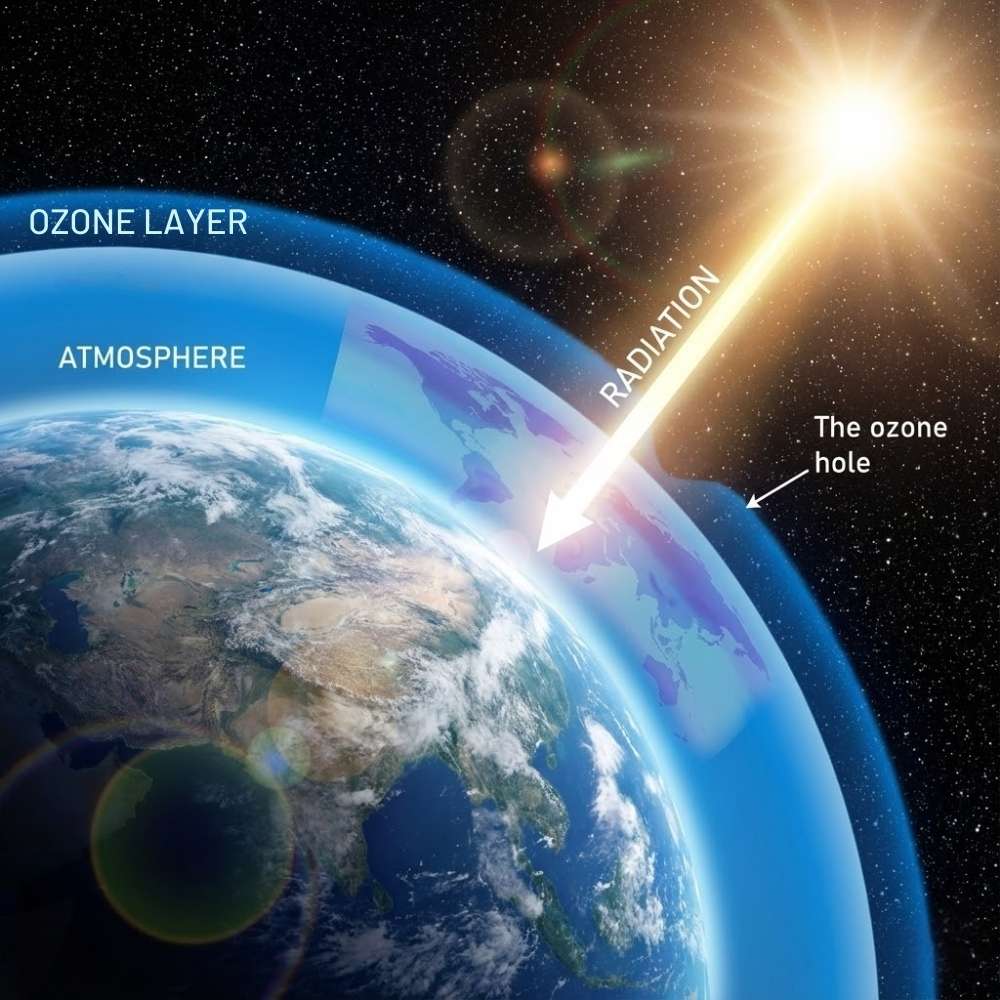
The reason is the ozone layer—an invisible chemical barrier high in the atmosphere that absorbs deadly ultraviolet radiation. It does not stop sunlight, heat, or visible light. It selectively blocks what would otherwise damage DNA, cause cancer, and collapse ecosystems.
The ozone layer is one of the most important yet fragile systems supporting life on Earth.
What Is the Ozone Layer?
The ozone layer is a region of the stratosphere with a higher concentration of ozone molecules (O₃).
Important clarifications:
Ozone is a form of oxygen, not a separate element
It is sparse—even at peak concentration
Spread evenly, it would form a layer only a few millimeters thick
Despite its thinness, its effect is enormous.
Where Exactly Is the Ozone Layer Located?
The ozone layer sits in the stratosphere, above the troposphere where weather occurs.
Altitude range:
Lower boundary: ~15 km
Peak concentration: ~20–25 km
Upper boundary: ~35 km
This height is critical because it allows ozone to intercept ultraviolet radiation before it reaches Earth’s surface.
Why Ozone Is Special
Ozone has a unique chemical property:
it strongly absorbs ultraviolet (UV-B and UV-C) radiation.
This absorption:
Protects living cells from DNA damage
Prevents widespread skin cancer
Shields plant photosynthesis
Stabilizes ecosystems
In doing so, ozone converts harmful radiation into harmless heat, warming the stratosphere.
The Ozone–UV Balance
The ozone layer exists in a delicate balance.
Natural process:
UV radiation splits oxygen molecules (O₂)
Free oxygen atoms combine with O₂ to form ozone (O₃)
Ozone absorbs UV and breaks back into O₂
This continuous cycle maintains the ozone layer—unless disrupted.
Ozone Layer vs Oxygen in the Air
A common misconception is that ozone and breathable oxygen serve the same role.
Key difference:
Oxygen (O₂): Supports respiration
Ozone (O₃): Protects from radiation
Too much ozone near the ground is harmful.
Ozone high in the stratosphere is life-saving.
Location matters.
Why Earth Has an Ozone Layer (and Mars Does Not)
Earth’s ozone layer exists because:
Abundant oxygen from photosynthesis
Strong solar UV to drive ozone formation
A stable atmosphere and magnetic field
Mars lacks a strong ozone layer due to:
Thin atmosphere
Low oxygen content
Weak magnetic protection
This comparison shows why ozone is central to planetary habitability.
What Happens Without an Ozone Layer?
If the ozone layer vanished:
UV radiation would sterilize land surfaces
Crop yields would collapse
Marine food chains would be disrupted
Skin cancer rates would skyrocket
Life might survive only underwater or underground.
The ozone layer is not just protective—it is foundational.
Why Scientists Monitor the Ozone Layer Closely
Ozone is chemically fragile.
It can be destroyed by:
Chlorine and bromine compounds
Certain industrial chemicals
Complex catalytic reactions
Because damage can happen faster than recovery, continuous monitoring is essential.
How Humans Began to Damage the Ozone Layer
For most of Earth’s history, the ozone layer remained stable.
That changed in the 20th century.
Scientists discovered that certain human-made chemicals could rise into the stratosphere and destroy ozone molecules far more efficiently than natural processes.
The most dangerous among them were:
CFCs (Chlorofluorocarbons)
Halons
Carbon tetrachloride
Methyl chloroform
These substances were widely used because they were:
Chemically stable
Non-toxic at ground level
Cheap and effective
Ironically, that same stability made them dangerous in the upper atmosphere.
Why CFCs Were So Destructive
CFCs do not break down in the lower atmosphere.
Instead:
They slowly drift into the stratosphere
Intense UV radiation breaks them apart
Free chlorine atoms are released
A single chlorine atom can:
Destroy thousands of ozone molecules
Act catalytically (not consumed in the reaction)
This meant small emissions caused large-scale damage.
The Discovery of the Ozone Hole
In the early 1980s, scientists noticed something alarming.
Over Antarctica:
Springtime ozone levels were collapsing
Losses exceeded 50% in some years
This phenomenon became known as the Antarctic ozone hole.
Key facts:
It forms seasonally (Antarctic spring)
It is linked to extremely cold stratospheric temperatures
Polar stratospheric clouds accelerate ozone destruction
This was not thinning—it was near-total local collapse.
Why Antarctica Was Hit First
Antarctica’s unique conditions made it especially vulnerable:
Extremely cold stratosphere
Isolated polar vortex
Formation of polar stratospheric clouds
These clouds allow chlorine compounds to become highly reactive when sunlight returns after winter darkness.
When sunlight returns, ozone destruction accelerates rapidly.
Global Effects Beyond Antarctica
Although most dramatic over Antarctica, ozone depletion affected the entire planet.
Observed consequences included:
Increased UV-B radiation at Earth’s surface
Higher skin cancer risk
Damage to phytoplankton
Reduced crop productivity
The ozone crisis was not regional—it was global.
Scientific Consensus and Urgency
By the mid-1980s:
Laboratory chemistry
Atmospheric observations
Satellite data
All pointed to the same conclusion:
Human activity was destroying the ozone layer.
This was one of the rare moments in science where:
Evidence was clear
Mechanisms were understood
Predictions were testable
The situation demanded immediate action.
The Montreal Protocol – A Turning Point
In 1987, nations acted.
The Montreal Protocol on Substances that Deplete the Ozone Layer:
Banned or phased out CFCs and halons
Included binding international commitments
Provided support for developing countries
It became the most successful environmental treaty in history.
Every UN member nation eventually ratified it.
Why the Montreal Protocol Worked
Several factors made it successful:
Clear scientific evidence
Availability of chemical alternatives
Global cooperation
Strong enforcement mechanisms
Most importantly, the problem was specific and solvable.
Early Signs of Recovery
After CFC emissions declined:
Stratospheric chlorine levels peaked and began falling
Ozone loss slowed
Gradual recovery trends became detectable
However, ozone recovery is slow because:
CFCs persist for decades
Atmospheric circulation is complex
The damage was reversible—but not quickly.
Ozone vs Climate Change – An Important Distinction
Ozone depletion and climate change are often confused.
Key difference:
Ozone depletion: caused by specific chemicals, now controlled
Climate change: caused by greenhouse gases, still increasing
The ozone crisis shows that global environmental problems can be solved—but only with coordinated action.
The Current State of the Ozone Layer
Today, the ozone layer is recovering, but it has not fully healed.
Key observations show that:
Stratospheric chlorine and bromine levels are declining
The Antarctic ozone hole is shrinking in size and duration
Global ozone levels are slowly increasing
According to scientific assessments, if current protections remain in place, the ozone layer is expected to return to pre-1980 levels within this century.
When Will the Ozone Layer Fully Recover?
Estimated recovery timelines:
Mid-latitudes: around 2040
Arctic regions: around 2045
Antarctica (ozone hole): around 2060–2070
These timelines depend on:
Continued compliance with the Montreal Protocol
No large-scale release of banned substances
Stable atmospheric circulation patterns
Ozone recovery is slow because many harmful chemicals remain in the atmosphere for 50–100 years.
Unexpected Challenges and Setbacks
Although progress is clear, challenges remain.
Examples include:
Illegal production of banned CFCs detected in recent years
Interactions between climate change and stratospheric chemistry
Changes in atmospheric circulation affecting ozone distribution
Climate change can both help and hinder ozone recovery, depending on altitude and region.
Ozone Layer and Climate Change – How They Interact
Ozone depletion and climate change are linked, but distinct.
Important interactions:
Greenhouse gases cool the stratosphere
Colder stratospheric temperatures can increase ozone loss in polar regions
Some ozone-depleting substances are also powerful greenhouse gases
This makes ozone protection and climate policy scientifically connected, even if politically separate.
Why Monitoring the Ozone Layer Never Stops
Even with recovery underway, continuous monitoring is essential.
Scientists rely on:
Satellite missions
High altitude balloons
Ground-based spectrometers
Monitoring ensures:
Early detection of new threats
Verification of treaty compliance
Understanding of long-term atmospheric trends
The ozone layer is stable only as long as it is protected and observed.
Frequently Asked Questions (FAQ)
Is the ozone layer fully healed now?
No.
It is recovering, but full restoration will take several more decades.
Is the ozone hole the same as global ozone depletion?
No.
The ozone hole is a severe seasonal loss over Antarctica, while global ozone depletion refers to thinner ozone worldwide.
Can the ozone layer be damaged again?
Yes.
If ozone-depleting substances are released in large quantities, damage could resume.
Does climate change destroy the ozone layer?
Not directly, but climate change affects atmospheric temperatures and circulation, which can influence ozone chemistry.
Is ground-level ozone the same as the ozone layer?
No.
Ground-level ozone is a pollutant harmful to health, while stratospheric ozone is protective.
Why don’t other planets have strong ozone layers?
Because they lack sufficient oxygen, biological production, or atmospheric stability needed to sustain ozone.
Why is the ozone layer important for Universe Map readers?
The ozone layer shows how planetary atmospheres protect life and how fragile habitability can be.
The Ozone Layer as a Planetary Habitability Lesson
The ozone layer teaches a profound lesson:
Life can transform a planet
That transformation can protect life itself
Technology can disrupt planetary systems
Collective action can repair damage
Earth’s habitability is not guaranteed—it is maintained.
Related Topics for Universe Map
Stratosphere
Atmospheric Chemistry
UV Radiation
Planetary Habitability
Mars Atmosphere
Climate Systems
Together, these topics explain how atmospheres evolve and support life.
Final Perspective
The ozone layer is thin, fragile, and invisible.
Yet it stands between life and lethal radiation from the Sun.
Humanity once damaged this shield—without understanding the consequences.
Then, guided by science, it chose to act.
The ozone story proves something rare and powerful:
planetary-scale damage can be reversed when knowledge and cooperation align.
Earth is habitable not by accident—but by balance, vigilance, and responsibility.