




Perseus Arm
The Grand Spiral Structure of Our Milky Way
Quick Reader
| Attribute | Details |
|---|---|
| Name | Perseus Arm |
| Type | Major Spiral Arm of the Milky Way |
| Location | Between the Sagittarius Arm (inside) and the Outer Arm (outside) |
| Distance from Earth | ~6,400 light-years at its nearest point |
| Length | ~40,000 light-years (estimated) |
| Width | ~3,000 light-years |
| Main Composition | Stars, gas clouds, molecular hydrogen, and dark matter |
| Dominant Stellar Features | Massive O- and B-type stars, H II regions, and young open clusters |
| Notable Regions | W3–W4–W5 complex, IC 1805 (Heart Nebula), IC 1848 (Soul Nebula), NGC 7538, Cassiopeia OB associations |
| Galactic Coordinates | Longitude range: 50°–160° |
| Discovery | Mapped in the 1950s via radio observations of hydrogen (21 cm line) |
| Best Observation Wavelengths | Radio and infrared (due to dust obscuration in visible light) |
| Significance | One of the Milky Way’s four primary spiral arms, rich in star formation and nebular activity |
Introduction — The Milky Way’s Bright Northern Arm
When we gaze at the night sky from the Northern Hemisphere, especially toward Cassiopeia, Perseus, and Auriga, we are looking directly into one of the Milky Way’s most majestic structures — the Perseus Arm.
Stretching across tens of thousands of light-years, this immense spiral arm is a cosmic nursery, filled with glowing nebulae, giant molecular clouds, and massive stars still forming from swirling gas.
It’s named after the constellation Perseus, along whose line of sight the arm is most prominent.
For astronomers, the Perseus Arm is both a map and a mystery — a fundamental part of our galaxy’s architecture that reveals how spiral arms trigger, sustain, and regulate star formation on a galactic scale.
Structure and Position in the Milky Way
1. Galactic Location
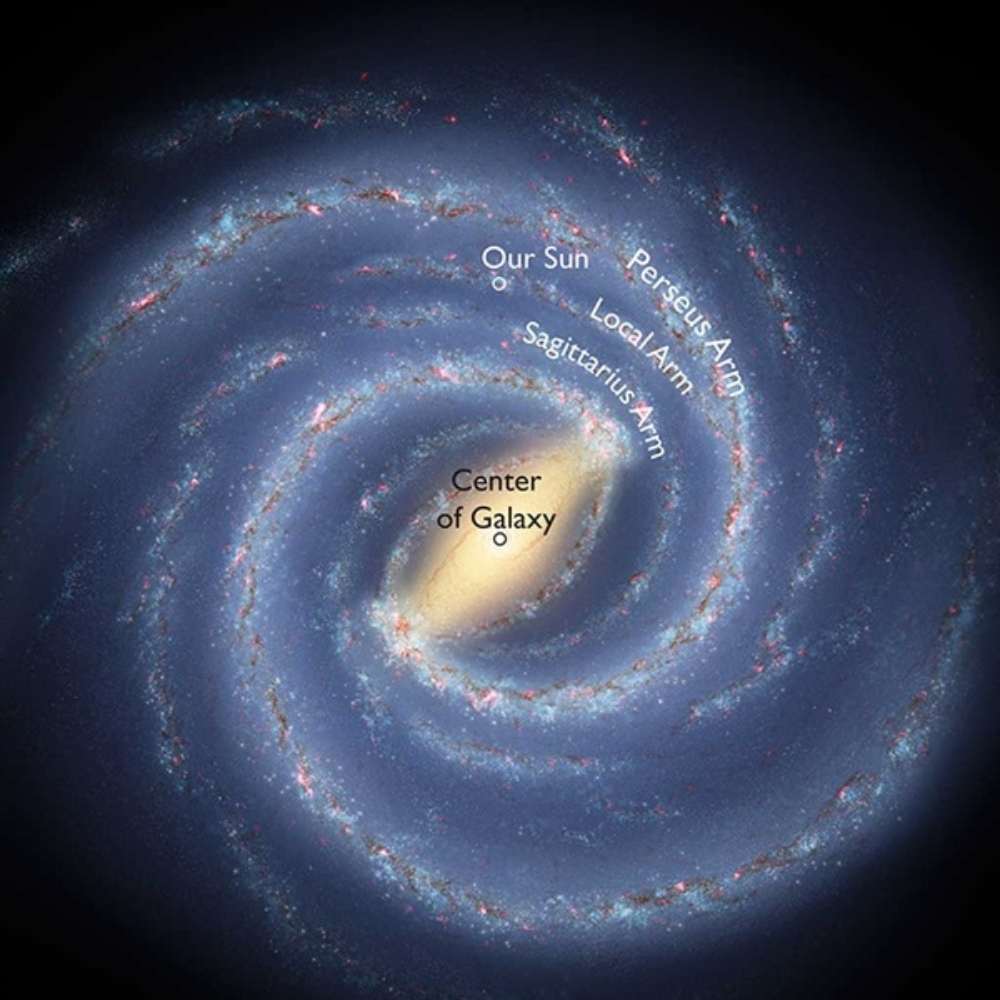
The Perseus Arm lies outside the Orion Arm (or Local Spur) — the smaller segment where our own Solar System resides — and inside the Outer Arm.
In the grand map of the Milky Way, it is considered the nearest major spiral arm beyond our own.
Here’s a simplified view of its position:
[Galactic Center]
 → Sagittarius Arm
 → Orion Arm (Local Spur; includes Sun)
 → Perseus Arm
 → Outer Arm
The arm arcs across the second and third Galactic quadrants, visible mainly from the Northern Hemisphere.
Its inner edge approaches about 6,000 light-years from Earth, while the farthest parts extend nearly 15,000 light-years away.
2. Physical Composition
Like all spiral arms, the Perseus Arm is not a solid structure — it’s a density wave made of stars and interstellar gas.
It contains:
Giant molecular clouds (where stars are born)
H II regions (ionized gas clouds around young stars)
Open clusters and OB associations (groups of hot, massive stars)
This arm is particularly bright in radio and infrared wavelengths, because dust obscures much of its visible light.
Star Formation Regions — The Beating Heart of the Perseus Arm
The Perseus Arm is home to some of the most active and visually stunning star-forming complexes in the galaxy.
1. W3–W4–W5 Complex
Located in the constellation Cassiopeia, this trio forms one of the most studied regions in radio and infrared astronomy.
W3: A giant molecular cloud rich in young stellar objects and massive protostars.
W4 (IC 1805): Known as the Heart Nebula, featuring a massive stellar cluster (Melotte 15) that lights up the surrounding gas.
W5 (IC 1848): The Soul Nebula, characterized by elephant-trunk pillars and ongoing stellar birth.
Together, W3–W4–W5 showcase the chain reaction of star formation, where winds and radiation from one generation of stars compress nearby gas, creating the next.
2. NGC 7538 — Birthplace of Massive Stars
NGC 7538, also located in the Perseus Arm, hosts one of the largest known protostars, more than 30 times the mass of the Sun.
It’s a laboratory for understanding how massive stars form — a process that remains one of astrophysics’ great challenges.
3. IC 1795 and Sh2-202
These nebulae form part of the same star-forming complex, producing clusters of young, blue O- and B-type stars.
Their ultraviolet radiation ionizes surrounding gas, creating the glowing red emission we see in hydrogen-alpha images.
Open Clusters and Stellar Associations
The Perseus Arm is dotted with numerous open clusters, most only a few million years old — evidence of its ongoing stellar activity.
| Cluster | Age (Myr) | Distance (ly) | Notable Feature |
|---|---|---|---|
| NGC 884 & NGC 869 (Double Cluster) | ~12 | 7,500 | Twin clusters in Perseus; rich in blue supergiants |
| NGC 7380 | ~5 | 8,000 | Hosts the Wizard Nebula (Sh2-142) |
| NGC 1624 | ~4 | 20,000 | Home to a massive O-type star with strong magnetic field |
| IC 1805 Cluster (Melotte 15) | ~1.5 | 6,500 | Central cluster in Heart Nebula |
| IC 1848 Cluster | ~2 | 6,800 | Young stellar nursery in Soul Nebula |
These clusters trace the spiral arm’s curvature, marking the locations of recent star formation across thousands of light-years.
How the Perseus Arm Was Discovered
Until the mid-20th century, astronomers couldn’t directly map our own galaxy’s spiral arms because we live inside them.
The breakthrough came in the 1950s, when radio astronomers began detecting 21 cm emission from neutral hydrogen (H I).
This allowed them to trace gas concentrations through the plane of the Milky Way.
The Perseus Arm appeared as a strong, continuous band of hydrogen emission, clearly distinct from the nearer Sagittarius–Carina and Orion arms.
Later, molecular line observations (especially CO emission) confirmed that the Perseus Arm is one of the Milky Way’s primary star-forming structures.
Comparison — Perseus Arm and Other Spiral Arms
| Arm Name | Distance from Galactic Center | Dominant Regions | Key Characteristic |
|---|---|---|---|
| Sagittarius–Carina Arm | 6,500 ly | Lagoon Nebula, Trifid Nebula | Strong radio emission; inner structure |
| Orion (Local) Spur | 8,000 ly | Orion Nebula, Solar System | Minor arm or spur |
| Perseus Arm | 9,000–10,000 ly | Heart & Soul Nebulae, W3–W5 Complex | Major northern arm; active star formation |
| Outer Arm | 13,000–14,000 ly | Sh2-298, NGC 2579 | Faint, distant, less active |
Structure, Motion, and Galactic Mapping
The Perseus Arm is one of the Milky Way’s four major spiral arms, forming a broad arc of stars, dust, and gas that defines much of the galaxy’s visible northern disk.
Yet, because we view it from within the Milky Way’s plane, understanding its true shape and extent has required decades of careful mapping.
1. The Architecture of the Arm
Spiral arms are not physical objects but density waves—regions where stars and gas crowd together like ripples in a rotating disk.
As interstellar clouds enter a density wave, they are compressed, triggering new star formation.
In the Perseus Arm:
Young, massive O- and B-type stars trace the spiral ridge.
Older stars drift ahead of the dense gas.
Shock fronts at the inner edge ignite molecular clouds into emission nebulae.
The result is a continuous ribbon of luminous clusters and glowing H II regions stretching for tens of thousands of light-years.
2. Velocity Mapping
The Perseus Arm was first identified through radio velocity surveys using the 21-centimeter hydrogen line.
Because hydrogen gas emits at a precise wavelength, astronomers could measure its Doppler shift to calculate radial velocity relative to the Sun.
By correlating these velocities with Galactic rotation models, they mapped the arm’s position and curvature.
3. Gaia and VLBI Parallax
Modern missions have refined this map with exquisite precision:
Gaia (ESA): Provides accurate parallax and proper motion data for thousands of stars within the arm.
VLBI (Very Long Baseline Interferometry): Measures maser emissions from star-forming regions, offering distances accurate to within a few percent.
These observations confirm that the Perseus Arm’s pitch angle—the degree of spiral winding—is about 9°–12°, typical of grand-design spiral galaxies.
Spiral Density Waves — The Engine Behind the Structure
1. The Theory
According to Spiral Density Wave Theory, spiral arms are gravitational standing waves rotating through the galactic disk.
Gas clouds entering these waves are compressed, forming bright arms filled with newborn stars, while older stars drift outward as the pattern moves on.
The Perseus Arm represents one of these long-lived density waves, persisting for hundreds of millions of years.
2. Star Formation Triggers
Infrared observations show that the Perseus Arm’s inner edge is packed with cold dust and dense gas—ideal conditions for triggered star formation.
As shock fronts move through, they squeeze molecular clouds into gravitational collapse, producing stellar nurseries like:
W3–W4–W5
NGC 7538
IC 1795
This pattern explains why so many young clusters and H II regions align neatly along the arm’s curvature.
3. Contrast with the Orion Spur
The Orion Arm (Local Spur)—where our Solar System resides—is merely a short branch connecting the Sagittarius and Perseus Arms.
It contains major features like the Orion Nebula but lacks the continuity and mass of the Perseus Arm.
In essence, the Perseus Arm is a primary highway of star formation, while the Orion Spur is a local side road branching from it.
Observational Highlights and Key Nebulae
The Perseus Arm spans a vast region of the northern Milky Way, visible in both optical and radio surveys. Some of its most iconic deep-sky landmarks include:
| Object | Type | Distance (ly) | Constellation | Notes |
|---|---|---|---|---|
| IC 1805 (Heart Nebula) | H II region + cluster | ~7,500 | Cassiopeia | Stellar winds sculpt massive cavity |
| IC 1848 (Soul Nebula) | H II region | ~7,500 | Cassiopeia | Active star-forming pillars |
| NGC 281 (Pacman Nebula) | Emission + reflection nebula | ~9,200 | Cassiopeia | Hosts cluster IC 1590 |
| NGC 7538 | Star-forming region | ~9,100 | Cepheus | Contains one of the largest known protostars |
| NGC 1624 | H II region | ~20,000 | Perseus | Massive O-type star with strong magnetic field |
| NGC 7380 (Wizard Nebula) | Emission nebula | ~8,000 | Cepheus | Compact cluster of young hot stars |
These nebulae and clusters serve as cosmic signposts, tracing the arm’s spiral ridge through space.
Mass and Composition
1. Stellar and Gas Content
The Perseus Arm contains an estimated tens of millions of solar masses worth of stars, gas, and dust.
About 60% of its mass resides in molecular hydrogen (H₂) clouds—raw material for star formation.
2. Elemental Composition
Spectroscopic surveys indicate that stars within the Perseus Arm have an average metallicity of [Fe/H] ≈ –0.1 to –0.3, slightly lower than the Sun’s.
This gradient supports the idea that metal abundance decreases with distance from the Galactic center.
3. Magnetic Fields and Cosmic Rays
Radio polarization studies reveal ordered magnetic fields along the arm, aligned with its spiral structure.
These magnetic fields influence:
The direction of cosmic ray propagation,
The shaping of molecular filaments, and
The confinement of charged particles within star-forming regions.
Relation to the Outer and Inner Arms
1. The Outer Arm Connection
Beyond the Perseus Arm lies the Outer Arm, a faint, more distant structure about 3,000–4,000 light-years farther out.
While much weaker in star formation, it continues the same spiral pattern, suggesting both arms are part of a single global density wave.
2. The Inner Boundary — Sagittarius–Carina Arm
On its inner edge, the Perseus Arm transitions toward the Sagittarius–Carina Arm, which dominates the southern Milky Way.
Together, these major arms define the galaxy’s grand design, forming a symmetrical four-armed spiral pattern.
Perseus Arm in Multiwavelength Astronomy
The arm’s true structure becomes clear only when observed across different wavelengths:
| Wavelength Range | Revealed Features | Observatories |
|---|---|---|
| Radio (21 cm, CO) | Cold hydrogen & molecular clouds | VLA, Arecibo, Green Bank |
| Infrared (IR) | Warm dust, young stars | Spitzer, WISE, Herschel |
| Optical (Hα) | Emission nebulae, open clusters | Hubble, ground-based telescopes |
| X-ray / UV | Stellar winds, hot plasma, O-type stars | Chandra, GALEX |
Combining these views gives astronomers a three-dimensional portrait of how stars, gas, and dust interact along the arm.
Star Formation Rate (SFR) and Lifespan
The average star formation rate in the Perseus Arm is estimated at 1–2 solar masses per year, concentrated in massive molecular clouds.
Over its lifespan of hundreds of millions of years, it has already produced thousands of star clusters and likely seeded many future generations of stars.
The Perseus Arm in Galactic Evolution
The Perseus Arm plays a fundamental role in shaping the Milky Way’s structure and stellar population.
It acts as one of the galaxy’s main engines of star formation, influencing both the chemical and dynamical evolution of the Galactic disk.
1. A Long-Lived Density Wave
Unlike the short, fragmented “spurs” that form and dissipate within a few tens of millions of years, the Perseus Arm is a stable, long-lived spiral pattern that has persisted for at least hundreds of millions of years.
Simulations of galactic evolution show that such arms maintain their form through:
Gravitational resonance with the Galactic bar and disk rotation
Continuous infall of interstellar gas from the halo
Feedback from massive stars and supernovae
This stability makes the Perseus Arm a major scaffold of the Milky Way’s spiral symmetry.
2. Star Formation Feedback
Massive stars formed within the arm exert powerful influence on their surroundings:
Stellar winds and supernova shocks compress nearby gas, creating a chain reaction of new star formation.
These same forces clear cavities in the interstellar medium, forming superbubbles like those in the W4 (Heart Nebula) region.
Over time, these processes regulate the arm’s star formation rate, maintaining a cycle of creation and dispersal.
Recent Discoveries and Precision Mapping
In the past decade, advanced missions have transformed our view of the Perseus Arm from a vague concept into a precisely measured spiral segment.
1. VLBI Maser Parallax Measurements
Using VLBI networks such as the VLBA (Very Long Baseline Array) and VERA (Japan), astronomers have measured water and methanol masers in star-forming regions with sub-milliarcsecond accuracy.
These measurements yield:
Distances with <10% uncertainty
Three-dimensional velocities, revealing how the arm moves relative to Galactic rotation
Results confirm that the Perseus Arm rotates at ~220 km/s, nearly matching the Milky Way’s overall rotation curve.
2. Gaia’s Stellar Map
ESA’s Gaia mission provided parallaxes for over a billion stars, enabling direct mapping of the Perseus Arm’s stellar skeleton.
It revealed:
Thousands of young OB stars tracing the arm’s ridge
Clear curvature consistent with a pitch angle of 9°–12°
Local deviations suggesting streaming motions caused by gravitational interactions with the Galactic bar
Together, Gaia and VLBI data now define the Perseus Arm as a well-resolved segment of the Milky Way’s grand spiral pattern.
The Perseus Arm and the Orion Spur — A Connected System
The Orion Spur, where our Solar System resides, lies between the Sagittarius–Carina and Perseus Arms.
It is often interpreted as a bridge or branch emerging from the Perseus Arm, connecting it toward the inner Galaxy.
Some simulations suggest that the Local Spur originated from:
Gravitational shearing between the Perseus and Sagittarius Arms, or
A localized shock front triggered by spiral density waves.
Thus, even though the Sun is not located directly in the Perseus Arm, its stellar environment and formation history were likely influenced by this arm’s long-term gravitational rhythm.
The Perseus Arm as a Milky Way Prototype
Comparing our galaxy with external spirals (like M51 or NGC 6946) reveals that the Perseus Arm shares many characteristics of grand-design spiral arms, including:
Regular spacing between arms (3–4 kpc)
Large, bright H II complexes visible in radio and IR
Star formation chains aligned with gas density ridges
These similarities affirm that the Milky Way follows the same fundamental processes that govern spiral structure across the universe.
Astrobiological and Cosmological Relevance
1. Starbirth and Planetary Systems
Because the Perseus Arm contains tens of thousands of young stars, it is a promising region for discovering exoplanets still in early formation.
Infrared missions (e.g., JWST, Spitzer, WISE) continue to uncover protoplanetary disks around newly formed stars in W3 and W5, offering snapshots of what our Solar System might have looked like 4.6 billion years ago.
2. Supernova Enrichment
Supernova explosions in the Perseus Arm inject heavy elements like iron, silicon, and carbon into the surrounding medium.
This gradual enrichment contributes to the chemical evolution of the Milky Way, allowing future generations of stars and planets to form with higher metallicity—an essential ingredient for life.
Comparison — Perseus Arm vs. Orion Spur and Outer Arm
| Feature | Perseus Arm | Orion Spur (Local Arm) | Outer Arm |
|---|---|---|---|
| Distance from Galactic Center | 9,000–10,000 ly | ~8,000 ly | 13,000–14,000 ly |
| Structure Type | Major arm | Minor spur | Outer spiral segment |
| Star Formation Rate | High | Moderate | Low |
| Metallicity | –0.2 to –0.3 | Solar | –0.4 to –0.6 |
| Dominant Regions | W3–W5, Heart & Soul Nebulae | Orion Nebula, Cygnus X | Sh2-298, NGC 2579 |
| Significance | Main northern spiral arm | Solar neighborhood bridge | Distant outer structure |
This comparison emphasizes the hierarchical structure of our galaxy — where the Perseus Arm anchors the northern spiral framework.
Frequently Asked Questions (FAQ)
Q1: Is the Solar System part of the Perseus Arm?
No. The Sun lies within the Orion Spur, a smaller bridge between the Sagittarius and Perseus Arms. However, the Perseus Arm’s gravitational influence extends across our region.
Q2: Why is it called the Perseus Arm?
Because its brightest sections are seen through the constellation Perseus, where the arm crosses our line of sight.
Q3: How far away is the Perseus Arm from Earth?
At its closest, roughly 6,000–7,000 light-years; at its farthest, over 12,000 light-years.
Q4: What makes the Perseus Arm special?
It’s the nearest major spiral arm beyond the Solar System, containing vast regions of active star formation and some of the Milky Way’s most iconic nebulae.
Q5: How do scientists map it if we live inside the Galaxy?
By combining radio (21 cm) and infrared observations with stellar parallax data from Gaia, astronomers can reconstruct a 3D model of the Milky Way’s spiral pattern.
Related Objects and Further Reading
Orion Arm (Local Spur): The region containing our Sun and the Orion Nebula.
Outer Arm: The faint, distant spiral beyond Perseus.
Sagittarius–Carina Arm: Inner arm hosting the Trifid and Lagoon Nebulae.
W3–W5 Complex: Cluster of massive star-forming regions in Cassiopeia.
Heart and Soul Nebulae: Twin emission nebulae marking the arm’s brightest section.
Final Thoughts
The Perseus Arm is the luminous backbone of the Milky Way’s northern disk — a colossal, ever-evolving region where gravity, gas, and time weave together the fabric of creation.
It embodies the essence of spiral-galaxy beauty: order amid chaos, rhythm amid randomness.
Through modern missions like Gaia and VLBI, we are finally tracing its true contours — revealing how our galaxy breathes, rotates, and renews itself over cosmic time.
For astronomers and dreamers alike, the Perseus Arm remains one of the most spectacular frontiers of the Milky Way — a reminder that even from within the spiral, we can still read the universe’s grand design.