










Phobos
The Doomed Moon of Mars
Quick Reader
Quick Reader – Phobos Overview (Expanded & Informative)
| Attribute | Details |
|---|---|
| Object Name | Phobos |
| Object Type | Natural satellite of Mars |
| Discovery | 1877 |
| Discoverer | Asaph Hall |
| Diameter | ~22.5 km (irregular) |
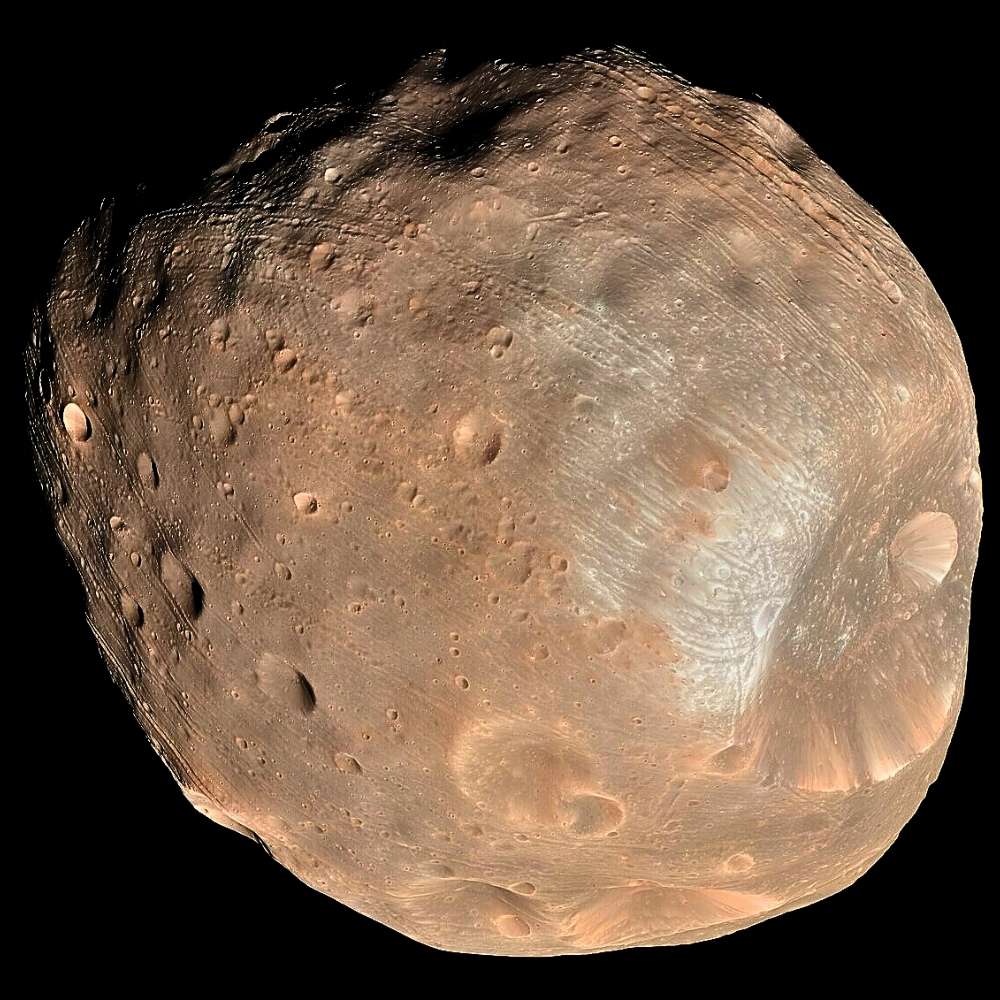
| Shape | Highly irregular (“potato-shaped”) |
| Mean Distance from Mars | ~6,000 km |
| Orbital Period | ~7 hours 39 minutes |
| Rotation | Synchronous (same face always toward Mars) |
| Gravity | Extremely weak |
| Escape Velocity | ~11 m/s |
| Composition | Carbon-rich, rubble-like |
| Notable Feature | Stickney crater |
| Fate | Gradually spiraling inward |
Key Points
- Phobos is the larger and inner moon of Mars
- It orbits Mars faster than Mars rotates
- It is slowly falling toward Mars
- Phobos will eventually be destroyed
- It may be a rubble pile, not a solid body
Introduction – A Moon That Is Running Out of Time
Phobos is not a stable moon.
Unlike Earth’s Moon, which slowly drifts away from its planet, Phobos is doing the opposite. It is spiraling inward, pulled closer to Mars with every orbit. This makes Phobos one of the most dramatic examples of orbital decay in the Solar System.
In roughly 30–50 million years, Phobos will either break apart into a ring or crash onto Mars.
Phobos is not just a moon—it is a countdown in motion.
Discovery – A Prediction Fulfilled
Phobos was discovered in 1877 by American astronomer Asaph Hall at the U.S. Naval Observatory.
The discovery was notable because:
Its existence had been predicted earlier
Jonathan Swift hinted at two Martian moons in Gulliver’s Travels
Voltaire later referenced them in fiction
Though coincidental, these predictions added to Phobos’s mystique.
Phobos was named after a figure from Greek mythology—Phobos, the personification of fear and companion of Ares (Mars).
Size and Shape – Not a Typical Moon
Phobos is extremely small compared to major moons.
Key physical traits:
Roughly 22 × 18 × 14 km in size
Irregular, non-spherical shape
Deep grooves and fractures
Extremely low gravity
A human standing on Phobos could jump into space with little effort.
Its shape and structure suggest that Phobos is not internally strong, unlike large spherical moons.
Orbit – A Moon That Moves Too Fast
Phobos orbits Mars at an altitude of only ~6,000 km, closer than any other known moon orbits its planet.
Its orbital behavior is unusual:
Completes one orbit in ~7.6 hours
Rises in the west and sets in the east
Passes over the Martian sky multiple times per day
Because Phobos orbits faster than Mars rotates, tidal forces act in reverse—pulling it inward instead of pushing it away.
This is the key reason Phobos is doomed.
Stickney Crater – A Scar That Almost Shattered Phobos
The most striking feature on Phobos is Stickney crater, nearly half the moon’s diameter.
This crater:
Formed from a massive impact
Nearly disrupted Phobos completely
Created fractures visible across the surface
That Phobos survived this impact suggests:
It absorbed the shock rather than shattering
Its interior may be a loosely bound rubble pile
Stickney crater is evidence that Phobos is fragile—but resilient.
Composition – Captured Asteroid or Martian Debris?
For decades, scientists debated Phobos’s origin.
Two main hypotheses exist:
Captured Asteroid Hypothesis
Composition similar to carbonaceous asteroids
Irregular shape
Low density
Reaccumulated Debris Hypothesis
Formed from debris around Mars
Result of ancient impacts
Explains orbital alignment
Recent evidence increasingly favors the reaccumulation scenario, though the debate is not fully settled.
Phobos may not be a visitor—it may be a product of Mars itself.
Why Phobos Is Scientifically Important
Phobos matters because it:
Reveals how small moons form and evolve
Demonstrates active orbital decay
Preserves early Mars system history
Is a potential resource hub for future missions
Studying Phobos helps scientists understand moon–planet interactions in extreme conditions.
Phobos vs Deimos – First Contrast
| Feature | Phobos | Deimos |
|---|---|---|
| Size | Larger | Smaller |
| Orbit | Very close | Farther |
| Shape | Highly irregular | More rounded |
| Fate | Falling inward | Slowly drifting outward |
| Stability | Unstable | Stable |
Phobos is the dramatic one.
Deimos is the survivor.
Tidal Forces – Why Phobos Is Falling Inward
Phobos’s fate is controlled by tidal interactions with Mars.
On most planet–moon systems, the moon orbits outside the planet’s synchronous orbit, so tidal forces transfer energy outward. Phobos is different. It orbits inside Mars’s synchronous distance, which means the tidal interaction works in reverse.
As Phobos moves around Mars:
Mars’s gravity raises tidal bulges on the planet
Because Phobos orbits faster than Mars rotates, these bulges lag behind
Gravitational drag removes orbital energy from Phobos
The moon spirals inward by about 1.8–2 cm per year
This slow inward drift is relentless. There is no mechanism to stop it.
Phobos is not being pulled in suddenly—it is being drained of orbital energy.
Approaching the Roche Limit – The Point of No Return
As Phobos continues to descend, it will eventually cross the Roche limit—the distance at which tidal forces exceed the moon’s structural strength.
For Phobos, this critical region lies roughly:
2,000–3,000 km above Mars’s surface (approximate range)
Once inside this zone:
Mars’s tidal forces will overwhelm Phobos’s gravity
Cracks and fractures will widen
Material will begin to separate
Because Phobos is likely a rubble pile rather than a solid rock, it will not resist deformation well.
The approach to the Roche limit marks the beginning of structural failure, not instant destruction.
Will Phobos Crash or Break Apart?
There are two leading scenarios for Phobos’s end:
1. Ring Formation (Most Likely)
Phobos gradually breaks apart
Debris spreads into orbit
Mars gains a temporary ring system
This ring could persist for millions of years before falling onto Mars or dispersing.
2. Direct Impact (Less Likely)
Phobos remains mostly intact
It spirals all the way down
Collides with Mars’s surface
Current models favor ring formation, especially given Phobos’s weak internal cohesion.
Mars may one day resemble a miniature version of Saturn—briefly.
Evidence Phobos Is Already Breaking
Several surface features suggest that Phobos is under active tidal stress.
These include:
Long, parallel grooves
Surface fractures aligned with tidal forces
Regions of regolith migration
For a long time, these grooves were thought to be impact ejecta. Newer studies suggest many of them are stress fractures, caused by Mars’s gravity slowly pulling Phobos apart.
Phobos is not waiting for destruction—it has already begun to fail structurally.
Internal Structure – Solid Rock or Rubble Pile?
Measurements of Phobos’s density and response to impacts indicate:
Very low bulk density
High porosity
Weak internal strength
This supports the idea that Phobos is:
A loosely bound aggregate of rocks and dust
Held together mainly by self-gravity
Filled with voids
Such a structure explains:
Survival after the Stickney impact
Ease of tidal deformation
Likely breakup into debris rather than a single impact event
Phobos behaves less like a moon and more like a gravitational pile of fragments.
Why Deimos Survives While Phobos Does Not
Deimos, Mars’s outer moon, has a very different future.
Key differences:
Orbits farther from Mars
Lies outside the synchronous orbit
Experiences outward tidal migration
As a result:
Deimos is slowly drifting away
Its orbit is stable
It faces no immediate threat
Phobos and Deimos demonstrate how orbital distance alone can determine survival or destruction.
A Ringed Mars – A Temporary Future
If Phobos becomes a ring, Mars will briefly host:
A thin debris ring
Likely composed of rocky material
Visible from the Martian surface
This ring would be:
Much smaller than Saturn’s
Short-lived by cosmic standards
Continuously raining material onto Mars
Mars’s geological record may already contain remnants of previous moon-ring cycles.
Phobos might not be the first—and may not be the last.
What Phobos Teaches About Orbital Evolution
Phobos is one of the clearest real-world examples of:
Tidal orbital decay
Moon destruction in action
Roche-limit physics
Non-eternal satellite systems
It shows that moons are not permanent fixtures.
They are temporary solutions to gravitational dynamics.
The Timeline – How Much Time Does Phobos Have Left?
Phobos’s inward spiral is slow but measurable.
Based on current models, Phobos is expected to reach a critical breakup phase in approximately 30 to 50 million years. This estimate depends on:
The moon’s internal strength
Its porosity and structure
How tidal stresses propagate through its body
Although this sounds distant on human timescales, it is relatively short in planetary terms.
Phobos is living on borrowed time.
Why Scientists Want to Visit Phobos
Phobos is a high-priority target for future exploration.
It offers unique scientific advantages:
Access to Mars system material without landing on Mars
Records of Mars’s early impact history
Insights into rubble-pile structure
A natural laboratory for tidal physics
Because of its weak gravity, landing on Phobos is easier than landing on Mars.
Phobos could become a stepping stone for future human missions.
Sample Return – A Window into Mars’s Past
One of the most valuable goals is returning samples from Phobos.
Why this matters:
Phobos may contain material ejected from Mars
Ancient Martian crust could be preserved
Samples could reveal early Mars chemistry
The Japanese MMX (Martian Moons eXploration) mission is designed to:
Visit Phobos and Deimos
Collect surface samples
Return them to Earth
This mission could resolve the long-standing debate about Phobos’s origin.
Phobos as a Human Gateway
Because of its low gravity and proximity, Phobos is often discussed as:
A staging point for Mars exploration
A fuel depot location
A scientific outpost
From Phobos, astronauts could:
Control robots on Mars in near real-time
Study Mars without atmospheric entry
Operate with lower energy costs
Phobos may never host cities—but it could host human presence.
Frequently Asked Questions (FAQ)
Is Phobos really falling toward Mars?
Yes. Measurements confirm it is spiraling inward by about 2 cm per year.
Will Phobos crash into Mars?
Possibly, but current models suggest it will break apart into a ring first.
How big would a Phobos impact be?
If intact, the impact would be catastrophic locally but not planet-destroying.
Why doesn’t Deimos fall too?
Deimos orbits farther out and is moving slowly away from Mars.
Could Phobos ever be saved?
No known natural or technological process could stop its orbital decay.
Phobos in the Context of Universe Map
Phobos connects multiple Universe Map themes:
Tidal dynamics
Moon formation and destruction
Planet–satellite interactions
Future space exploration
Related Universe Map topics include:
Deimos
Mars
Roche limit
Planetary rings
Orbital decay
Together, these objects show that satellite systems are temporary structures, not permanent ones.
Final Perspective
Phobos is a moon in decline.
It has survived massive impacts, extreme tidal stress, and billions of years of orbital evolution—but it cannot escape its final trajectory.
In the future, Mars may gain a ring made from its own moon. Long after that ring fades, the story of Phobos will remain written in Mars’s surface and in scientific records.
Phobos reminds us of a subtle truth of the Solar System:
nothing in orbit is forever.