







Pioneer 10
Humanity’s First Journey Beyond the Planets
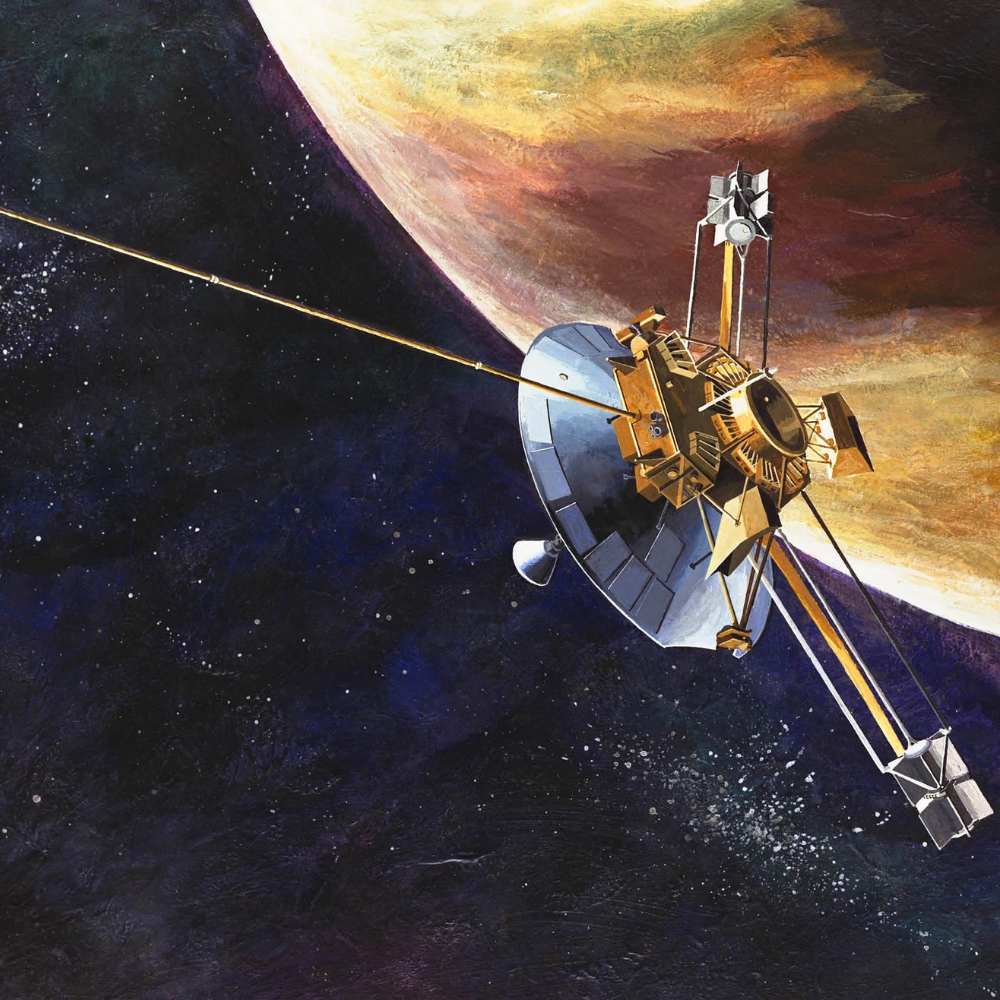
Quick Reader
| Attribute | Details |
|---|---|
| Name | Pioneer 10 |
| Mission Type | Interplanetary → Interstellar precursor probe |
| Launch Date | March 2, 1972 |
| Launch Site | Cape Canaveral, Florida |
| Operator | NASA / Ames Research Center |
| Primary Objective | First flyby of Jupiter |
| Historic Firsts | First spacecraft to cross asteroid belt safely |
| Jupiter Flyby | December 1973 |
| Final Signal | January 23, 2003 |
| Current Status | Inactive, drifting through interstellar space |
| Power Source | Radioisotope Thermoelectric Generators (RTGs) |
| Symbolic Payload | Pioneer Plaque |
| Legacy | Path-finder for Voyager missions |
Introduction – The Spacecraft That Opened the Way
Before Voyager, before New Horizons, and long before interstellar space was ever reached, there was Pioneer 10.
Pioneer 10 was the first spacecraft ever built to venture beyond the inner Solar System and survive. It was a bold experiment launched at a time when scientists were not even sure a spacecraft could safely pass through the asteroid belt.
Its success changed everything.
Pioneer 10 proved that robotic explorers could travel far from Earth, withstand intense radiation, and survive for decades in deep space. Without Pioneer 10, missions like Voyager 1 and 2 might never have been approved.
In many ways, Pioneer 10 was the true beginning of humanity’s outward expansion into the Solar System.
Why Pioneer 10 Was Launched
In the late 1960s, Jupiter remained largely a mystery. Scientists knew it was massive, magnetically intense, and potentially dangerous to spacecraft.
Key unknowns included:
Strength of Jupiter’s radiation belts
Composition of its atmosphere
Structure of its magnetic field
Safety of the asteroid belt
NASA designed Pioneer 10 to answer a simple but critical question:
Can a spacecraft survive the journey to Jupiter and beyond?
If the answer was no, future deep-space missions would be impossible.
A Risky Path Through the Asteroid Belt
At the time of Pioneer 10’s launch, the asteroid belt was widely misunderstood.
Some scientists feared:
Dense asteroid fields
Frequent collisions
Micrometeoroid storms capable of destroying spacecraft
Pioneer 10 carried:
Meteoroid detectors
Dust counters
Shielded electronics
As it traveled through the belt, Pioneer 10 transmitted continuous data—showing that the asteroid belt was far emptier and safer than feared.
This single discovery cleared the path for every outer-planet mission that followed.
Launch and Early Flight
Pioneer 10 was launched on March 2, 1972, aboard an Atlas-Centaur rocket.
Unlike later missions, Pioneer 10 had:
No onboard computer by modern standards
Very limited memory
Extremely simple command sequences
Yet its design prioritized:
Redundancy
Radiation shielding
Long-term durability
It was built not for speed or complexity, but for survival.
First Encounter with Jupiter – A Giant Revealed
In December 1973, Pioneer 10 became the first spacecraft to fly past Jupiter.
This moment changed planetary science forever.
Major Discoveries
Confirmed Jupiter’s intense radiation belts
Mapped Jupiter’s magnetic field
Measured atmospheric composition
Revealed Jupiter’s immense gravitational dominance
Pioneer 10 passed within about 130,000 km of Jupiter’s cloud tops—closer than any previous object.
Despite radiation levels far exceeding expectations, the spacecraft survived.
This proved that Jupiter was navigable, making Voyager missions possible.
Gravity Assist – The Doorway to Escape
Jupiter’s enormous gravity accelerated Pioneer 10 to solar escape velocity.
For the first time in history:
A human-made object was on a trajectory that would never return
Pioneer 10 became the first interstellar precursor spacecraft
After its Jupiter flyby, Pioneer 10 was flung outward, heading toward the constellation Taurus.
This marked the moment humanity truly left the planetary neighborhood.
The Pioneer Plaque – Humanity’s First Interstellar Message
Attached to Pioneer 10 is one of the most iconic artifacts ever launched into space: the Pioneer Plaque.
It depicts:
A man and a woman
The location of the Sun relative to pulsars
The spacecraft’s trajectory
A symbolic greeting from Earth
Unlike later messages, the plaque was not designed for communication—it was a cosmic calling card, acknowledging that the spacecraft might one day be found.
Pioneer 10 was the first time humanity deliberately placed its image into the galaxy.
Beyond Jupiter – Into the Unknown
After Jupiter, Pioneer 10 continued outward, studying:
Solar wind behavior
Cosmic rays
Interplanetary magnetic fields
As distance increased:
Signal strength weakened
Power levels dropped
Instruments were gradually shut down
Yet Pioneer 10 continued transmitting for decades—far longer than expected.
Why Pioneer 10 Matters
Pioneer 10 accomplished what once seemed impossible:
Proved deep-space travel was feasible
Opened the route to the outer planets
Became humanity’s first interstellar pathfinder
It was not the fastest, nor the most advanced—but it was the bravest.
Beyond Jupiter – A One-Way Path Out of the Solar System
After its historic Jupiter flyby in December 1973, Pioneer 10 was placed on a hyperbolic escape trajectory. Unlike planetary orbiters or probes designed for multiple encounters, Pioneer 10 was never meant to turn back.
From this point onward, its mission quietly transformed into something unprecedented: a long-term exploration of deep space far beyond the planets.
Post-Jupiter Mission Goals
Measure the solar wind at increasing distances
Study the interplanetary magnetic field
Monitor cosmic ray intensity
Track how the Sun’s influence weakens with distance
These measurements laid the groundwork for understanding the structure of the heliosphere—years before terms like termination shock or heliopause entered common scientific use.
Communicating Across the Vastness of Space
As Pioneer 10 moved farther from Earth, communication became its greatest challenge.
Communication Reality
Transmit power: ~8 watts
Data rates dropped to bits per second
Signals became weaker than background noise
NASA relied on the Deep Space Network (DSN) to maintain contact. Commands took hours to arrive, and responses took just as long to return.
Each communication session required:
Precise antenna pointing
Long integration times
Extreme sensitivity to extract data
By the late 1990s, Pioneer 10 was operating at the very limits of detectability.
Gradual Instrument Shutdown
Pioneer 10 was powered by radioisotope thermoelectric generators (RTGs), whose output declined steadily over time.
To conserve power:
Instruments were turned off one by one
Heaters were disabled
Only essential systems remained active
Despite this, Pioneer 10 continued to send engineering and scientific data far beyond its original design lifetime.
This longevity demonstrated the robustness of early spacecraft engineering—and the value of conservative design.
The Pioneer Anomaly – A Scientific Puzzle
One of Pioneer 10’s most intriguing contributions came unintentionally.
As scientists tracked its motion with extreme precision, they noticed something unexpected:
Pioneer 10 appeared to experience a small, unexplained acceleration toward the Sun.
This effect became known as the Pioneer Anomaly.
Key Observations
Detected in both Pioneer 10 and Pioneer 11
Very small but persistent
Could not be explained by gravity alone
For years, the anomaly sparked intense debate. Proposed explanations ranged from:
Modified gravity theories
Dark matter effects
Instrumental errors
Solving the Pioneer Anomaly
Eventually, a detailed reanalysis provided a solution.
The anomaly was traced to:
Asymmetric heat radiation from the spacecraft
Waste heat from RTGs and onboard electronics
Tiny recoil forces acting over long periods
This explanation matched observations precisely, resolving the mystery without requiring new physics.
While the anomaly itself vanished, the episode highlighted the importance of precision navigation and deepened confidence in gravitational models used across space science.
How Long Did Pioneer 10 Keep Talking?
Pioneer 10’s last confirmed signal was received on January 23, 2003, at a distance of about 82 astronomical units from the Sun.
By that time:
Signal strength was barely detectable
Power levels were critically low
No further communication was possible
NASA made several attempts to re-establish contact after 2003, but none succeeded.
At that moment, Pioneer 10 became a silent interstellar traveler.
Pioneer 10 vs Voyager Missions – A Contrast
Pioneer 10 was a pathfinder, not a replacement for later missions.
| Feature | Pioneer 10 | Voyager 1 |
|---|---|---|
| Launch Year | 1972 | 1977 |
| Planet Encounters | Jupiter only | Jupiter, Saturn |
| Instrument Suite | Minimal | Advanced |
| Data Longevity | ~31 years | 45+ years |
| Interstellar Entry | Precursor | Confirmed |
Voyager built upon the lessons Pioneer 10 taught—about radiation, navigation, and long-term survival.
Pioneer 10’s Trajectory Today
Pioneer 10 is moving roughly in the direction of the constellation Taurus.
Key facts:
Speed: ~12 km/s relative to the Sun
Travel time to nearby stars: tens of thousands of years
Will continue drifting through the Milky Way indefinitely
Like Voyager 1, Pioneer 10 will likely survive far longer than Earth itself—an inert relic of early space exploration.
Pioneer 10’s Ultimate Fate
Pioneer 10 is no longer transmitting, but it is far from gone.
After losing contact in 2003, Pioneer 10 continued its silent journey outward from the Sun. With no atmosphere, no collisions, and minimal external forces acting upon it, the spacecraft will remain largely unchanged for billions of years.
Long-Term Trajectory
Direction: Toward the constellation Taurus
Velocity: ~12 km/s relative to the Sun
Time to pass near another star: ~40,000 years (very approximate)
Pioneer 10 is now an inert object drifting through interstellar space—a relic of early space exploration.
The Pioneer Plaque – More Than a Message
The Pioneer Plaque remains one of the most profound symbolic gestures ever made by humanity.
What Makes It Unique
First physical message intentionally sent beyond the Solar System
Designed to be understandable without language
Represents humans not as conquerors, but as inhabitants
The plaque includes:
The relative position of the Sun using pulsars
The spacecraft’s trajectory
A scale of human anatomy
It was not intended to initiate contact, but to acknowledge humanity’s existence in a vast universe.
Cultural and Scientific Legacy
Pioneer 10’s influence extends far beyond science.
Scientific Impact
Validated gravity-assist navigation
Confirmed the structure of Jupiter’s radiation belts
Enabled the Voyager Grand Tour
Cultural Impact
Inspired science fiction and public imagination
Set the precedent for interstellar messaging
Marked humanity’s first step beyond planetary exploration
It changed how humans perceived their reach and ambition.
Pioneer 10 vs Pioneer 11 – Twin Paths
While Pioneer 10 led the way, it was accompanied by Pioneer 11, which followed a different trajectory.
| Feature | Pioneer 10 | Pioneer 11 |
|---|---|---|
| First Planet | Jupiter | Jupiter |
| Additional Flyby | None | Saturn |
| Direction | Taurus | Aquila |
| Final Signal | 2003 | 1995 |
Together, they proved deep-space travel was not a one-time success, but a repeatable achievement.
Frequently Asked Questions (FAQ)
Is Pioneer 10 outside the Solar System?
By gravitational definition, it remains loosely bound to the Sun. By distance and trajectory, it is far beyond the planetary region and on an interstellar path.
Will Pioneer 10 ever reach another star?
It may pass near another star system in tens of thousands of years, but direct encounters are extremely unlikely.
Can Pioneer 10 be reactivated?
No. Its power source has decayed beyond operational limits.
Why wasn’t Pioneer 10 designed to last forever?
In the early 1970s, missions were planned for years, not decades. Pioneer 10’s longevity was a bonus, not a requirement.
Related Topics for Universe Map
Pioneer 11
Voyager 1 and Voyager 2
Jupiter Flybys
Asteroid Belt
Interstellar Space
Pioneer Plaque
Together, these topics form the foundation of humanity’s first steps into deep space.
Final Perspective
Pioneer 10 was not the most advanced spacecraft. It had no cameras capable of dramatic images and no computers by modern standards.
Yet it did something no machine had ever done before.
It crossed the asteroid belt, survived Jupiter, and escaped the Solar System—opening the way for everything that followed. Pioneer 10 represents courage through engineering and vision through simplicity.
Long after its signal faded, Pioneer 10 continues to carry humanity’s first interstellar whisper into the galaxy.