





Pleiades
The Seven Sisters of the Night Sky
Quick Reader
| Attribute | Details |
|---|---|
| Name | Pleiades, Seven Sisters, Messier 45 (M45) |
| Object Type | Open star cluster |
| Constellation | Taurus |
| Distance from Earth | ~440 light-years |
| Apparent Magnitude | ~1.6 (visible without telescope) |
| Number of Stars | > 1,000 confirmed; ~7 brightest visible to the naked eye |
| Age | ~100 million years (young cluster) |
| Dominant Features | Hot blue stars, reflection nebulae, dust filaments |
| Nebula Type | Reflection nebula (sunlight reflected from dust) |
| Cluster Diameter | ~17–20 light-years |
| Best Viewing Season | November–April |
| Best Regions | Visible worldwide; highest in Northern Hemisphere winter skies |
Introduction – The Most Famous Star Cluster in the Night Sky
The Pleiades, also known as Messier 45 or the Seven Sisters, is one of the most iconic and easily recognizable objects in the entire night sky. Visible to the naked eye as a shimmering group of bright, blue-white stars, the cluster has inspired countless myths, agricultural calendars, sea-navigation systems, and astronomical discoveries across thousands of years.
Located approximately 440 light-years away in the constellation Taurus, the Pleiades represents a young open cluster, only around 100 million years old—a cosmic infant compared to the Sun’s age of 4.6 billion years. Its brightest stars shine brilliantly due to their high temperature and intrinsic luminosity, forming a stellar jewel box easily spotted even from moderately light-polluted regions.
Although the cluster is best known for its seven brightest stars—Alcyone, Merope, Maia, Electra, Taygeta, Celaeno, and Sterope—astronomers have identified more than one thousand stars gravitationally bound within the cluster.
The Mythology of the Seven Sisters
The Pleiades stand at the crossroads of astronomy and ancient culture. Civilizations on nearly every continent have woven stories around them.
Greek Mythology – The Seven Sisters
In Greek tradition:
The Pleiades are seven daughters of the Titan Atlas and the sea-nymph Pleione
They are pursued across the sky by Orion, the hunter
Their names mirror the visible stars in the cluster
This myth explains why the Pleiades lie near the constellation Orion, one of the sky’s brightest and most recognizable figures.
Indigenous Cultures
The cluster appears prominently in:
Australian Aboriginal astronomy
Native American tribal stories
Japanese culture (Subaru)
Hindu and Vedic traditions
Arabic star lore
African navigation songs
The Japanese automaker Subaru uses the cluster as its logo, symbolizing unity and shared origins.
Agricultural Calendars
Across ancient civilizations:
Rising of the Pleiades signaled planting seasons
Setting of the Pleiades marked the beginning of harvest
Many maritime cultures used the cluster to predict monsoons and seasonal winds
No other star cluster on Earth has been so deeply woven into human history.
Physical Characteristics of the Pleiades
A Young and Hot Open Cluster
The Pleiades are extremely young on astronomical timescales. They consist mostly of:
Hot blue-white B-type stars
Luminous, rapidly rotating, short-lived stars
Dozens of medium-mass stars and hundreds of low-mass red dwarfs
These stars formed together from the same molecular cloud, meaning they:
Share the same age
Have nearly identical chemical compositions
Move together through the Milky Way
This makes the Pleiades an important object for studying star formation.
True Size of the Cluster
The Pleiades span roughly:
17–20 light-years across
More than 2° of the sky (four times the width of the full Moon)
Most of the cluster’s faint stars cannot be seen with the naked eye but appear in long-exposure images.
The Reflection Nebula
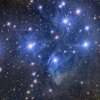
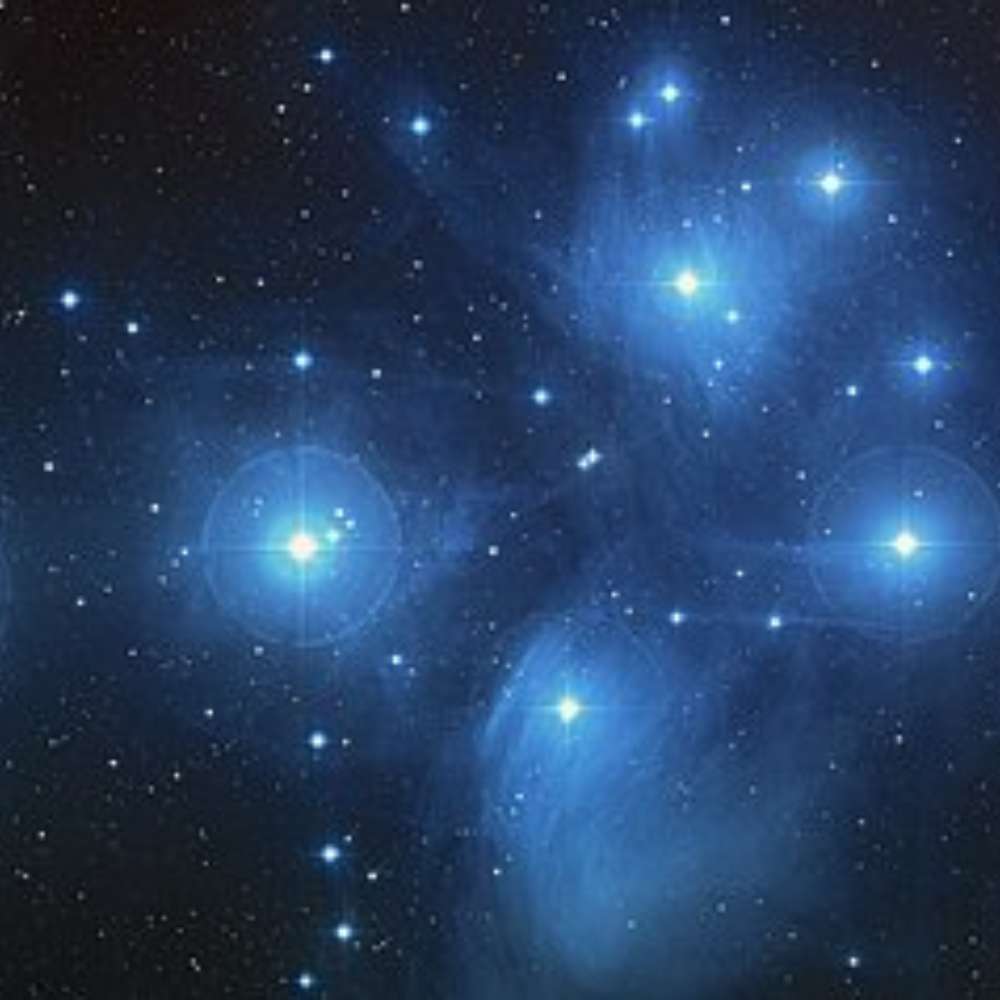
Surrounding the brightest Pleiades stars is a delicate blue reflection nebula caused by starlight scattering off fine interstellar dust.
Key facts:
Dust grains are not remnants of the original birth cloud
Instead, the cluster is passing through a dense dust filament in the Milky Way
The dust reflects blue light more efficiently, creating the nebula’s characteristic color
The subtle swirls and arcs of this nebula are among the most photographed deep-sky images in amateur astrophotography.
The Brightest Stars of the Pleiades
The Pleiades contain hundreds of stars, but the seven brightest give the cluster its name.
Alcyone
The brightest star in the cluster
Spectral type B7III
A massive, luminous giant star
Serves as the gravitational center of the cluster’s brightest core
Merope
Surrounded by one of the most dramatic portions of the reflection nebula
Famous for its “Merope Nebula” dust fan
Maia
A blue subgiant
Associated with wispy nebular patterns known as the Maia Nebula
Electra
Rapidly rotating
Contributes significantly to the cluster’s overall brightness
Taygeta
Celaeno
Sterope (Asterope)
These stars form the recognizable “mini-dipper” pattern easily seen without binoculars.
Pleione and Atlas
Just to one side of Alcyone are:
Pleione — a variable Be star with a gaseous disk
Atlas — a massive bright blue star
Both are visible in binoculars and contribute to the “seven” count depending on historical interpretations.
Stellar Population of the Cluster
Although most famous for its seven brightest stars, the Pleiades contains:
>1,000 confirmed stars
Dozens of brown dwarfs
Several white-dwarf candidates
A dense population of low-mass red dwarfs (M-type)
The presence of brown dwarfs is especially significant. They:
Were among the first ever identified in a major star cluster
Help astronomers model the low-mass end of the initial mass function
Provide insight into failed star formation processes
The Pleiades remain a cornerstone sample for studying how stars of different masses form from the same cloud.
Motion Through the Milky Way
The Pleiades are not stationary. They are moving through the galaxy as a gravitationally bound group.
Cluster Movement
The cluster is traveling at roughly:
43 km/s relative to Earth
Moving southwest across the sky
Its stars will eventually drift apart over the next several hundred million years due to:
Galactic tidal forces
Internal gravitational interactions
Stellar winds and mass loss
Eventually, the Pleiades will dissolve into the galactic disk, becoming indistinguishable from surrounding field stars.
Why the Pleiades Are Scientifically Important
The Pleiades serve as a reference point in many areas of astrophysics:
Stellar Evolution Models
Because all stars:
Formed together
Have the same composition
Are similar ages
—astronomers can compare how stars evolve as a function of mass.
Distance Measurements
The Pleiades were at the heart of a decades-long debate regarding:
Parallax measurements
Distance ladder calibration
Discrepancies between Hipparcos and VLBI data
Today, the accepted distance is ~440 light-years, crucial for calibrating:
Main-sequence fitting
Gaia DR3 stellar models
Stellar luminosity relationships
Brown Dwarf Research
The discovery of Pleiades brown dwarfs revolutionized low-mass star studies.
Reflection Nebula Dynamics
The nebula illustrates how star clusters interact with the interstellar medium as they travel through the galaxy.
Formation History of the Pleiades
The Pleiades are often regarded as a showpiece of the night sky, but their beauty is the result of a dynamic and complex formation process that began around 100 million years ago. Compared to the Sun’s age of 4.6 billion years, the Pleiades are cosmic newborns.
Birth in a Giant Molecular Cloud
The Pleiades formed within a dense molecular cloud, similar to today’s Orion Nebula. In such clouds:
Gravity pulls gas and dust into tight clumps
These clumps collapse into protostars
Gas accretes around forming stellar cores
New stars ignite when nuclear fusion begins
The Pleiades cluster emerged as a single star-forming event, meaning:
All its stars share a common origin
They are chemically identical
They formed within a very short time window
They move together through space
This uniformity is why the Pleiades are essential for calibrating stellar evolution models.
Early Evolution
When the Pleiades were young:
They were embedded in a thick, dusty nebula
Many of their stars were still surrounded by protoplanetary disks
Some stars likely hosted intense jets and outflows
Stellar winds cleared the region of much of the remaining dust
The original birth cloud is long gone, but the modern reflection nebula around the cluster is not that cloud—it is unrelated dust the cluster has encountered during its motion through the Milky Way.
The Reflection Nebula – Why the Pleiades Glow Blue
The Pleiades are surrounded by a faint, electric-blue luminosity in long-exposure images. This is caused by a reflection nebula, not an emission nebula.
What Is a Reflection Nebula?
A reflection nebula occurs when:
Dust grains scatter starlight
Blue wavelengths scatter more efficiently than red
The cluster appears enveloped in a soft, blue glow
This phenomenon is similar to why Earth’s sky looks blue.
Not the Original Birth Cloud
A key scientific discovery is that:
The Pleiades are passing through a dusty region of the galaxy
The dust was not part of their birth material
The encounter is recent (within a few hundred thousand years)
This explains:
The sharp edges of the dust
The irregular distribution
The lack of deep nebular structure
Merope Nebula and Maia Nebula
The brightest dust structures lie near:
Merope — surrounded by the distinctive “Merope Nebula,” a curved dust wall
Maia — associated with delicate, thread-like dust filaments
These are popular astrophotography targets due to their striking shape and contrast.
Stellar Rotation, Activity, and Magnetic Fields
The Pleiades’ youth makes them ideal for studying stellar rotation and magnetic evolution.
Rapid Rotation
Most Pleiades stars rotate:
Much faster than the Sun
With periods measured in hours or days instead of weeks
Producing strong magnetic fields
This rotation drives:
Starspots
Magnetic storms
X-ray emission from stellar coronae
Magnetic Activity in Young Stars
Young stars exhibit:
High levels of flaring
Enhanced ultraviolet radiation
Active coronal loops
Irregular brightness variations
This activity decreases with age. Because the Pleiades stars are ~100 Myr old, they represent an important evolutionary stage in the spin-down process.
Lithium Abundance as an Age Marker
Lithium levels help determine stellar ages. Pleiades stars show:
Higher lithium than older clusters
A predictable correlation between rotation and lithium depletion
This helps astronomers:
Estimate ages of other young clusters
Understand mixing processes inside stars
The Brown Dwarfs of the Pleiades
One of the most notable discoveries in the Pleiades is the presence of dozens of brown dwarfs, objects too large to be planets but too small to sustain hydrogen fusion like stars.
Characteristics of Pleiades Brown Dwarfs
Mass: ~10–70 Jupiter masses
Emit faint infrared radiation
Often surrounded by leftover dust disks
Some exhibit variability from patchy atmospheres
The Pleiades were among the first clusters where brown dwarfs were confirmed, marking a milestone in low-mass star research.
Importance in Astrophysics
Brown dwarfs in the Pleiades help astronomers:
Test formation theories of substellar objects
Understand the bottom edge of the initial mass function
Study evolution of ultra-cool atmospheres
Investigate early disk evolution
The Pleiades remain a benchmark cluster for brown dwarf population studies.
Cluster Structure and Subgroups
The Pleiades are not a simple round cluster—they have internal structure.
Core Region
The core hosts:
The seven brightest stars
The densest concentration of medium-mass B and A-type stars
Strong gravitational binding
This region is ~8 light-years across.
Halo Region
Surrounding the cluster is a halo of:
Low-mass red dwarfs
Brown dwarfs
Dimmer cluster members
The outer halo extends to ~20 light-years.
Tidal Boundaries
Gravitational interactions with the Milky Way are slowly stripping stars from the cluster. Simulations show:
The Pleiades are losing stars along tidal tails
Eventually, the cluster will dissolve into the galaxy
This process is common for open clusters, which rarely survive beyond a billion years.
How the Pleiades Compare with Other Open Clusters
Pleiades vs. Hyades
| Feature | Pleiades | Hyades |
|---|---|---|
| Age | ~100 Myr | ~625 Myr |
| Distance | ~440 ly | ~153 ly |
| Appearance | Compact, bright blue stars | Larger, more dispersed |
| Nebula | Reflection nebula | None |
| Stars | Younger, hotter | Older, more evolved |
Pleiades vs. Praesepe (Beehive Cluster)
- Praesepe is older (~600 Myr)
- Fainter and farther away
- Stars are more evolved
Pleiades show more blue, massive stars and nebular structures.
Pleiades vs. Alpha Persei Cluster
- Similar age (~50–70 Myr younger)
- Larger spatial extent
- Less concentrated bright core
Among all open clusters, the Pleiades remain the most visually striking.
Scientific Contributions of the Pleiades
The cluster has contributed to major astronomical fields:
Stellar Population Studies
The Pleiades provide a complete sample of:
Young B-type stars
Intermediate A-type stars
Large numbers of K and M dwarfs
Brown dwarfs
Distance Scale Calibration
Debates over Pleiades distance helped refine:
Parallax measurements
Stellar luminosity formulas
Calibration of the cosmic distance ladder
Rotation and Activity Studies
Used to build foundational models of:
Gyrochronology
Stellar age estimation
Magnetic evolution
Unresolved Mysteries and Scientific Questions
Even though the Pleiades are one of the best-studied open clusters in astronomy, several intriguing mysteries remain. Their youth, motion, and unexpected properties continue to challenge stellar evolution models.
Why Is the Reflection Nebula So Prominent?
The Pleiades’ reflection nebula is unusually bright given the cluster’s age. Key questions include:
Why is the dust so dense around certain stars like Merope and Maia?
Why does the dust show sharp edges and swirling patterns?
How long has the cluster been passing through this dust region?
Observations suggest the encounter is relatively recent—possibly within the last few hundred thousand years—but the exact timeline remains uncertain.
The True Depth of the Cluster
Although the Pleiades appear compact, their three-dimensional structure is complex:
Some stars lie hundreds of light-years behind or in front of the main core
The cluster appears elongated along our line of sight
Gaia data reveals subtle depth differences among stars previously thought to be at the same distance
Understanding this structure helps refine distance measurements and stellar luminosity models.
The Brown Dwarf Population
The number of brown dwarfs in the Pleiades is still debated. Open questions include:
Why does the cluster seem to contain fewer brown dwarfs than expected?
Are some brown dwarfs being stripped away by tidal forces?
How do brown dwarf disks evolve in young clusters like this?
This remains an active area of research using infrared telescopes such as Spitzer, WISE, and JWST.
Age Discrepancies
Although the cluster is widely accepted to be around 100 million years old, different measurement techniques sometimes give slightly different values.
For example:
Gyrochronology
Lithium abundance
HR diagram fitting
White dwarf cooling ages
These yield ages ranging between 70 and 125 million years, prompting ongoing investigation.
The Future and Fate of the Pleiades
Open clusters like the Pleiades do not last forever. Over hundreds of millions of years, gravitational forces cause them to disperse across the galaxy.
Cluster Dispersion
The Pleiades are gradually losing stars through:
Galactic tidal forces
Internal gravitational interactions
Stellar winds and mass loss
Encounters with giant molecular clouds
Over time, these processes weaken the cluster’s gravitational binding.
Timeline for Dissolution
Astronomers estimate:
Within the next 250–300 million years, the cluster will begin to lose its current shape
Eventually, its stars will spread through the Milky Way as individual field stars
Some of the stars—including the Seven Sisters—will continue to shine for hundreds of millions of years, but not as a bound cluster.
Observing the Pleiades – A Complete Guide
The Pleiades are one of the most accessible astronomical objects for observers of all skill levels.
Naked-Eye Observation
From almost anywhere on Earth:
The cluster appears as a small, shimmering group of stars
Most observers can see 6–7 bright stars under normal conditions
Under very dark skies, up to 10 or more stars may be visible
Ideal viewing time: November to April
Binoculars
Binoculars are the best way to enjoy the Pleiades:
A wide field of view reveals dozens of stars
The cluster takes on a delicate, multi-layered structure
The blue color becomes more noticeable
Binoculars (10×50 or 15×70) show the cluster at its finest.
Small Telescopes
While telescopes provide more detail:
The Pleiades fill the entire field of view at low magnification
Higher magnification is usually unnecessary
Nebulosity may be faint unless using long-exposure imaging
A large field-of-view eyepiece is ideal.
Astrophotography
Long-exposure photography reveals:
Deep blue reflection nebula
Dust filaments around Merope and Maia
Subtle arcs of illuminated interstellar dust
Astrophotographers often capture:
The Merope Nebula
The Maia dust complex
Fine structures invisible to the naked eye
The Pleiades are among the most photographed deep-sky objects.
Frequently Asked Questions (FAQ)
Why are the Pleiades called the Seven Sisters?
Because their seven brightest stars were historically visible to the naked eye.
However, the cluster contains more than a thousand stars.
Are the Pleiades moving through space?
Yes. They travel through the Milky Way at about 43 km/s, moving southwest across the sky.
Is the nebula part of the cluster’s birth cloud?
No.
The nebula is unrelated dust the cluster is currently passing through.
How old is the Pleiades cluster?
About 100 million years, though some estimates range from 70–125 million years.
Are there planets in the Pleiades?
A few candidates exist around some lower-mass stars, but most Pleiades stars are young, active, and rotate rapidly, which makes detecting planets difficult.
Will the Pleiades ever disappear?
They won’t vanish, but over hundreds of millions of years, the cluster will gradually disperse into the Milky Way, becoming individual field stars.
Final Scientific Overview
The Pleiades are one of the most iconic and scientifically valuable open clusters in the galaxy. Their brilliant blue stars, shimmering reflection nebulae, and rich population of young stellar objects make them a cornerstone of stellar evolution research.
As a young cluster, the Pleiades provide a rare window into:
Early stellar development
Magnetic activity and rapid rotation
Brown dwarf formation
Interaction between moving star clusters and interstellar dust
Their cultural impact spans millennia, uniting civilizations across continents under the same glittering group of stars.
For observers, the Pleiades are a timeless and majestic sight—easy to find, dazzling to view, and endlessly rewarding to study.