











Procyon
The Bright Guardian of Canis Minor and Its Hidden White Dwarf Companioncc
Quick Reader
| Attribute | Details |
|---|---|
| Name | Procyon |
| Bayer Designation | Alpha Canis Minoris |
| Star System Type | Binary (F5 IV-V + DA White Dwarf) |
| Constellation | Canis Minor |
| Distance from Earth | ~11.46 light-years |
| Apparent Magnitude | ~0.34 (8th brightest star in the night sky) |
| Primary Star Type | F5 IV–V (Subgiant transitioning from main sequence) |
| Companion | Procyon B (White dwarf) |
| Temperature (Primary) | ~6,530 K |
| Temperature (Companion) | ~7,750 K |
| Radius (Primary) | ~2.0 R☉ |
| Mass (Primary) | ~1.5 M☉ |
| Mass (Companion) | ~0.6 M☉ |
| Luminosity (Primary) | ~7 L☉ |
| Age | ~1.7 billion years |
| Notable Features | Binary system with famous white dwarf, precursor of future giant phase |
| Best Viewing Season | January–March |
Introduction – A Brilliant Star with a Hidden Companion
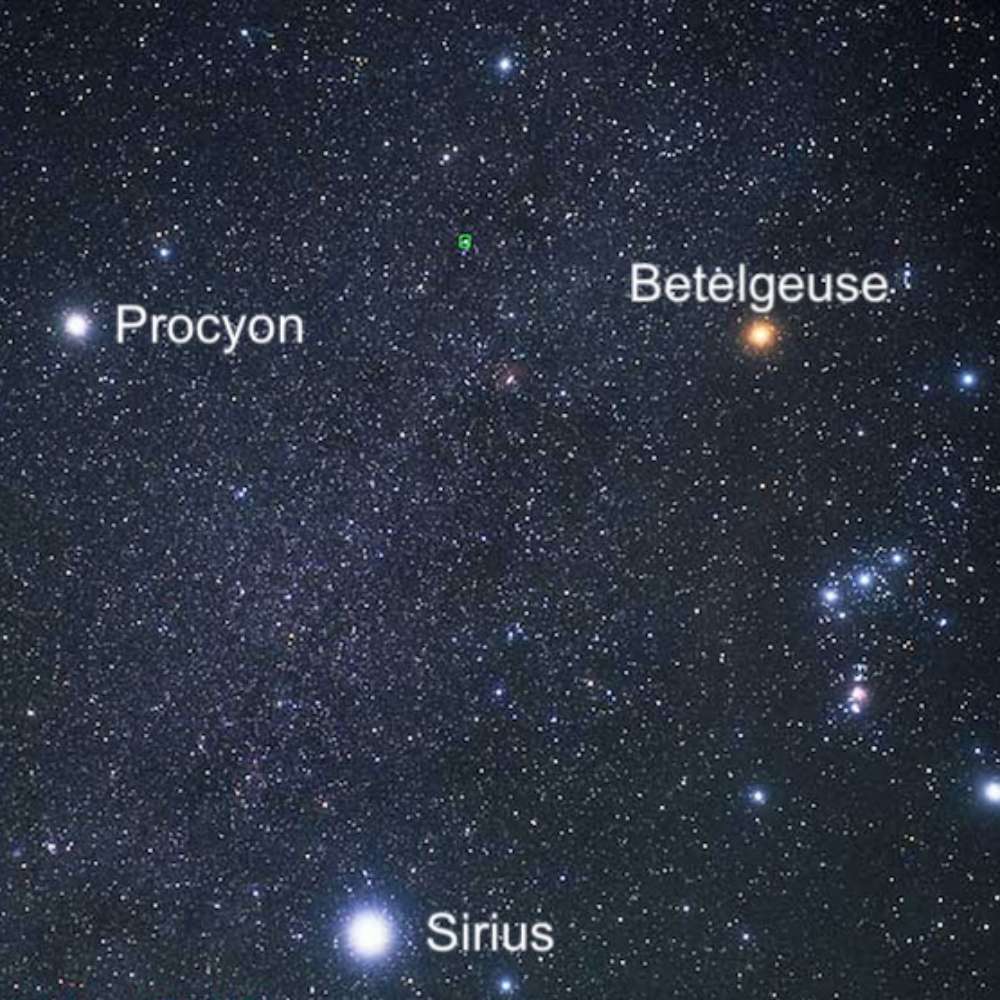
Procyon, meaning “The One Who Comes Before the Dog,” shines as the brightest star in the constellation Canis Minor and the 8th brightest star in the entire night sky. Its name reflects its celestial timing: Procyon rises shortly before Sirius, the Dog Star. Together they form part of the Winter Triangle (with Sirius and Betelgeuse), one of the most recognizable patterns in the northern winter sky.
But the beauty of Procyon lies not only in its brightness. It is actually a binary star system, consisting of:
Procyon A, a luminous F-type subgiant
Procyon B, a dense, compact white dwarf
This combination makes Procyon one of the most important stellar systems for studying stellar evolution, end-of-life cycles, mass loss, and binary dynamics. Although Procyon B is far too faint to see without large telescopes, it plays a critical role in shaping the history and future of the system.
Procyon is also part of the Sun’s immediate cosmic neighborhood—one of the nearest bright stars to Earth. Its closeness, evolutionary state, and binary nature make it a benchmark object for astrophysical research.
Physical Characteristics of Procyon A
A Star Leaving the Main Sequence
Procyon A is classified as:
F5 IV–V
Intermediate between main-sequence and subgiant
This means:
Hydrogen fusion in its core is slowing
The core is contracting
The outer layers are expanding slowly
Procyon A is beginning its evolutionary transition toward the red giant phase.
Size, Temperature, and Luminosity
Compared to the Sun, Procyon A is:
Hotter: ~6,530 K
Larger: ~2.0 solar radii
More luminous: ~7 times solar brightness
Its temperature gives it:
A white-yellow color
A spectral type between A-type and G-type stars
Despite being hotter than the Sun, Procyon is not massive enough to undergo extreme giant phases like Betelgeuse or Antares.
Mass and Age
Procyon A has:
A mass of ~1.5 M☉
An age of ~1.7 billion years
This age is much younger than the Sun, yet Procyon is already leaving the main sequence because higher-mass stars evolve faster.
The Hidden Powerhouse – Procyon B (White Dwarf Companion)
The White Dwarf That Reveals Stellar Endings
Procyon B is one of the most studied white dwarfs due to its proximity.
Key characteristics:
Mass: ~0.6 M☉
Temperature: ~7,750 K
Radius: Comparable to Earth’s radius
Density: Hundreds of thousands of times greater than water
It is composed mostly of:
Carbon
Oxygen
Held together by electron degeneracy pressure.
A Silent Survivor of a Giant Star
Procyon B is the remnant of a star that:
Was once more massive than Procyon A
Evolved rapidly
Expanded into a red giant
Shed its outer layers
Collapsed into a white dwarf
This explains why Procyon B exists even though Procyon A is still transitioning to the subgiant stage.
Orbital Dynamics of the Procyon System
The two stars orbit their common center of mass in a period of:
~40.8 years
Their average separation:
~15 AU (roughly the distance of Saturn from the Sun)
Because Procyon B is faint and close to Procyon A, observing its orbit has historically been challenging.
Why the Orbit Matters
By studying Procyon B’s orbit, astronomers can:
Test gravitational models
Determine precise stellar masses
Study white dwarf cooling
Understand past mass-loss events
Procyon is a benchmark system for testing theories of stellar evolution.
Procyon in the Sky – One of Winter’s Key Stars
Procyon is part of the Winter Triangle, along with:
Sirius (Canis Major)
Betelgeuse (Orion)
This triangle marks some of the brightest and most colorful stars in the winter night sky.
Locating Procyon
From mid-northern latitudes, Procyon is:
High in the sky during January–March
East of Orion
Above Sirius
Easy to spot due to its brightness
Observers in the Southern Hemisphere also see Procyon prominently, though lower in the sky.
Procyon and Stellar Evolution – A Glimpse of the Sun’s Future
Procyon offers a preview of how stars like the Sun evolve.
Procyon A’s Future
In the next few hundred million years:
Hydrogen in its core will fully deplete
It will expand into a red giant
Helium fusion will ignite in the core
The star will eventually shed its outer layers
It will leave behind a white dwarf like Procyon B
Thus, Procyon is a real-time demonstration of the Sun’s distant destiny.
Procyon B’s Cooling Curve
As a white dwarf, Procyon B is slowly cooling:
Luminosity decreases steadily
Temperature drops over billions of years
Eventually it will become a cold black dwarf
Studying Procyon B helps calibrate white dwarf cooling models.
Scientific Importance of Procyon
Procyon is central to several astrophysical fields:
1. White Dwarf Studies
As one of the closest white dwarfs, Procyon B allows:
Precise mass measurements
Cooling rate analysis
Study of dense matter physics
2. Stellar Evolution Benchmarks
Procyon A’s transitional phase provides:
Insight into subgiant development
Constraints for stellar age modeling
A reference point for solar evolution
3. Binary Stellar Dynamics
The Procyon system is used to:
Test orbital mechanics
Refine parallax measurements
Measure stellar parameters with exceptional accuracy
Internal Physics of Procyon A – A Star Transitioning Toward Giant Phase
Procyon A is no longer a stable main-sequence star. It is entering a transitional state that reveals how sunlike stars evolve as they age.
Core Evolution
Procyon A’s core is:
Contracting under gravity
Heating up as hydrogen fusion slows
Preparing for shell burning
Hydrogen fusion in the core has nearly ended, and most remaining hydrogen burns in a shell around a helium-rich core.
Envelope Expansion
As the core contracts:
Outer layers expand
Luminosity increases
Surface temperature slowly decreases
This is why Procyon A is classified as F5 IV–V, indicating a star evolving from the main sequence (V) toward subgiant (IV).
Energy Transport
Procyon A has:
A radiative core
A convective outer envelope
Increased convection is typical during the transition from main-sequence to subgiant, influencing:
Magnetic activity
Surface temperature dynamics
Stellar wind strength
Procyon A presents a snapshot of the Sun’s future 3–4 billion years from now.
White Dwarf Physics – The Structure of Procyon B
Procyon B is one of the closest and most scientifically valuable white dwarfs.
Composition and Structure
Procyon B is composed primarily of:
Carbon
Oxygen
These are the ash of helium fusion from its earlier giant phase. Because the star is so dense:
A teaspoon of white dwarf material would weigh tons on Earth
Gravity is about 200,000 times stronger than Earth’s surface gravity
Electrons are forced into a degenerate quantum state
This electron degeneracy pressure supports the star against gravitational collapse.
Cooling Process
White dwarfs do not fuse elements anymore. They cool through:
Radiation into space
Chemistry-dependent crystallization processes
Heat transfer through a dense plasma interior
Procyon B is a middle-aged white dwarf with a surface temperature of ~7,750 K, actively cooling toward a colder, dimmer state.
Importance in White Dwarf Modeling
Because of its proximity, Procyon B allows astronomers to:
Measure mass and radius with high precision
Test equations of state for degenerate matter
Validate white dwarf cooling curves used for galactic chronologies
It is one of the few white dwarfs whose mass is known directly from orbital motion.
Orbital Evolution and Binary Dynamics
The Procyon system’s 40.8-year orbit offers rich insight into binary evolution.
Evolutionary History of the System
The current white dwarf was once:
A main-sequence star of ~2.5 M☉
Hotter and more massive than Procyon A
It evolved rapidly:
Expanded into a red giant
Lost most of its mass through stellar wind
Formed a planetary nebula
Collapsed into the white dwarf Procyon B
During this process, the system experienced mass transfer and orbital widening.
Present-Day Orbital Characteristics
Semi-major axis: ~15 AU
Orbital period: ~40.8 years
Eccentricity: ~0.4 (moderately elliptical orbit)
This orbit is wide enough that Procyon A and B do not strongly interact today.
Future Orbital Evolution
The binary is stable and will remain so for billions of years until:
Procyon A ascends the red giant branch
Mass loss from Procyon A alters orbital parameters
The system becomes a double white dwarf binary
This double-white-dwarf stage will last for trillions of years.
Comparison with Other Bright Stars
Procyon occupies a unique place among the brightest stars.
Procyon vs Sirius
| Feature | Procyon | Sirius |
|---|---|---|
| System | F-type + white dwarf | A-type + white dwarf |
| Brightness | 8th brightest | Brightest |
| Temperature | ~6,530 K | ~9,940 K |
| Evolution | Subgiant | Main-sequence star |
Both are nearby binaries with white dwarf companions.
Procyon vs Vega
| Feature | Procyon | Vega |
|---|---|---|
| Type | F-type | A-type |
| Evolution | Leaving main sequence | Young, stable |
| Luminosity | ~7 L☉ | ~40 L☉ |
Vega is younger and hotter, while Procyon is older and evolving.
Procyon vs Altair
- Altair is rapidly rotating
- Altair is flattened
- Altair is younger and more massive
Procyon is slower rotating and more evolved.
Procyon vs Canopus
- Canopus is vastly more luminous (~10,000 L☉)
- Canopus is a giant or supergiant
- Canopus represents a far later evolutionary stage
Procyon is much closer and far less massive.
Planetary Survival in the Procyon System
If Procyon A had planets originally:
Inner planets would have been destabilized by the earlier giant phase of Procyon B
They may have been swallowed or ejected
Outer planets could have survived
However:
No exoplanets have been detected
Stellar noise and binary motion complicate searches
Any stable orbit must lie several AU from Procyon A
Future high-precision RV and astrometry missions (e.g., Gaia follow-up) may reveal faint planets.
Procyon in the Night Sky – Cultural and Navigational Importance
Part of the Winter Triangle
Procyon forms one of the vertices of this iconic asterism with Sirius and Betelgeuse. Together, they help:
Identify Orion
Mark the winter sky
Provide seasonal cues in ancient astronomy
Ancient and Cultural Names
In Greek tradition, Procyon’s rising announced Sirius’s arrival
In Arabic astronomy, it was known as “The Shining One Before the Dog”
Polynesian navigators used it for long-distance navigation
Chinese astronomy grouped it in celestial divisions related to guardians and seasonal cycles
Procyon’s brightness ensured widespread recognition across cultures.
Observing Procyon – A Guide for Skywatchers
Procyon is one of the easiest bright stars to observe, offering excellent visibility from both hemispheres.
Naked-Eye Observation
Procyon appears as:
A bright white star
Slightly yellowish compared to Sirius or Vega
The 8th brightest star in the night sky
It is visible from nearly all inhabited regions of Earth.
Best time to observe:
January through March in the Northern Hemisphere
High in the evening sky
Forms the Winter Triangle with Sirius and Betelgeuse
How to Find Procyon
You can locate Procyon by:
Finding Orion
Looking eastward toward Sirius
Finding the smaller constellation Canis Minor
Procyon is the brightest star in that region
It is also easily found by extending a mental line from Betelgeuse toward Sirius.
Binoculars
Although Procyon is already bright to the naked eye, binoculars reveal:
A more stable point of light
Enhanced color contrast
Surrounding field stars in Canis Minor
Because Procyon B is extremely faint, binoculars cannot detect it.
Telescopes
Even with telescopes:
Procyon A remains too bright to reveal Procyon B easily
The companion’s separation (~4–5 arcseconds at maximum) is small
The brightness difference makes detection challenging
Only large professional telescopes or adaptive optics systems can reliably image Procyon B.
Astrophotography
Procyon is excellent for:
Constellation-wide winter sky imaging
Star color calibration
Astro-landscape compositions
Its brightness makes it ideal for wide-field photos of the Winter Triangle.
Long-Term Evolution of the Procyon System
Future of Procyon A
In about 100–200 million years:
Procyon A will fully exhaust hydrogen in its core
It will expand into a red giant
The outer layers will cool and redden
It will experience helium fusion in the core
It will shed material through stellar wind
It will create a planetary nebula
It will end as a white dwarf, like Procyon B
When this happens, the Procyon system will become a double white dwarf binary.
Long-Term Double White Dwarf Fate
Double white dwarfs:
Are extremely stable
Can orbit for trillions of years
Slowly cool toward black dwarf states
Represent one of the universe’s longest-lasting stellar configurations
Procyon, therefore, will survive long after stars like Betelgeuse and Rigel have exploded as supernovae.
Scientific Value of Procyon in Modern Astrophysics
Procyon is central to several research fields:
1. White Dwarf Cooling Models
Procyon B:
Helps calibrate cooling curves
Allows precise age estimation
Tests equations of state in degenerate matter
Because it is so close, its mass and radius can be measured more accurately than most white dwarfs.
2. Subgiant Evolution Studies
Procyon A is an ideal example of:
A star leaving the main sequence
Early expansion phases
Pre-giant-branch heating
Core contraction physics
It is an excellent analog for predicting the Sun’s evolution.
3. Binary Orbital Mechanics
The orbit of Procyon A and B allows:
Direct mass measurement
Detailed dynamical modeling
Constraints on stellar evolution theory
Binary systems with white dwarfs are rare among bright stars, making Procyon especially important.
Cultural and Navigational Significance
Throughout history, Procyon has been recognized as a key navigational marker.
In Ancient Astronomy
Greeks saw Procyon as “the precursor” to Sirius
Egyptians associated it with seasonal cycles
Arab astronomers placed it among the brightest “guard stars” of the sky
In Navigation
Polynesian navigators used Procyon:
To determine island latitudes
To guide canoe voyaging across the open Pacific
As part of stellar navigation star lines
Its brightness made it a reliable guide long before modern tools.
In Modern Celestial Navigation
Procyon remains part of:
The U.S. Naval Observatory’s navigational star catalog
The standard set of bright reference stars for spacecraft orientation
Frequently Asked Questions (FAQ)
Why is Procyon so bright?
Because it is:
Larger and hotter than the Sun
Relatively close (~11.46 light-years)
More luminous (~7 L☉)
What makes Procyon unusual?
It is a binary system combining:
A subgiant star (A)
One of the closest white dwarfs (B)
This pairing helps test theories of stellar evolution.
Is Procyon older than the Sun?
No. Procyon is younger (~1.7 billion years old) but evolves faster due to its greater mass.
Will Procyon explode as a supernova?
No. Neither Procyon A nor Procyon B has enough mass to undergo supernova collapse.
Can Procyon B be seen with amateur telescopes?
No. The combination of:
Very faint magnitude
Very small separation
Glare from Procyon A
makes it nearly impossible without professional equipment.
Does Procyon have planets?
No confirmed planets, but searches continue. Planet formation may have been disrupted during Procyon B’s red giant phase.
Final Scientific Overview
Procyon is one of the most fascinating nearby star systems, pairing a bright subgiant with a compact white dwarf. As:
A marker of the winter sky
A cornerstone object in stellar evolution
A key system for understanding dense matter
One of our Sun’s nearest bright neighbors
Procyon offers exceptional scientific and observational value.
Its ongoing evolution toward a red giant, its binary dynamics, and the cooling trajectory of its white dwarf companion together form one of the most informative stellar laboratories in the galaxy.
When Procyon A eventually becomes a white dwarf, the system will become a long-lived double white dwarf binary—an enduring reminder of the slow, graceful aging of stars like our own Sun.