










Proxima Centauri
The Closest Star to the Sun
Quick Reader
| Attribute | Details |
|---|---|
| Name | Proxima Centauri |
| Other Designations | Alpha Centauri C, Gliese 551 |
| Star Type | Red dwarf (M5.5 V) |
| Constellation | Centaurus |
| Distance | ~4.24 light-years (closest known star) |
| Apparent Magnitude | ~11.13 |
| Temperature | ~3,050 K |
| Mass | ~0.122 M☉ |
| Radius | ~0.154 R☉ |
| Luminosity | ~0.0017 L☉ |
| Age | ~4.8 billion years |
| Notable Features | Three known planets, including a confirmed Earth-mass world in the habitable zone |
| Best Viewing Season | Southern Hemisphere, April–July |
Introduction – The Sun’s Nearest Neighbor
Proxima Centauri is the closest star to the Sun, located just 4.24 light-years away — a distance so small that it defines our modern concept of nearby stars. Despite its faintness to the naked eye, Proxima is the most observed and studied red dwarf in the galaxy.
It is part of the Alpha Centauri triple-star system, consisting of:
Alpha Centauri A – Sun-like star
Alpha Centauri B – Cooler K-type star
Proxima Centauri – A small red dwarf orbiting the pair at great distance
Proxima’s small size, low luminosity, intense magnetic activity, and confirmed exoplanets make it a central target for exoplanet habitability studies. With one of the planets located in the habitable zone, Proxima has become a focal point for scientific speculation about the nearest potentially livable world.
Because of its proximity, Proxima is also the most realistic potential destination for future interstellar probes.
Physical Characteristics of Proxima Centauri
A Small but Powerful Red Dwarf
Proxima is an M5.5 V red dwarf:
Very small
Very cool
Very dim
Highly magnetically active
Its surface temperature of ~3,050 K gives it a deep red hue typical of late-M stars.
Size, Mass, and Luminosity
Compared to the Sun:
Mass: ~12% of the Sun
Radius: ~15% of the Sun
Luminosity: Only 0.17% of the Sun
This faintness explains why Proxima was only discovered in 1915 despite being so close.
A Star Dominated by Convection
Like most low-mass red dwarfs, Proxima is fully convective:
Energy circulates from the core to the surface
Hydrogen fuel is mixed continuously
The star burns very slowly and efficiently
Fusion is entirely through the proton–proton chain
This guarantees a lifespan of trillions of years.
Extreme Magnetic Activity – The Flare Star Behavior
Proxima Centauri is one of the most active flare stars known.
Frequent Stellar Flares
Proxima emits:
Intense X-ray flares
UV bursts
Solar-wind-like particle streams
Occasional “superflares” capable of briefly increasing brightness 10–20 times
These flares:
Affect nearby planets
Strip atmospheres
Influence habitability
Create extreme radiation environments
Proxima’s high activity is due to:
Full convection
Rapid rotation in early life
Strong magnetic dynamo behavior
Despite being older than the Sun, Proxima remains magnetically fierce.
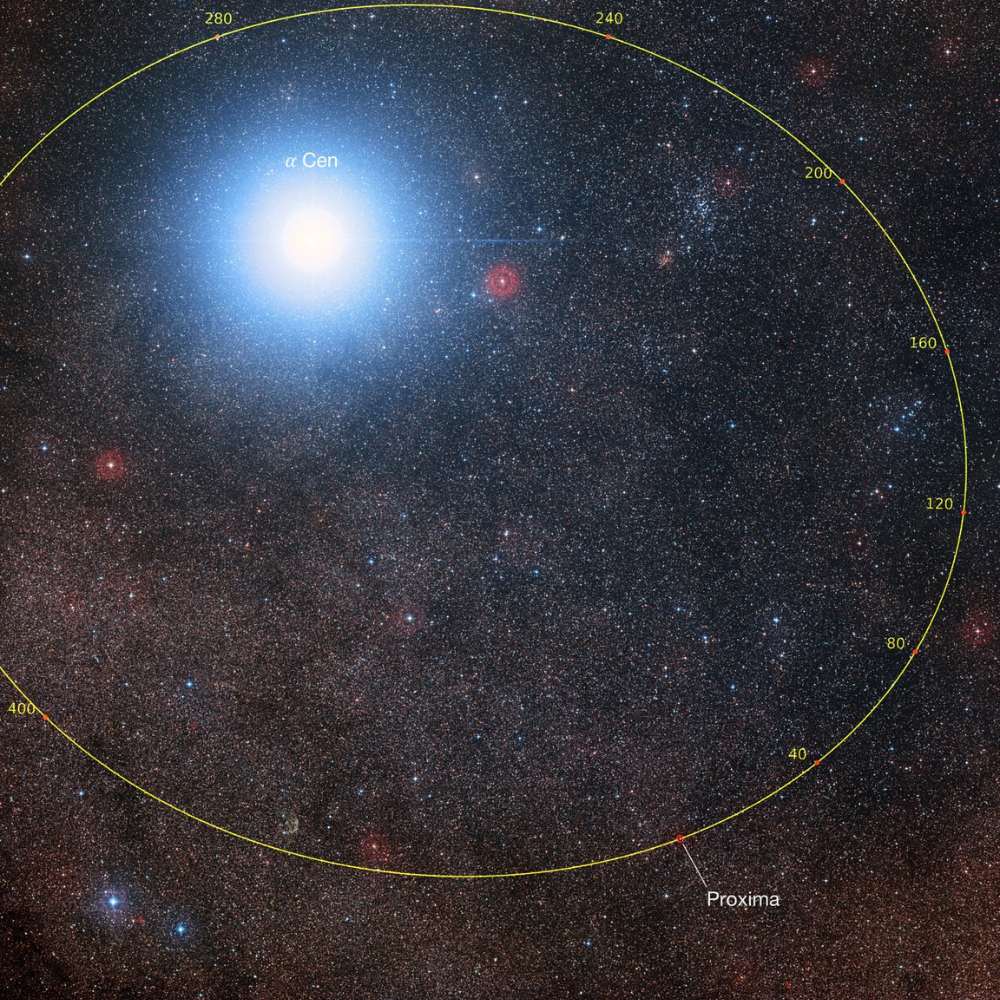
Proxima’s Proper Motion and Orbit Around Alpha Centauri A & B
Although part of the Alpha Centauri system, Proxima orbits the A–B pair at a vast distance:
~13,000 AU average separation
Orbital period: ~550,000 years
This orbit confirms:
Proxima is gravitationally bound to the Alpha Centauri system
The triple system is stable over long timescales
Proxima also has high proper motion, typical of nearby stars.
The Exoplanets of Proxima Centauri
Proxima is famous for hosting at least three planets, including one in the habitable zone.
1. Proxima Centauri b (Confirmed)
Mass: ~1.17 Earth masses
Orbital period: 11.2 days
Orbit distance: ~0.0485 AU
Lies inside the habitable zone
However:
Tidally locked rotation is likely
Proxima’s violent flares threaten atmospheric retention
Habitability remains uncertain
2. Proxima c (Candidate/Confirmed by multiple RV studies)
Mass: ~7 Earth masses
Orbital period: ~5.21 years
Cold super-Earth or mini-Neptune
Too far to be habitable
3. Proxima d (Confirmed in 2022)
Mass: ~0.26 Earth masses
Orbital period: 5.1 days
Very close to the star
Too hot for habitability
Proxima b remains the most intriguing nearby exoplanet known.
Proxima Centauri and Habitability Challenges
Although Proxima b lies in the habitable zone, several issues threaten its ability to support life:
1. Powerful Flares
Atmosphere can be stripped over time
UV radiation levels may sterilize surfaces
CME bursts can erode magnetospheres
2. Tidal Locking
One hemisphere always faces the star
Extreme temperature contrast
Atmospheric heat redistribution required
3. Stellar Wind Pressure
Proxima’s stellar wind is hundreds of times stronger than the Sun’s.
Despite these challenges, models show that with a strong magnetic field or ocean world characteristics, Proxima b could still retain habitability.
Why Proxima Centauri Is the Most Important Exoplanet Target
Because it is:
The closest star
Hosting an Earth-mass world in its habitable zone
Accessible for future probe missions such as Breakthrough Starshot
Observable with JWST, ELT, GMT, and future direct imaging telescopes
Proxima b is the nearest place where life might exist outside the Solar System.
Internal Structure of Proxima Centauri – A Fully Convective Red Dwarf
Proxima Centauri belongs to the low-mass M-class red dwarfs whose interiors differ dramatically from Sun-like stars.
Fully Convective Interior
Because Proxima is only ~0.12 solar masses:
It has no radiative core
Convection occurs from center to surface
Hydrogen is mixed uniformly throughout the star
No helium-rich core forms until extremely late in its life
This structure:
Extends Proxima’s lifespan to trillions of years
Leads to strong magnetic field generation
Produces global-scale dynamo activity
Proxima’s fully convective nature is a key reason it is such a powerful flare star.
Energy Generation – The Proton–Proton Chain
Fusion in Proxima Centauri occurs entirely through the pp chain, which is efficient at:
Low densities
Low core temperatures
Low stellar masses
The fusion rate is incredibly slow:
Proxima emits only 0.17 percent of the Sun’s luminosity
Nuclear reactions proceed at a glacial pace
Energy output remains stable over billions of years
Its low luminosity ensures it will stay on the main sequence far longer than stars like the Sun.
Magnetic Field and Stellar Activity
Proxima Centauri is one of the most magnetically active stars known.
Dynamo Behavior
Full convection allows large-scale magnetic fields to form:
Strong global magnetic cycles
Large starspots
Frequent flares
High-energy particle emissions
X-Ray and UV Emission
Proxima emits:
~100 times more X-ray energy per unit luminosity than the Sun
Extreme levels of ultraviolet radiation
This makes Proxima b’s atmospheric retention highly uncertain.
Superflares
Proxima occasionally produces superflares capable of:
Increasing brightness 10–20 times
Releasing massive bursts of charged particles
Altering atmospheric chemistry on nearby planets
These superflares happen roughly once every few years.
Rotation, Age, and Activity Relationship
Proxima Centauri is relatively old (~4.8 billion years), yet it remains active.
Rotation
Its rotation period is approximately:
~83 days
This slow rotation indicates:
Angular momentum loss over time
Age-related magnetic braking
Even so, Proxima is far more active than the Sun because fully convective stars maintain strong magnetic fields even after slow rotation sets in.
Galactic Motion and Thick Disk Connection
Space Velocity
Proxima moves rapidly through the galaxy:
Space velocity relative to the Sun: ~32 km/s
Shows moderately high proper motion
Stable trajectory around the galactic center
Orbit Through the Milky Way
Proxima is part of the thin disk population, but with:
Slightly elevated velocity components
Signs of older stellar age
A complex galactic orbit similar to Alpha Centauri A and B
Proxima will remain near the Sun for tens of thousands of years.
Comparisons with Other Nearby Red Dwarfs
Proxima Centauri vs Barnard’s Star
| Feature | Proxima Centauri | Barnard’s Star |
|---|---|---|
| Distance | 4.24 ly | 5.96 ly |
| Activity | Extremely high | Low |
| Age | ~4.8 billion years | ~7–12 billion years |
| Luminosity | Lower | Slightly higher |
Barnard’s Star is older and calmer; Proxima is younger and more energetic.
Proxima Centauri vs Wolf 359
- Wolf 359 is cooler (~2,800 K)
- Even dimmer
- A strong flare star like Proxima
But Proxima is far closer and better studied.
Proxima Centauri vs TRAPPIST-1
- TRAPPIST-1 is smaller and cooler
- Hosts seven Earth-sized planets
- Emits fewer superflares
Proxima is hotter, slightly more massive, but significantly more violent magnetically.
Proxima Centauri vs Teegarden’s Star
- Proxima is more active
- Has stronger magnetic fields
- Is younger
Teegarden’s Star is very old and extremely quiet.
Why Proxima Centauri Is Challenging for Habitability
Although Proxima b lies in the habitable zone, several factors threaten stability:
Tidal Locking
The planet almost certainly rotates with:
One hemisphere permanently facing the star
One hemisphere in perpetual darkness
This requires:
A thick atmosphere
Oceans or atmospheric circulation
to redistribute heat.
Strong Stellar Winds
Proxima’s stellar wind is estimated to be:
500–2,000 times stronger than the Sun’s wind
Capable of stripping atmospheres without magnetic protection
UV and X-ray Radiation Exposure
Proxima b receives:
Up to 500 times more X-ray flux than Earth
Extreme UV bursts during flares
This can destroy atmospheric molecules such as ozone.
Potential for Subsurface or Ocean Life
Despite the difficulties, models suggest life might survive if:
Proxima b has a magnetic field
It possesses a dense atmosphere
It is an ocean world
It has thick cloud decks
Habitability is not ruled out — only complicated.
Observing Proxima Centauri – A Telescope-Level Challenge
Even though Proxima Centauri is the closest star to the Sun, it is not visible to the naked eye.
Naked-Eye Visibility
Impossible. With an apparent magnitude of ~11.13, Proxima is far below naked-eye threshold.
Binocular Observation
Standard binoculars (7×50, 10×50) cannot reveal Proxima Centauri.
However, they help identify the broader region around Alpha Centauri in the southern sky.
Telescope Observation
To see Proxima directly:
A telescope of at least 80–120 mm aperture is recommended
Clear, dark southern latitudes are ideal
Precise star charts are necessary since Proxima has few bright neighbors
Proxima will appear as:
A tiny, faint red point
Sitting near a dense background of stars in Centaurus
Because it is faint and red, it blends easily with other faint field stars.
Proper Motion Tracking
Proxima’s proper motion is high enough that:
Its position shifts noticeably over decades
Astrophotographers can track its path relative to background stars
Long-term imaging reveals its trajectory through the Alpha Centauri region
This makes Proxima an interesting star for long-term amateur observation projects.
The Future Evolution of Proxima Centauri
As a red dwarf, Proxima will have an incredibly long evolution.
Main Sequence Lifetime
Proxima will remain on the main sequence for:
Over 4 trillion years
This is nearly a thousand times longer than the Sun’s total lifespan.
Evolutionary Path
Because it is low mass:
It will never become a red giant
It will gradually brighten over trillions of years
It will eventually contract into a helium white dwarf
White dwarfs formed this way are extremely rare—only low-mass stars with fully convective interiors can take this path.
Long-Term Changes for Proxima b
Over trillions of years:
The habitable zone will slowly move outward
Radiation levels may decrease as Proxima calms
Atmospheric escape may slow
The system may progress toward long-term equilibrium
But these changes occur far beyond human or geological timescales.
Proxima Centauri in Interstellar Exploration
Because it is the closest star, Proxima is frequently discussed as:
The first target for interstellar probes
The testing ground for light-sail propulsion
The nearest system where extraterrestrial life could exist
Breakthrough Starshot Mission
This proposed project aims to:
Send gram-scale spacecraft to Proxima
Use Earth-mounted lasers to accelerate them
Achieve ~20 percent the speed of light
Reach Proxima in ~20 years after launch
If successful, it would be humanity’s first direct exploration of another star system.
Cultural and Scientific Significance
While Proxima lacks ancient mythological importance, its scientific value is immense.
Proximity Makes It Unique
Being the closest star means:
It defines interstellar distance concepts
It shapes our understanding of the local stellar neighborhood
It is central to exoplanet research and future exploration missions
A Symbol of Possibility
Proxima Centauri b, the nearest Earth-mass planet in a habitable zone, represents:
The closest potential home beyond the Solar System
A milestone in the search for life
A prime candidate for next-generation telescopes and laser-driven probes
Proxima has become the modern-day gateway to imagining interstellar travel.
Frequently Asked Questions (FAQ)
Why is Proxima Centauri so faint if it’s the closest star?
Because it is a red dwarf, which are small, cool, and dim. Proximity alone does not guarantee brightness.
What makes Proxima b so interesting?
It is:
Earth-mass
In the habitable zone
The nearest exoplanet to Earth
But harsh stellar flares pose habitability challenges.
Does Proxima belong to the Alpha Centauri system?
Yes.
It has a loosely bound orbit around Alpha Centauri A and B with a period of ~550,000 years.
How dangerous are Proxima’s flares?
Very dangerous:
They can strip atmospheres
They irradiate planetary surfaces
They destabilize climate conditions
But habitability is not ruled out—especially for subsurface oceans or thick atmospheres.
How far is Proxima from Alpha Centauri A and B?
Approximately:
13,000–15,000 AU
Equivalent to 0.21–0.24 light-years
This is a wide, stable orbit in a triple-star system.
Does Proxima have a habitable planet?
Possibly.
Proxima b sits in the habitable zone, but its habitability depends on whether it has:
A strong magnetic field
A thick enough atmosphere
Protection against stellar flares
Will Proxima ever come closer to the Sun?
No significant approach beyond its current distance.
Its motion is stable.
Final Scientific Overview
Proxima Centauri is far more than just the closest star. It is:
A fully convective red dwarf
A powerful flare star
A host to at least three planets
The nearest known world in the habitable zone beyond Earth
A realistic destination for future interstellar probes
A cornerstone in understanding red dwarf habitability
Despite its small size, Proxima exerts a massive influence on modern astrophysics and interstellar ambitions. It represents the nearest frontier of exploration, the closest opportunity to find life beyond Earth, and a window into the evolution of the most common stars in the galaxy.