








Queqiao
The Invisible Bridge to the Far Side of the Moon
Quick Reader
| Attribute | Details |
|---|---|
| Mission Name | Queqiao |
| Meaning of Name | “Magpie Bridge” |
| Mission Type | Lunar relay communications satellite |
| Operating Agency | CNSA (China National Space Administration) |
| Launch Date | 20 May 2018 |
| Launch Vehicle | Long March 4C |
| Orbital Location | Earth–Moon L₂ halo orbit |
| Primary Role | Communication relay for the lunar far side |
| Supported Missions | Chang’e 4, Chang’e 6 (and future missions) |
| Special Payload | Netherlands–China Low-Frequency Explorer (NCLE) |
Why Queqiao Is Special
Queqiao is the first dedicated relay satellite ever placed at the Earth–Moon L₂ point. Without it, direct communication with spacecraft operating on the Moon’s far side would be impossible.
Queqiao enabled the historic Chang’e 4 far-side landing and permanently transformed the architecture of lunar exploration.
Key Insight Snapshot
- First operational Earth–Moon L₂ relay satellite
- Enabled humanity’s first-ever landing on the Moon’s far side
- Maintains a continuous Earth–Moon communication link
- Critical space infrastructure rather than a science-only mission
- Forms the foundation for future deep lunar exploration
Introduction — Why the Moon’s Far Side Is Silent
The Moon is tidally locked to Earth.
This means:
One side always faces Earth
The far side never has a direct line of sight to Earth
As a result:
Radio communication from the far side is impossible
Signals are completely blocked by the Moon itself
For decades, this made the lunar far side scientifically attractive but operationally unreachable.
Queqiao exists to solve exactly this problem.
What Is Queqiao, Functionally?
Queqiao is not a lander, rover, or orbiter in the traditional sense.
It is a communication bridge.
Its core function is to:
Receive signals from spacecraft on the Moon’s far side
Relay those signals to Earth
Send commands from Earth back to the lunar surface
Without Queqiao:
Chang’e 4 could not be controlled
Scientific data could not be transmitted
The mission would be blind and deaf
Queqiao turns an unreachable region into an operational zone.
Why Earth–Moon L₂ Was the Only Logical Choice
Queqiao operates around the Earth–Moon L₂ Lagrange point, located beyond the Moon, opposite Earth.
From this position:
The satellite can see both Earth and the Moon’s far side
Continuous communication is possible
No lunar occultation blocks the signal
Fuel-efficient halo orbits can be maintained
This geometry is uniquely suited for relay missions.
Earth–Moon L₂ is not about observation—it is about connectivity.
Why Queqiao Was a First-of-Its-Kind Mission
Before Queqiao:
No nation had placed a relay satellite at Earth–Moon L₂
Far-side missions were theoretical or short-lived
Communication was the main unsolved barrier
Queqiao proved that:
Stable operations at Earth–Moon L₂ are feasible
Continuous relay links can be maintained
Complex multi-body orbits can be operationally reliable
This shifted lunar exploration from possibility to permanence.
The Name “Queqiao” — Cultural Meaning
“Queqiao” means “Magpie Bridge” in Chinese mythology.
In folklore:
Magpies form a bridge across the Milky Way
Allowing separated lovers to meet
Symbolically, the satellite:
Forms a bridge across space
Connects Earth with the Moon’s hidden hemisphere
The name reflects both function and philosophy.
Mission Context — Chang’e 4 and Beyond
Queqiao was launched before Chang’e 4.
This sequencing was intentional.
The mission architecture required:
A relay satellite in position first
Orbital stability verified
Communication tested
Only then could the lander and rover be sent safely.
Queqiao is not an accessory—it is mission-critical infrastructure.
Technical Role — Always in the Background
Queqiao does not generate headlines.
It:
Does not land
Does not move on the surface
Does not take dramatic images
Yet every command sent to the far side
and every byte of scientific data received
passes through Queqiao.
Its success is measured by how invisible it is.
Why the Lunar Far Side Matters Scientifically
The far side of the Moon offers:
Radio-quiet environment shielded from Earth
Pristine geology different from the near side
Insights into early lunar and Solar System history
Queqiao made long-term exploration of this region operationally viable for the first time.
Orbit and Halo Dynamics — How Queqiao Stays in Position
Queqiao does not orbit the Moon in a traditional circular path.
Instead, it operates in a halo orbit around the Earth–Moon L₂ point, roughly 65,000 km beyond the Moon.
This orbit allows Queqiao to:
Maintain constant visibility of the lunar far side
Keep an uninterrupted line of sight to Earth
Avoid eclipses and radio blockage by the Moon
Because Earth–Moon L₂ is semi-stable, Queqiao performs:
Periodic station-keeping maneuvers
Small fuel corrections to remain in its halo orbit
This balance makes long-duration relay operations feasible with minimal fuel use.
How the Communication Relay Actually Works
Queqiao functions as a bent-pipe relay, meaning it does not process scientific data—it simply transfers it.
The communication chain works as follows:
Far-side lander or rover sends data upward
Queqiao receives the signal using its high-gain antenna
The signal is retransmitted toward Earth
Ground stations receive and decode the data
Commands are sent back through the same path
This relay system ensures:
Real-time command capability
Continuous telemetry reception
Safe mission operations
Without this loop, far-side missions would be uncontrollable.
Antenna and Signal Architecture
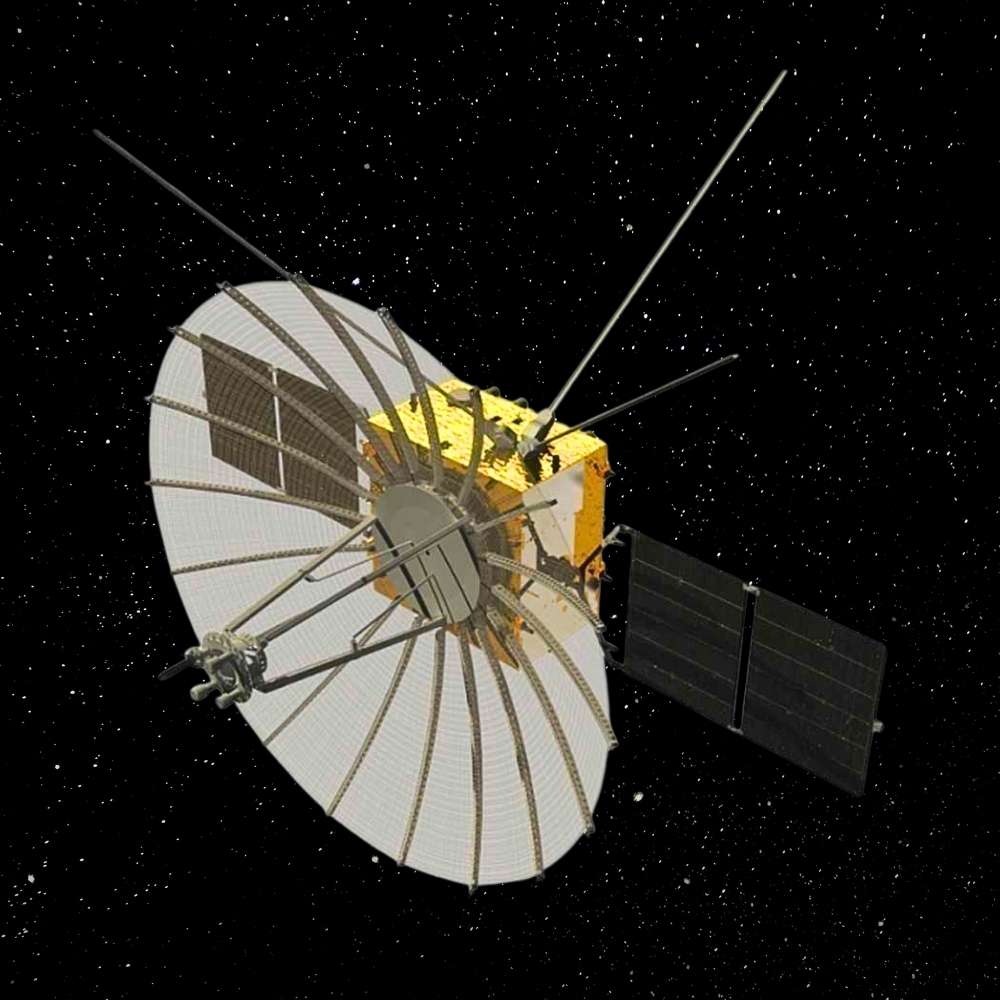
Queqiao is equipped with a large parabolic dish antenna, optimized for:
Long-distance communication
High data reliability
Stable pointing accuracy
Key features include:
Dual-directional communication capability
Redundant communication channels
Compatibility with multiple lunar missions
This design allows Queqiao to support more than one surface asset, enabling mission expansion.
Why Direct Earth–Moon Communication Is Impossible
The Moon completely blocks radio signals.
This creates a permanent radio shadow on the far side.
As a result:
No Earth-based antenna can reach far-side landers
Orbiters alone cannot maintain constant coverage
Communication gaps would be fatal to long-term missions
Queqiao solves this by lifting the relay point above and behind the Moon, where geometry allows continuous contact.
NCLE — A Science Payload Riding on Infrastructure
Although Queqiao is primarily an engineering mission, it also carries a scientific instrument:
Netherlands–China Low-Frequency Explorer (NCLE)
NCLE is designed to:
Observe low-frequency radio waves
Study cosmic radio emissions
Test techniques for future far-side radio astronomy
Why the far side matters for radio science:
Earth produces intense radio noise
The Moon blocks this interference
The far side is the quietest radio environment near Earth
Queqiao demonstrated that infrastructure missions can also enable frontier science.
Queqiao vs Traditional Lunar Relay Concepts
Earlier lunar missions depended on communication methods that imposed strict operational limits:
- Direct line-of-sight visibility with Earth
- Short-lived lunar orbiters
- Intermittent and fragile communication windows
Queqiao introduced a fundamentally new relay architecture that removed these constraints.
| Aspect | Traditional Relay | Queqiao |
|---|---|---|
| Coverage | Partial | Continuous |
| Location | Lunar orbit | Earth–Moon L₂ |
| Mission Duration | Limited | Long-term |
| Far-Side Support | Temporary | Permanent |
This architectural shift transforms lunar exploration from short, opportunistic missions into persistent, infrastructure-supported exploration—a prerequisite for long-term science, robotic networks, and future human activity on the Moon’s far side.
Operational Reliability — Why Queqiao Worked
Queqiao succeeded because:
Its mission goal was narrow and well-defined
Orbit selection minimized complexity
Redundancy was built into communication systems
It was deployed before surface missions
This careful sequencing turned a high-risk concept into a reliable operational system.
Queqiao as a Template for Future Exploration
Queqiao’s success established a model that future missions are likely to follow:
Dedicated relay satellites
Strategic placement at Lagrange points
Infrastructure-first mission architecture
This approach is essential for:
Sustained lunar presence
Polar and far-side exploration
Future human–robotic cooperation
Queqiao’s Long-Term Legacy — Infrastructure Before Exploration
Queqiao changed the logic of lunar exploration.
Before Queqiao, missions were designed first, and communication was treated as a constraint.
After Queqiao, communication infrastructure became the foundation.
Its legacy is not a single discovery, but a structural shift:
Far-side lunar missions became operationally realistic
Continuous control replaced intermittent contact
Infrastructure-first mission planning proved effective
Queqiao demonstrated that exploration follows connectivity, not the other way around.
Enabling a New Class of Lunar Missions
Because Queqiao exists, future missions can:
Operate continuously on the lunar far side
Support multiple landers and rovers
Conduct long-duration surface science
Prepare for permanent lunar infrastructure
Chang’e 6 and later missions directly build on Queqiao’s relay architecture.
Without this relay model, sustained far-side exploration would remain impractical.
Why Queqiao Matters Beyond China’s Lunar Program
Although Queqiao was developed for China’s Chang’e missions, its implications are global.
It proved that:
Earth–Moon L₂ is operationally reliable
Relay satellites can be long-lived and stable
Far-side exploration is no longer a technical barrier
This sets a precedent that other space agencies can follow, adapt, or expand upon.
Queqiao’s success lowers the barrier for international far-side science.
Frequently Asked Questions
Is Queqiao still operational?
Yes. Queqiao continues to function as a relay satellite, supporting far-side lunar missions and maintaining its halo orbit around Earth–Moon L₂.
Can Queqiao support missions from other countries?
In principle, yes. Relay satellites are not limited by nationality, but by compatibility and mission agreements.
Why not place relay satellites in lunar orbit instead?
Lunar orbiters suffer from frequent communication gaps. Earth–Moon L₂ provides continuous line-of-sight to both Earth and the far side.
Does Queqiao perform scientific observations?
Its primary role is communication, but it also carries the NCLE radio instrument for low-frequency science experiments.
Is Queqiao unique?
It was the first of its kind. Future missions are expected to deploy similar or more advanced relay satellites.
Queqiao as a Strategic Template
Queqiao established a repeatable strategy:
Deploy communication infrastructure first
Verify orbital stability and data flow
Launch surface missions afterward
Maintain long-term operational continuity
This model is applicable not only to the Moon, but also to:
Mars moons
Asteroid exploration
Future deep-space outposts
Connectivity is now treated as mission-critical architecture.
Queqiao in the Universe Map Context
Within Universe Map, Queqiao connects directly to:
Earth–Moon L₂ dynamics
Lunar far-side exploration
Space communication architecture
Lagrange-point infrastructure missions
The evolution from exploration to permanence
Queqiao represents the moment when lunar exploration transitioned from episodic visits to sustained presence.
Final Perspective
Queqiao does not land on the Moon.
It does not drill, roam, or sample.
It does not take iconic photographs.
Yet without it, none of those actions could occur on the Moon’s far side.
By quietly holding position in a delicate gravitational balance, Queqiao transformed silence into signal and isolation into access. It turned the Moon’s hidden hemisphere into an active scientific frontier.
Queqiao reminds us of a fundamental truth of space exploration:
Before we can explore distant worlds,
we must first learn how to stay connected to them.