





Rigel
The Blue Supergiant Beacon of Orion
Quick Reader
| Attribute | Details |
|---|---|
| Name | Rigel |
| Bayer Designation | β Orionis |
| Star Type | Blue Supergiant |
| Spectral Class | B8 Ia |
| Constellation | Orion |
| Distance from Earth | ~860 light-years |
| Mass | ~18–24 M☉ |
| Radius | ~70–80 R☉ |
| Luminosity | ~120,000–180,000 L☉ |
| Temperature | ~11,000 K |
| Variability | Small-amplitude variable star |
| Companion System | Rigel B, C, and D (triple companion system) |
| Notable Feature | One of the brightest stars in the night sky |
| Best Viewing Months | December to March |
Introduction – The Brilliant Blue Foot of Orion
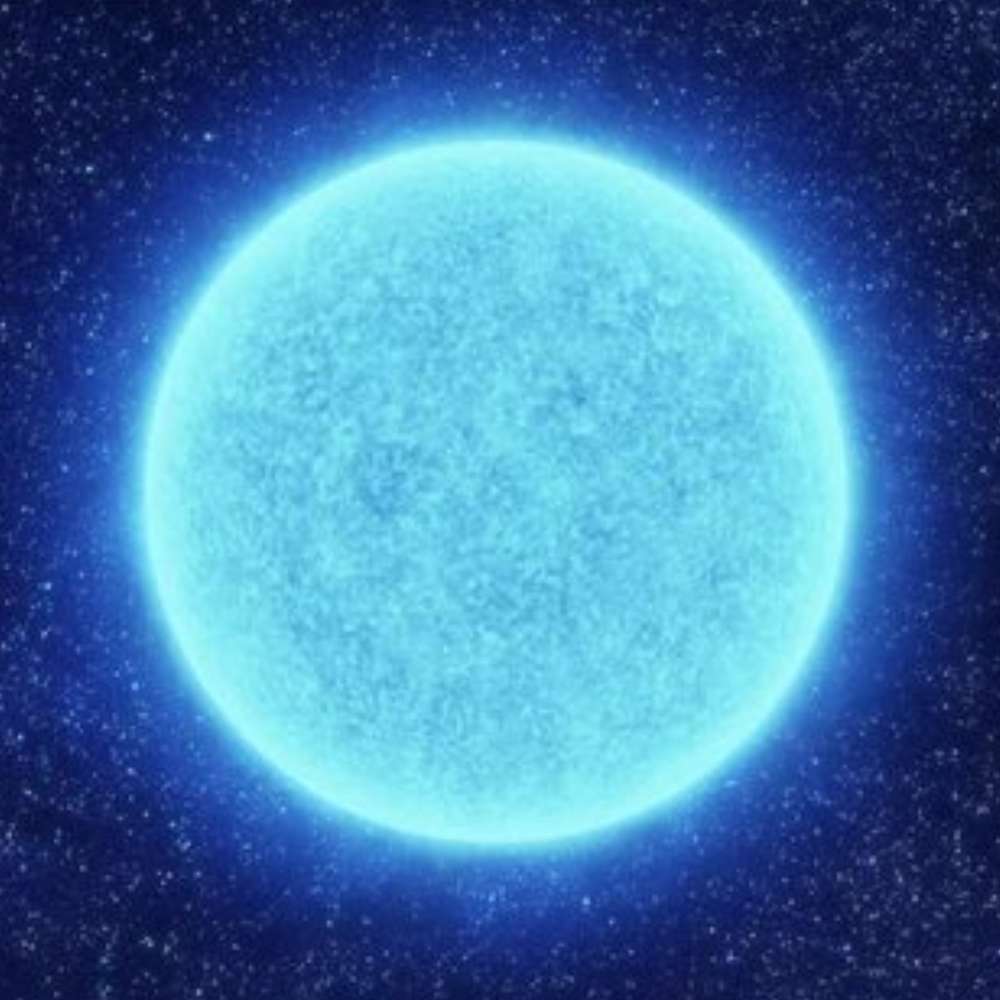
Rigel, shining at the foot of Orion the Hunter, is one of the brightest and most spectacular stars in the entire night sky. Though designated β Orionis, it often outshines Betelgeuse and dominates the constellation with its striking blue-white light.
This massive blue supergiant is in an advanced evolutionary stage, radiating more than 100,000 times the luminosity of the Sun. Rigel is so luminous that, despite being nearly 900 light-years away, it appears as one of the top seven brightest stars visible from Earth.
Rigel is not a single star—it is the primary component of a multi-star system, accompanied by three smaller companions. The star’s extreme luminosity, powerful stellar wind, and rapid evolution make it a key object for understanding the life cycles of massive stars.
Physical Characteristics of Rigel – A Hot and Luminous Giant
Rigel’s classification as a B8 Ia supergiant reveals several key features:
Temperature: ~11,000 K, giving it a blue-white color
Radius: Around 70–80 times that of the Sun
Mass: Estimated between 18 and 24 solar masses
Luminosity: Up to 180,000 L☉
Because Rigel is so large and luminous, it burns through its fuel quickly. Massive stars live fast and die young, and Rigel is already past its main-sequence life.
Its photosphere is extremely bright and turbulent, and internal pulsations create small changes in brightness—classifying Rigel as a semi-regular variable star.
Rigel’s Stellar Wind and Mass Loss
As a massive blue supergiant, Rigel produces a strong stellar wind that ejects significant mass into the surrounding space.
Characteristics of its mass loss:
Mass-loss rate: millions of times stronger than the Sun’s
Wind speed: hundreds to over a thousand kilometers per second
Creates extended envelopes of gas around the star
Influences the chemical enrichment of Orion’s interstellar medium
This outflow contributes to shaping the surrounding region, including the Orion–Eridanus superbubble, a vast cavity of hot gas in which many Orion stars reside.
Rigel’s Multiplicity – A System of Four Stars
What we see as a single bright point in the sky is actually a quadruple star system.
Rigel A
The blue supergiant itself.
Rigel B and C
A close pair of B-type main-sequence stars orbiting each other and Rigel A.
Rigel D
A fainter companion orbiting farther out.
Because Rigel A is so overwhelmingly bright, detecting and analyzing its companions requires high-resolution instruments. Their interactions with the primary star provide valuable insights into the evolution of massive multi-star systems.
Rigel’s Role in Orion
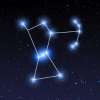
Rigel forms the left foot of Orion and balances Betelgeuse on the opposite side of the constellation.
Together they create a famous color contrast:
Rigel: Blue-white
Betelgeuse: Red-orange
This contrast helps illustrate different stages of massive star evolution:
Rigel: Hot, massive, still burning heavier elements
Betelgeuse: Cooler, expanded, nearing supernova stages
Both stars highlight the dynamic and diverse nature of Orion’s stellar population.
Rigel as a Distance Indicator
Rigel’s extreme luminosity makes it useful as a standard candle for intermediate cosmic distances.
Because we can estimate its intrinsic brightness based on spectral type and variability, Rigel assists astronomers in calibrating:
Distances to star-forming regions
Luminosity classes of other supergiants
Models of early-type stellar evolution
Massive blue supergiants like Rigel act as markers within the galaxy due to their brightness and distinct spectral properties.
Rigel’s Evolutionary Stage – A Massive Star Nearing a Transformative Phase
Rigel is no longer a main-sequence star. It has already exhausted the hydrogen in its core and is now fusing heavier elements. Massive stars evolve rapidly, and Rigel’s current phase places it in a transitional period before becoming a red supergiant.
Current evolutionary status of Rigel:
Has left the main sequence
Burning helium and heavier elements in its core
Beginning to expand slowly
Will eventually swell into a red supergiant, similar to Betelgeuse
Will ultimately end its life in a core-collapse supernova
This transition is short-lived on cosmic scales. Massive stars like Rigel spend millions of years on the main sequence but only hundreds of thousands of years in advanced stages.
Rigel’s current properties reflect a star in “mid-life crisis”—hot, bright, unstable, and shedding mass.
Internal Structure and Pulsations
Rigel is classified as a semi-regular variable star because its brightness fluctuates slightly over time. The variations are caused by internal pulsations—waves of pressure and gravity moving through the star.
Pulsation characteristics:
Caused by instability in the helium-burning layers
Produce surface temperature changes
Result in small luminosity shifts (fractions of a magnitude)
Offer insights into the star’s internal density and energy transport
These pulsations make Rigel a subject of interest in asteroseismology, the study of stellar oscillations. Since Rigel is nearby and extremely luminous, it serves as a benchmark for studying the internal physics of blue supergiants.
Chemical Composition and Heavy-Element Formation
Rigel’s spectrum shows signs of processed material from deep within the star.
Indicators of advanced nuclear activity:
Enrichment of helium and nitrogen
Depletion of carbon
Evidence of CNO-cycle processing
These chemical changes reflect the mixing of material from deeper layers through convection and rotational dynamics. Rigel demonstrates how massive stars shape galactic chemistry long before they explode.
When Rigel eventually goes supernova, it will create:
Oxygen
Silicon
Sulfur
Calcium
Iron
And other heavy elements
These elements will be injected into the Orion region, contributing to the next generation of star formation.
Rigel’s Companions – A Closer Look
The multi-star structure of Rigel makes it more than just a single luminous supergiant.
Rigel B + Rigel C
These form a tight binary:
Spectral types: likely B-type dwarfs
Orbit each other at ~28 AU separation
Orbit Rigel A at ~2,200 AU
Their combined brightness is overwhelmed by Rigel A, but they are important for understanding the region’s stellar population.
Rigel D
A more distant and faint companion:
Uncertain spectral classification
Possibly a low-mass main-sequence star
Orbits at thousands of AU from the main system
These companions demonstrate how massive stars often form in multiple systems rather than isolation.
The Influence of Rigel on the Orion Region
Rigel is one of the dominant sources of energy, ultraviolet radiation, and stellar wind within the Orion–Eridanus superbubble, a large cavity filled with hot gas created by multiple supernova explosions.
Rigel contributes to this environment by:
Ionizing surrounding gas clouds
Injecting energy into the interstellar medium
Shaping star-forming regions in Orion
Influencing dust dynamics and gas flows
This makes Rigel not only a visual landmark but also a physical force shaping the structure of the Orion molecular clouds.
Observing Rigel Through Different Wavelengths
Different wavelengths reveal different aspects of this massive star.
Visible Light
Shows a brilliant blue-white supergiant.
Ultraviolet
Highlights the hot, ionized layers and strong stellar wind.
Infrared
Reveals the cooler outer envelope and surrounding dust.
Radio
Detects ionized wind structures.
Spectroscopy
Provides detail on chemical abundances, temperature, rotation, and wind velocity.
Because Rigel is so bright, it is ideal for high-resolution observation with modern telescopes.
Rigel and Betelgeuse – Opposites Within the Same Constellation
Rigel and Betelgeuse create one of the most iconic contrasts in the night sky.
Rigel:
Blue supergiant
Hot, compact (compared to red supergiants)
Earlier evolutionary stage
Represents a massive star before expansion
Betelgeuse:
Red supergiant
Cool, extremely expanded
Much closer to supernova
Represents a massive star after expansion
Together, they visually demonstrate the life cycle of high-mass stars.
Rigel’s Fate – A Future Supernova Giant
Rigel’s life will eventually end in a spectacular core-collapse supernova, one of the brightest that will occur in our region of the Milky Way.
What will happen as Rigel nears its end:
Expansion into a Red Supergiant
Rigel will swell dramatically, likely becoming comparable in size to Betelgeuse.Layered Nuclear Burning
It will fuse heavier and heavier elements in nested shells:Hydrogen
Helium
Carbon
Neon
Oxygen
Silicon
Formation of an Iron Core
Once iron accumulates in the core, fusion can no longer produce energy.Catastrophic Core Collapse
Gravity wins, the core collapses in milliseconds, and a shockwave triggers the explosion.Supernova Explosion (Type II)
Rigel will briefly outshine its entire host galaxy.Formation of a Compact Remnant
The remnant could be:A neutron star (likely), or
A black hole (possible if the final core mass is large enough)
Because Rigel is nearly 900 light-years away, the future supernova will be safe for Earth but extraordinarily bright in our sky.
Rigel in the Hertzsprung–Russell Diagram
Rigel sits in the upper-left region of the H-R diagram:
Very hot
Extremely luminous
Massive
Rapidly evolving
Its location is typical for blue supergiants, which occupy a short-lived but crucial evolutionary stage. Rigel serves as a benchmark for:
High-mass stellar evolution
Post-main-sequence behavior
Internal pulsation modes
Mass-loss processes
Supergiant atmosphere modeling
Because of its brightness and distance, Rigel provides one of the clearest observational reference points for studying upper-mass stars.
Frequently Asked Questions (FAQ)
Is Rigel hotter than the Sun?
Yes—about twice as hot, at ~11,000 K versus the Sun’s ~5,778 K.
Can Rigel explode soon?
Not imminently. It still needs to expand into a full red supergiant first. Its remaining lifetime may be in the tens to hundreds of thousands of years.
Is Rigel larger than Betelgeuse?
No. Betelgeuse is much larger in radius, though Rigel is hotter and comparably luminous.
Is Rigel part of a multi-star system?
Yes. Rigel has at least three smaller companions.
Why is Rigel so bright despite being so far away?
Because it is extremely luminous—over 100,000 times brighter than the Sun.
Is Rigel dangerous to Earth?
No. Its future supernova would be bright but harmless at ~860 light-years.
Related Stars and Comparative Study
Betelgeuse – A red supergiant also in Orion
Deneb – A blue supergiant similar to Rigel but farther away
Mintaka & Alnitak – Other massive stars in Orion’s belt
Antares – A red supergiant offering contrast to Rigel’s hotter phase
Gamma Velorum – A Wolf–Rayet + massive-star system nearing supernova
Comparing Rigel with these stars helps illustrate the full evolutionary path of massive stars.
Related Stars and Comparative Study
Betelgeuse – A red supergiant also in Orion
Deneb – A blue supergiant similar to Rigel but farther away
Mintaka & Alnitak – Other massive stars in Orion’s belt
Antares – A red supergiant offering contrast to Rigel’s hotter phase
Gamma Velorum – A Wolf–Rayet + massive-star system nearing supernova
Comparing Rigel with these stars helps illustrate the full evolutionary path of massive stars.
Final Thoughts
Rigel is a brilliant example of a massive star in a transitional, highly energetic evolutionary stage. Its powerful stellar wind, pulsations, extreme luminosity, and multiple companions make it one of the most fascinating stars close to our Solar System.
As a future supernova, Rigel will one day reshape its surrounding region and enrich the Orion complex with new elements. Until then, it stands as a luminous beacon in the winter sky and one of the finest astronomical laboratories for studying the life cycles of massive stars.