





Saturn
The Ringed Giant and Architect of the Outer Solar System
Quick Reader
| Attribute | Details |
|---|---|
| Official Name | Saturn |
| Planet Type | Gas Giant |
| Discovery | Known since antiquity |
| Average Distance from Sun | ~9.58 AU |
| Orbital Period | ~29.5 Earth years |
| Diameter | ~116,460 km |
| Mass | ~95 Earth masses |
| Density | ~0.69 g/cm³ (lowest of all planets) |
| Rotation Period | ~10.7 hours |
| Atmosphere | Hydrogen, helium |
| Ring System | Most extensive in Solar System |
| Known Moons | 140+ (confirmed & provisional) |
| Largest Moon | Titan |
| Magnetic Field | Strong, nearly axis-aligned |
| Major Missions | Pioneer 11, Voyager 1 & 2, Cassini–Huygens |
Introduction to Saturn – Beauty with Deep Complexity
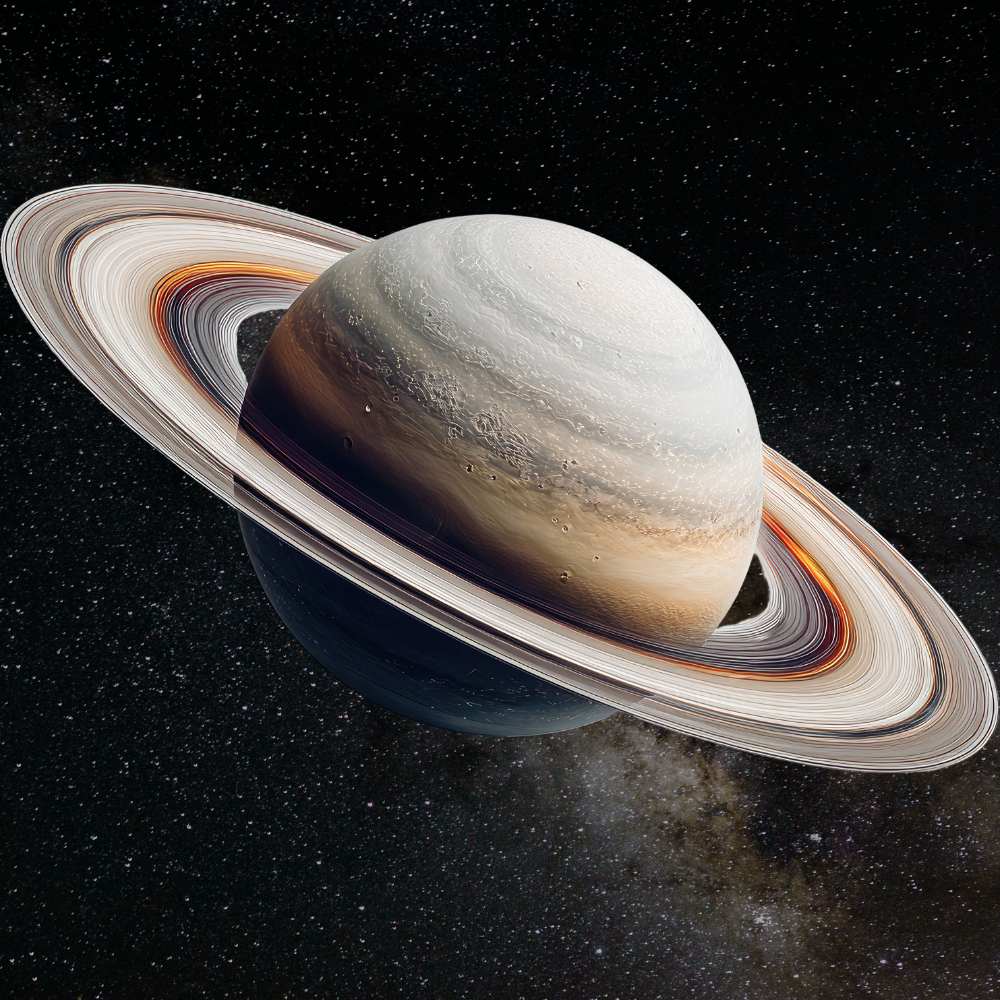
Saturn is often remembered for its spectacular rings, but this iconic appearance hides one of the most complex planetary systems in the Solar System. Beyond its beauty, Saturn is a dynamic gas giant with powerful atmospheric processes, a vast moon system, and a gravitational influence that has shaped nearby regions for billions of years.
Saturn is not merely a gas giant—it is a system builder, governing moons, rings, chemistry, and orbital stability across its domain.
Saturn in Human History
Saturn has been known since prehistoric times and was named after the Roman god of agriculture and time.
Historical significance:
Visible to the naked eye
Used by ancient civilizations to track time
Represented limits of the known Solar System until Uranus
Before telescopes, Saturn marked the edge of the planetary world.
Saturn as a Gas Giant – Composition and Structure
Saturn is composed primarily of hydrogen and helium, similar to Jupiter, but with important differences.
Internal structure:
Small rocky core
Thick layer of metallic hydrogen
Massive outer gaseous envelope
Saturn’s low density means it would theoretically float in water—if a body of water large enough existed.
Why Saturn Is Less Dense Than Jupiter
Saturn’s lower density is caused by:
Lower overall mass
Less compression of hydrogen
Different formation and cooling history
These differences make Saturn an important comparison point for understanding gas giant evolution.
Saturn’s Atmosphere – Calm Bands and Hidden Power
At first glance, Saturn’s atmosphere appears calmer than Jupiter’s, but it is far from inactive.
Atmospheric features include:
Broad cloud bands
Long-lived storms
Periodic planet-encircling storms
The most dramatic of these are Great White Spots, massive storms that erupt roughly once every Saturnian year.
Saturn’s Internal Heat
Saturn emits significantly more heat than it receives from the Sun.
This excess heat comes from:
Gravitational contraction
Helium rain falling through the interior
Helium rain releases energy, helping power Saturn’s atmospheric dynamics.
Saturn’s Magnetic Field – A Near-Perfect Alignment
Saturn’s magnetic field is unusual because it is:
Almost perfectly aligned with its rotation axis
Highly symmetrical
Generated deep within metallic hydrogen layers
This alignment challenges traditional models of planetary dynamos.
Saturn’s Gravity and Its Influence
Saturn’s gravity:
Shapes its extensive ring system
Controls the orbits of dozens of moons
Influences dust and debris far beyond its atmosphere
Saturn acts as a gravitational organizer, maintaining order within a vast orbital network.
Why Saturn Matters in Planetary Science
Saturn is essential because it:
Hosts the most complex ring–moon system
Includes Titan, one of the most Earth-like worlds in behavior
Demonstrates helium rain physics
Serves as a model for gas giants across the galaxy
Many exoplanets resemble Saturn more than any other Solar System planet.
Why Saturn Matters (Big-Picture Context)
Saturn shows how a planet can shape an entire ecosystem of rings, moons, and atmospheric processes. It demonstrates that planetary importance is not defined by size alone, but by how deeply a planet influences its surrounding environment over time.
Saturn’s Rings – A Dynamic, Living System
Saturn’s rings are the most extensive and complex ring system in the Solar System. Far from being static decorations, they are active, evolving structures shaped by gravity, collisions, and electromagnetic forces.
Key characteristics:
Composed mostly of water-ice particles
Particle sizes range from micrometers to meters
Organized into thousands of ringlets
The rings extend over 280,000 km in diameter but are remarkably thin—often only tens of meters thick.
How Old Are Saturn’s Rings?
The age of Saturn’s rings remains debated.
Two leading possibilities:
Relatively young (100–400 million years), formed from a disrupted moon
Ancient (as old as Saturn), continually recycled by collisions
Cassini data suggests the rings may be younger than Saturn, but ongoing recycling could mask their true age.
Ring–Moon Interactions – Gravitational Sculpting
Saturn’s moons play a crucial role in shaping the rings.
Important interactions include:
Shepherd moons (like Prometheus and Pandora) maintaining sharp ring edges
Orbital resonances creating gaps and waves
Density waves revealing Saturn’s internal oscillations
These interactions turn the rings into a seismograph, allowing scientists to probe Saturn’s interior.
Saturn’s Major Moons – A Planetary System in Miniature
Saturn hosts one of the richest moon systems known, ranging from tiny moonlets to world-sized bodies.
Major moons include:
Titan – Atmosphere, lakes, and prebiotic chemistry
Enceladus – Active geysers and subsurface ocean
Rhea, Dione, Tethys – Icy moons with tectonic histories
Iapetus – Extreme albedo contrast
Together, these moons represent nearly every known category of icy world.
Enceladus – Small Moon, Big Surprise
Enceladus revolutionized planetary science.
Key discoveries:
Water-ice geysers erupting from the south pole
A global subsurface ocean beneath the ice
Organic compounds and energy sources
Despite its small size, Enceladus is one of the most promising places to search for life in the Solar System.
Titan – Saturn’s Planet-Like Moon (Contextual Link)
Titan stands apart even within Saturn’s diverse system.
Titan:
Has a thick nitrogen atmosphere
Hosts methane rivers, lakes, and seas
Contains complex organic chemistry
Saturn’s gravity helps stabilize Titan’s atmosphere and climate over long timescales.
Saturn’s Smaller Moons and Ring Moons
Beyond the major moons, Saturn has dozens of smaller satellites.
These include:
Ring-embedded moonlets
Irregular captured moons
Trojan moons sharing orbits
These bodies reveal ongoing processes of accretion, disruption, and capture.
Cassini–Huygens Mission – Transforming Saturn Science
The Cassini mission (2004–2017) provided an unprecedented view of Saturn.
Major contributions:
Detailed mapping of rings and moons
Discovery of Enceladus’s geysers
Long-term atmospheric monitoring
Huygens landing on Titan
Cassini transformed Saturn from a visual icon into a deeply understood system.
Saturn vs Jupiter – Gas Giants Compared
| Feature | Saturn | Jupiter |
|---|---|---|
| Mass | ~95 Earth masses | ~318 Earth masses |
| Density | Very low | High |
| Rings | Extensive & bright | Faint |
| Magnetic Field | Strong, aligned | Extremely strong |
| Major Moons | Titan, Enceladus | Ganymede, Europa |
Interpretation:
Jupiter dominates through mass; Saturn dominates through system complexity.
Why Saturn’s System Is Unmatched
Saturn is unique because:
Rings and moons actively interact
Internal processes affect external structures
Life-related chemistry exists on multiple moons
No other planet combines rings, oceans, atmospheres, and active geology at this scale.
Why Saturn Matters (Interpretive Perspective)
Saturn demonstrates that planets can act as architects rather than isolated objects. By shaping rings, energizing moons, and sustaining complex interactions, Saturn reveals how planetary systems evolve as interconnected networks—not just collections of orbiting bodies.
The Long-Term Future of Saturn
Saturn will remain a dominant and stable gas giant for billions of years. Its mass, gravity, and internal energy sources ensure that its large-scale structure will not change dramatically in the foreseeable future.
Over very long timescales:
Saturn’s internal heat will slowly decline
Atmospheric storms may weaken but not disappear
The planet itself will remain gravitationally stable
Saturn’s evolution is slow, steady, and governed by deep internal physics.
The Fate of Saturn’s Rings
Saturn’s rings are not permanent.
Evidence from Cassini indicates:
Ring material is slowly falling into Saturn (“ring rain”)
Micrometeorite bombardment darkens and erodes ice
The rings are gradually losing mass
Estimates suggest:
Saturn’s rings may disappear or become faint within 100–300 million years
This means we are observing Saturn during a special, temporary era in its history.
Will Saturn Ever Lose Its Moons?
Saturn’s large moons are dynamically stable.
Titan’s orbit is slowly expanding
Enceladus may remain active for millions of years
Major moons are unlikely to be lost
However:
Small inner moons may collide or be disrupted
New ring material could form from moon breakup
Saturn’s moon system will continue to evolve, even as the planet remains unchanged.
Saturn and Exoplanet Science
Saturn plays a critical role in interpreting exoplanetary systems.
Why Saturn matters for exoplanets:
Saturn-mass planets are extremely common
Ring systems may be detectable around exoplanets
Moon-hosting gas giants may influence habitability
Understanding Saturn helps astronomers recognize system-level architecture, not just individual planets.
Saturn vs Ice Giants – System-Level Comparison
| Feature | Saturn | Uranus | Neptune |
|---|---|---|---|
| Planet Type | Gas giant | Ice giant | Ice giant |
| Internal Heat | High | Very low | High |
| Ring System | Massive & bright | Narrow & dark | Faint |
| Major Moons | Many, diverse | Moderate | Few large |
| Habitability Interest | High (moons) | Moderate | Moderate |
Interpretation:
Saturn stands apart not because of size, but because it hosts multiple active and complex moons.
Why Saturn Is Central to Astrobiology
Saturn itself is not habitable—but its moons are transformative.
Saturn’s system includes:
Enceladus – liquid ocean + energy + organics
Titan – atmosphere, chemistry, surface liquids
This makes Saturn the most astrobiologically diverse planetary system in the Solar System.
Frequently Asked Questions (FAQ)
Is Saturn made entirely of gas?
Mostly, but not entirely. Saturn likely has a rocky core surrounded by metallic hydrogen and a deep gaseous envelope.
Why does Saturn have such prominent rings?
Saturn’s rings likely formed from the breakup of an icy moon and are continually shaped by gravitational interactions with nearby moons.
Are Saturn’s rings permanent?
No. They are slowly losing material and may disappear in the distant future.
Which Saturn moon is most important scientifically?
Both Titan and Enceladus are critical—Titan for chemistry and climate, Enceladus for subsurface ocean and potential habitability.
Does Saturn influence life beyond itself?
Indirectly, yes. Saturn stabilizes its moons’ environments and creates conditions where complex chemistry can exist.
Has Saturn been fully explored?
No. Cassini provided deep insights, but many processes—especially long-term climate and interior dynamics—remain uncertain.
Saturn’s Place in the Universe Map
Within the Universe Map framework, Saturn represents:
The most complex planetary system
A hub of ring–moon–atmosphere interactions
The strongest bridge between planetary science and astrobiology
A model for system-scale evolution
Saturn is not just a planet—it is a planetary ecosystem.
Final Thoughts
Saturn’s beauty is only the surface expression of a deeper truth. Beneath its rings lies a planet that organizes matter, fuels moons, shapes chemistry, and evolves entire systems over time.
As Saturn’s rings slowly fade and its moons continue their quiet revolutions, the planet remains a reminder that the most important worlds are not always defined by what they are—but by what they make possible.