







Sedna
The Distant World at the Edge of the Solar System
Quick Reader
| Attribute | Details |
|---|---|
| Name | 90377 Sedna |
| Type | Extreme Trans-Neptunian Object (ETNO) |
| Category | Detached object / Inner Oort Cloud candidate |
| Discovery | 14 November 2003 |
| Discoverers | Mike Brown, Chad Trujillo, David Rabinowitz |
| Discovery Survey | Palomar Observatory |
| Distance from Sun | ~76 AU (perihelion) to ~937 AU (aphelion) |
| Orbital Period | ~11,400 years |
| Orbital Shape | Extremely elongated (eccentricity ~0.85) |
| Inclination | ~11.9° |
| Diameter | ~995 km (estimated) |
| Surface Composition | Methane ice, water ice, nitrogen compounds |
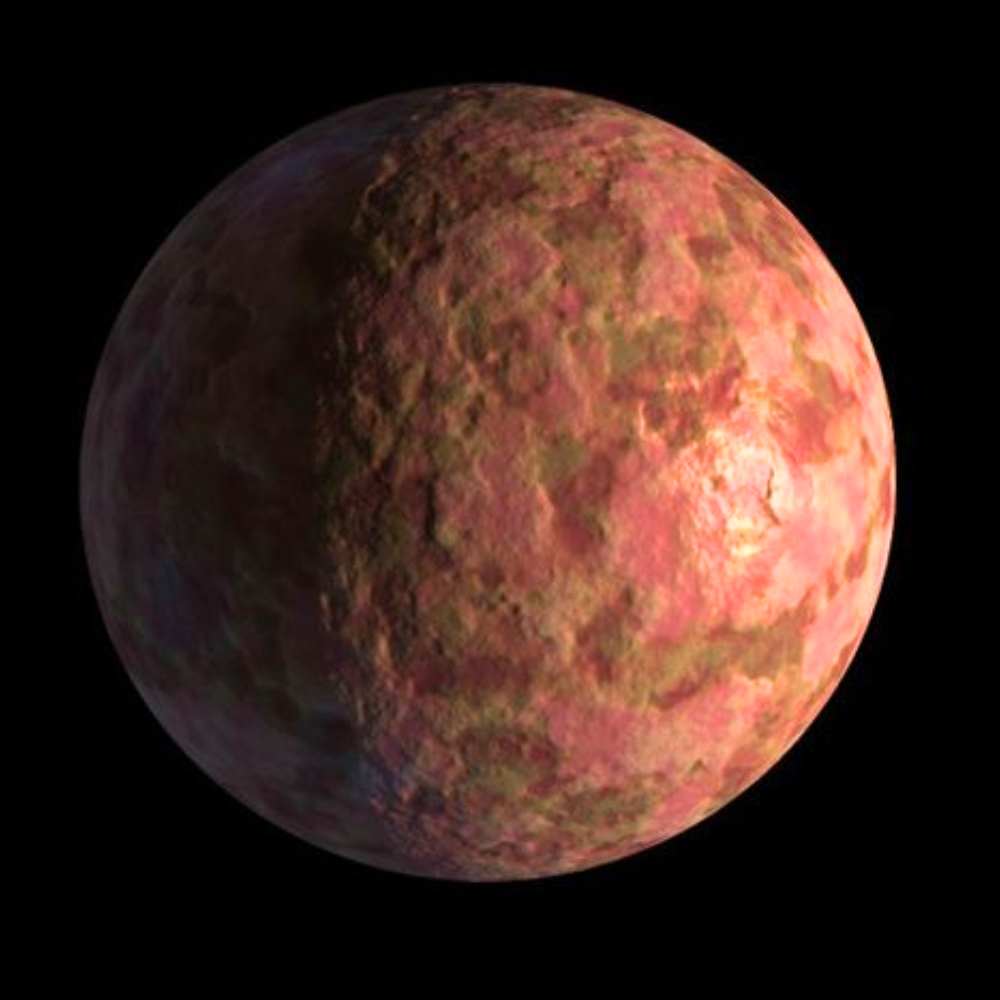
| Surface Color | Deep reddish |
| Temperature | ~−240°C (−400°F) |
| Moons | None detected |
| Official Planet Status | Not classified as a planet |
| Significance | Possible inner Oort Cloud object |
Introduction to Sedna – A World Beyond Neptune’s Reach
At the farthest known frontier of the Solar System lies a mysterious object whose orbit defies conventional planetary formation models. Sedna is not a planet, not a comet, and not quite like any other known trans-Neptunian object. It occupies a region so distant and isolated that it barely feels the gravitational influence of the giant planets.
Discovered in 2003, Sedna immediately challenged astronomers’ understanding of the Solar System’s outer structure. Its orbit carries it far beyond the Kuiper Belt and into a realm previously considered theoretical — a transitional zone between the known planetary system and the hypothesized Oort Cloud.
Sedna represents a fossil from the Solar System’s earliest era, preserved in deep cosmic cold for over 4.5 billion years. Studying it is like reading a time capsule from the Sun’s infancy.
What Makes Sedna Different from Other Distant Objects
Most objects beyond Neptune belong to the Kuiper Belt, a flattened disk extending roughly from 30 to 50 astronomical units (AU). Sedna does not fit this pattern.
An Orbit Unlike Any Other
Sedna’s closest approach to the Sun is about 76 AU — well beyond Neptune’s orbit at 30 AU. At its farthest point, Sedna travels nearly 1,000 AU from the Sun, entering a region where the Sun’s gravity weakens and external forces begin to matter.
Unlike Kuiper Belt objects, Sedna:
Never comes close enough to Neptune to be gravitationally disturbed
Has an orbit too detached to be explained by known planetary interactions
Spends most of its time in extreme darkness far beyond the planetary zone
This unusual orbit places Sedna in a class of its own.
Is Sedna Part of the Oort Cloud?
Sedna is often described as a bridge object between the Kuiper Belt and the Oort Cloud.
Inner Oort Cloud Candidate
The Oort Cloud is thought to be a vast spherical halo of icy bodies extending tens of thousands of AU from the Sun. While no object from the Oort Cloud has been directly observed, Sedna may belong to its inner edge, sometimes called the inner Oort Cloud or Hills Cloud.
Sedna’s orbit suggests:
It was not shaped by Neptune or other known planets
It may have been influenced by passing stars or galactic tides
Its current trajectory was likely set very early in Solar System history
If Sedna truly belongs to the inner Oort Cloud, it provides the first observational evidence that this region exists.
Physical Characteristics of Sedna
Despite its vast distance, astronomers have managed to infer key physical traits of Sedna.
Size and Shape
Sedna is estimated to be just under 1,000 kilometers in diameter, placing it among the largest known trans-Neptunian objects, though smaller than Pluto and Eris.
Its shape is likely spherical or near-spherical due to self-gravity, though this has not been directly confirmed.
Surface and Color
Sedna has one of the reddest surfaces observed in the Solar System. This deep red color is believed to result from:
Methane and nitrogen ices
Long-term exposure to cosmic radiation
Formation of complex organic molecules (tholins)
This makes Sedna chemically similar to some of the most primitive objects known.
Extreme Cold and Environmental Conditions
At Sedna’s current distance, sunlight is more than 10,000 times weaker than on Earth. Surface temperatures are estimated to be around −240°C, making Sedna one of the coldest known objects orbiting the Sun.
At such temperatures:
Volatile ices remain permanently frozen
No atmosphere can be sustained
Geological activity is extremely unlikely
Sedna is a world locked in permanent winter.
Why Sedna Matters to Astronomy
Sedna is not important because of what it is alone, but because of what it implies.
Its existence suggests:
The early Solar System was not isolated
The Sun likely formed in a stellar cluster
External gravitational forces shaped the outer Solar System
Sedna forces astronomers to rethink how planetary systems evolve — not just ours, but those around other stars as well.
Sedna and the Mystery of Its Origin
Sedna’s existence raises one of the most profound questions in planetary science: how did an object end up on such an extreme, detached orbit? None of the known planets can easily explain Sedna’s trajectory. This has led astronomers to explore several competing formation scenarios.
The Passing Star Hypothesis
One of the earliest and most widely discussed explanations is that Sedna’s orbit was shaped by a close stellar encounter early in the Sun’s history.
Birth in a Stellar Nursery
Astronomers believe the Sun formed within a dense star cluster. In such an environment:
Nearby stars could pass within a few hundred AU
Gravitational tugs could pull distant icy bodies onto elongated orbits
Objects like Sedna could be lifted far beyond the Kuiper Belt
A single close stellar flyby could explain:
Sedna’s unusually high perihelion
Its long, stable orbit
The lack of interaction with Neptune
This scenario suggests Sedna is a relic of the Sun’s birth environment.
Capture from Another Star System
Another intriguing possibility is that Sedna did not form around the Sun at all.
An Interstellar Origin?
Some models propose that Sedna:
Formed around another young star
Was gravitationally captured by the Sun during a close stellar encounter
Became permanently bound to our Solar System
While this idea is speculative, it highlights how chaotic and dynamic early star clusters may have been. If true, Sedna would be one of the first known objects captured from another planetary system.
The Planet Nine Hypothesis
Sedna plays a central role in one of modern astronomy’s most debated ideas: the existence of a ninth planet far beyond Neptune.
What Is Planet Nine?
Planet Nine is a hypothetical massive planet proposed to explain the clustered orbits of several extreme trans-Neptunian objects (ETNOs), including Sedna.
Predicted properties of Planet Nine:
Mass: 5–10 times Earth
Distance: 400–800 AU from the Sun
Orbit: Highly elongated and inclined
Such a planet could exert long-term gravitational influence on distant objects.
Sedna’s Role in the Planet Nine Debate
Sedna’s orbit alone does not prove Planet Nine exists, but it strengthens the case.
Sedna shows:
A perihelion too high to be shaped by Neptune
Long-term orbital stability
Similar orbital traits to other extreme objects
If Planet Nine exists, it could:
Maintain Sedna’s detached orbit
Shape the alignment of distant ETNOs
Redefine the architecture of the outer Solar System
However, no direct observation of Planet Nine has yet been made.
Alternative Explanations Without Planet Nine
Not all scientists agree that a new planet is necessary.
Other models include:
Combined effects of multiple stellar flybys
Galactic tidal forces over billions of years
Statistical bias in how distant objects are discovered
These alternatives remind researchers to be cautious before adding new planets to the Solar System.
Comparing Sedna with Similar Extreme Objects
Sedna is not alone. A growing population of extreme trans-Neptunian objects shares some of its characteristics.
Sedna vs 2012 VP113
| Feature | Sedna | 2012 VP113 |
|---|---|---|
| Perihelion | ~76 AU | ~80 AU |
| Aphelion | ~937 AU | ~450 AU |
| Orbital Period | ~11,400 years | ~4,200 years |
| Classification | Inner Oort Cloud candidate | Inner Oort Cloud candidate |
Both objects remain permanently beyond Neptune’s influence.
Sedna vs Kuiper Belt Objects
Key differences:
Kuiper Belt objects interact with Neptune
Sedna never approaches the giant planets
Sedna’s orbit is far more elongated
Sedna occupies a unique dynamical class.
Why Sedna Is So Hard to Study
Sedna’s extreme distance makes observation incredibly challenging.
Major limitations include:
Extremely faint brightness
Slow apparent motion across the sky
Long orbital period that prevents full orbit tracking
Even the most powerful telescopes can only observe Sedna during a small fraction of its orbit.
Scientific Importance of Sedna
Sedna acts as:
A probe of the Solar System’s early environment
Evidence of external gravitational influences
A guide to where new distant objects may be found
Its study helps astronomers refine search strategies for:
Inner Oort Cloud members
Planet Nine
Distant exoplanetary analogs
Could Humanity Ever Visit Sedna?
Reaching Sedna would be one of the greatest challenges in the history of space exploration. Its extreme distance places it far beyond the practical reach of current spacecraft technology.
Distance and Travel Time
At its closest approach to the Sun (perihelion), Sedna is still about 76 astronomical units away — more than twice the distance of Pluto. At aphelion, it drifts nearly 1,000 AU from the Sun.
Even with gravity assists and advanced propulsion:
A spacecraft could take 25–40 years to reach Sedna at perihelion
A mission to aphelion would be effectively impossible with present-day technology
Unlike Pluto, Sedna has no known atmosphere, moons, or active geology to study up close, reducing short-term mission priority.
Why No Mission Is Planned (Yet)
Sedna’s scientific value is high, but mission feasibility is low.
Key challenges include:
Extremely long travel times
Limited solar power availability
Minimal opportunity for orbital insertion
Sparse data return compared to cost
However, future propulsion systems — such as nuclear electric propulsion or solar sails — could change this assessment.
Sedna’s Long-Term Fate
Sedna’s orbit is stable on billion-year timescales, but not permanent in a cosmic sense.
Orbital Evolution
Over millions to billions of years:
Galactic tides may slowly reshape its orbit
Passing stars could alter its trajectory
It may drift deeper into the Oort Cloud
Sedna is effectively decoupled from the planetary system, making it more influenced by the galaxy than by the Sun’s planets.
What Sedna Tells Us About Planetary Systems
Sedna is more than a distant object — it is a clue.
Its existence suggests:
Planetary systems are shaped by their stellar environment
External forces play a major role in system architecture
The boundary of a planetary system is far larger than once believed
Many exoplanet systems may host Sedna-like objects, silently orbiting far beyond detection limits.
Frequently Asked Questions
Is Sedna a planet?
No. Sedna does not meet the criteria for a planet or a dwarf planet. While it may be nearly spherical, it has not cleared its orbital neighborhood and lacks sufficient mass.
Is Sedna larger than Pluto?
No. Sedna is significantly smaller than Pluto. Pluto has a diameter of about 2,377 km, while Sedna is estimated to be just under 1,000 km across.
Why is Sedna so red?
Sedna’s surface color is likely caused by:
Methane and nitrogen ices
Long-term cosmic radiation
Formation of complex organic compounds (tholins)
This radiation-processed chemistry creates its deep reddish appearance.
Could Sedna have an atmosphere?
At perihelion, some models suggest trace sublimation of nitrogen or methane might occur, but any atmosphere would be:
Extremely thin
Temporary
Undetectable with current instruments
For most of its orbit, Sedna is completely airless.
Does Sedna support the Planet Nine theory?
Sedna does not prove Planet Nine exists, but it supports models that require an external gravitational influence. Its orbit is difficult to explain without invoking either:
A massive unseen planet
Early stellar encounters
Or both
Sedna’s Place in the Solar System Map
Sedna occupies a critical transitional zone:
Too distant to be Kuiper Belt
Too close to be classic Oort Cloud
Dynamically detached from known planets
It represents the inner edge of the Solar System’s true frontier.
Final Thoughts
Sedna is a reminder that the Solar System does not end at Neptune, or even at Pluto. Beyond the planets lies a vast, dark region filled with relics from the Sun’s formation — objects shaped by forces far beyond our immediate cosmic neighborhood.
Though invisible to the naked eye and unreachable for now, Sedna reshapes our understanding of:
Where the Solar System truly ends
How stars and planets form together
How hidden structures influence cosmic evolution
In mapping Sedna, we map the limits of our own celestial home.