





Sirius
The Brightest Star in the Night Sky and Its White Dwarf Companion
Quick Reader
| Attribute | Details |
|---|---|
| Name | Sirius |
| System | Sirius A + Sirius B (binary) |
| Other Names | Alpha Canis Majoris, Dog Star |
| Constellation | Canis Major |
| Distance | ~8.6 light-years |
| Apparent Magnitude | −1.46 (brightest in the night sky) |
| Sirius A Type | A1 V (Main-sequence, hydrogen-burning) |
| Sirius B Type | DA2 White Dwarf |
| Temperature (A) | ~9,940 K |
| Temperature (B) | ~25,000 K |
| Mass (A) | ~2.06 M☉ |
| Mass (B) | ~1.02 M☉ |
| Luminosity (A) | ~25 L☉ |
| Radius (A) | ~1.71 R☉ |
| Orbital Period | ~50.1 years |
| Best Viewing Season | December–March |
| Importance | Brightest star, classic white dwarf, key evolutionary system |
Introduction – The Dog Star of Winter Skies
Sirius is the most brilliant star in Earth’s night sky.
It shines so intensely that its beams shimmer and flicker with multiple colors when viewed low on the horizon. Located in the constellation Canis Major, Sirius has been a central figure in astronomy, navigation, mythology, and astrophysics for thousands of years.
But Sirius is not a single star.
It is a binary system, made of:
Sirius A – a bright, hot A-type star
Sirius B – a faint but crucial white dwarf companion
The contrast between these two stars makes the Sirius system one of the most scientifically important binary systems in the Milky Way. Sirius B, especially, was the first white dwarf ever discovered, helping establish the physics of electron degeneracy and stellar evolution.
At only 8.6 light-years away, Sirius is one of Earth’s closest neighbors, and its exceptional brightness comes from a combination of:
High intrinsic luminosity
Proximity to the Solar System
Hot surface temperature
Sirius is not just bright — it is astrophysically influential, historically significant, and a key anchor of winter constellations.
Physical Characteristics of Sirius A – The Main Star
Temperature and Color
Sirius A’s surface temperature of nearly 10,000 K gives it:
A blue-white color
Strong hydrogen Balmer absorption lines
A luminous, clean spectral signature of an A-type star
It emits far more ultraviolet radiation than the Sun.
Size and Luminosity
Sirius A:
Is about 1.7 times the Sun’s radius
Has roughly twice the Sun’s mass
Emits nearly 25 times the Sun’s light
Because luminosity rises steeply with mass, Sirius A burns through its fuel faster and will have a much shorter lifespan than the Sun.
Age and Evolutionary Stage
Sirius A is young, likely:
~220–250 million years old
Although young, Sirius A is already more evolved than the Sun because higher-mass stars evolve more quickly.
It is still on the main sequence, fusing hydrogen in its core, but will eventually swell into a red giant and later become a white dwarf, similar to Sirius B.
The Sirius System – A Binary in Motion
Sirius A and Sirius B orbit each other every 50.1 years, with an average separation of:
~20 AU (similar to the distance between the Sun and Uranus)
Their orbit is elliptical, causing their distance to vary between:
~8 AU (close approach)
~31 AU (maximum separation)
This binary orbit allows astronomers to measure precise stellar masses — critical for testing theories of stellar structure.
Why Sirius Appears So Bright
Sirius is bright because of two reasons combined:
Intrinsic luminosity: Sirius A is about 25 times more luminous than the Sun
Proximity: It is only 8.6 light-years away
If Sirius were placed at the Sun’s distance from Earth, it would outshine the Sun by a factor that would make daylight overwhelmingly intense.
Its brightness also causes strong atmospheric scintillation, which is why Sirius “twinkles” more dramatically than most stars.
Historical and Cultural Importance
Sirius has been:
The “Nile Star” of ancient Egypt, heralding the flooding of the Nile
A key star in Greek mythology, associated with the Dog Days of Summer
A navigation star used by ancient seafarers
A central star in indigenous cultures across Australia, Polynesia, Africa, and the Americas
Its prominence in global astronomy is unmatched.
Scientific Value of the Sirius System
Sirius is crucial in modern astrophysics because:
1. Sirius B was the first white dwarf discovered
This allowed scientists to:
Discover electron degeneracy pressure
Develop white dwarf cooling theory
Test gravitational redshift predictions
2. The binary orbit enables precise stellar mass measurements
These measurements validate stellar evolution models.
3. Sirius A is a benchmark for A-type main-sequence stars
Its proximity makes it ideal for detailed spectral and photometric studies.
Internal Physics of Sirius A – The Engine Behind the Brightest Star
Sirius A is one of the most intensively studied A-type stars because of its proximity and brightness. Its internal structure reveals how moderately massive stars generate energy, evolve, and eventually leave the main sequence.
Core Structure – Hydrogen Fusion at High Intensity
Sirius A’s core is:
Extremely hot (over 20 million K)
High-density hydrogen plasma
Supported by strong radiation pressure
Fusion takes place via the CNO cycle, not the proton–proton chain dominant in the Sun.
The CNO cycle:
Requires higher temperatures
Produces energy more efficiently
Leads to faster hydrogen consumption
This explains why Sirius A has a shorter main-sequence lifespan.
Radiative Interior and Thin Convective Zone
Unlike the Sun, Sirius A has:
A radiative core and radiative envelope
Only a very thin outer convective layer
Consequences:
Weak magnetic activity
Minimal starspot formation
Very low levels of coronal emission
Sirius A is not magnetically turbulent like Sun-like or red dwarf stars.
Rotation and Oblateness
Sirius A:
Rotates at ~16 km/s (moderate for an A-type star)
Is not as rapidly rotating as Vega or Altair
Shows only slight flattening at the equator
Sirius A’s rotation is fast enough to generate subtle effects but does not significantly distort the star.
Surface and Atmospheric Features of Sirius A
Temperature and Color
With a surface temperature near 10,000 K:
Sirius A emits brilliant blue-white light
Its spectrum is dominated by hydrogen Balmer absorption lines
Ultraviolet radiation is strong
The star shows no strong metallic lines typical of cooler stars
The color contrast between Sirius A and its surroundings makes the star appear unusually sharp in winter skies.
Spectral Characteristics
Sirius A’s spectrum provides:
Strong hydrogen Balmer lines
Weak metallic lines
High-fidelity temperature diagnostics
It is used as a spectrophotometric standard because its spectrum is clear, bright, and well understood.
Age and Evolution – A Young Star Burning Quickly
Despite its youth (~220–250 million years), Sirius A is:
Already significantly evolved compared to the Sun
Consuming hydrogen rapidly via the CNO cycle
Expected to leave the main sequence in a few hundred million years
Sirius A will evolve into:
A subgiant
A red giant
A helium-burning horizontal branch star
An asymptotic giant
A white dwarf
This evolution mirrors the path that Sirius B already completed.
Sirius A in Comparison with Other Bright A-Type Stars
Understanding Sirius becomes easier by comparing it with similar bright stars.
Sirius A vs Vega
| Feature | Sirius A | Vega |
|---|---|---|
| Temperature | ~9,940 K | ~9,600 K |
| Rotation | Slow | Very rapid |
| Luminosity | 25 L☉ | 40 L☉ |
| Age | Younger | Older |
Vega rotates so fast that its poles are much hotter than its equator, unlike Sirius.
Sirius A vs Altair
- Altair rotates extremely quickly
- Altair is severely oblate
- Altair shows major temperature differences between equator and poles
Sirius A is far more stable and symmetric.
Sirius A vs Deneb
- Deneb is a supergiant
- Deneb is hundreds of thousands of times more luminous
- Deneb represents the opposite extreme of stellar evolution
Sirius A is far smaller and more stable.
The Evolutionary Link to Sirius B
One of the greatest astrophysical mysteries of the 19th century was resolved when astronomers realized:
Sirius A is younger in appearance
But Sirius B evolved faster and already became a white dwarf
This meant:
Sirius B was originally more massive
It aged rapidly, shed its envelope, and shrank
Sirius A, less massive originally, is still on the main sequence
The two stars give a full evolutionary timeline in a single system.
he Gravitational Relationship Between Sirius A and Sirius B
Although Sirius B is tiny, its mass is high (~1.02 M☉).
This means:
The two stars orbit around a barycenter located just outside Sirius A
They gravitationally influence each other strongly
The system’s orbital motion was the key to predicting Sirius B’s discovery
Sir Isaac Newton’s laws were tested and confirmed using the Sirius system’s dynamics.
Why Sirius Flickers So Dramatically in Earth’s Sky
The intense scintillation of Sirius is due to:
Its brightness
Atmospheric turbulence
Being observed often at low altitude during winter evenings
Rapid temperature variations in Earth’s atmosphere
This creates the famous shimmering, color-shifting appearance that many observers notice.
Scientific Contribution of Sirius A to Modern Astronomy
Sirius A has helped astronomers:
Calibrate stellar models for A-type stars
Understand radiative envelopes
Compare solar vs non-solar fusion mechanisms
Establish photometric baselines for bright star studies
It is one of the most thoroughly analyzed stars in the sky thanks to its brightness and proximity.
Introduction of Sirius B – The Hidden Companion of the Brightest Star
Sirius B is one of the most important stellar objects in the history of astronomy.
Although invisible to the naked eye, it completely transformed our understanding of:
Stellar evolution
Dense matter
Quantum physics
Gravitational theory
Sirius B was the first white dwarf ever discovered, providing direct evidence for the existence of stars supported by quantum mechanical pressure—something unimaginable before the 20th century.
Today, Sirius B is one of the closest and best-studied white dwarfs, orbiting Sirius A every 50.1 years. Its small size, extreme density, and fascinating physical processes make it one of the most valuable astrophysical laboratories in the sky.
The Discovery of Sirius B – A Milestone in Astronomy
Orbital Wobble Predicts Its Existence
In the 1840s, Friedrich Bessel noticed:
Sirius A was not moving in a straight line
Its position shifted due to an unseen companion
This was the first major evidence of a star influenced by an invisible object.
First Imaging of the Companion
Sirius B was first seen in 1862 by Alvan Clark using a new refracting telescope.
Astronomers were shocked:
The companion was extremely faint
Yet gravitational calculations required it to be massive
This contradiction led to the birth of white dwarf physics.
Physical Characteristics of Sirius B – A Star Smaller Than Earth
Sirius B is extraordinary because it is:
- About the size of Earth
- With a mass similar to the Sun
- One of the densest objects known outside neutron stars and black holes
Key Properties
| Attribute | Sirius B |
|---|---|
| Star Type | DA2 White Dwarf |
| Temperature | ~25,000 K |
| Radius | ~0.008 R☉ (slightly larger than Earth) |
| Mass | ~1.02 M☉ |
| Density | ~2 million g/cm³ |
| Composition | Carbon-oxygen core, hydrogen atmosphere |
| Absolute Magnitude | ~11.3 |
Its surface gravity is incredible:
- About 400,000 times stronger than Earth's
- Capable of compressing matter into exotic quantum states
The Physics of Degenerate Matter – Why Sirius B Doesn’t Collapse
Sirius B is supported by electron degeneracy pressure, not thermal pressure.
Electron Degeneracy Pressure
This quantum mechanical pressure arises because:
Electrons cannot occupy the same energy state
Compression forces electrons into higher states
This creates an outward pressure independent of temperature
Consequences:
The star no longer undergoes nuclear fusion
Cooling happens slowly over billions of years
The more massive the white dwarf, the smaller it becomes
This counterintuitive behavior is one of the cornerstones of modern astrophysics.
Gravitational Redshift – Relativity in Action
Sirius B was the first star to demonstrate gravitational redshift predicted by Einstein:
Light leaving Sirius B loses energy climbing out of its intense gravitational field
The light wavelength shifts redward
This shift was measured precisely and matched general relativity
Sirius B became one of the earliest stellar confirmations of Einstein’s theory.
Cooling Sequence and Stellar Age
Sirius B is currently:
Around 120 million years old as a white dwarf
Very hot now, but gradually cooling
White dwarfs cool by:
Radiating leftover heat
Slowly becoming dimmer
Taking billions of years to fade to invisibility
Eventually, Sirius B will become a black dwarf, a cold remnant—though the universe is not old enough for any black dwarfs to exist yet.
The Evolutionary History of Sirius B
Step-by-Step Life Path
Sirius B began as a massive main-sequence star (~5 M☉).
It burned through its hydrogen quickly.
It grew into a red giant.
It fused helium into carbon and oxygen.
It shed its outer layers as a planetary nebula.
The core collapsed, forming the white dwarf we see today.
Why Did Sirius B Evolve Faster Than Sirius A?
Because originally:
Sirius B was more massive
Higher mass stars evolve exponentially faster
It aged and died while Sirius A is still relatively young
This gives astronomers a rare opportunity to observe two evolutionary stages in one binary system.
The Orbit of Sirius B Around Sirius A
Key Orbital Features
Period: 50.1 years
Average distance: ~20 AU
Highly elliptical orbit
Strong gravitational interaction between the stars
Sirius B’s orbit:
Allowed astronomers to measure its mass precisely
Confirmed the existence of white dwarfs
Helped calibrate stellar mass-luminosity relations
The Sirius System in Modern Astrophysics
Sirius B plays a central role in the study of:
1. White Dwarf Mass–Radius Relationships
Observations of Sirius B perfectly match theoretical predictions.
2. Dense Matter Physics
Electron degeneracy theory is verified by its physical properties.
3. Binary Evolution
Sirius is a model system for understanding:
Mass loss
Orbital expansion
Post-main-sequence behavior
4. Relativity
Gravitational redshift measurements support Einstein’s predictions.
Why Sirius B Is So Difficult to Observe
Despite being relatively close and important, Sirius B is very hard to detect because:
Sirius A is overwhelmingly bright
The glare hides Sirius B
Only large, high-precision telescopes can resolve the pair
Adaptive optics is often required
Most amateur astronomers never observe Sirius B directly.
Observing Sirius – A Guide for Skywatchers
Sirius is one of the most dazzling objects in the night sky, and its brightness makes it an essential target for both beginners and advanced observers.
Naked-Eye Viewing
Sirius appears:
Brilliant blue-white
Extremely bright (apparent magnitude −1.46)
Flickering with color due to atmospheric refraction
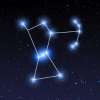
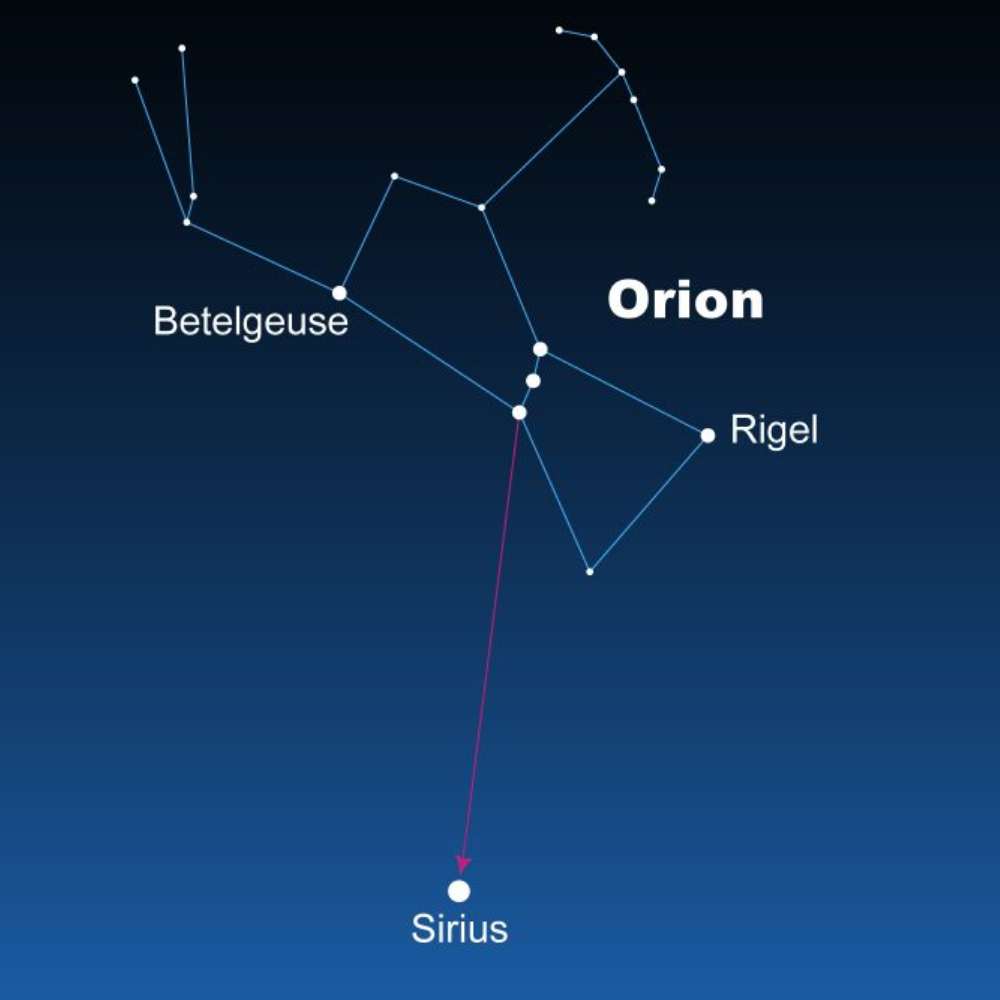
Positioned in Canis Major, below Orion
Its brilliance makes it impossible to miss in winter evenings.
How to Locate Sirius
Find Orion’s Belt
Extend a line downward and left (for Northern Hemisphere)
Sirius will appear as an intensely bright point in Canis Major
From the Southern Hemisphere, Sirius shines even higher and more dominantly.
Binoculars
Under binoculars:
Sirius A remains a single, blazing star
Color purity becomes more apparent
The surrounding star field of Canis Major becomes visible
Because Sirius A is so bright, binoculars cannot reveal Sirius B.
Telescope Observation
Observing Sirius B is difficult due to Sirius A’s glare.
To detect Sirius B:
A telescope of at least 150–200 mm aperture is required
Excellent seeing conditions are essential
Sirius must be high above the horizon
Adaptive optics dramatically improves chances
Even professional astronomers struggled for decades to observe Sirius B reliably.
Astrophotography
For imaging:
Sirius A is excellent for testing exposure control
Sirius B requires long exposures, careful filtering, and high-resolution optics
The Sirius field makes an iconic wide-angle winter composition
Its brilliance and color contrast make the Sirius region ideal for astrophotography practice.
Cultural and Mythological Importance of Sirius
Sirius has a cultural legacy unmatched by any other star.
Ancient Egypt – The Star of the Nile
The heliacal rising of Sirius marked the annual flood of the Nile
This event defined Egypt’s agricultural calendar
Sirius (Sopdet) was worshipped as a divine symbol of renewal
Greek and Roman Traditions
Sirius was the “Dog Star,” associated with:
Heat
Summer drought
The “Dog Days” (the hottest days of the year)
The ancients believed Sirius influenced weather and human behavior.
Indigenous Astronomy Across the World
Sirius appears prominently in:
Polynesian navigation star lines
Aboriginal Australian Dreamtime stories
Inuit seasonal calendars
African mythologies (notably the Dogon cosmology)
Across Earth’s cultures, Sirius consistently appears as a symbol of guidance and cosmic rhythm.
Modern Cultural References
Sirius remains iconic in:
Literature
Navigation
Astronomy textbooks
Space exploration history
Its presence in humanity’s sky lore is unmatched.
The Future Evolution of the Sirius System
What Will Happen to Sirius A?
In the next 1–1.5 billion years:
Sirius A will exhaust its core hydrogen
It will expand into a red giant
Helium fusion will begin in the core
It will eject its outer layers
It will form a planetary nebula
It will contract into a white dwarf
Eventually, both Sirius A and Sirius B will be:
A double white dwarf binary
Orbiting slowly for trillions of years
Long-Term Binary Evolution
White dwarfs slowly cool, meaning:
Sirius B will fade gradually
Sirius A (future white dwarf) will fade even more slowly
The system will remain gravitationally stable for ages far beyond the lifetime of the Milky Way
This binary will outlive the Sun and nearly all nearby stars.
Frequently Asked Questions (FAQ)
Why is Sirius so bright?
Because of its:
Proximity (8.6 light-years)
Intrinsic luminosity (~25 times the Sun)
Hot temperature (~10,000 K)
Why does Sirius flicker so intensely?
Because it is:
Extremely bright
Often observed low on the horizon
Affected heavily by atmospheric turbulence
Can Sirius go supernova?
No. Neither Sirius A nor Sirius B is massive enough.
Why is Sirius B important?
Because it:
Was the first white dwarf discovered
Proved the existence of degenerate matter
Demonstrated gravitational redshift
Is crucial for validating stellar models
Can we see Sirius B with amateur telescopes?
Only under perfect conditions.
It requires:
Large aperture
Steady atmospheric seeing
High magnification
Sirius positioned high in the sky
How old is the Sirius system?
Sirius A: ~220–250 million years
Sirius B (white dwarf): ~120 million years as a remnant
Does Sirius have planets?
No confirmed planets.
The system’s evolution (especially Sirius B’s original giant phase) likely destabilized any early planetary system.
Final Scientific Overview
Sirius, the brightest star in the night sky, is far more than a beacon of winter evenings. It is a complex binary system whose two stars reveal the entire arc of stellar evolution:
Sirius A represents the main-sequence phase of a moderately massive star
Sirius B represents the final remnant of a star that once burned much hotter and faster
Together, they showcase:
Hydrogen fusion via the CNO cycle
The physics of electron degeneracy
Orbital dynamics in binary systems
Gravitational redshift validation
The life cycles of stars from birth to white dwarf stage
The system’s brilliance, proximity, and astrophysical richness make Sirius one of the most influential stellar objects in human history — and an essential page in UniverseMap’s catalog of stars.