







Small Magellanic Cloud (SMC)
A Dwarf Galaxy Shaped by Cosmic Tides
Quick Reader
| Attribute | Details |
|---|---|
| Name | Small Magellanic Cloud (SMC) |
| Type | Dwarf Irregular Galaxy (Transitional type between irregular and spheroidal) |
| Constellation | Tucana |
| Distance from Earth | ~200,000 light-years |
| Diameter | ~7,000 light-years |
| Discovery | Known since ancient times; recorded by Persian and Arabic astronomers; named after Ferdinand Magellan’s expedition (1519–1522) |
| Galaxy Group | Member of the Local Group; satellite of the Milky Way |
| Mass | ~3 × 10⁹ M☉ (about 1/100 of the Milky Way) |
| Star Formation Rate | Moderate (~0.05–0.1 M☉ per year) |
| Metallicity | ~1/5 solar (very metal-poor) |
| Companion | Large Magellanic Cloud (LMC) |
| Connection | Linked to LMC by the Magellanic Bridge |
| Apparent Magnitude | ~2.7 (visible to naked eye from Southern Hemisphere) |
| Best Viewing Months | November to March |
| Scientific Importance | Key laboratory for studying low-metallicity star formation, galactic interaction, and stellar evolution |
Introduction — The Little Cloud That Tells a Big Story
The Small Magellanic Cloud (SMC) may appear faint and unassuming in the southern sky, but it carries immense scientific importance.
Located about 200,000 light-years away in the constellation Tucana, this dwarf irregular galaxy is one of the Milky Way’s closest companions — and one of the most studied galaxies in the Local Group.
Though much smaller than its neighbor, the Large Magellanic Cloud (LMC), the SMC has a turbulent past marked by gravitational tides, starbursts, and gas stripping.
Together, the Magellanic Clouds orbit our galaxy, forming a trio of interacting systems that constantly reshape one another through gravity.
Astronomers often describe the SMC as a “living fossil” — its chemical composition and structure resemble the primitive galaxies that populated the early universe, offering clues to how galaxies evolve from simple clouds of gas into complex star systems.
Appearance and Structure — A Distorted Dwarf
Visually, the SMC looks like a hazy, elongated patch of light about 3° wide (equivalent to six full moons).
Its irregular shape is the result of repeated tidal interactions with both the Milky Way and the LMC.
1. Central Bar and Wing
The SMC is roughly divided into two major parts:
The Bar: A dense, elliptical core region rich in old stars.
The Wing: A diffuse extension of younger stars stretching toward the LMC, connected by the Magellanic Bridge.
The “bar” represents the galaxy’s main stellar body, while the “wing” shows the direction of tidal stretching caused by the LMC’s gravity.
2. Stellar Distribution
The SMC contains a mixture of old, intermediate, and young stars, distributed unevenly:
Old stars (10+ billion years) dominate the bar.
Intermediate-age stars (1–8 billion years) are scattered throughout.
Young stars (under 500 million years) cluster in the wing and outer regions.
This gradient hints that the SMC’s structure and star formation were strongly shaped by gravitational interaction rather than internal dynamics alone.
3. Gas and Dust
The SMC is rich in neutral hydrogen gas (HI) but has very little heavy element content.
Its gas clouds are often elongated and fragmented — signs of past tidal stripping and ram pressure as it moves through the Milky Way’s halo.
Infrared and radio surveys (like those by Spitzer, Gaia, and ATCA) show:
A warped disk-like gas structure
Active molecular clouds (though less dense than those in the Milky Way)
Evidence of gas being siphoned off toward the Magellanic Bridge and Stream
The Magellanic Bridge — A Cosmic Connection
Perhaps the most striking feature of the SMC’s environment is the Magellanic Bridge, a long filament of hydrogen gas and young stars linking it directly to the Large Magellanic Cloud.
Formed roughly 200 million years ago, the Bridge was likely created when the SMC and LMC had a close gravitational encounter.
This event stripped gas from both galaxies and triggered new bursts of star formation along the connecting arm.
Observations show that:
The Bridge contains young star clusters (10–100 million years old).
It acts as a pipeline of material exchange between the two Clouds.
Some of its gas is also flowing into the Magellanic Stream, which trails behind both galaxies as they orbit the Milky Way.
The Bridge proves that even small galaxies can interact dramatically, leaving visible signatures of cosmic tides across tens of thousands of light-years.
Star Formation — A Modest but Ongoing Process
The SMC’s star formation rate is moderate compared to the LMC but highly variable across regions.
Its low metallicity (about 20% of solar) makes it an excellent laboratory for studying how stars form in primitive environments — similar to the conditions of early galaxies.
Star-Forming Regions
Some of the most active include:
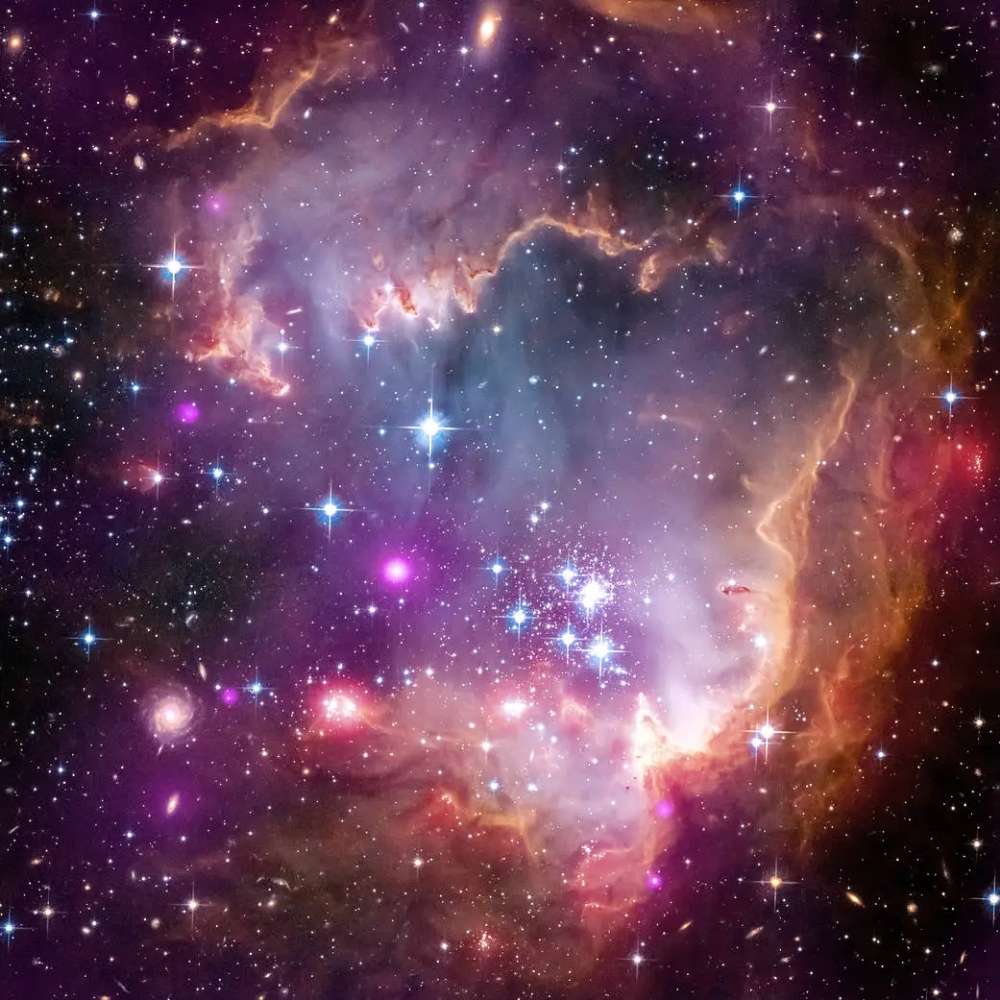
NGC 346: The largest and brightest star-forming complex in the SMC.
Contains massive O-type and B-type stars.
Surrounded by filaments of glowing hydrogen.
NGC 602: A striking young cluster near the galaxy’s outskirts, with stars less than 5 million years old.
DEM S 103: A complex nebular region rich in ionized gas and young stellar associations.
These regions illustrate how supernova shock waves, stellar winds, and gravitational tides continue to shape new generations of stars even in small galaxies.
Supernovae and Stellar Death in the SMC
The SMC, like the LMC, has been host to several supernova remnants and high-mass X-ray binaries (HMXBs).
These remnants provide valuable data on stellar evolution and feedback processes in low-metallicity galaxies.
Notable remnants include:
1E 0102.2-7219: A young, oxygen-rich supernova remnant captured by Hubble and Chandra.
N 19 and DEM S 32: Extended X-ray sources showing complex shell structures.
HMXBs like SMC X-1: Binary systems where a compact neutron star pulls matter from a massive companion — a sign of advanced stellar evolution.
These objects make the SMC a prime testing ground for understanding how massive stars die and enrich their galaxies with heavy elements.
Comparison with Neighboring Systems
| Feature | Small Magellanic Cloud | Large Magellanic Cloud | Milky Way |
|---|---|---|---|
| Type | Dwarf Irregular | Barred Irregular | Barred Spiral |
| Diameter | ~7,000 ly | ~14,000 ly | ~100,000 ly |
| Distance | ~200,000 ly | ~163,000 ly | — |
| Star Formation Rate | Moderate | High | Moderate |
| Metallicity | ~20% solar | ~30% solar | 100% (solar) |
| Interaction | Strong with LMC, mild with MW | Strong with both | Dominant host |
| Visibility | Naked-eye (southern sky) | Naked-eye (southern sky) | — |
The SMC’s smaller mass and higher vulnerability to gravitational influence make it a dynamic, evolving system — a dwarf galaxy being slowly torn apart and reshaped by its larger neighbors.
Kinematics and Motion — The SMC’s Chaotic Orbit
The Small Magellanic Cloud (SMC) doesn’t follow a calm, circular path around the Milky Way — it moves through space in a distorted and irregular orbit, tugged by both the Large Magellanic Cloud (LMC) and our own galaxy.
Recent measurements from the Gaia and Hubble Space Telescopes reveal that:
The SMC travels at an average velocity of about 300 km/s relative to the Milky Way.
Its motion is not stable — it’s being pulled, stretched, and twisted by ongoing gravitational interactions.
The SMC may have been a satellite of the LMC for billions of years before both were captured by the Milky Way’s gravity.
This tri-galactic interaction — Milky Way, LMC, and SMC — has produced features like the Magellanic Bridge and the Magellanic Stream, and continues to strip gas and stars from the SMC, slowly reshaping its destiny.
The LMC–SMC Relationship — A Gravitational Dance
The LMC and SMC are often described as a binary pair of dwarf galaxies, connected by tidal forces and a shared history.
Their mutual gravitational pull has caused both galaxies to deform and lose material into the Bridge and Stream.
Evidence of Interaction:
Distorted Stellar Distribution: The SMC’s stars and gas show tidal stretching toward the LMC.
Asymmetric Disk Rotation: The galaxy’s internal rotation is warped, with its eastern side moving faster — a result of tidal influence.
Triggered Star Formation: Past encounters between the Clouds have ignited multiple bursts of stellar birth, especially in the “Wing” region.
The most recent close passage between the two Clouds occurred around 200 million years ago, an event that left behind both structural scars and new star clusters.
Metallicity and Chemical Gradients
The SMC’s low metallicity — about 20% of the Milky Way’s — makes it a crucial reference for early-universe conditions.
Stars here formed from gas that has undergone far less chemical enrichment, allowing scientists to study the first generations of stars and stellar nucleosynthesis processes.
Chemical Observations
The bar region contains stars with slightly higher metallicity (~0.3 solar).
The outer regions and wing are more metal-poor, reflecting newer, less-enriched star-forming zones.
The presence of old, metal-poor globular clusters such as NGC 121 (aged ~10 billion years) shows that the SMC has been forming stars for most of cosmic history.
Because of its chemical simplicity, the SMC serves as a natural analog for dwarf galaxies in the early universe that later merged to form larger spirals.
Star Clusters and Associations — A Timeline of Stellar Birth
The SMC hosts a fascinating variety of star clusters, ranging from ancient globulars to very young associations.
| Cluster/Association | Age (Approx.) | Significance |
|---|---|---|
| NGC 121 | ~10–11 Gyr | Oldest known cluster in the SMC; similar age to Milky Way globulars |
| NGC 416 | ~6 Gyr | Intermediate-age cluster; evidence of metallicity evolution |
| NGC 330 | ~50 Myr | Young, dense open cluster; full of massive O- and B-type stars |
| NGC 346 (Nebular Complex) | ~3–5 Myr | Major star-forming region; part of the SMC “Wing” |
| NGC 602 | ~5 Myr | Located near the edge; shows stars forming from tidally compressed gas |
These clusters provide a chronological record of the galaxy’s evolution, showing how tidal interactions repeatedly rejuvenated its star-forming activity.
Star Formation Cycles and Feedback
Although the SMC’s overall star formation rate (~0.05–0.1 M☉ per year) is modest, it shows periodic bursts — likely synchronized with close approaches to the LMC.
Each tidal encounter compresses interstellar gas, leading to:
Massive star formation (O- and B-type clusters).
Supernova explosions, injecting energy into the interstellar medium.
New nebulae and shells, triggering secondary generations of stars.
Feedback in Action
Observations from Spitzer, Chandra, and JWST have revealed:
Expanding supernova shells in N66 (NGC 346).
X-ray binaries that trace the deaths of massive stars.
Dust-poor star-forming regions, showing how stars form efficiently even with minimal metals.
This process makes the SMC an invaluable testing ground for stellar feedback models that explain how galaxies regulate their growth over time.
Supernova Remnants and Compact Objects
The SMC’s relatively low dust content makes it easier to study supernova remnants and compact stars.
Key Examples:
1E 0102.2–7219: A well-studied remnant of a massive star that exploded roughly 2,000 years ago.
Observed in X-rays and optical light, showing oxygen-rich ejecta.
SMC X-1: One of the brightest X-ray binaries known, featuring a neutron star accreting matter from a massive companion.
DEM S5: A newly identified remnant containing a runaway pulsar — the first of its kind found outside the Milky Way.
These remnants show how even small galaxies can host extreme astrophysical phenomena, providing essential data for studying stellar death and compact object formation in low-metallicity environments.
Morphological Evolution — From Irregular to Tidal Stream
The SMC’s structure today is a product of gravitational stripping and ram pressure as it moves through the Milky Way’s halo.
Simulations suggest that:
Over the past 1–2 billion years, the SMC has lost up to 30% of its gas.
Much of this gas now forms part of the Magellanic Stream, trailing behind both Clouds.
Its stellar disk is being gradually stretched and disrupted, indicating it may eventually dissolve into the Milky Way’s halo as a stellar stream.
Thus, the SMC offers a direct look at the final stages of dwarf galaxy assimilation, a process that has shaped the Milky Way’s growth throughout its history.
Future Evolution — The Eventual Fate of the SMC
The Small Magellanic Cloud (SMC) may be small in size, but its cosmic journey is dramatic.
Over billions of years, its gravitational interactions with both the Large Magellanic Cloud (LMC) and the Milky Way will eventually determine its fate.
1. The Current Orbit and Motion
Today, the SMC orbits roughly 200,000 light-years from Earth, moving at a velocity of around 300 km/s.
Simulations indicate that:
It is bound to the LMC gravitationally, orbiting in a loose binary configuration.
Both Clouds are falling toward the Milky Way, possibly for the first time in their shared history.
This motion is creating vast structures like the Magellanic Bridge (between SMC and LMC) and the Magellanic Stream (a trailing gas tail), which map out the gravitational pull of the Milky Way’s halo.
2. The Coming Merger
Astronomers predict that within 1.5–2.5 billion years, the SMC will merge with the Milky Way — likely after first merging with the LMC.
This will mark the end of its independent existence, but not its legacy.
During the merger:
The SMC’s gas will feed star formation in the outer regions of the Milky Way.
Its stars will be absorbed into the Galactic halo, enriching it with metal-poor populations.
Some stripped material will form stellar streams, similar to the Sagittarius Dwarf remnants seen today.
Thus, the SMC represents a snapshot of an ongoing process that has shaped galaxies since the dawn of time — smaller systems merging to build larger ones.
The SMC as a Key to Early Galaxy Formation
Because the SMC is metal-poor, gas-rich, and irregular, it provides a unique window into how the first galaxies in the universe might have looked.
Why the SMC Is So Important for Cosmology:
Chemical Simplicity: Its low metallicity allows astrophysicists to study stellar processes that mimic those of early galaxies.
Resolved Stars: At only ~200,000 light-years away, telescopes can study individual stars within the SMC — something impossible for most distant dwarfs.
Star Cluster Diversity: From ancient globulars to very young clusters, it shows all stages of stellar evolution in one galaxy.
Feedback in Low-Metallicity Systems: Supernovae and stellar winds in the SMC provide direct insight into feedback mechanisms that shaped galaxy evolution in the early universe.
In short, studying the SMC helps scientists bridge the gap between nearby galaxies and primordial systems seen at high redshift by JWST.
The SMC and Dark Matter Studies
The SMC, together with the LMC, acts as a natural probe of the Milky Way’s dark matter halo.
Its orbital motion and gravitational wake reveal how the invisible mass of our galaxy interacts with its satellites.
Recent Gaia-based models suggest:
The SMC–LMC system may be disrupting the Milky Way’s outer halo through gravitational torques.
Its motion creates subtle distortions in stellar streams, helping to map the dark matter distribution.
The survival of the SMC despite strong tides indicates that it is embedded in its own dark matter subhalo, protecting it from immediate disintegration.
These findings are critical for refining ΛCDM cosmology, confirming how galaxies grow by accreting smaller, dark matter–bound systems.
Scientific Legacy — A Natural Astrophysical Laboratory
The Small Magellanic Cloud remains one of the most intensively studied dwarf galaxies in the sky. Its proximity allows astronomers to test nearly every aspect of astrophysics — from star birth to supernova death, from chemical enrichment to galactic dynamics.
Key Contributions of the SMC to Modern Astronomy
| Field of Study | Scientific Impact |
|---|---|
| Stellar Evolution | Observation of full life cycles — from protostars to compact remnants |
| Chemical Evolution | Tracks enrichment from low to intermediate metallicity |
| Galaxy Interaction | Demonstrates tidal forces and gas transfer between satellites |
| Supernova Physics | Reveals remnant structures in dust-poor environments |
| Distance Calibration | Cepheid variables and RR Lyrae stars help refine the cosmic distance scale |
Thanks to its location and properties, the SMC continues to function as a galactic laboratory, complementing the Large Magellanic Cloud in nearly every research field.
Frequently Asked Questions (FAQ)
Q1: Is the Small Magellanic Cloud visible to the naked eye?
Yes — it appears as a faint, misty patch in the southern sky, visible from dark locations south of the equator, especially between November and March.
Q2: What makes the SMC different from the LMC?
The SMC is smaller, more irregular, and more metal-poor. The LMC is about twice as large and has a barred structure with stronger star formation.
Q3: Why is the SMC important to astronomers?
Because it provides a nearby, low-metallicity environment that helps scientists study conditions similar to those in the early universe.
Q4: Will the SMC ever collide with the Milky Way?
Yes, simulations predict that both Magellanic Clouds will eventually merge with the Milky Way in about 2 billion years.
Q5: How far is the SMC from Earth?
Approximately 200,000 light-years, making it one of the Milky Way’s nearest galactic companions.
Related Objects and Further Reading
Large Magellanic Cloud (LMC): The SMC’s larger companion and its main gravitational partner.
Magellanic Bridge: The gas and star bridge connecting the LMC and SMC.
Magellanic Stream: A massive tail of gas trailing behind both Clouds.
Milky Way Galaxy: The host galaxy toward which both Clouds are moving.
NGC 346 and NGC 602: Active star-forming regions within the SMC.
Sagittarius Dwarf Galaxy: A comparison example of a dwarf galaxy merging into the Milky Way.
Final Thoughts
The Small Magellanic Cloud may be humble in scale, but it embodies the grand narrative of galactic evolution.
It has survived billions of years of cosmic turbulence — pulled, stretched, and stripped — yet it continues to shine with vitality, forming new stars and enriching the interstellar medium.
In studying this small companion, astronomers glimpse not just the history of the Magellanic system but also the earliest chapters of the universe itself.
Its simplicity, proximity, and dynamism make the SMC one of the most valuable cosmic laboratories in the entire sky — a little galaxy with a story far greater than its size.