




Sun
The Star That Makes the Solar System Possible
Quick Reader
| Attribute | Details |
|---|---|
| Object Name | Sun |
| Object Type | G-type main-sequence star (G2V) |
| Age | ~4.6 billion years |
| Mass | ~1.99 × 10³⁰ kg (99.86% of Solar System mass) |
| Diameter | ~1.39 million km |
| Surface Temperature | ~5,500 °C |
| Core Temperature | ~15 million °C |
| Energy Source | Nuclear fusion (hydrogen → helium) |
| Luminosity | ~3.8 × 10²⁶ watts |
| Rotation | Differential (faster at equator) |
| Distance from Earth | ~149.6 million km (1 AU) |
| Fate | Red giant → planetary nebula → white dwarf |
Key Points
- The Sun contains almost all the mass of the Solar System
- Its gravity defines every planetary orbit
- Nuclear fusion in its core powers all life on Earth
- The Sun is a typical star, yet uniquely important to us
- Without the Sun, the Solar System would not exist
Introduction – Not Just a Star, but the System Itself
The Sun is often described as one object among many in the Solar System.
This description is misleading.
The Sun is the Solar System in every meaningful sense.
Planets, asteroids, comets, and dust are secondary structures—minor additions orbiting a dominant central engine.
More than 99.8% of the Solar System’s mass resides in the Sun. Every orbit, every resonance, and every long-term stability pattern traces back to its gravity.
To understand planets, moons, or life itself, one must first understand the Sun.
What Is the Sun?
The Sun is a main-sequence star, classified as a G-type (G2V) star.
This means:
It fuses hydrogen into helium in its core
It exists in a long, stable phase of stellar life
Its energy output changes slowly over billions of years
The Sun is not unusual by cosmic standards.
There are billions of similar stars in the Milky Way.
What makes it special is location and timing—it formed in the right place, at the right moment, with the right mass to allow planets and life to develop.
The Sun’s Immense Dominance
The scale difference between the Sun and everything else is extreme.
Key facts:
The Sun is ~330,000 times more massive than Earth
Over 1.3 million Earths could fit inside it
Jupiter, the largest planet, is only 0.1% of the Sun’s mass
Because of this dominance:
The Sun controls all orbital motion
Planetary systems exist because stars exist
Without the Sun, planets would drift into interstellar space
The Solar System is not a collection of planets with a star—it is a star with leftover material.
Internal Structure – A Layered Nuclear Engine
The Sun is not a uniform ball of gas. It has a complex internal structure.
Core
The core is where nuclear fusion occurs.
Temperature: ~15 million °C
Pressure: extreme
Hydrogen nuclei fuse into helium
This process releases enormous energy according to E = mc², converting mass into radiation.
Radiative Zone
Energy moves outward slowly.
Photons bounce randomly
A single photon can take hundreds of thousands of years to escape
Convective Zone
Closer to the surface:
Hot plasma rises
Cooler plasma sinks
Energy moves rapidly
This churning motion drives much of the Sun’s surface activity.
The Solar Surface – Not Solid, Not Calm
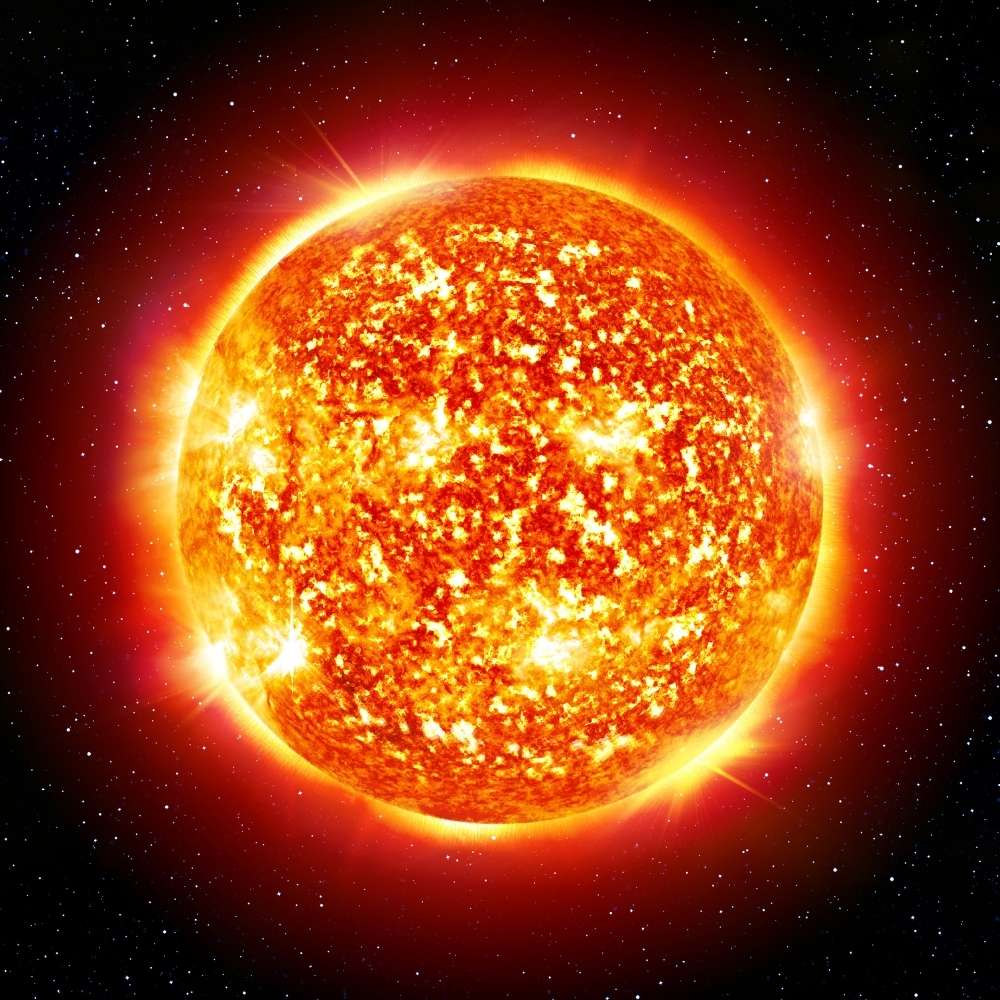
The visible “surface” of the Sun is called the photosphere.
It is:
A glowing layer of plasma
About 500 km thick
Marked by granulation patterns
These patterns are the tops of convection cells—constant evidence that the Sun is never static.
Above the photosphere lie:
The chromosphere
The corona (millions of degrees hot)
The corona’s extreme temperature remains one of solar physics’ great puzzles.
Nuclear Fusion – The Sun’s Power Source
The Sun shines because of nuclear fusion.
In each second:
~600 million tons of hydrogen fuse into helium
~4 million tons of mass are converted into energy
Enough energy is released to power Earth for millions of years
This steady fusion provides:
Light
Heat
Radiation
Long-term stability
The Sun’s mass places it in the perfect range:
large enough to sustain fusion, but not so large as to burn out quickly.
Why the Sun Is Exceptionally Stable
Many stars are variable, violent, or short-lived.
The Sun is relatively calm.
Reasons include:
Moderate mass
Balanced fusion rate
Stable internal structure
This stability allows:
Long-term climate consistency
Planetary orbit stability
Evolution of complex life
From a biological perspective, the Sun is quietly extraordinary.
The Sun as the Solar System’s Timekeeper
The Sun defines time on multiple levels:
Day and night
Seasons
Climate cycles
Geological rhythms
Even radioactive decay rates and biological processes are indirectly influenced by solar energy.
The Sun is not just a light source—it is a temporal regulator.
Why the Sun Matters More Than Any Planet
Planets are passengers.
The Sun is the driver.
It determines:
Where planets can exist
How long systems remain stable
Whether habitable zones form
How material is distributed
Remove the Sun, and every planetary story ends instantly.
Birth of the Sun – From Interstellar Cloud to Star
The Sun did not appear suddenly. It formed through a slow, structured process that began inside a giant molecular cloud—a cold, dense region of gas and dust drifting through the Milky Way.
About 4.6 billion years ago, a portion of this cloud collapsed under gravity. Possible triggers include:
Shock waves from a nearby supernova
Gravitational disturbances within the cloud
Turbulence compressing local regions
As collapse began, gravity pulled material inward while angular momentum caused the cloud to flatten into a rotating disk.
At the center, pressure and temperature rose steadily.
This growing central mass became the proto-Sun.
The Solar Nebula – A Star with a Disk
The early Sun was surrounded by a vast protoplanetary disk, known as the solar nebula.
This disk contained:
Hydrogen and helium gas
Dust grains rich in metals and silicates
Ices forming beyond the frost line
Inside this disk:
Dust stuck together
Pebbles formed
Planetesimals grew
Planets slowly emerged
The Sun and planets formed together, not separately.
The Sun is not the center of a finished system—it is the center of a system that co-evolved.
Ignition – When the Sun Became a Star
As material continued to fall inward, the proto-Sun reached a critical point.
At roughly 10 million degrees, nuclear fusion ignited in the core.
This moment marked the Sun’s transition from a collapsing object to a true star.
Key consequences:
Fusion pressure balanced gravity
Collapse stopped
Long-term stability began
This balance—called hydrostatic equilibrium—defines main-sequence stars.
From this moment onward, the Sun entered the longest and calmest phase of its life.
The Sun’s Birth Cluster – Not Born Alone
The Sun did not form in isolation.
Evidence from isotopic anomalies in meteorites suggests that the Sun formed in a stellar cluster, alongside hundreds or thousands of other stars.
Clues include:
Short-lived radioactive isotopes
Chemical fingerprints of nearby supernovae
Orbital structure of distant Solar System objects
This crowded birth environment likely influenced:
The outer Solar System’s structure
The truncation of the protoplanetary disk
The population of distant icy bodies
The Solar System carries subtle scars from its early neighbors.
Why the Sun Is Not a Massive Star
The Sun’s mass is not accidental—it is critical.
If the Sun were significantly more massive:
It would burn fuel much faster
Its lifespan would be far shorter
Life would not have time to develop
If it were significantly less massive:
Fusion might never ignite
The Solar System would never form
The Sun’s mass places it in a narrow window where:
Fusion is stable
Lifespan exceeds 10 billion years
Habitable planets can exist
This balance is one of the quiet requirements for life.
Metallicity – Why the Sun Is “Just Right”
In astronomy, “metals” mean all elements heavier than hydrogen and helium.
The Sun has moderate metallicity, meaning:
Enough heavy elements to form rocky planets
Not so many that the disk became unstable
This metallicity allowed:
Formation of Earth-like planets
Creation of planetary cores
Development of complex chemistry
Stars with very low metallicity struggle to form planets.
Stars with very high metallicity often produce unstable systems.
Again, the Sun sits near an optimal middle ground.
Early Solar Activity – A Young, Violent Star
The young Sun was far more active than it is today.
During its early years, it emitted:
Intense ultraviolet radiation
Powerful stellar winds
Frequent flares
These early outbursts:
Stripped gas from the inner Solar System
Influenced planetary atmospheres
Helped shape Earth’s early environment
This phase explains why:
Earth and Mars lack thick hydrogen atmospheres
Inner planets are rocky
Gas giants formed farther out
The young Sun sculpted the planetary layout before settling down.
Clearing the Solar System
As the Sun matured, its radiation and winds cleared remaining gas from the disk.
This process:
Ended planet formation
Froze orbital architecture in place
Marked the transition to a stable system
Once the gas was gone:
No new giant planets could form
Planetary migration slowed
The Solar System became dynamically mature
The Sun’s evolution set a deadline on planetary growth.
What the Sun’s Formation Teaches Us
The Sun’s origin reveals that:
Stars and planets form together
Planetary systems depend on stellar properties
Timing and environment matter as much as mass
Every exoplanet system we observe today is shaped by the same rules—but with different outcomes.
Understanding the Sun’s birth allows us to understand why our system looks the way it does.
The Sun’s Magnetic Field – The Engine of Solar Activity
The Sun is not only a nuclear reactor—it is a magnetic machine.
Its magnetic field is generated by the motion of electrically charged plasma inside the Sun, a process known as the solar dynamo. Because the Sun is not solid, different latitudes rotate at different speeds. This differential rotation twists and stretches magnetic field lines over time.
As these magnetic fields become tangled, stressed, and concentrated, they give rise to nearly all forms of solar activity.
Without magnetism, the Sun would be calm, featureless, and far less influential on its surroundings.
Sunspots – Windows into Solar Magnetism
Sunspots are the most visible signs of solar magnetic activity.
They appear as dark regions on the Sun’s surface because:
Strong magnetic fields suppress convection
Less heat reaches the surface locally
The region cools relative to its surroundings
Despite appearing dark, sunspots are still hotter than molten lava on Earth.
Key characteristics:
Often appear in pairs or groups
Magnetic fields are thousands of times stronger than Earth’s
Their number rises and falls over time
Sunspots are not flaws—they are diagnostics of the Sun’s internal dynamics.
The Solar Cycle – A Rhythmic Star
The Sun follows an approximately 11-year solar cycle, during which magnetic activity waxes and wanes.
During solar minimum:
Few sunspots
Reduced solar flares
Calmer space weather
During solar maximum:
Many sunspots
Frequent flares and eruptions
Enhanced radiation output
Every 11 years, the Sun’s magnetic field reverses polarity, completing a full magnetic cycle every 22 years.
This rhythm is a fundamental property of Sun-like stars.
Solar Flares – Sudden Energy Release
Solar flares occur when twisted magnetic field lines suddenly snap and reconnect.
This process releases enormous energy in seconds to minutes.
Solar flares emit:
X-rays
Ultraviolet radiation
High-energy particles
Effects include:
Radio communication disruption
GPS signal interference
Increased radiation exposure for astronauts
Flares demonstrate how stored magnetic energy can be converted instantly into radiation.
Coronal Mass Ejections – Solar Storms in Motion
Coronal Mass Ejections (CMEs) are among the most powerful events in the Solar System.
A CME involves:
Billions of tons of charged plasma
Ejected into space at millions of km/h
Carrying embedded magnetic fields
When directed toward Earth, CMEs can:
Compress Earth’s magnetosphere
Trigger intense auroras
Damage satellites and power grids
The Sun does not merely shine—it interacts.
Space Weather – The Sun’s Invisible Influence
The combined effects of flares, CMEs, and solar wind create what scientists call space weather.
Space weather affects:
Satellites
Astronaut safety
Aviation at high latitudes
Electrical infrastructure on Earth
Unlike terrestrial weather, space weather originates from a star—but its consequences are very real.
Understanding the Sun has become a matter of technological necessity, not curiosity.
The Solar Wind – A Constant Outflow
Even during quiet periods, the Sun continuously releases a stream of charged particles known as the solar wind.
The solar wind:
Shapes planetary magnetospheres
Creates comet tails
Defines the heliosphere’s boundary
At its outer edge lies the heliopause, where the Sun’s influence gives way to interstellar space.
The Sun’s reach extends far beyond the planets.
How Solar Activity Affects Earth’s Climate
On short timescales, solar activity influences:
Upper-atmosphere heating
Ionospheric behavior
Auroral activity
On long timescales, subtle variations in solar output may influence climate patterns. However:
The Sun is not responsible for modern global warming
Solar variability is relatively small
Human-driven factors dominate recent climate change
The Sun sets the baseline—but Earth’s climate system adds complexity.
Why the Sun Is Not “Quiet”
Compared to many stars, the Sun is calm.
But calm does not mean inactive.
The Sun is constantly:
Moving plasma
Reconfiguring magnetic fields
Releasing energy
Its activity follows rules, cycles, and limits—but it never truly stops.
The Sun is a regulated variable star.
Why Solar Physics Matters
Understanding the Sun allows scientists to:
Predict space weather
Protect satellites and astronauts
Understand stellar behavior elsewhere
Study plasma physics under extreme conditions
The Sun is the only star we can study in detail.
It serves as the foundation for all stellar astrophysics.
The Sun’s Distant Future – A Star That Will Change Everything
The Sun is stable—but not eternal.
Although it will continue shining in its current form for about another 5 billion years, the processes powering it are slowly changing. Hydrogen in the core is steadily being converted into helium, altering the balance that keeps the Sun stable today.
When core hydrogen becomes scarce, the Sun’s life will enter a new and dramatic phase.
Leaving the Main Sequence – The Beginning of the End
The Sun is currently a main-sequence star, defined by stable hydrogen fusion in its core.
Eventually:
Core hydrogen will be depleted
Fusion will slow in the core
Gravity will cause the core to contract
Temperatures around the core will rise
This triggers hydrogen fusion in a shell around the core, causing the outer layers of the Sun to expand.
At this point, the Sun will leave the main sequence.
The Red Giant Phase – A Transformed Sun
As shell fusion intensifies, the Sun will expand enormously and become a red giant.
During this phase:
The Sun’s radius may extend beyond Earth’s current orbit
Surface temperature will decrease
Total luminosity will increase dramatically
Possible outcomes for the inner planets:
Mercury will be destroyed
Venus will almost certainly be engulfed
Earth may be swallowed or left scorched and airless
Even if Earth avoids physical engulfment, it will become completely uninhabitable long before that.
The Sun will still be the same star—but its influence will be catastrophic for the inner Solar System.
Helium Fusion – A Brief Second Life
After the red giant expansion:
The Sun’s core will reach ~100 million °C
Helium fusion will ignite
Helium will fuse into carbon and oxygen
This phase is relatively short, lasting only hundreds of millions of years.
The Sun will temporarily stabilize again—smaller and hotter than during the red giant peak—but this stability will not last.
The Sun is not massive enough to fuse carbon.
The Final State – A White Dwarf
After shedding its outer layers, the Sun’s core will remain as a white dwarf.
Properties of the future Sun:
Size similar to Earth
Mass about half of its current value
No fusion—only residual heat
This white dwarf will slowly cool over trillions of years, fading from white to yellow to black.
The Sun will no longer shine—but it will still exist.
The Fate of the Outer Solar System
While the inner planets face destruction, the outer Solar System will survive—though altered.
Expected changes:
Planetary orbits will expand as the Sun loses mass
Jupiter, Saturn, Uranus, and Neptune will drift outward
Moons and rings may remain intact
Some icy moons may temporarily warm, but no long-term habitability will emerge.
The Solar System will become a quieter, colder place—centered on a fading stellar remnant.
The Sun’s Legacy – More Than a Star
The Sun’s true importance is not only in what it is—but in what it enables.
Because of the Sun:
Planets formed
Chemistry became complex
Life emerged
Intelligence evolved
The Sun is not remarkable by cosmic standards, yet it is perfectly sufficient.
Its moderate mass, stability, and lifespan created a narrow window where life could arise—and did.
The Sun in a Galactic Context
Stars like the Sun are common in the Milky Way.
This suggests:
Planetary systems may be widespread
Earth-like conditions may not be unique
Life-friendly stars are not rare
By studying the Sun, astronomers gain insight into billions of other systems, many of which may host planets—and possibly life.
The Sun is our local example of a universal process.
Frequently Asked Questions (FAQ)
Will the Sun explode as a supernova?
No. The Sun is far too small. Supernovae require much more massive stars.
When will Earth become uninhabitable?
Likely within 1–2 billion years, as the Sun’s brightness slowly increases.
Can humanity survive the Sun’s evolution?
Only by leaving Earth. Long-term survival would require interstellar or deep-space adaptation.
Will the Sun become a black hole?
No. It lacks the mass required to collapse into one.
Will the Solar System survive after the Sun dies?
Partially. The outer planets may continue orbiting the Sun’s white dwarf remnant.
The Sun’s Role in Universe Map
The Sun anchors nearly every major theme in Universe Map:
Stellar evolution
Planet formation
Habitability
Space weather
Galactic ecology
Related Universe Map topics include:
Main-sequence stars
Red giants
White dwarfs
Habitable zones
Stellar life cycles
The Sun is both a starting point and a reference standard.
Final Perspective
The Sun is not eternal—but it is sufficient.
For billions of years, it has provided steady light, stable gravity, and a calm environment in a chaotic universe. It will one day change, expand, and fade—but its influence will persist in the matter it disperses and the life it enabled.
The Sun reminds us of a profound truth:
even ordinary stars can give rise to extraordinary worlds.