







Sun–Earth L₅
The Overlooked Watchtower of the Solar System
Quick Reader
| Attribute | Details |
|---|---|
| System | Sun–Earth |
| Lagrange Point | L5 |
| Orbital Position | ~60° behind Earth in its orbit |
| Distance from Earth | ~150 million km (1 AU) |
| Dynamical Type | Gravitationally stable equilibrium point |
| Motion | Co-orbits the Sun with Earth |
| Stability | Long-term stable (unlike L1, L2, L3) |
| Visibility from Earth | Always far from Earth–Sun line |
| Natural Trapping | Possible (dust, small bodies) |
| Strategic Importance | Space weather forecasting, heliophysics |
Key Insights
- Sun–Earth L5 is one of the most dynamically stable locations in near-Earth space
- It provides a side-on view of the Sun–Earth system
- Ideal for early detection of solar activity that will later affect Earth
- Increasingly important for space weather monitoring
Introduction – A Quiet Point with Outsized Importance
When people think of important locations in space, they usually imagine planets, moons, or dramatic places like black holes.
Sun–Earth L₅ is none of those.
It is an invisible gravitational location, yet it may become one of the most strategically important positions in the inner Solar System.
Unlike the famous Sun–Earth L₁ and L₂ points, which lie directly between Earth and the Sun or beyond Earth, L₅ sits to the side, quietly moving along Earth’s orbit — unseen, stable, and exceptionally valuable.
What Is the Sun–Earth L₅ Point?
Sun–Earth L₅ is one of five Lagrange points in the Sun–Earth system.
At L₅:
The gravitational forces of the Sun and Earth balance
An object can orbit the Sun with the same period as Earth
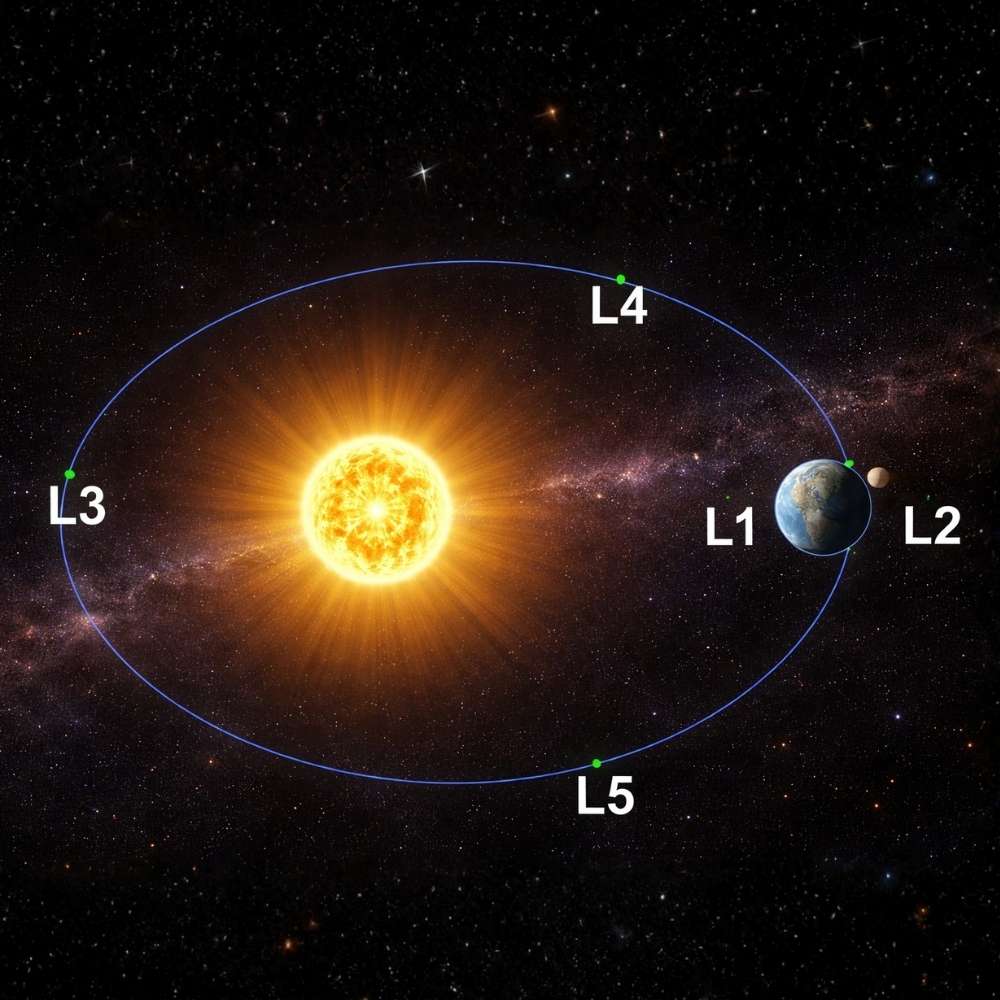
The object stays roughly 60° behind Earth
This creates a gravitational parking zone where spacecraft can remain with minimal fuel use.
Understanding Lagrange Points (Brief Context)
Lagrange points arise in a two-body system where a third, much smaller object can remain in a stable or semi-stable position.
In the Sun–Earth system:
L₁ – Between Earth and the Sun (unstable)
L₂ – Beyond Earth, opposite the Sun (unstable)
L₃ – Opposite Earth on the far side of the Sun (unstable)
L₄ & L₅ – 60° ahead and behind Earth (stable)
L₅ belongs to the rare category of naturally stable Lagrange points.
Why L₅ Is Dynamically Special
Sun–Earth L₅ is stable because:
Small disturbances do not grow over time
Objects tend to oscillate gently around the point
Gravitational forces act as a restoring mechanism
This stability allows:
Long-duration spacecraft missions
Potential accumulation of dust or small particles
Reduced station-keeping fuel requirements
Few locations near Earth offer this combination of stability and strategic positioning.
Why L₅ Is Not Widely Known
Despite its importance, L₅ remains relatively obscure because:
No major long-term mission has yet operated there
It is not directly useful for astronomy like L₂
It does not lie along the Earth–Sun line
However, modern space weather science is rapidly changing that perspective.
The Unique Viewing Geometry of Sun–Earth L₅
From L₅, a spacecraft would observe:
The Sun from an oblique angle
Solar active regions rotating toward Earth days in advance
The structure of coronal mass ejections from the side
This geometry offers early-warning capability that no Earth-based or L₁ mission can provide.
Why Sun–Earth L₅ Matters for Space Weather
Solar storms do not affect Earth instantly.
They rotate with the Sun and propagate through space.
From L₅, scientists can:
Detect active regions before they face Earth
Track the development of solar eruptions
Improve prediction lead times for geomagnetic storms
This could provide days of additional warning for satellites, power grids, and astronauts.
L5 Compared to Sun–Earth L1 and L2
| Feature | L1 | L2 | L5 |
|---|---|---|---|
| Stability | Unstable | Unstable | Stable |
| Fuel Use | Continuous station-keeping | Continuous | Minimal |
| Viewing Angle | Earth-facing Sun | Deep space | Side-on Sun |
| Space Weather Role | Real-time monitoring | None | Early warning |
L5 does not replace L1 — it complements it.
Why Interest in L₅ Is Growing Now
Several factors have renewed interest in Sun–Earth L₅:
Increasing reliance on satellites
Growing vulnerability to space weather
Expansion of crewed missions beyond Earth orbit
Improved spacecraft autonomy and propulsion
L₅ is shifting from a theoretical curiosity to a practical necessity.
Universe Map Context – Why L₅ Deserves Its Own Page
Sun–Earth L₅ sits at the intersection of:
Orbital mechanics
Solar physics
Space weather
Planetary system dynamics
It represents how invisible structures shape the behavior and safety of the entire Solar System.
Proposed and Planned Missions to Sun–Earth L₅
For decades, Sun–Earth L₅ existed mostly in theory and simulation. That is now changing.
As space weather risks become better understood, L₅ has emerged as a prime candidate for permanent monitoring missions.
Why No Mission Has Flown Yet
The absence of a long-term L₅ mission is not due to lack of value, but rather timing and priorities.
Historically:
Space weather monitoring focused on real-time conditions at L₁
Spacecraft autonomy was limited
Funding favored planetary and deep-space exploration
Today, these constraints are weakening, and L₅ is moving into focus.
ESA’s Interest in an L₅ Space Weather Mission
The European Space Agency has repeatedly identified Sun–Earth L₅ as a strategic location for future space weather observatories.
Concept studies propose an L₅ mission that would:
Continuously image solar active regions rotating toward Earth
Measure the structure and direction of coronal mass ejections
Complement L₁ spacecraft with early-warning data
Such a mission would significantly extend forecasting lead times.
How an L₅ Spacecraft Would Operate
A spacecraft at L₅ would not “sit still” in the classical sense.
Instead, it would orbit the Sun in lockstep with Earth, maintaining a stable relative position.
Operational advantages include:
Minimal station-keeping fuel requirements
Long mission lifetimes
Stable thermal and power conditions
These factors make L₅ well-suited for persistent, decades-long monitoring.
The Ideal Instruments for an L₅ Observatory
An L₅ mission would not require the full complexity of a solar observatory like Solar Orbiter.
Instead, it would focus on targeted, operational science.
Key Instrument Types
Likely payload elements include:
Heliospheric imagers for tracking solar eruptions
Magnetographs to map solar magnetic fields
Coronagraphs to image the solar corona
In-situ plasma and magnetic field sensors
Together, these instruments would bridge the gap between observation and prediction.
Why L₅ Sees What Earth and L₁ Cannot
From Earth or L₁, scientists see the Sun face-on.
This view is limited.
From L₅:
Active regions are visible days before they rotate toward Earth
CME shapes and trajectories are seen side-on
Magnetic complexity is revealed earlier in its evolution
This geometric advantage is the core scientific value of L₅.
Early Warning vs Real-Time Monitoring
It is important to distinguish roles.
L₁ missions provide real-time solar wind conditions
L₅ missions provide advance context and early alerts
An effective space weather system would use both, forming a predictive chain rather than a reactive one.
Dust and Small-Particle Accumulation at L₅
Because Sun–Earth L₅ is dynamically stable, it raises an intriguing question:
Can natural material accumulate there?
Theoretical Expectations
Models suggest that:
Dust particles may linger near L₅ for extended periods
Small grains can be temporarily trapped
Long-term accumulation is limited by solar radiation pressure
Unlike Jupiter’s L₄ and L₅, Sun–Earth L₅ is unlikely to host large bodies — but subtle dust structures may exist.
Is There a Sun–Earth L₅ “Cloud”?
There is no confirmed equivalent to Jupiter’s Trojan populations at Sun–Earth L₅.
However:
Transient dust enhancements are possible
Weak, diffuse concentrations may form
Detection is extremely difficult from Earth
Future dedicated observations may clarify whether L₅ hosts persistent material.
L₅ in the Context of Planetary Defense
Beyond space weather, L₅ may play a role in planetary defense.
From L₅, a spacecraft could:
Detect Earth-directed CMEs earlier
Observe near-Earth objects approaching from sunward directions
Improve orbit determination for difficult-to-detect objects
This side-view perspective fills a blind spot in Earth-based monitoring.
Why L₅ Is a Natural Candidate for Space Infrastructure
As space activity increases, stable locations become increasingly valuable.
Sun–Earth L₅ offers:
Long-term orbital stability
Strategic observational geometry
Low operational cost once deployed
In the future, L₅ could host monitoring platforms, not just single missions.
The Long-Term Role of Sun–Earth L₅
Sun–Earth L₅ is not important because of what it is today, but because of what it enables over long timescales.
As human activity in space expands, Earth becomes more dependent on systems that operate beyond the atmosphere. Satellites, navigation networks, communication links, and future crewed missions are all exposed to solar activity. L₅ offers a rare opportunity to shift from reactive monitoring to predictive awareness.
Rather than waiting for solar disturbances to reach Earth, L₅ allows scientists to observe the conditions that create those disturbances, days before they become a threat.
From Monitoring to Forecasting
Most current space weather systems are reactive by design. They measure conditions as solar wind reaches Earth.
Sun–Earth L₅ changes this logic.
From L₅, scientists can:
Observe solar active regions before they rotate into Earth-facing view
Track the early evolution of coronal mass ejections
Constrain the direction and structure of solar eruptions more accurately
This transforms space weather science from real-time measurement into forward modeling.
Why L₅ Becomes More Important in the Coming Decades
Several long-term trends increase the strategic value of L₅:
Growing satellite constellations in Earth orbit
Increased reliance on space-based infrastructure
Planned crewed missions to the Moon and Mars
Rising awareness of solar storm risks
As these systems scale up, even moderate space weather events can have large economic and safety consequences. L₅ directly addresses this vulnerability.
L₅ as a Permanent Space Weather Node
In the future, Sun–Earth L₅ may function less like a single mission location and more like a permanent node in near-Earth space.
Possible long-term roles include:
Continuous solar imaging platforms
Heliospheric monitoring stations
Data relay points for space weather networks
Coordination with L₁ and Earth-based observatories
Together, these elements could form a distributed system that monitors the Sun–Earth connection from multiple angles.
How L₅ Reshapes Our View of Earth’s Space Environment
Earth does not exist in isolation.
It moves through a structured, dynamic space environment shaped by the Sun.
Sun–Earth L₅ reveals that:
Space weather is not a sudden phenomenon
Solar disturbances evolve over time and geometry
Perspective is as important as proximity
By observing the Sun from the side, L₅ exposes the three-dimensional nature of solar influence, something Earth-based observation alone cannot capture.
Frequently Asked Questions (Expanded)
Is Sun–Earth L₅ a physical object?
No. L₅ is a gravitational equilibrium point — a location in space defined by orbital dynamics, not a material body.
Why is Sun–Earth L₅ stable while L₁ and L₂ are not?
L₅ lies at a position where gravitational and orbital forces naturally restore small disturbances.
L₁ and L₂ lack this restoring geometry, making them inherently unstable.
Does anything naturally orbit at Sun–Earth L₅?
There is no confirmed population of large objects.
However, small dust particles may remain near L₅ temporarily due to its stability, though long-term accumulation is limited.
Why hasn’t a major mission already been placed at L₅?
Historically, space weather science prioritized real-time monitoring at L₁.
Only recently has the value of early-warning geometry become widely recognized.
How much warning time could an L₅ mission provide?
Depending on solar rotation and eruption type, L₅ could provide several days of advance context, significantly improving forecast accuracy.
Is Sun–Earth L₅ useful for astronomy?
Its primary value is heliophysics and space weather, not deep-sky astronomy.
Its strength lies in geometry and stability, not darkness or distance from Earth.
Could L₅ help with planetary defense?
Indirectly, yes.
Its side-on perspective can help detect objects and events approaching from Sun-facing directions that are difficult to observe from Earth.
Why Sun–Earth L₅ Matters for Universe Map
Sun–Earth L₅ represents a class of objects that Universe Map aims to highlight:
structures that are invisible, non-material, yet fundamentally important.
It connects:
Orbital mechanics
Solar physics
Earth system safety
The future of space infrastructure
L₅ shows that some of the most important places in the Solar System are not planets or moons, but positions shaped by gravity and motion.
Related Topics for Universe Map
Lagrange points
Sun–Earth L₁ and L₂
Space weather
Solar wind
Heliosphere
Solar Orbiter
Together, these topics explain how Earth is embedded within a constantly changing solar environment.
Final Perspective
Sun–Earth L₅ is easy to overlook because it has no surface, no light, and no dramatic appearance.
Yet it offers something rare: foresight.
By observing the Sun from the side, L₅ allows us to see not just what the Sun is doing now, but what it is about to do to Earth. In an age where space-based systems underpin daily life, that perspective may become indispensable.
Sun–Earth L₅ reminds us that in the Solar System, position can matter as much as place — and sometimes, the most powerful vantage point is the one we have not yet used.