








Sun–Earth L₂
The Quiet Gateway to the Deep Universe
Quick Reader
| Attribute | Details |
|---|---|
| System | Sun–Earth gravitational system |
| Lagrange Point | L₂ |
| Distance from Earth | ~1.5 million km (away from the Sun) |
| Direction | Opposite the Sun, beyond Earth |
| Stability Type | Semi-stable (halo / Lissajous orbits required) |
| Orbital Period | ~6 months (typical halo orbit) |
| Key Advantage | Constant Sun–Earth alignment |
| Thermal Environment | Extremely stable and cold |
| Primary Use | Space astronomy & deep-space observation |
| Famous Missions | JWST, Planck, Gaia, WMAP, Euclid |
Why Sun–Earth L₂ Is Special (Quick Context)
Sun–Earth L₂ is the most important observation point ever used for precision astronomy. It provides a quiet, thermally stable environment where space telescopes can observe the Universe with unmatched sensitivity—free from Earth’s heat, shadows, and interference.
Key Insight Snapshot
- Best location for infrared and precision astronomy
- Allows continuous, uninterrupted deep-space observation
- Hosts humanity’s most advanced space observatories
- Requires active station-keeping but offers unrivaled stability
- Acts as a gateway to studying cosmic origins
Introduction — What Is Sun–Earth L₂, Really?
The Sun–Earth L₂ point is not a physical object.
It is a mathematical balance point in space.
At L₂, the gravitational pull of the Sun and Earth combines in such a way that a spacecraft can orbit the Sun in step with Earth, remaining roughly aligned with our planet as both move around the Sun.
What makes L₂ remarkable is where it is located:
Beyond Earth, on the night side
Always opposite the Sun
Permanently facing deep space
This geometry creates one of the quietest environments near Earth.
Lagrange Points — The Bigger Picture
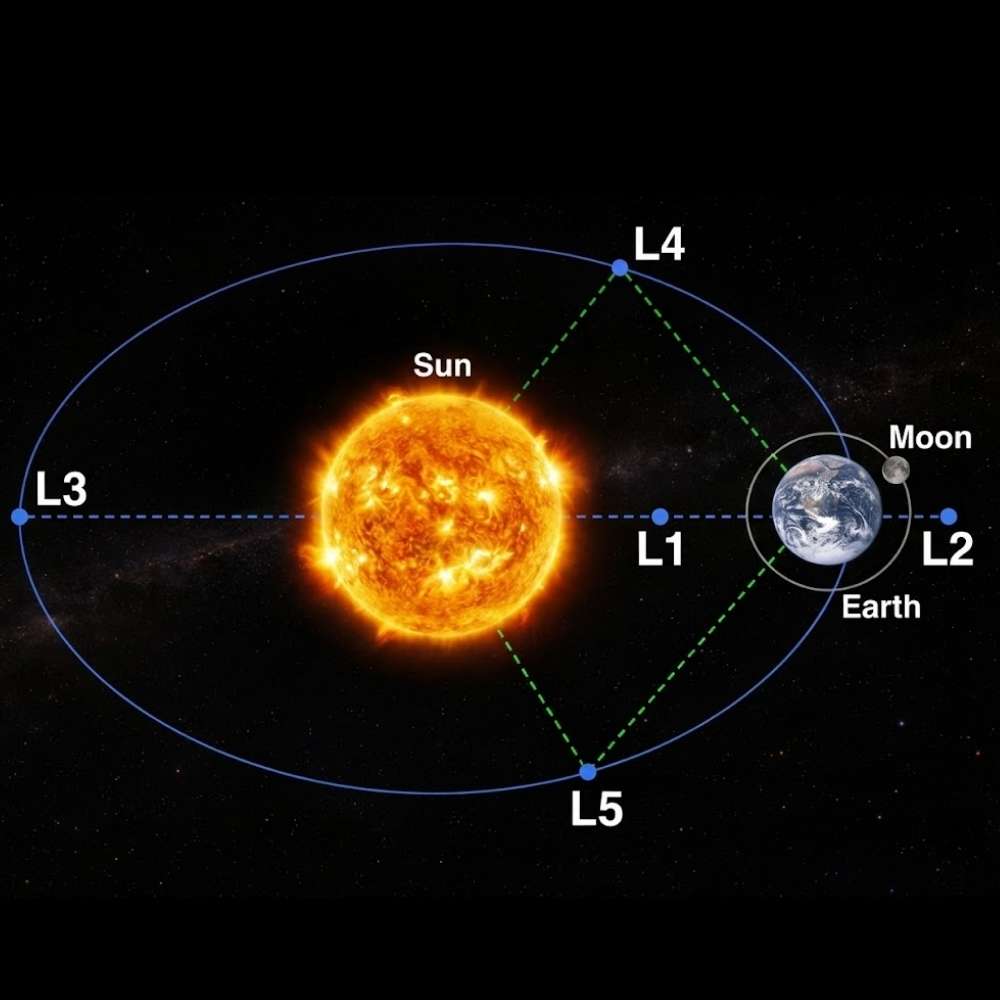
In any two-body system like Sun–Earth, there are five Lagrange points (L₁ to L₅) where gravitational and orbital forces balance.
Very briefly:
L₁: Between Sun and Earth (space weather monitoring)
L₂: Beyond Earth (deep-space astronomy)
L₃: Opposite Earth on the Sun’s far side (unstable)
L₄ & L₅: Stable triangular points (Trojan regions)
Sun–Earth L₂ is optimized not for protection—but for observation.
Why L₂ Is Not Truly “Stable”
A common misconception is that spacecraft “sit” at L₂.
They do not.
Sun–Earth L₂ is semi-stable:
Small disturbances grow over time
Spacecraft cannot remain exactly at the point
Continuous station-keeping is required
Instead, spacecraft orbit around L₂ in large loops called:
Halo orbits
Lissajous orbits
These orbits keep spacecraft close to L₂ while avoiding Earth’s shadow.
The Thermal Advantage — Why Astronomers Love L₂
L₂ offers an unmatched thermal environment.
From this location:
The Sun, Earth, and Moon all lie in roughly the same direction
A single sunshield can block all major heat sources
Spacecraft remain in permanent sunlight (no eclipses)
This enables:
Passive cooling
Ultra-stable temperatures
Minimal thermal expansion and contraction
For infrared telescopes, this is mission-critical.
Why Earth Orbit Is Not Good Enough
Low Earth orbit (LEO) is noisy.
Problems include:
Constant day–night temperature swings
Earth’s infrared heat
Atmospheric interference
Frequent eclipses
L₂ eliminates all of these.
That is why missions requiring extreme sensitivity leave Earth orbit entirely.
Sun–Earth L₂ as a Scientific Philosophy
Choosing L₂ reflects a deeper shift in space science.
Instead of fighting Earth’s environment, astronomers chose to step away from it.
L₂ represents:
Distance for clarity
Stability for precision
Isolation for sensitivity
It is where humanity goes when accuracy matters more than proximity.
What Kind of Missions Use L₂?
Sun–Earth L₂ is ideal for missions that need:
Long, uninterrupted observations
Ultra-cold temperatures
Stable pointing and geometry
Typical mission types include:
Infrared space telescopes
Precision cosmology observatories
Astrometric surveys
All-sky mapping missions
JWST is the most famous—but not the first.
Why L₂ Changed Modern Astronomy
Before L₂, astronomers were limited by Earth.
After L₂, they were limited only by instrument design.
This shift enabled:
Detection of the first galaxies
Mapping of the cosmic microwave background
Precision measurement of stellar positions
Infrared spectroscopy of exoplanet atmospheres
Sun–Earth L₂ became the default location for frontier astronomy.
Why Major Missions Choose Sun–Earth L₂
Sun–Earth L₂ is not chosen by accident.
It is selected when precision, stability, and uninterrupted observation are more important than proximity to Earth.
Major missions that chose L₂ include:
James Webb Space Telescope (JWST) — infrared astronomy and exoplanets
Gaia — ultra-precise astrometry of over a billion stars
Planck — cosmic microwave background (CMB) mapping
WMAP — early precision cosmology
Euclid — dark matter and dark energy surveys
Each of these missions required conditions that Earth orbit could not provide.
Halo Orbits Explained — How Spacecraft “Live” at L₂
A spacecraft cannot remain fixed at L₂.
Instead, it follows a controlled looping path around it.
These paths are called:
Halo orbits (three-dimensional, closed loops)
Lissajous orbits (more complex, non-repeating loops)
Key characteristics:
Orbits span hundreds of thousands of kilometers
Spacecraft never pass into Earth’s shadow
Sun, Earth, and Moon remain on the same side
This geometry allows a spacecraft to:
Keep a fixed sunshield orientation
Maintain stable temperatures
Point continuously toward deep space
JWST’s halo orbit is one of the most famous examples.
Communication from L₂ — Far, But Reliable
At ~1.5 million km from Earth, L₂ is far—but not unreachable.
Communication features:
Round-trip light-time delay of ~10 seconds
Continuous line-of-sight to Earth
High-gain antennas required
Compared to low Earth orbit:
Data rates are lower
Latency is higher
But coverage is uninterrupted
For observatories, continuity matters more than speed.
Navigation and Station-Keeping at L₂
Because L₂ is only semi-stable, spacecraft must perform regular station-keeping maneuvers.
Key points:
Small thruster burns every few weeks or months
Fuel use determines mission lifetime
Navigation is highly precise but well understood
JWST, for example:
Carries fuel only for station-keeping
Has no fuel for major orbit changes
Could operate far longer than planned if fuel is conserved
At L₂, fuel is time.
Risk Profile — Why L₂ Is Safe, but Final
L₂ has advantages—but also trade-offs.
Advantages
No atmospheric drag
No orbital debris
No Earth eclipses
Extremely stable thermal environment
Risks
No possibility of servicing (currently)
Any major failure is permanent
Long communication distance
This is why only high-confidence, mature technologies are sent to L₂.
JWST was a calculated risk—taken because the scientific return justified it.
L₂ vs L₁ — Similar Distance, Different Purpose
Although both Sun–Earth L₁ and L₂ lie approximately 1.5 million km from Earth, their scientific roles and operational purposes are fundamentally different.
| Feature | Sun–Earth L₁ | Sun–Earth L₂ |
|---|---|---|
| Position | Between Sun and Earth | Beyond Earth, night side |
| Main Use | Space weather monitoring | Deep-space astronomy |
| Thermal Stability | Moderate | Exceptional |
| Earth View | Constant | Always behind |
| Famous Missions | WIND, ACE, DSCOVR | JWST, Gaia, Planck |
In short:
- L₁ watches the Sun
- L₂ watches the Universe
Why L₂ Is Ideal for Infrared Astronomy
Infrared telescopes are especially sensitive to heat.
At L₂:
Earth’s infrared glow is blocked
No atmospheric emission exists
Passive cooling is possible
Instrument temperatures remain steady
This is why every major infrared flagship mission either uses or plans to use L₂.
How L₂ Changed Mission Design Philosophy
Before L₂:
Engineers tried to fight thermal instability
Missions relied heavily on active cooling
Observation windows were limited
After L₂:
Passive cooling became standard
Continuous observation became possible
Instrument design simplified and improved
L₂ did not just enable better science—it enabled simpler, cleaner engineering.
Why L₂ Is Sometimes Called “Astronomy’s High Ground”
From L₂, telescopes:
Look outward, away from Earth
Avoid contamination and interference
Observe the faintest signals in the Universe
In strategic terms, L₂ offers clarity through distance.
That is why it has become the preferred location for answering humanity’s deepest cosmic questions.
The Future of Sun–Earth L₂ — A Permanent Astronomical Outpost
Sun–Earth L₂ is no longer an experimental location.
It is becoming a permanent hub for frontier astronomy.
Future and proposed missions indicate a clear trend:
Next-generation infrared telescopes
Precision cosmology observatories
Large survey missions
Possibly coordinated multi-spacecraft platforms
L₂ is evolving from a destination into an ecosystem.
As mission confidence grows, L₂ will host longer-lived, more ambitious observatories.
Is 2002 VE₆₈ Unique—or Just the First We Found?
There is no reason to believe 2002 VE₆₈ is alone.
Instead, it likely represents:
The most visible member of a transient population
Objects that drift in and out of Venus’s resonant neighborhood
A class that is difficult to detect due to solar glare
Future inner Solar System surveys may reveal:
Additional Venus quasi-satellites
Short-lived companions we have missed
A richer resonant environment than previously assumed
2002 VE₆₈ may be the prototype, not the exception.
Could Humans Ever Go to L₂?
In principle, yes—but not soon.
Key considerations:
L₂ is far beyond low Earth orbit
No rapid return capability exists
Radiation exposure is significant
No servicing infrastructure is present
However, some future concepts include:
Human-assisted servicing missions
Robotic assembly or upgrades at L₂
Refueling or modular telescope architectures
For now, L₂ remains a robot-only domain, optimized for precision, not presence.
Frequently Asked Questions (Expanded)
Is Sun–Earth L₂ a point you can “park” at?
No. Spacecraft orbit around L₂ in halo or Lissajous orbits and require station-keeping.
Why is L₂ better than deep space farther away?
L₂ balances distance with communication reliability and stable geometry. Farther distances increase cost and complexity without proportional benefit.
Can spacecraft at L₂ see Earth?
Yes, but Earth always appears small and remains in the same direction, behind the spacecraft’s sunshield.
Why can’t we service L₂ missions like Hubble?
The distance is far greater, and no human-rated servicing system currently exists for L₂.
Does L₂ ever go into Earth’s shadow?
No. Halo orbits are designed specifically to avoid eclipses.
Is L₂ unique in the Solar System?
No. Every planet–Sun system has its own L₂ point, but Sun–Earth L₂ is the most scientifically valuable to us.
Why L₂ Is Central to Next-Generation Astronomy
L₂ has quietly become the default answer to a fundamental engineering question:
“Where should we put our most sensitive telescope?”
Its advantages are now so well established that future mission planning often begins with L₂ as the assumed baseline.
This marks a philosophical shift:
From Earth-centered observation
To Sun-centered, system-level observation
L₂ is where astronomy goes when it wants truth without interference.
Sun–Earth L₂ in the Universe Map Context
Within Universe Map, Sun–Earth L₂ connects directly to:
Lagrange point dynamics
Space telescope architecture
Infrared astronomy
Cosmic microwave background studies
Deep-space mission design
It acts as the invisible foundation behind many of humanity’s most important astronomical discoveries.
Final Perspective
Sun–Earth L₂ has no scenery, no surface, and no physical structure.
Yet it may be the most important place in modern astronomy.
By stepping away from Earth—just far enough to escape its noise—humanity found a location where the Universe reveals itself more clearly. From L₂, we have traced cosmic origins, mapped the structure of spacetime, and begun to read the atmospheres of distant worlds.
L₂ reminds us of a subtle truth:
Sometimes, the best way to understand where we are
is to move just far enough away to see everything clearly.