



Sun–Earth L₄ (Earth Trojans)
The Hidden Companions of Our Planet
Quick Reader
| Attribute | Details |
|---|---|
| System | Sun–Earth |
| Lagrange Point | L4 |
| Orbital Position | ~60° ahead of Earth in its orbit |
| Distance from Earth | ~150 million km (1 AU from the Sun) |
| Dynamical Type | Gravitationally stable equilibrium point |
| Stability | Long-term stable |
| Associated Objects | Earth Trojan asteroids |
| First Confirmed Trojan | 2010 TK7 |
| Observation Difficulty | Very high (near Sun in sky) |
| Scientific Importance | Planetary dynamics, early Solar System |
Key Insights
- Sun–Earth L4 is one of the most stable locations in near-Earth space
- It can host small natural bodies called Earth Trojans
- These objects share Earth’s orbit but never collide with Earth
- Earth Trojans may preserve ancient Solar System material
Introduction – Earth’s Companions You Rarely Hear About
Earth is often described as a lonely planet, accompanied only by its Moon.
That picture is incomplete.
Far ahead of Earth in its orbit lies Sun–Earth L₄, a gravitational balance point where small bodies can quietly orbit the Sun alongside Earth for millions or even billions of years.
These bodies are known as Earth Trojans — companions that move with Earth, not around it.
What Is Sun–Earth L₄?
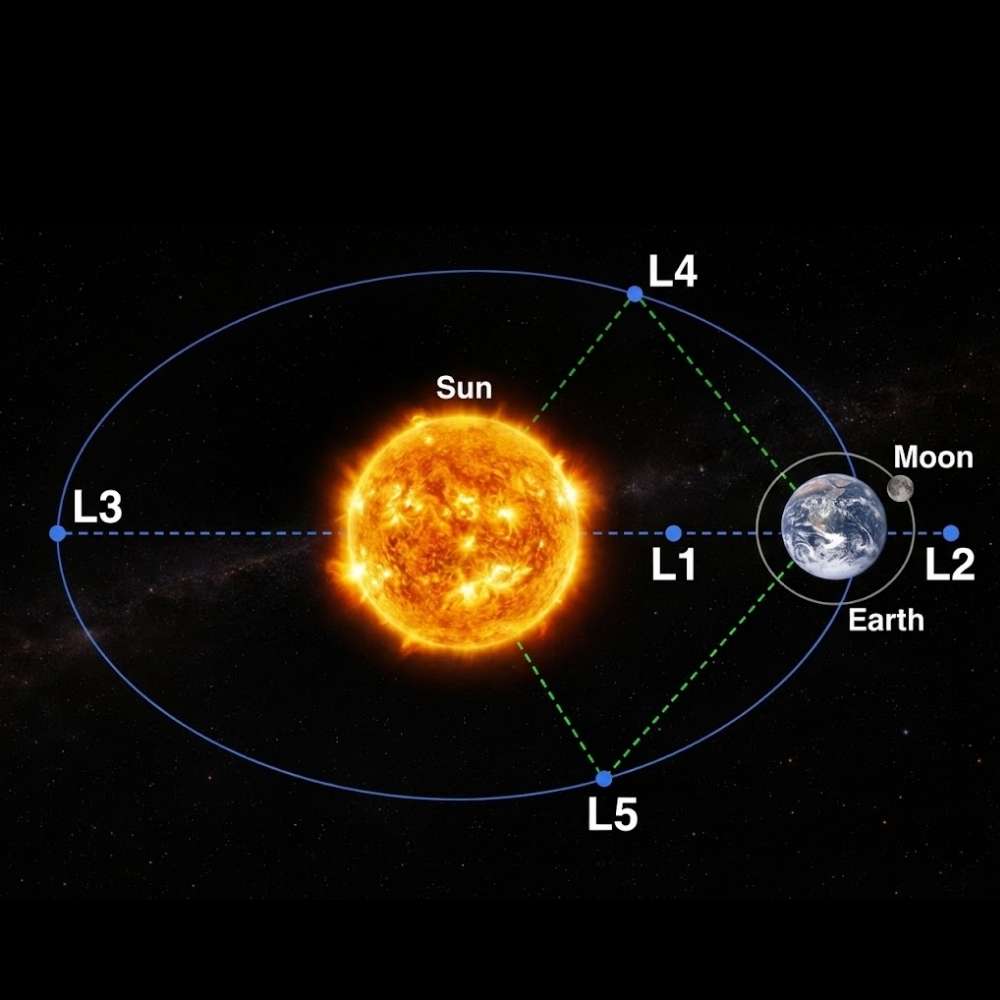
Sun–Earth L₄ is one of five Lagrange points in the Sun–Earth system.
At L₄:
The gravitational pull of the Sun and Earth balances orbital motion
A small object can orbit the Sun with the same period as Earth
The object remains about 60° ahead of Earth
This configuration creates a stable gravitational pocket, unlike the unstable L₁, L₂, and L₃ points.
Why L₄ Is Dynamically Stable
Sun–Earth L₄ is stable because of its geometry.
If an object drifts slightly away:
Gravitational forces nudge it back
The object oscillates around L₄ instead of escaping
Perturbations do not grow uncontrollably
This stability allows objects to survive at L₄ for extremely long timescales.
What Are Earth Trojans?
Earth Trojans are asteroids that:
Orbit the Sun, not Earth
Share Earth’s orbital period
Linger near the L₄ or L₅ points
Avoid close encounters with Earth
They are not satellites and not typical near-Earth asteroids.
They are co-orbital companions.
The First Confirmed Earth Trojan – 2010 TK₇
In 2010, astronomers confirmed the first Earth Trojan: 2010 TK₇.
Key characteristics:
Located near Sun–Earth L₄
Follows a complex tadpole-shaped orbit
Remains gravitationally linked to Earth
Likely temporarily trapped (thousands to millions of years)
Its discovery proved that Earth Trojans can exist.
Why Earth Trojans Are So Hard to Detect
Earth Trojans are notoriously difficult to observe.
Reasons include:
They appear close to the Sun in the sky
Observations must be made during twilight
Their surfaces are dark and faint
Ground-based telescopes face severe limitations
This means many Earth Trojans could remain undiscovered.
Are Earth Trojans Common or Rare?
Current observations suggest:
Large Earth Trojans are rare
Small Earth Trojans may be more common
Long-term stable populations are possible but constrained
Unlike Jupiter, Earth’s weaker gravity limits the size and number of Trojan companions.
Why Earth Trojans Matter Scientifically
Earth Trojans are important because they may:
Preserve material from Earth’s formation era
Represent a unique population distinct from near-Earth asteroids
Help constrain models of planet formation and migration
They offer a window into conditions that existed when Earth was still forming.
Earth Trojans vs Near-Earth Asteroids
Earth Trojans differ fundamentally from typical near-Earth objects.
| Feature | Earth Trojans | Near-Earth Asteroids |
|---|---|---|
| Orbital Period | Same as Earth | Different |
| Collision Risk | Extremely low | Variable |
| Orbital Stability | High (L4/L5) | Often chaotic |
| Origin | Possibly primordial | Mixed |
This distinction makes Earth Trojans scientifically valuable and dynamically unique.
Universe Map Context – Why L₄ Deserves Attention
Sun–Earth L₄ sits at the intersection of:
Orbital mechanics
Small-body populations
Earth’s long-term dynamical environment
It shows that Earth’s neighborhood includes not just nearby asteroids, but co-orbital companions hidden by geometry.
The Orbital Dynamics of Earth Trojans
Earth Trojans do not sit motionless at Sun–Earth L₄.
Instead, they follow complex, looping paths around the Lagrange point while remaining gravitationally linked to Earth.
Typical motion includes:
Tadpole orbits around L₄
Slow oscillations ahead of and behind the exact L₄ position
Stable co-orbital motion with a one-year period
This behavior allows Earth Trojans to remain dynamically separated from Earth while sharing its orbit around the Sun.
Tadpole Orbits vs Horseshoe Orbits
Not all co-orbital objects behave the same way.
Tadpole Orbits
Confined near L₄ or L₅
Small oscillation amplitude
Higher long-term stability
Horseshoe Orbits
Sweep across both L₄ and L₅ regions
Pass near Earth’s orbit without close encounters
Generally less stable over long timescales
Confirmed Earth Trojans, including 2010 TK₇, occupy tadpole-like configurations, at least temporarily.
Is 2010 TK₇ a Permanent Companion?
Although 2010 TK₇ proved that Earth Trojans exist, it may not be permanent.
Numerical simulations indicate:
Its orbit is stable for thousands to millions of years
Long-term perturbations from Venus and Jupiter affect its motion
It may eventually leave the L₄ region
This suggests that temporary capture may be common for Earth Trojans, while truly primordial ones could be harder to detect.
Long-Term Stability of Sun–Earth L₄
Sun–Earth L₄ is dynamically stable in theory, but real Solar System conditions add complexity.
Factors affecting stability include:
Gravitational perturbations from Venus
Secular resonances with Jupiter
Non-gravitational forces on small bodies
Despite this, simulations show that small, low-inclination objects can remain near L₄ for extremely long timescales under the right conditions.
Earth Trojans vs Jupiter Trojans
Earth Trojans are often compared to the famous Trojan populations of Jupiter, but the environments differ significantly.
| Feature | Earth Trojans | Jupiter Trojans |
|---|---|---|
| Planet Mass | Low | Very high |
| Trojan Population | Very small (known) | Thousands |
| Orbital Stability | Moderate to high | Very high |
| Discovery Difficulty | Extreme | Moderate |
| Primordial Survivability | Uncertain | Well established |
Jupiter’s strong gravity creates vast Trojan swarms.
Earth’s weaker gravity results in fewer, subtler companions.
Why Earth Trojans Are Scientifically Special
Earth Trojans occupy a unique niche.
They may:
Represent material formed near Earth’s orbit
Preserve early Solar System chemistry
Avoid the intense collisional history of the asteroid belt
If primordial Earth Trojans exist, they could offer clues about Earth’s building blocks that no other population can provide.
Could Earth Trojans Have Supplied Earth’s Water?
One speculative idea is that Earth Trojans may have played a role in early volatile delivery.
Possibilities include:
Temporary Earth Trojans destabilized during planetary migration
Gradual leakage of material into Earth-crossing orbits
Contribution to water and organic delivery
While unproven, Earth Trojans are part of broader discussions on how Earth became habitable.
Why We Likely Haven’t Found Most Earth Trojans Yet
The known Earth Trojan population is almost certainly incomplete.
Key observational limitations:
Sun-proximity restricts telescope observing time
Small size and low reflectivity reduce detectability
Survey biases favor night-sky objects
Space-based infrared and twilight-optimized surveys may reveal many more.
Future Search Strategies
Improved detection of Earth Trojans will likely rely on:
Space-based telescopes inside Earth’s orbit
Wide-field infrared surveys
Dedicated twilight observation campaigns
Missions designed to observe near the Sun–Earth L₄ region could dramatically expand the known population.
Earth Trojans and Planetary Defense
Although Earth Trojans are not impact threats, they still matter for planetary defense.
Studying them helps:
Understand co-orbital dynamics
Improve models of near-Earth object evolution
Identify objects transitioning between orbital classes
They provide context, not danger.
Universe Map Perspective – A Subtle Population
Earth Trojans demonstrate that the Solar System contains hidden structures shaped by motion, not proximity.
They remind us that Earth’s neighborhood includes:
Stable gravitational niches
Long-lived companions
Populations concealed by observational geometry
The Long-Term Scientific Value of Earth Trojans
Earth Trojans matter not because of their size or number, but because of where they live.
Objects near Sun–Earth L₄ experience:
Low collision rates
Long dynamical lifetimes under favorable conditions
Minimal thermal alteration compared to near-Sun asteroids
If even a small fraction of Earth Trojans are primordial, they could preserve near-Earth formation material that has been lost elsewhere.
Earth Trojans as Fossils of Earth’s Formation Zone
Most samples we study today come from:
The asteroid belt
Near-Earth asteroids scattered inward
Comets formed far from the Sun
Earth Trojans are different.
They may represent material that:
Formed near 1 AU
Avoided large-scale scattering
Remained dynamically insulated
This makes them uniquely valuable for understanding how Earth itself assembled.
Temporary vs Primordial Earth Trojans
A critical open question is whether Earth Trojans are:
Temporary captures, or
Primordial survivors from early Solar System history
Current evidence suggests both may exist.
Temporary Earth Trojans:
Captured from near-Earth asteroid populations
Stable for thousands to millions of years
Primordial Earth Trojans (hypothetical):
Formed near Earth’s orbit
Stable for billions of years
Extremely difficult to detect today
Distinguishing between these populations is a key goal of future research.
Why Earth Trojans Matter for Planetary System Architecture
Earth Trojans show that planetary systems are not just planets and debris belts.
They contain:
Co-orbital niches
Stable equilibrium regions
Long-lived dynamical structures
Similar Trojan populations may exist in exoplanetary systems, especially around Earth-like planets.
Frequently Asked Questions (Expanded)
Are Earth Trojans satellites of Earth?
No.
Earth Trojans orbit the Sun, not Earth. They simply share Earth’s orbital period and remain near the L₄ or L₅ points.
Can Earth Trojans ever collide with Earth?
Under normal conditions, no.
Their orbits are dynamically separated from Earth. Only major perturbations over long timescales could destabilize them.
Why is only one Earth Trojan known so far?
Detection is extremely difficult because Earth Trojans appear close to the Sun in the sky.
Most surveys are not optimized for twilight or near-Sun observations.
Are Earth Trojans dangerous?
No.
They are not considered impact hazards and are not part of near-term planetary defense concerns.
Could Earth Trojans be mined in the future?
In theory, yes — due to their Earth-like orbits.
In practice, their small size, uncertain composition, and observational challenges make this a long-term consideration, not a near-term goal.
Do Earth Trojans exist at both L₄ and L₅?
Yes, in principle.
Sun–Earth L₄ and L₅ are dynamically equivalent. The lack of discoveries at L₅ reflects observational bias, not physical impossibility.
Are there dust clouds at Sun–Earth L₄ like Jupiter’s Trojans?
No large, confirmed clouds exist.
However, weak and transient dust concentrations are theoretically possible but very difficult to observe.
Could more Earth Trojans be discovered soon?
Yes.
Space-based infrared surveys and twilight-optimized observations could dramatically increase the known population in the coming decades.
Why Sun–Earth L₄ Matters for Universe Map
Sun–Earth L₄ represents a class of Solar System structures that Universe Map emphasizes:
Dynamical, not physical, locations
Small populations with outsized scientific value
Objects hidden by geometry rather than distance
Earth Trojans remind us that Earth’s orbital neighborhood is richer than it appears.
Related Topics for Universe Map
Sun–Earth L₅
Lagrange points
Co-orbital dynamics
Near-Earth asteroids
Jupiter Trojans
Planetary formation
Together, these topics explain how stability, motion, and gravity shape hidden populations across the Solar System.
Final Perspective
Sun–Earth L₄ is easy to ignore because it has no surface, no glow, and no obvious landmark.
Yet it quietly hosts one of the most intriguing populations near Earth:
objects that share our orbit, avoid our path, and preserve clues from the earliest chapters of planetary history.
Earth Trojans show that some of the Solar System’s most valuable information is not found in dramatic places, but in balanced ones — where gravity, motion, and time conspire to keep ancient material hidden in plain sight.