




Sunflower Galaxy
A Spiral Bloom in the Cosmos
Quick Reader
| Attribute | Details |
|---|---|
| Name | Sunflower Galaxy (Messier 63 / NGC 5055) |
| Galaxy Type | Spiral Galaxy (SA(rs)bc) |
| Constellation | Canes Venatici |
| Distance from Earth | ~27 million light-years |
| Apparent Magnitude | 9.3 |
| Diameter | ~100,000 light-years |
| Discovered By | Pierre Méchain, 1779 (later cataloged by Charles Messier as M63) |
| Group Membership | M51 Group (with Whirlpool Galaxy, M51) |
| Inclination | ~55° (partially tilted view) |
| Notable Features | Multi-arm spiral pattern, intense yellowish bulge, flocculent texture |
| Star Formation Rate | Moderate; scattered H II regions |
| Supermassive Black Hole | ~10⁸ M☉ (estimated) |
| Best Viewing Time | March–June (Northern Hemisphere) |
| Telescope Requirement | Visible in small amateur telescopes; detailed arms in larger scopes |
Introduction — The Galaxy That Blossoms Like a Flower
In the constellation Canes Venatici, just north of the celestial equator, lies a galaxy that looks uncannily like a celestial bloom — the Sunflower Galaxy (M63).
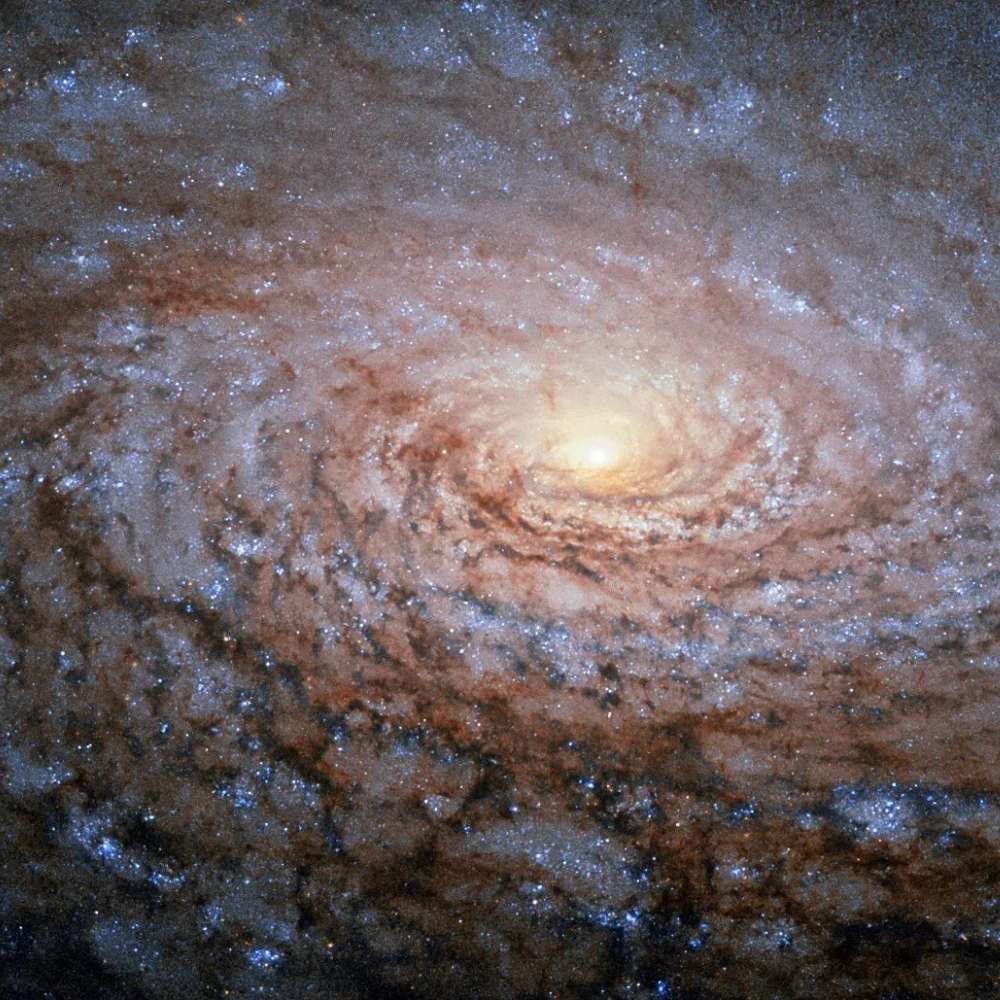
When viewed through a telescope, its spiral arms unfold like petals, illuminated by thousands of young stars and framed by dark dust lanes curling around a glowing yellow center.
Discovered in 1779 by French astronomer Pierre Méchain, and later added to Messier’s catalog, M63 quickly became one of the most iconic spiral galaxies for both professionals and amateurs.
Its beauty is matched by its scientific importance — as an archetype of a “flocculent” spiral galaxy, where arms appear fragmented yet collectively form a graceful pattern.
Unlike the grand-design spirals such as NGC 1300 or the Whirlpool Galaxy, M63’s arms are patchy and irregular. But within that irregularity lies a story of dynamic stellar birth, turbulence, and cosmic self-organization.
Structure and Classification — A Flocculent Spiral Masterpiece
Astronomers classify M63 as SA(rs)bc, meaning it lacks a prominent bar (unbarred spiral), shows a partial inner ring (rs), and has moderately wound spiral arms (bc).
What sets it apart is its flocculent spiral structure — instead of two symmetric arms, it exhibits dozens of short, overlapping segments that create a “feathery” look.
Key Structural Elements
Bulge: Bright, compact, golden core of old Population II stars.
Arms: Patchy, fragmented, and rich in blue clusters and dust.
Disk: Smoothly transitions outward with faint, extended spiral patterns.
Halo: Large and faint, reaching far beyond the visible disk — an indicator of M63’s dynamic history.
Though M63 may appear calm, this structure hides signs of past interactions that have shaped its disk and halo over billions of years.
Stellar Populations and Color Palette
The colors of the Sunflower Galaxy tell a clear evolutionary story:
Central Bulge: Dominated by yellow and orange light — ancient stars several billion years old.
Spiral Arms: Blue clusters of massive, young stars mark active star-forming regions (H II regions).
Dust Lanes: Dark filaments of interstellar gas trace where gravity compresses material into new stars.
Infrared observations from Spitzer Space Telescope and WISE show that M63’s disk contains significant warm dust emission, confirming continuous star formation.
Ultraviolet surveys from GALEX highlight numerous bright knots — stellar nurseries spread across the inner and outer arms.
Halo and Hidden Streams — Clues of an Ancient Encounter
In 2011, deep imaging revealed a faint tidal stream — a ghostly arc of stars wrapping around M63’s outskirts.
This feature likely originated from a dwarf satellite galaxy that was torn apart and absorbed long ago.
Significance of the Stellar Stream
Evidence of ongoing hierarchical growth — galaxies evolve by accreting smaller systems.
Suggests that M63’s outer halo is still assembling, even today.
Reveals how seemingly isolated spirals still experience minor mergers that influence their structure.
The Sunflower Galaxy’s extended halo, stretching up to 140,000 light-years, contains remnants of these interactions — faint signatures of cosmic evolution that can be traced with long-exposure imaging.
The Galactic Core — A Silent Powerhouse
Though visually serene, the nucleus of M63 is far from quiet.
Spectroscopic studies show a central supermassive black hole estimated at roughly 100 million solar masses.
Unlike active galaxies, however, M63’s black hole is dormant, accreting little gas at present.
Still, subtle emissions from the core indicate low-level nuclear activity, perhaps a faded echo of a more energetic past.
Infrared and X-ray data confirm the presence of hot dust and weak ionization lines, typical of Low-Ionization Nuclear Emission-line Regions (LINERs).
The Sunflower Effect — Why It Looks the Way It Does
The name “Sunflower Galaxy” originates from its optical appearance: the alternating bright and dark spiral segments resemble the pattern of seeds in a sunflower’s disk.
This pattern emerges from the interplay of density waves, star formation fronts, and dust obscuration.
Unlike the tidy symmetry of grand-design spirals, M63’s arms are self-propagating, where each star-forming region triggers the next — like sparks traveling through a chain of fireworks.
The result is a galaxy that looks chaotic up close, but reveals remarkable harmony from afar.
Galactic Motion — The Rotation Curve and the Dark Matter Mystery
One of the most intriguing aspects of the Sunflower Galaxy (M63) lies not in its bright petals of starlight, but in the way it moves.
Astronomers studying its rotation curve — the speed at which stars and gas orbit the galactic center — discovered something extraordinary.
The Flat Rotation Curve
In a simple Newtonian model, the further a star is from the center, the slower it should orbit.
But in M63, as in most spiral galaxies, the outer regions rotate almost as fast as the inner ones.
This phenomenon cannot be explained by visible matter alone.
The implication is clear: M63, like the Milky Way, is embedded in a massive, invisible halo of dark matter that extends far beyond its luminous disk.
Observational Evidence
21-cm HI radio mapping reveals extended neutral hydrogen gas well outside the visible galaxy.
The rotation curve remains flat beyond 40,000 light-years, suggesting a dark halo several times more massive than the stellar component.
Simulations estimate that up to 90% of M63’s total mass lies in this unseen halo.
Dark matter not only keeps the galaxy stable — it defines the framework upon which the Sunflower’s petals can bloom.
The Interstellar Medium — Gas, Dust, and Star Formation
Neutral Hydrogen (HI)
Radio surveys using the Very Large Array (VLA) have mapped M63’s extended HI disk, which spans nearly twice the optical diameter.
This diffuse gas acts as a reservoir for future star formation, slowly drifting inward over millions of years.
Molecular Gas (CO)
Observations of carbon monoxide (CO) emissions reveal molecular clouds concentrated in the inner arms.
These regions coincide with bright H II zones, where ultraviolet light from newborn stars ionizes hydrogen — marking the places where star formation is actively occurring.
Dust and Infrared Glow
Infrared data from Spitzer and Herschel telescopes show a glowing web of warm dust tracing the spiral arms.
This dust absorbs starlight and re-emits it at longer wavelengths, providing astronomers with a way to measure star formation rates and energy output even when optical light is obscured.
Star Formation History — From Past to Present
The Sunflower Galaxy is a stellar garden in continuous bloom. Its flocculent arms are filled with localized bursts of star formation, driven by stochastic self-propagating processes rather than large-scale density waves.
Chronology of Activity
| Epoch | Description | Key Traces |
|---|---|---|
| >5 billion years ago | Formation of the central bulge; early disk settled | Yellow old stars, metal-rich bulge |
| 1–3 billion years ago | Moderate disk growth; weak mergers | Thickened disk, faint stellar halo |
| 0–500 million years ago | Ongoing star formation in outer arms | Blue clusters, H II regions, UV knots |
Spectral studies indicate a gradual inside-out evolution, with the inner disk composed of older stars and the outskirts hosting ongoing stellar birth. This pattern mirrors the growth of spiral galaxies in general — slow, sustained, and self-regulating.
Connection to the Whirlpool Galaxy (M51) Group
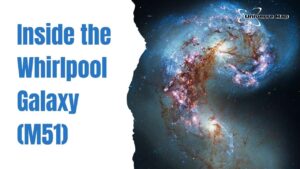
M63 is part of the M51 Group, a small cluster of galaxies that includes the famous Whirlpool Galaxy (M51), NGC 5023, and several dwarf companions. Although M63 and M51 are separated by over 300,000 light-years, their mutual gravitational influence has likely shaped each other’s evolution over cosmic time.
Evidence of Interaction
HI mapping shows subtle distortions in M63’s outer gas disk, possibly caused by tidal interactions within the group.
Faint stellar streams around M63 hint at past mergers with dwarf companions.
Simulations suggest that small encounters — not major collisions — have gently stirred its disk, creating the flocculent spiral pattern we see today.
The M51–M63 Contrast
| Property | M51 (Whirlpool) | M63 (Sunflower) |
|---|---|---|
| Spiral Type | Grand-design | Flocculent |
| Bar Presence | Yes (weak) | None |
| Interaction | Ongoing with NGC 5195 | Mild tidal shaping |
| Star Formation Rate | High (starburst) | Moderate |
| Visibility | Face-on, very bright | Tilted, more subtle |
Together, they demonstrate the two extremes of spiral structure — one sculpted by strong interaction, the other by gentle self-regulation.
Outer Disk and Extended Halo — The Galaxy Beyond the Glow
Recent deep exposures have revealed that M63 extends far beyond its visible spiral arms.
This outer stellar disk and halo hold keys to its long-term stability and evolutionary past.
Extended Disk Characteristics
Extends to over 140,000 light-years, faint but detectable in long exposures.
Contains diffuse, old stars and weak UV emission.
Shows warped gas layers — likely remnants of past minor accretions.
Stellar Halo
Composed of low-metallicity stars, typical of accreted material.
The tidal stream detected by Martínez-Delgado et al. (2010) wraps around the halo like a ghostly ribbon.
The halo contributes to the smooth transition from disk to intergalactic space — a rare and beautiful structure to observe around a spiral galaxy.
The Magnetic Field — Hidden Order Beneath the Chaos
One of the lesser-known wonders of M63 is its ordered magnetic field, discovered through radio polarization mapping.
Despite its flocculent optical pattern, the magnetic field follows a coherent spiral structure, extending well into the halo.
Scientific Implication
This surprising discovery shows that magnetism is not tied to visible arms — even in patchy spirals, galactic magnetic fields remain globally ordered, possibly maintained by a dynamo mechanism driven by rotation and turbulence.
It’s another example of how hidden forces bring order to what seems chaotic — a cosmic parallel to the Sunflower’s visual harmony.
The Central Engine — A Dormant Black Hole at Work
At the luminous core of the Sunflower Galaxy (M63) lies a supermassive black hole with an estimated mass of about 100 million Suns (10⁸ M☉).
Although it currently shows no signs of active accretion, subtle features in its spectrum reveal a quiet but persistent influence on the surrounding galactic environment.
Nuclear Characteristics
Spectral Signature: Weak emission lines characteristic of a LINER-type nucleus (Low-Ionization Nuclear Emission-line Region).
Infrared Excess: Slightly elevated IR flux hints at warm dust heated by faint nuclear activity.
Kinematics: The central gas rotates rapidly within the inner 300 light-years, indicating the gravitational presence of a compact massive object.
Even though M63’s black hole slumbers, it serves as the anchor of the galaxy’s central bulge, stabilizing stellar orbits and maintaining symmetry over billions of years.
Future encounters or gas inflows from the outer disk could reignite it — briefly transforming the Sunflower into a mild active galaxy.
Galactic Ecosystem — Balancing Feedback and Growth
The Sunflower Galaxy represents a delicate equilibrium between inward and outward forces.
Gas flows inward through spiral arms, forming stars and feeding the central mass, while stellar winds and supernovae blow material outward — a self-regulating galactic ecosystem.
Star Formation Feedback Loop
Gas Inflow: Gravity pulls interstellar material toward dense spiral segments.
Star Birth: Compressed gas collapses to form new stars and clusters.
Stellar Feedback: Young stars release winds and radiation, dispersing surrounding clouds.
Renewal: The cleared gas cools and falls back, starting the cycle again.
This process sustains M63’s moderate star formation rate — neither starburst nor dormant — and preserves its structural balance without triggering disruptive outflows.
Role in the M51 Group — Gravitational Harmony
Within the M51 Group, the Sunflower Galaxy acts as a stabilizing counterpart to its more turbulent neighbor, the Whirlpool Galaxy (M51). While M51 undergoes an energetic interaction with NGC 5195, M63 evolves quietly, serving as a control case for understanding the diversity of spiral morphologies within one galactic neighborhood.
Environmental Comparison
| Parameter | M63 (Sunflower) | M51 (Whirlpool) |
|---|---|---|
| Type | Flocculent Spiral | Grand-Design Spiral |
| Interaction | Weak tidal influence | Strong ongoing merger |
| Star Formation | Moderate, patchy | Intense, centralized |
| Nuclear Activity | LINER (low) | Seyfert (active) |
| Disk Stability | Very high | Distorted |
The contrast between these galaxies demonstrates that gravitational environment is a key driver in determining whether a galaxy’s arms appear fragmented or well-organized.
The Sunflower Galaxy and the Cosmic Order
Beyond its aesthetic allure, M63 is a symbol of cosmic order emerging from local randomness.
Its spiral arms appear chaotic up close — clouds and clusters scattered irregularly — yet when viewed as a whole, they form a perfectly balanced disk.
Lessons from M63
Flocculent spirals reveal that galactic symmetry does not require external triggers or perfect bars.
Internal dynamics — gas turbulence, magnetism, and self-propagating star formation — can naturally create beauty.
Outer halos preserve fossil records of minor mergers, chronicling billions of years of evolution.
The Sunflower thus teaches us that the universe’s elegance often arises not from precision, but from persistence.
Frequently Asked Questions (FAQ)
Q1: Why is it called the “Sunflower Galaxy”?
Its spiral arms radiate outward like petals from a central core, resembling the pattern of a sunflower’s disk. The bright clumps of stars give a petal-like appearance in optical images.
Q2: How far away is M63 from Earth?
Approximately 27 million light-years, within the constellation Canes Venatici and part of the nearby M51 Galaxy Group.
Q3: What kind of spiral galaxy is it?
M63 is a flocculent spiral galaxy (SA(rs)bc) — meaning its spiral arms are patchy and irregular, without a strong central bar.
Q4: Does the Sunflower Galaxy have active galactic nuclei (AGN)?
Currently no strong AGN activity, but spectral studies classify it as a LINER-type galaxy, meaning low-level nuclear emission is present — a possible sign of a slowly accreting black hole.
Q5: Can amateur astronomers see it?
Yes. With a small telescope (4–6 inch) under dark skies, M63 appears as a faint oval glow. Larger telescopes or long-exposure photography reveal its distinct spiral “petals.”
Q6: What is the galaxy’s role in the cosmic context?
It’s a nearby laboratory for studying dark matter, flocculent spiral dynamics, and galactic halos, helping scientists understand how galaxies maintain stability and form stars without major interactions.
Related Galaxies and Further Reading
Whirlpool Galaxy (M51): The Sunflower’s dynamic neighbor — a grand-design spiral undergoing interaction.
NGC 2403: Another flocculent spiral, similar in scale but located in Camelopardalis.
NGC 2903: A barred spiral in Leo with similar star formation distribution.
Milky Way: Our own barred spiral, possibly intermediate between M51 and M63 in structure.
Final Thoughts
The Sunflower Galaxy (M63) stands as a perfect fusion of chaos and coherence — a galaxy where randomness blooms into cosmic beauty.
Its patchy arms, golden core, and silent halo reflect the delicate mechanisms of self-organization that define spiral galaxies across the universe.
From the inside-out growth of its stars to the faint whispers of ancient mergers in its halo, M63 embodies the quiet resilience of the cosmos.
While others blaze with violent collisions or active nuclei, the Sunflower simply shines — calm, balanced, and eternally in bloom.