







Terzan 1
The Hidden Globular Cluster in the Galactic Bulge
Quick Reader
| Attribute | Details |
|---|---|
| Name | Terzan 1 |
| Type | Globular Cluster |
| Constellation | Scorpius |
| Distance from Earth | ~21,000 light-years |
| Distance from Galactic Center | ~4,200 light-years |
| Apparent Magnitude | ~10.3 |
| Diameter | ~150 light-years (apparent radius ~2 arcmin) |
| Discovered By | Agop Terzan (1966, published 1968) |
| Metallicity ([Fe/H]) | ~–1.3 (moderately metal-poor) |
| Age | ~12 billion years |
| Population | Mostly old, evolved red giant stars |
| Special Feature | One of the closest clusters to the Milky Way’s core; heavily obscured by interstellar dust |
| Best Viewing Time | May–August (Southern Hemisphere) |
| Observation Method | Infrared telescopes; invisible in visible light due to heavy extinction |
Introduction — A Cluster Lost in the Dust
Hidden deep within the dense star fields of Scorpius, less than 5,000 light-years from the Galactic Center, lies a remarkable stellar congregation — Terzan 1, one of the innermost globular clusters in our Milky Way.
Discovered by the French-Armenian astronomer Agop Terzan in the 1960s, this cluster was almost invisible to optical telescopes because of the thick clouds of interstellar dust that obscure our view of the Galactic Bulge.
Only with the advent of infrared astronomy did Terzan 1’s true nature come to light — revealing an ancient, compact system that has survived near the heart of our Galaxy for more than 12 billion years.
Discovery and Location — Deep Inside the Bulge
Terzan 1 is located in the constellation Scorpius, not far from the direction of the Galactic Center.
Its celestial coordinates are approximately:
Right Ascension: 17h 35m
Declination: –30° 29′
The region is so heavily reddened by dust that Terzan 1 is completely invisible in optical wavelengths, appearing only in infrared and radio observations.
Why It’s Special
It is one of the closest globular clusters to the Galactic core, located just 4,200 light-years from the Milky Way’s nucleus.
The intense environment exposes it to gravitational tides, stellar interactions, and radiation fields far stronger than those in halo clusters.
Its survival for billions of years makes it a dynamically robust relic of the early Galaxy.
Structure and Appearance
Terzan 1 has a dense core surrounded by a faint halo, typical of bulge clusters but compressed by tidal forces.
Observational Characteristics
Core Radius: ~0.5 light-years
Half-light Radius: ~2.5 light-years
Apparent Diameter: ~4 arcminutes (≈150 light-years across)
Core Density: Extremely high — thousands of stars per cubic parsec in the center.
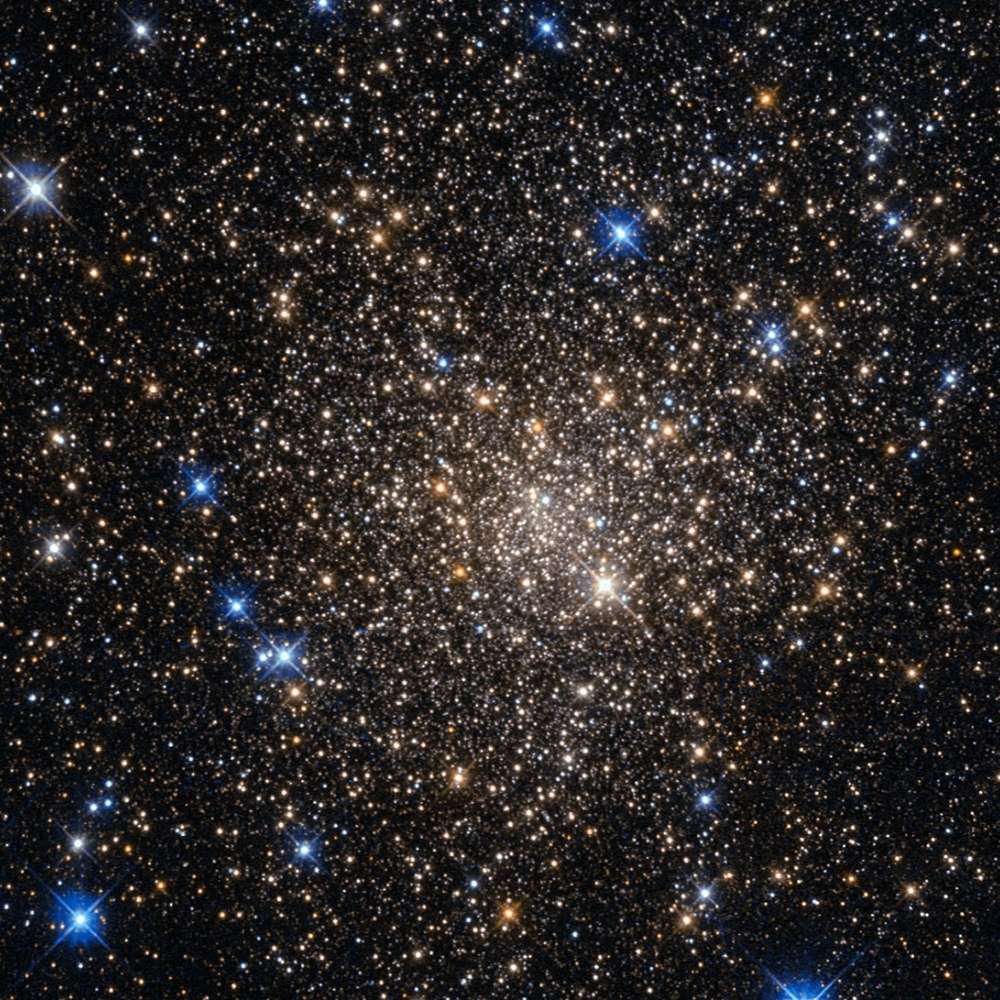
Infrared images from telescopes like VISTA (Visible and Infrared Survey Telescope for Astronomy) and 2MASS reveal a brilliant red-glowing center dominated by cool red giant stars, while visible-light images show only dark obscuration and faint haze.
Stellar Population — Survivors of a Harsh Environment
Most of the stars in Terzan 1 are Population II giants, formed in the early epochs of the Milky Way’s evolution.
These stars are poor in metals but extremely old — around 12 billion years, meaning they were born when the Galaxy itself was still taking shape.
Stellar Components
Red Giant Branch (RGB): Prominent, dominates the cluster’s luminosity.
Horizontal Branch: Poorly defined, likely affected by differential reddening.
Variable Stars: Contains several long-period variables and RR Lyrae-type stars, useful for distance and metallicity measurements.
Spectroscopic studies have identified several bright red giants with peculiar chemical signatures, providing clues to the chemical enrichment history of the Galactic Bulge.
Chemical Composition — A Bulge Relic
Although Terzan 1 is moderately metal-poor ([Fe/H] ≈ –1.3), it shows enhanced alpha elements (like Mg, Si, and Ca), typical of early Population II clusters. These abundances indicate that it formed from gas enriched primarily by Type II supernovae — the first explosions of massive stars in the young Milky Way.
Chemical Highlights
| Element | Abundance Trend | Implication |
|---|---|---|
| Iron (Fe) | Low (–1.3 dex) | Early formation era |
| Magnesium (Mg) | Enhanced | Type II supernova origin |
| Calcium (Ca) | Enhanced | Rapid enrichment |
| Oxygen (O) | High ratio | Massive star contributions |
Thus, Terzan 1 preserves the chemical fingerprint of the primordial bulge, making it a key reference point for studying the Galaxy’s first billion years.
The Challenge of Observing Terzan 1
Because Terzan 1 is so close to the Galactic Center, it lies behind an enormous wall of dust and gas — causing optical extinction of more than 4 magnitudes (Av > 20).
This makes it virtually invisible to visible-light telescopes.
Observation Techniques
Infrared Astronomy: Penetrates the dust and reveals the cluster’s stellar population.
Adaptive Optics Imaging: Used in near-IR to resolve crowded core stars.
Spectroscopy: Near-infrared spectra measure radial velocities and chemical abundances.
Thanks to these methods, astronomers have been able to determine that Terzan 1’s stars are slowly rotating, and the cluster is moving relative to the Galactic Center at about +50 km/s.
Kinematics and Motion — A Survivor Near the Galactic Core
Among the hundreds of globular clusters in our Galaxy, Terzan 1 holds a unique position — both geographically and dynamically.
Orbiting less than 4,200 light-years from the Galactic Center, it moves through one of the most turbulent gravitational environments in the Milky Way.
Measured Motion and Orbit
Radial Velocity: ~+57 km/s (relative to the Sun)
Proper Motion: Consistent with Galactic bulge rotation.
Orbit Type: Likely elliptical, confined within the inner bulge region.
Orbital Period: A few tens of millions of years — much shorter than halo clusters.
Its proximity to the center means that Terzan 1 is constantly bombarded by tidal forces from the Milky Way’s bar and nucleus.
These interactions heat the cluster dynamically, leading to mass loss, stellar evaporation, and gradual core contraction — yet it remains bound even after billions of years.
X-ray Sources — A Cluster of Neutron Stars and Binaries
Terzan 1 has gained scientific fame for another reason — it hosts multiple X-ray sources, including one of the earliest low-mass X-ray binaries (LMXBs) discovered in a globular cluster.
Key Discoveries
1E 1724–3045: A bright and persistent X-ray source located within Terzan 1.
Identified by the Einstein Observatory in the 1970s.
Confirmed later by Chandra and XMM-Newton as a neutron star binary system.
Thermonuclear X-ray Bursts: Observed from this system, confirming the presence of a compact object accreting matter from a companion star.
Additional Faint Sources: Subsequent infrared follow-up has detected multiple candidate binaries and cataclysmic variables.
These findings show that even ancient, low-metallicity clusters like Terzan 1 can harbor exotic stellar remnants, preserved in their dense gravitational cores.
Stellar Dynamics and Core Density
Terzan 1’s core density is among the highest known in the bulge clusters — comparable to that of more famous dense systems like Terzan 5 and NGC 6440.
Dynamical Properties
| Parameter | Value | Description |
|---|---|---|
| Central Density | >10⁵ M☉/pc³ | Extremely dense stellar packing |
| Core Radius | ~0.5 ly | Small and gravitationally strong |
| Velocity Dispersion | ~8–10 km/s | Indicates deep potential well |
| Relaxation Time | ~1 Gyr | The cluster is dynamically evolved |
These conditions create an ideal environment for stellar interactions — binary formation, mass exchange, and even stellar collisions. Such processes may explain why many Terzan clusters (1, 2, 5, 6) host multiple neutron stars and pulsars.
Connection to the Galactic Bulge — A Fossil Record of Formation
Globular clusters like Terzan 1 are among the oldest structures in the Milky Way, but those in the Galactic Bulge are particularly important because they formed during the Galaxy’s earliest collapse phase.
Significance of Bulge Clusters
Represent the first generation of massive star clusters.
Preserve the chemical signature of rapid star formation before the thin disk existed.
Trace the gravitational history and shape of the Milky Way’s central bar.
Terzan 1, positioned near the core, offers direct evidence that globular cluster formation occurred very early — possibly even before the Milky Way fully developed its spiral arms.
Variable Stars and Distance Determination
Despite the high extinction, astronomers have detected RR Lyrae and Mira variables within Terzan 1 using infrared time-series photometry.
These variable stars act as standard candles, helping determine accurate distances.
Findings
Distance Modulus: (m–M)₀ ≈ 13.5
Distance: ~21,000 light-years from Earth.
Reddening: E(B–V) ≈ 2.4, among the highest for any cluster.
Such high reddening explains why early surveys missed Terzan 1 entirely — it was essentially invisible to optical astronomy until the infrared era.
The Environment — Close to the Galactic Black Hole
At just over 4,000 light-years from the *Milky Way’s central black hole (Sagittarius A)**, Terzan 1 experiences one of the most extreme stellar environments possible.
It orbits in a region packed with millions of stars, molecular clouds, and strong magnetic fields.
Environmental Effects
Tidal Stress: Constant stretching and compression distort its outer halo.
Gas Interactions: Occasional collisions with molecular clouds can shock and heat outer stars.
Radiation Fields: Intense near-infrared and X-ray background from the Galactic Center influences its stellar evolution.
Despite all this, Terzan 1 endures — a stable core of ancient stars that has resisted the galaxy’s most destructive region for over 12 billion years.
Scientific Importance — A Window into the Milky Way’s Formation
Terzan 1 holds immense importance for astrophysicists studying the early evolution of the Milky Way, particularly its bulge region.
Because of its age, metallicity, and proximity to the Galactic Center, it functions as a time capsule — preserving evidence of the first stages of star formation within our Galaxy.
Key Contributions to Galactic Science
Tracing Early Chemical Enrichment
Its high α-element abundance (Mg, Si, Ca) compared to iron confirms that early star formation in the bulge was dominated by short-lived massive stars.
This makes Terzan 1 a direct record of the supernova-driven chemical evolution that shaped the bulge’s current composition.
Understanding the Galactic Bar’s Structure
Terzan 1’s orbit and position provide constraints on the three-dimensional structure of the Galactic Bar, particularly its density distribution and rotation rate.
Probing the Inner Dark Matter Profile
Its kinematics allow astronomers to test mass models of the inner Milky Way and evaluate how dark matter behaves near the core.
Testing Stellar Evolution Models
Its dense, metal-poor population provides a laboratory for calibrating stellar evolutionary tracks, particularly red giant and horizontal branch phases under extreme conditions.
Comparison with Other Terzan Clusters
The Terzan series of clusters — discovered by Agop Terzan — include some of the most intriguing stellar systems near the Galactic Center. Many of them share similar characteristics: strong extinction, extreme density, and exotic stellar remnants.
| Cluster | Distance (ly) | Metallicity ([Fe/H]) | Notable Features |
|---|---|---|---|
| Terzan 1 | ~21,000 | –1.3 | Closest bulge cluster; X-ray binary; dense core |
| Terzan 2 | ~23,000 | –0.4 | Contains transient X-ray sources |
| Terzan 4 | ~28,000 | –1.6 | Old, very metal-poor; near bulge limit |
| Terzan 5 | ~19,000 | –0.2 to –0.8 | Multiple populations; possible relic of bulge formation |
| Terzan 6 | ~22,000 | –0.6 | Hosts neutron star binary; highly obscured |
Among them, Terzan 1 is exceptional for being the closest to the Galactic nucleus and one of the most compact. While Terzan 5 may preserve evidence of a proto-bulge fragment, Terzan 1 remains the simpler, primordial archetype — a pure survivor of the Galaxy’s turbulent youth.
Role in the Broader Galactic Context
Terzan 1’s survival offers direct clues about the stability of the Milky Way’s inner regions over billions of years.
Its high density and deep gravitational potential allowed it to resist tidal dissolution, even as other early clusters were destroyed by encounters with the bulge and bar.
Broader Implications
Galaxy Formation: Confirms that dense star clusters could form even in high-pressure, radiation-rich proto-galactic environments.
Bulge Assembly: Suggests that part of the bulge population originated from early cluster mergers and dissolutions.
Cosmic Archaeology: Each surviving bulge cluster, like Terzan 1, acts as a stellar fossil, preserving a snapshot of the universe only 1–2 billion years after the Big Bang.
Observing Terzan 1 Today — Hidden Beauty in Infrared
For professional astronomers, Terzan 1 is a rewarding challenge.
It cannot be appreciated visually through optical telescopes, but infrared imaging reveals a stunning, jewel-like cluster glowing red against a sea of dark dust.
Observation Summary
Visible Light: Completely obscured.
Infrared (J, H, K bands): Fully resolved star field, dominated by red giants.
Space Missions: Hubble (NIRCam), VISTA, and JWST all capable of observing its inner core.
Photometric Depth: Reaches down to the main sequence turnoff, confirming its ancient age.
Under infrared filters, Terzan 1’s dense heart gleams with the warm tones of countless aging suns — a hidden sphere of light buried within the Milky Way’s core.
Frequently Asked Questions (FAQ)
Q1: Why is Terzan 1 called a “hidden cluster”?
Because it lies behind heavy clouds of interstellar dust near the Galactic Center, making it invisible in visible light and detectable only in infrared observations.
Q2: How old is Terzan 1?
Approximately 12 billion years, placing it among the oldest known objects in the Milky Way.
Q3: What makes it special among the Terzan clusters?
It is the closest to the Galactic Center, extremely dense, and hosts notable X-ray binaries — a sign of strong stellar interaction.
Q4: Can Terzan 1 be observed by amateur astronomers?
Not effectively in optical light. Even large ground-based telescopes can barely detect it without infrared filters due to extreme dust obscuration.
Q5: What does Terzan 1 tell us about the Milky Way’s history?
It reveals that the bulge region formed early, through rapid star formation and supernova enrichment, and that ancient clusters like this were the building blocks of our Galaxy.
Related Objects and Further Reading
Terzan 5: Complex, multi-generation bulge cluster — possible fossil of early bulge formation.
NGC 6528 & NGC 6553: Metal-rich bulge clusters used to trace Galactic chemical evolution.
Sagittarius A* — The Milky Way’s central supermassive black hole, ~4,200 light-years from Terzan 1.
Arches Cluster: Young, massive cluster near the Galactic Center — modern counterpart to early bulge formation.
Final Thoughts
Deep in the shadows of the Milky Way’s heart, Terzan 1 remains one of the most enigmatic survivors of the early universe.
Forged from primordial gas, tested by gravity, and scarred by the tides of the Galactic core, it still endures — shining faintly through the veil of dust that has hidden it for millennia.
This single cluster tells the story of resilience and cosmic memory:
how the Milky Way’s first generations of stars lived, died, and built the heavy elements that now form planets, life, and even us.
Though invisible to human eyes, Terzan 1’s light still reaches us — a silent echo from the ancient heart of our Galaxy, whispering the history of everything that came after.