





TESS
The Planet Hunter Scanning the Entire Sky
Quick Reader
| Attribute | Details |
|---|---|
| Mission Name | Transiting Exoplanet Survey Satellite (TESS) |
| Space Agency | NASA |
| Launch Date | 18 April 2018 |
| Launch Vehicle | Falcon 9 |
| Mission Type | Space-based exoplanet survey |
| Primary Method | Transit photometry |
| Orbit Type | Highly elliptical Earth orbit (P/2 lunar resonance) |
| Primary Targets | Bright, nearby stars |
| Sky Coverage | ~85–90% of entire sky |
| Mission Status | Operational (extended missions) |
Scientific Role
TESS is designed to discover nearby exoplanets suitable for detailed follow-up, shifting exoplanet science from detection to characterization.
Why It Matters
TESS does not just find planets—it finds the right planets, around stars close enough for atmospheric study by telescopes like JWST.
Introduction – Why TESS Was Needed After Kepler
Before TESS, NASA’s Kepler mission revolutionized exoplanet science by proving that planets are common.
But Kepler had a limitation:
Most of its planets orbit distant, faint stars.
TESS was created to solve that problem.
Instead of staring at one patch of sky, TESS scans almost the entire sky, focusing on bright, nearby stars—targets that can be studied in detail long after discovery.
This marked a strategic shift:
From statistical discovery
To physical understanding of alien worlds
Mission Philosophy – Survey First, Study Later
TESS follows a clear scientific logic:
Find nearby planets
Prioritize bright host stars
Enable follow-up by other observatories
Rather than replacing Kepler, TESS complements it, acting as a discovery engine for the next generation of telescopes.
How TESS Finds Exoplanets
TESS uses the transit method.
When a planet passes in front of its star:
The star’s brightness dips slightly
The depth of the dip reveals planet size
Repeated dips reveal orbital period
From this, scientists can determine:
Planet radius
Orbital distance
Potential habitability zone
TESS does not directly image planets—it detects their shadows.
The Four-Camera Design – Watching Big, Not Deep
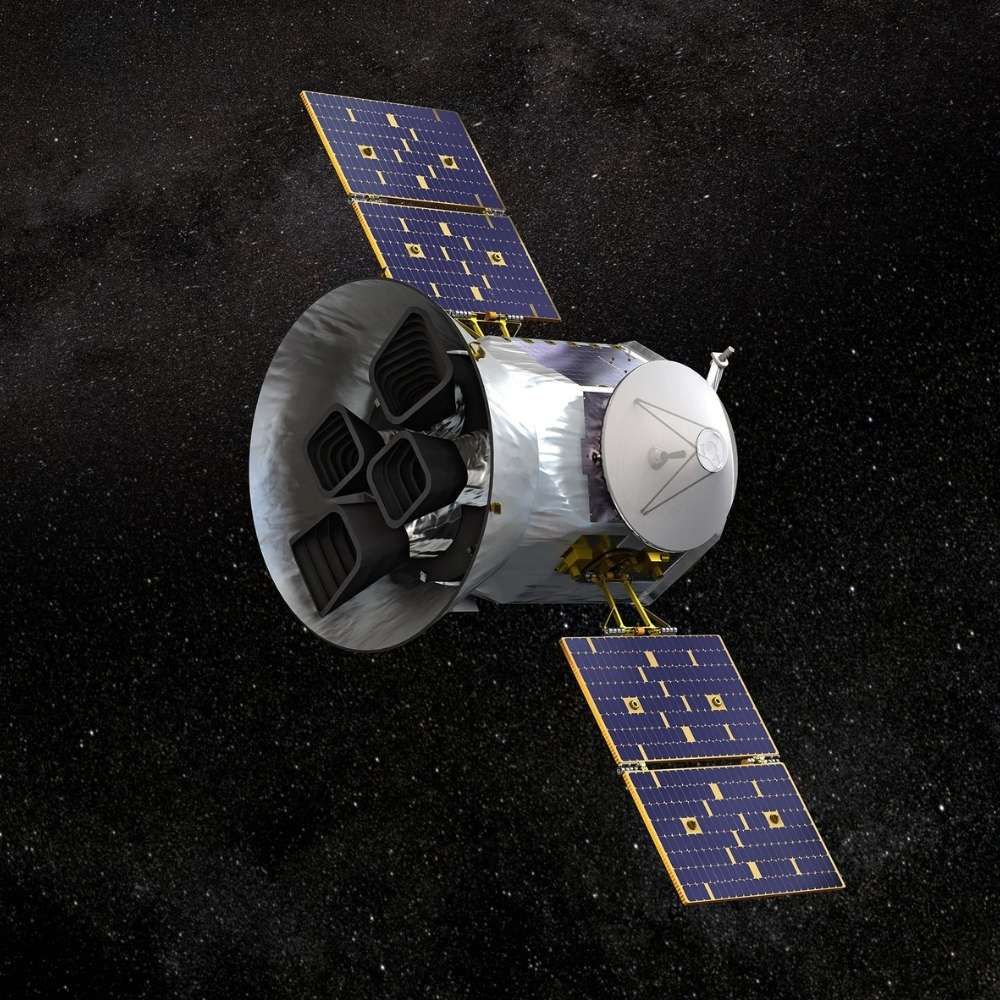
Unlike Kepler’s single telescope, TESS uses four wide-field cameras.
Key advantages:
Huge field of view
Rapid sky coverage
Continuous monitoring of large sectors
Each sector is observed for:
~27 days
Longer near the ecliptic poles
This design allows TESS to:
Observe hundreds of thousands of stars
Revisit key regions multiple times
Build long-duration light curves for some targets
TESS Orbit – Designed for Stability and Precision
TESS operates in a unique, highly elliptical orbit around Earth.
This orbit:
Keeps TESS away from Earth’s radiation belts
Provides long, uninterrupted observing periods
Offers thermal and pointing stability
The result is:
Extremely precise brightness measurements
Minimal interruptions
Long mission lifetime with low fuel use
This orbit choice is one of TESS’s quiet engineering successes.
What Kind of Planets TESS Finds Best
TESS excels at detecting:
Short-period planets
Planets around small stars (especially red dwarfs)
Super-Earths and sub-Neptunes
These planets are ideal because:
Transits are deeper and easier to detect
Host stars are often nearby
Atmospheric signals are stronger
TESS is optimized for follow-up science, not exotic edge cases.
Why Bright Stars Change Everything
Planets around bright stars allow:
Precise mass measurements from radial velocity
Atmospheric spectroscopy during transits
Direct comparison across telescopes
This makes TESS discoveries:
More scientifically valuable
More reusable across decades
Central to future exoplanet research
TESS discoveries often become community targets, not one-off detections.
Why TESS Matters
TESS matters because it:
Connects discovery with characterization
Enables atmospheric studies of exoplanets
Expands exoplanet science beyond statistics
Serves as a feeder mission for JWST and beyond
It represents the moment when exoplanet science moved from:
“How many planets exist?”
to
“What are these planets actually like?”
TESS Discoveries – From Thousands of Candidates to Confirmed Worlds
Since launch, TESS has transformed exoplanet discovery into a high-throughput process.
Its output includes:
Thousands of TESS Objects of Interest (TOIs)
Hundreds of confirmed exoplanets
A continuous stream of high-priority targets for follow-up
What makes TESS discoveries special is not just quantity, but accessibility—most orbit stars close enough for detailed study.
Standout TESS Discoveries
TESS has identified a wide variety of planetary systems.
Notable categories include:
Ultra-short-period planets orbiting in less than a day
Multi-planet systems around nearby stars
Planets around red dwarfs, ideal for atmospheric analysis
Sub-Neptunes and super-Earths, a class absent in our Solar System
These discoveries filled key gaps left by earlier missions.
Habitable-Zone Candidates – Where Life Could Exist
One of TESS’s most anticipated outcomes is finding planets in or near the habitable zone.
TESS has identified:
Rocky or potentially rocky planets
Orbits where liquid water could exist
Systems suitable for atmospheric follow-up
While TESS alone cannot confirm habitability, it provides:
The best nearby targets
Accurate radii and orbital periods
Ideal candidates for spectroscopy
TESS shifted the search for life from distant stars to our cosmic neighborhood.
TESS vs Kepler – Complementary Missions, Different Goals
| Aspect | Kepler | TESS |
|---|---|---|
| Survey Area | Small sky region | Nearly whole sky |
| Target Stars | Distant, faint | Nearby, bright |
| Primary Goal | Planet statistics | Follow-up-ready planets |
| Typical Planet | Far-away | Close and observable |
| Legacy | Frequency of planets | Physical characterization |
Interpretation
Kepler told us planets are common.
TESS tells us which planets to study next.
Ground-Based Follow-Up – A Global Effort
TESS is only the first step.
After detection:
Ground telescopes measure planet mass
Radial velocity confirms planetary nature
Transit timing variations reveal system dynamics
This global follow-up network includes:
Professional observatories
Dedicated exoplanet facilities
Skilled amateur astronomers
TESS democratized exoplanet science by providing open, community-driven targets.
Feeding JWST and Future Telescopes
One of TESS’s core design goals was to support future observatories.
TESS discoveries are now:
Prime targets for JWST atmospheric spectroscopy
Candidates for ARIEL and next-generation missions
Foundations for comparative planetology
Without TESS, many of JWST’s most exciting exoplanet observations would lack suitable targets.
Beyond Planets – Extra Science from TESS
Although designed for exoplanets, TESS also contributes to:
Stellar variability studies
Supernova detection
Asteroid light curve analysis
Asteroseismology
This makes TESS a general-purpose time-domain observatory, not just a planet hunter.
Why TESS Data Is Especially Valuable
TESS data is:
Publicly released
Continuously updated
Uniformly calibrated
This allows:
Rapid discovery confirmation
Independent reanalysis
Long-term archival science
Few missions offer such immediate and open scientific return.
Extended Missions – Why TESS Keeps Going
TESS was originally planned as a two-year mission. Its success, however, quickly justified extensions.
During its extended missions, TESS:
Re-observes large portions of the sky
Increases sensitivity to longer-period planets
Improves detection confidence through repeated coverage
Extended observations are especially important because:
Habitable-zone planets often have longer orbits
Multiple transits are needed for confirmation
Long-term stellar behavior must be understood
TESS has evolved from a rapid surveyor into a long-baseline exoplanet observatory.
Limitations – What TESS Cannot Do
Despite its power, TESS is not a complete solution.
Key limitations include:
Bias toward short-period planets
Reduced sensitivity to Earth-size planets around Sun-like stars
Limited ability to detect very long orbital periods
This is not a flaw—it is a design trade-off.
TESS is optimized to find the best nearby candidates, not to perform a complete census of all planet types.
How TESS Complements Other Missions
TESS works best as part of a system.
Kepler provided statistics
TESS provides targets
JWST provides atmospheric detail
ARIEL / ELTs provide population-level characterization
Together, these missions form a pipeline:
Detection → Confirmation → Characterization → Comparison
TESS is the front door of this pipeline.
Frequently Asked Questions (FAQ)
Is TESS still operating?
Yes. TESS remains operational under extended mission phases and continues to discover new exoplanets.
Can TESS find Earth-like planets?
Yes, particularly around small, cool stars. Finding true Earth analogs around Sun-like stars is more challenging.
Does TESS directly image exoplanets?
No. TESS detects planets indirectly using the transit method.
How many planets has TESS discovered?
TESS has identified thousands of planet candidates and hundreds of confirmed exoplanets, with numbers growing continuously.
Why are TESS planets good for JWST?
They orbit bright, nearby stars, making atmospheric signals stronger and easier to study.
Why TESS Changed Exoplanet Science
TESS changed the field by redefining success.
Instead of maximizing raw discovery numbers, it maximized scientific usability.
Its legacy includes:
A catalog of nearby, well-characterized planetary systems
Community-driven follow-up science
A bridge between discovery and atmospheric study
TESS transformed exoplanets from distant statistics into physical worlds we can examine in detail.
What We Would Not Know Without TESS
Without TESS:
JWST would lack many ideal exoplanet targets
Nearby planetary systems would remain undiscovered
Atmospheric characterization would be far more limited
TESS ensured that the next generation of telescopes had something meaningful to study.
Related Topics for Universe Map
Exoplanets
Transit Method
Kepler Mission
JWST
Habitable Zone
Red Dwarf Stars
ARIEL Mission
Together, these topics explain how exoplanet science matured from discovery to understanding.
Final Perspective
TESS does not search for the rarest planets.
It searches for the most reachable ones.
By scanning nearly the entire sky and focusing on nearby stars, TESS made exoplanet science practical, repeatable, and collaborative.
Its greatest achievement is not a single discovery—but a transformation of strategy:
From finding planets anywhere
to finding planets we can actually study.
That shift defines the modern era of exoplanet exploration.