






Tethys
Saturn’s Ancient Ice World Shaped by Fractures and Craters
Quick Reader
| Attribute | Details |
|---|---|
| Object Type | Icy moon of Saturn |
| Discovery | 1684 |
| Discoverer | Giovanni Domenico Cassini |
| Mean Radius | ~531 km |
| Diameter | ~1,062 km |
| Orbital Distance | ~295,000 km from Saturn |
| Orbital Period | ~1.89 Earth days |
| Rotation | Synchronous (tidally locked) |
| Density | ~0.98 g/cm³ |
| Composition | Mostly water ice with trace rock |
| Surface Age | Very old (heavily cratered) |
| Notable Features | Odysseus crater, Ithaca Chasma |
Key Points
- One of Saturn’s most ice-dominated moons
- Extremely low density, suggesting minimal rock content
- Surface preserves some of the oldest terrains in the Saturn system
- Contains one of the largest impact craters relative to moon size
- Appears geologically quiet today, but not always so
Introduction – A Moon Frozen in Time
At first glance, Tethys seems simple.
A bright, icy moon quietly circling Saturn, showing little sign of activity.
But this simplicity is deceptive.
Tethys carries deep planetary scars—a massive impact basin and a globe-spanning fracture system—evidence that this small moon once endured catastrophic forces. Unlike active moons such as Enceladus, Tethys does not renew its surface. Instead, it preserves its past, acting as a geological archive of early Solar System violence.
Understanding Tethys helps scientists answer a fundamental question:
What happens to an icy world when internal energy fades—but history remains written on its surface?
Physical Nature – A Moon Made Mostly of Ice
Tethys is one of the least dense large moons in the Solar System.
Its low density indicates:
Composition dominated by water ice
Very small rocky core, if any
Weak internal gravity
Limited ability to retain heat
This composition places Tethys at the extreme end of ice-rich satellites, even compared to other Saturnian moons.
As a result:
Internal geological activity shut down early
Surface features remain largely unchanged for billions of years
Tethys is not a living world—it is a preserved one.
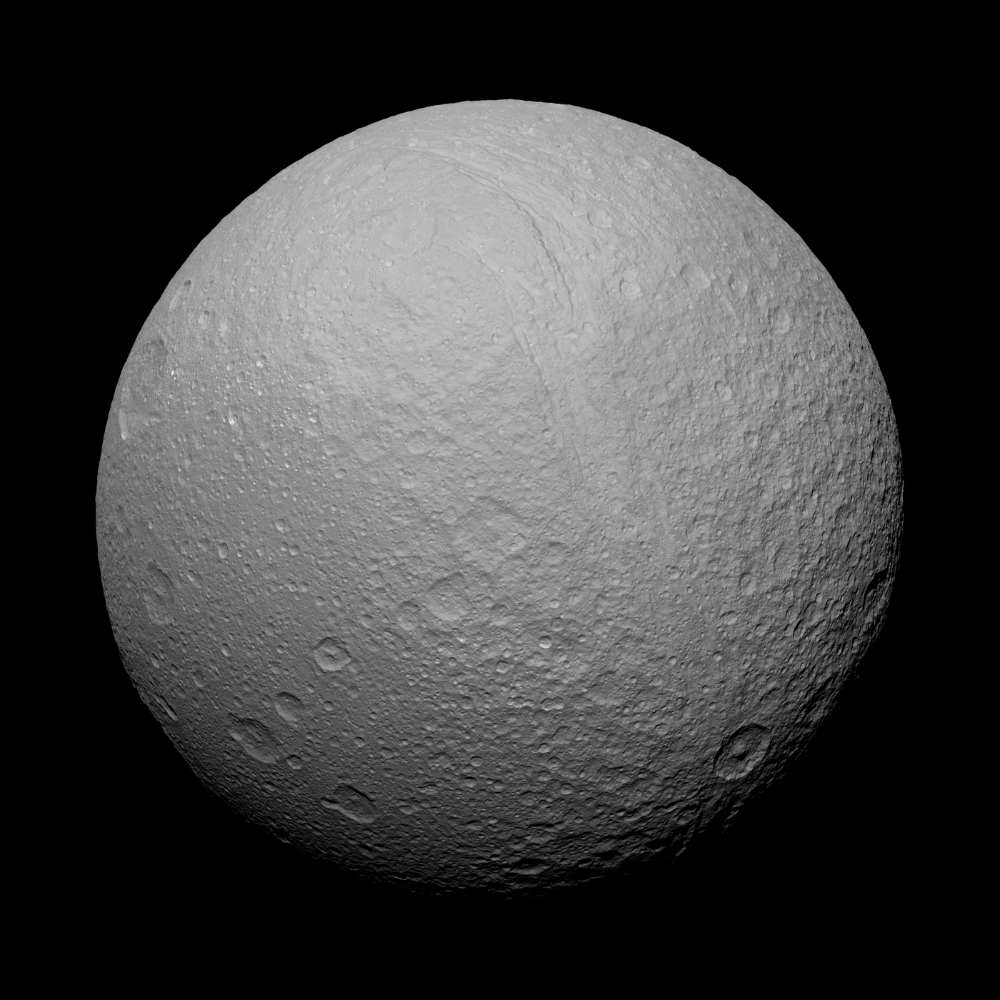
Surface Appearance – Bright, Ancient, and Heavily Cratered
Tethys reflects a high percentage of sunlight, making it one of Saturn’s brightest moons.
Its surface shows:
Dense impact cratering across most regions
Very few smooth or young plains
Minimal evidence of recent resurfacing
This tells us that:
Bombardment was intense in the early Solar System
Geological renewal ceased long ago
The surface we see today is extremely ancient
In planetary science terms, Tethys is a fossil surface.
Odysseus – A Crater That Nearly Shattered the Moon
One of Tethys’s most striking features is Odysseus, a colossal impact crater.
Key facts:
Diameter ~400 km
Nearly 40% of Tethys’s total diameter
Formed by a massive collision early in its history
The impact was so powerful that:
It nearly disrupted the moon entirely
The crater floor relaxed over time, smoothing its edges
The event likely altered Tethys’s internal structure
Odysseus represents the upper limit of what an icy moon can survive.
Ithaca Chasma – A Fracture Across the World
Stretching over 2,000 km across Tethys is Ithaca Chasma, a massive canyon-like fracture.
Characteristics:
Several kilometers deep
Extends across more than three-quarters of the moon
Older than many surface craters
Leading explanation:
Internal expansion as Tethys froze solid
Possible connection to early tidal heating
Stress release from internal volume changes
This feature suggests that Tethys was not always completely inert.
Orbital Behavior – Locked and Quiet
Tethys is tidally locked to Saturn, meaning:
The same hemisphere always faces the planet
Rotational and orbital periods are identical
Tidal heating today is negligible
Unlike Enceladus:
Tethys does not experience strong orbital resonance
No active plumes or internal oceans are detected
Thermal energy is extremely low
Its orbit promotes long-term stability, not geological excitement.
Why Tethys Matters
Tethys plays a crucial role in comparative planetology.
It helps scientists understand:
How icy moons evolve without sustained internal heat
The long-term effects of massive impacts on small bodies
The transition from early activity to permanent geological dormancy
Tethys represents a dead-end evolutionary path—not failed, but finished.
Tethys vs Enceladus vs Dione – Why Similar Moons Evolved So Differently
At first glance, Tethys, Enceladus, and Dione appear closely related. All are mid-sized icy moons orbiting Saturn. Yet today, they represent three very different evolutionary outcomes.
Comparative Evolution of Saturn’s Icy Moons
| Feature | Tethys | Enceladus | Dione |
|---|---|---|---|
| Mean Diameter | ~1,062 km | ~504 km | ~1,123 km |
| Density | ~0.98 g/cm³ | ~1.61 g/cm³ | ~1.48 g/cm³ |
| Rock Content | Very low | Moderate | Moderate |
| Current Activity | None observed | Active geysers | None observed |
| Subsurface Ocean | Unlikely | Confirmed | Possible (past or present) |
| Tidal Heating | Very weak | Strong | Weak |
| Surface Age | Very old | Very young (south pole) | Mixed |
This comparison highlights a key truth: size alone does not determine geological activity.
Why Enceladus Stayed Alive While Tethys Went Silent
The fundamental difference lies in energy.
Rock Content Matters
Enceladus and Dione contain significantly more rock
Rock holds heat longer than ice
Radiogenic heating persisted inside them
Tethys, being mostly ice, lost internal heat rapidly.
Orbital Resonances Shape Destiny
Enceladus is locked in a powerful orbital resonance with Dione, which:
Maintains orbital eccentricity
Generates continuous tidal heating
Drives internal melting and cryovolcanism
Tethys lacks any strong resonance today.
Without sustained tidal flexing, internal energy faded early.
Did Tethys Ever Have Internal Activity?
Although inactive today, Tethys was not always completely inert.
Evidence suggests:
Internal heating occurred early in its history
Partial melting may have happened during formation
Structural changes produced large-scale fractures
Ithaca Chasma likely formed during a phase when Tethys’s interior was still evolving.
However:
Any subsurface ocean would have frozen quickly
No long-term heat source remained
Activity shut down permanently billions of years ago
Tethys represents a world that cooled too fast.
Cratering Record – A Window into Early Solar System Violence
Tethys’s heavily cratered surface is scientifically valuable.
It preserves:
Impact rates from the early Solar System
Evidence of large-body collisions
Surface conditions before geological renewal ended
Unlike Enceladus, which erases craters, Tethys keeps them.
This makes Tethys an important reference surface for:
Dating other moons
Understanding impactor populations
Reconstructing Saturn’s early environment
Structural Weakness – Why Tethys Nearly Broke Apart
Tethys’s ice-rich makeup made it vulnerable.
Consequences of its low density:
Weaker internal cohesion
Easier fracture propagation
Greater deformation during impacts
The formation of Odysseus and Ithaca Chasma likely occurred close in time, when the moon was still mechanically fragile.
These events pushed Tethys close to structural failure, yet it survived.
Is Tethys Truly a “Dead” World?
From a modern perspective, yes.
No detected heat anomalies
No plume activity
No changing surface features
But scientifically, “dead” does not mean unimportant.
Tethys is a control sample—a baseline for understanding how icy moons behave when energy sources disappear.
Why Tethys Is Essential for Comparative Planetology
Tethys helps answer:
What happens when tidal heating stops?
How long do icy worlds retain geological memory?
Why do some moons stay active while others freeze?
Without Tethys, Enceladus would be harder to interpret.
Long-Term Orbital Stability – Why Tethys Still Exists
Many small moons in the Saturn system did not survive the Solar System’s violent youth.
Some were shattered. Others became ring material.
Tethys endured.
Its survival is tied to its stable orbital configuration.
Key factors:
Nearly circular orbit
Low orbital eccentricity
Minimal long-term perturbations
Lack of strong destabilizing resonances today
This stability prevented:
Excessive tidal stress
Orbital decay
Disruption into debris
Tethys represents a structurally fragile moon that survived by orbital calm.
Why Tethys Did Not Become Part of Saturn’s Rings
Given its icy composition, Tethys is similar to material found in Saturn’s rings.
Yet it remains intact.
Reasons include:
Orbit safely outside Saturn’s Roche limit
Structural coherence despite large impacts
Early stabilization before major ring-forming events
Had Tethys formed slightly closer to Saturn, tidal forces could have:
Pulled it apart
Fed Saturn’s rings
Erased its geological history entirely
Its current position preserved both its structure and its past.
Is Tethys a Ring-Moon Hybrid?
Tethys occupies an important conceptual boundary.
It shows:
Ring-like ice purity
Moon-like structural survival
No ongoing mass loss
This makes it a useful reference for understanding:
Ring formation limits
Moon survival thresholds
Ice cohesion under planetary tides
Tethys helps define where rings end and moons begin.
Frequently Asked Questions (FAQ)
Is Tethys geologically active today?
No. There is no evidence of current tectonics, volcanism, or internal heating.
Does Tethys have a subsurface ocean?
Highly unlikely. Its low rock content and lack of tidal heating suggest any past ocean would have frozen long ago.
Why is Tethys so bright?
Its surface is dominated by clean water ice, with little dark contamination.
Could Odysseus have destroyed Tethys?
Yes—if the impact had been slightly stronger. Odysseus represents a near-catastrophic event.
Is Tethys important for future missions?
Yes, as a geological reference world rather than an exploration target for life.
Tethys in the Context of Saturn’s Moon System
Tethys connects several major themes:
Early Solar System bombardment
Ice-rich moon formation
Orbital stability vs geological activity
The boundary between active and fossil worlds
It is a quiet benchmark—essential for understanding louder moons like Enceladus.
Final Perspective
Tethys is a moon that tells its story without change.
While other worlds evolve, erupt, and renew themselves, Tethys preserves the scars of ancient impacts and internal stresses. Its frozen surface is not a sign of failure, but of completion.
In the architecture of the Saturn system, Tethys stands as proof that not all worlds are meant to remain alive forever—some exist to remember.