




Tiangong S.S.
China’s Permanent Home in Low Earth Orbit
Quick Reader
| Attribute | Details |
|---|---|
| Official Name | Tiangong Space Station (Chinese Space Station – CSS) |
| Meaning of Name | “Heavenly Palace” |
| Operator | China National Space Administration (CNSA) |
| Orbit Type | Low Earth Orbit (LEO) |
| Orbital Altitude | ~340–450 km |
| Inclination | ~41.5° |
| Core Module | Tianhe |
| Experiment Modules | Wentian, Mengtian |
| Operational Status | Fully operational |
| Crew Size | 3 (expandable to 6 during crew rotation) |
| First Core Module Launch | April 2021 |
Scientific Role
Tiangong is a modular, permanently crewed space laboratory designed for long-duration human habitation, microgravity science, and technology validation.
Why It Matters
Tiangong makes China the third entity in history—after the Soviet Union/Russia and the United States—to independently operate a long-term human space station.
Introduction – Why Tiangong Exists
Tiangong was not built as a replacement for the International Space Station.
It was built because China needed independent, uninterrupted access to human spaceflight and orbital research.
After being excluded from ISS cooperation, China pursued a clear, long-term strategy:
Develop human spaceflight step by step
Master orbital rendezvous and docking
Build a permanent space station under national control
Tiangong is the result of that strategy reaching maturity.
From Tiangong-1 to a Permanent Station
The Tiangong program evolved through deliberate phases.
Early Experimental Stations
Tiangong-1 (2011–2018) – Technology demonstrator
Tiangong-2 (2016–2019) – Life-support and crew-duration testing
These missions:
Validated docking procedures
Tested life-support systems
Prepared crews for longer stays
Only after these steps did China proceed to a full modular station.
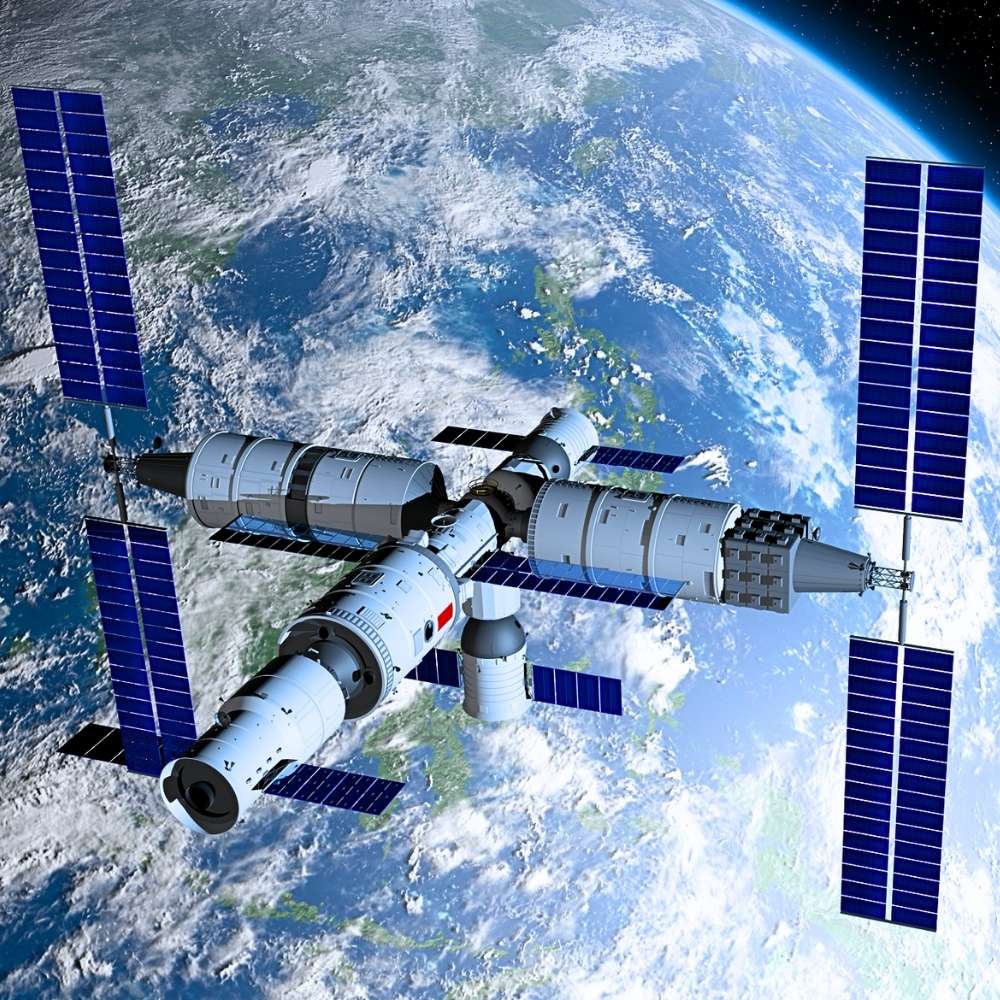
Station Architecture – A Modular Design
Tiangong follows a classic modular space station design.
Core Module
Tianhe (“Harmony of the Heavens”)
Provides:
Living quarters
Life-support systems
Guidance and propulsion
Power and communications
Experiment Modules
Wentian – Focus on life sciences and biotechnology
Mengtian – Focus on materials science and microgravity physics
Together, the three modules form a T-shaped configuration.
Why Low Earth Orbit Was Chosen
Tiangong operates in low Earth orbit for several reasons:
Reduced launch energy requirements
Easier crew and cargo access
Lower communication latency
Proven environment for human spaceflight
LEO also allows:
Frequent resupply missions
Rapid crew rotation
Safe emergency return options
This orbit choice prioritizes operational safety and sustainability.
Crewed Operations – Life Aboard Tiangong
Tiangong supports:
Long-duration missions (~6 months)
Three-person crews as standard
Overlapping crews during rotation phases
Astronauts (taikonauts) conduct:
Scientific experiments
Station maintenance
Technology demonstrations
The station is designed for continuous human presence, not short visits.
Cargo and Crew Transportation
Tiangong relies on a dedicated launch and transport ecosystem.
Shenzhou spacecraft – Crew transport
Tianzhou spacecraft – Cargo resupply
This mirrors the ISS model but remains fully independent:
Chinese launch vehicles
Chinese spacecraft
Chinese mission control
End-to-end autonomy is a central design goal.
Scientific Focus – What Tiangong Studies
Tiangong supports experiments in:
Microgravity physics
Human physiology
Life sciences and biotechnology
Fluid dynamics
Materials science
Space medicine
The station is optimized for repeatable, long-term experiments, not one-off demonstrations.
Why Tiangong Is Strategically Important
Tiangong represents:
Technological independence
Long-term human spaceflight capability
A platform for international collaboration under Chinese leadership
It ensures that even after the ISS retires, continuous human research in orbit will continue.
Scientific Research on Tiangong – What Is Being Studied
Tiangong is not symbolic infrastructure; it is an active orbital laboratory with a focused research agenda.
Key Research Domains
Life Sciences & Space Medicine
Effects of long-duration microgravity on the human body
Bone density, muscle atrophy, and cardiovascular changes
Cellular and molecular biology experiments
Biotechnology
Protein crystal growth
Gene expression in microgravity
Plant growth and seed experiments
Microgravity Physics
Fluid behavior without gravity
Combustion and flame dynamics
Granular materials and soft matter
Materials Science
Alloys and composite formation
Semiconductor crystal growth
Advanced materials processing
These experiments require continuous crew presence, making a permanent station essential.
External Experiment Platforms – Science Outside the Station
Tiangong includes exterior experiment racks, allowing instruments to be mounted outside the pressurized modules.
These platforms support:
Space environment exposure experiments
Radiation measurement
Astrophysics and Earth observation payloads
External platforms allow experiments to interact directly with:
Vacuum
Solar radiation
Atomic oxygen
This expands Tiangong’s scientific reach beyond internal labs.
Earth Observation Capabilities
From low Earth orbit, Tiangong supports Earth-focused research:
Atmospheric monitoring
Climate-related observations
Natural disaster tracking
While not a dedicated Earth-observation satellite, the station provides:
Flexible instrument hosting
Human-assisted calibration
Targeted observation opportunities
Human presence allows adaptive observation, something automated satellites cannot do.
Tiangong vs International Space Station (ISS)
Structural and Operational Comparison
| Feature | Tiangong (CSS) | International Space Station |
|---|---|---|
| Operators | China (CNSA) | Multinational (NASA, Roscosmos, ESA, JAXA, CSA) |
| Mass | ~100 tons | ~420 tons |
| Modules | 3 main modules | 15+ modules |
| Orbit Inclination | ~41.5° | ~51.6° |
| Crew Size | 3 (up to 6 temporarily) | 6–7 |
| Design Philosophy | Compact, optimized | Large, evolving |
Interpretation
Tiangong emphasizes efficiency and autonomy, while the ISS represents international scale and complexity.
Technological Innovations on Tiangong
Tiangong incorporates modern design lessons learned from earlier stations.
Notable features include:
Highly automated systems
Robotic arms for module manipulation and maintenance
Efficient power management
Streamlined module integration
Its robotic arm system enables:
Payload handling
External maintenance support
Reduced astronaut workload
Automation is central to long-term sustainability.
International Participation – A New Model
Tiangong is open to international scientific collaboration, but under a different framework than the ISS.
Key aspects:
Experiments selected through international proposals
Collaboration via the United Nations Office for Outer Space Affairs (UNOOSA)
Payloads from multiple countries approved for flight
This positions Tiangong as:
A global research platform
Operated under Chinese leadership
Independent of ISS governance structures
Why Tiangong Matters After the ISS Era
The ISS is approaching retirement in the 2030s.
Tiangong ensures:
Continued human presence in low Earth orbit
Ongoing microgravity research
A platform for future international missions
It represents a continuity bridge between the ISS era and future commercial or deep-space stations.
Operational Reliability and Long-Term Vision
Tiangong is designed for:
Decade-long operation
Regular crew rotation
Modular upgrade potential
This reflects a shift from experimental missions to routine orbital operations.
Future Plans – How Long Tiangong Will Operate
Tiangong is not a short-term project.
It is designed for long-duration operation, extending well into the 2030s and potentially beyond.
Planned objectives include:
Continuous crewed missions with 6-month rotations
Expansion of onboard scientific payloads
Regular international experiment campaigns
Technology testing for future deep-space missions
China has stated that Tiangong will remain operational as long as it remains safe and scientifically productive.
Safety and Sustainability in Orbit
Operating a permanent station in low Earth orbit requires careful risk management.
Key Safety Measures
Collision avoidance maneuvers
Continuous space debris tracking
Redundant life-support and power systems
Autonomous fault detection
Tiangong regularly performs:
Orbital adjustments to avoid debris
System health checks without crew intervention
This reflects modern station design, where automation reduces human risk.
Orbital Debris and End-of-Life Planning
China has publicly committed to:
Responsible orbital operations
Controlled deorbit planning at end of life
Minimizing long-term debris generation
Like the ISS, Tiangong is expected to:
Re-enter Earth’s atmosphere in a controlled manner
Avoid uncontrolled breakup risks
Orbital sustainability is now a core requirement, not an afterthought.
Tiangong’s Role in Future Human Spaceflight
Tiangong is more than a destination—it is a training ground.
It supports:
Long-duration crew health studies
Life-support system validation
Operational experience for future missions
This experience feeds directly into:
Lunar orbital stations
Crewed lunar surface missions
Long-duration deep-space exploration
In this sense, Tiangong is part of a larger roadmap, not an endpoint.
Frequently Asked Questions (FAQ)
1. Is Tiangong the same as the International Space Station?
No. Tiangong is independently built and operated by China. It is smaller, more compact, and fully autonomous.
2. Is Tiangong permanently crewed?
Yes. Tiangong is designed for continuous human presence with rotating crews, similar to the ISS model.
3. Can other countries send astronauts to Tiangong?
Potentially yes. International participation is possible through approved scientific collaborations, primarily coordinated via the United Nations framework.
4. How is Tiangong supplied with food and equipment?
Cargo is delivered using Tianzhou spacecraft, while crew are transported by Shenzhou spacecraft.
5. What happens to Tiangong when it reaches the end of its life?
Plans include a controlled deorbit to safely dispose of the station and avoid creating space debris.
6. Will Tiangong replace the ISS globally?
No. Tiangong does not replace the ISS politically or structurally, but it ensures continued human presence in orbit after the ISS era.
Why Tiangong Matters in Global Space History
Tiangong marks several historical milestones:
China’s first long-term space station
Independent mastery of human spaceflight infrastructure
A shift toward multi-polar human presence in orbit
It signals that:
Human activity in space is no longer limited to one alliance
Orbital research will continue beyond the ISS
Space stations are becoming routine infrastructure, not rare achievements
What We Would Lose Without Tiangong
Without Tiangong:
Continuous human research in orbit would rely on a single aging station
Opportunities for international experiments would narrow
Redundancy in human spaceflight would decrease
Tiangong adds resilience to humanity’s presence in space.
Related Topics for Universe Map
International Space Station (ISS)
Low Earth Orbit (LEO)
Human Spaceflight
Shenzhou Spacecraft
Tianzhou Cargo Vehicle
Future Lunar Space Stations
Together, these topics explain how humanity is learning to live and work beyond Earth.
Final Perspective
Tiangong is not built to impress—it is built to last.
Quietly orbiting above Earth, it supports science, trains crews, and prepares the next phase of human exploration. Its greatest achievement is not a single experiment or record, but the normalization of permanent human presence in space.
As the ISS era gradually ends, Tiangong ensures that humanity does not step back from orbit—but moves forward with experience, continuity, and purpose.