





Titan
Saturn’s Moon That Feels Like a Planet
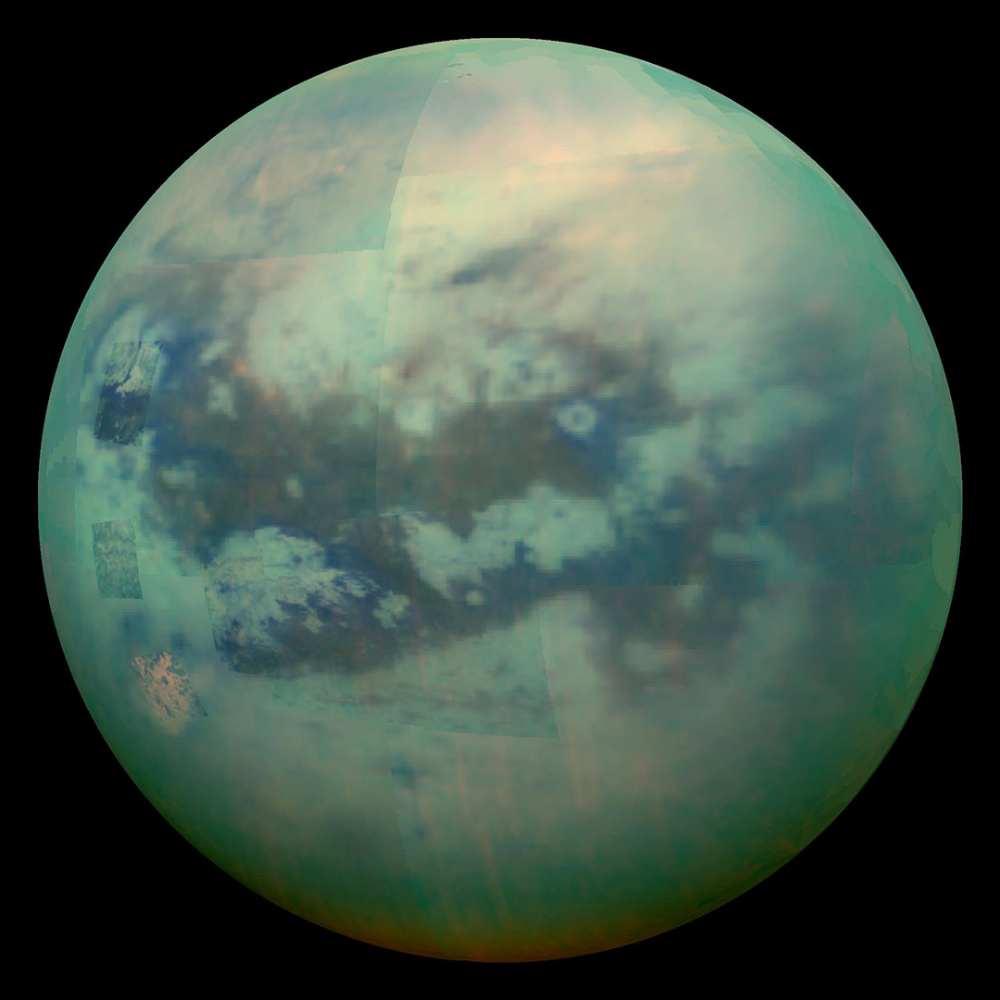
Quick Reader
| Attribute | Details |
|---|---|
| Name | Titan |
| Parent Planet | Saturn |
| Type | Natural satellite |
| Discovery Date | 25 March 1655 |
| Discoverer | Christiaan Huygens |
| Diameter | ~5,150 km |
| Rank | 2nd largest moon in the Solar System |
| Larger Than | Planet Mercury (by diameter) |
| Density | ~1.88 g/cm³ |
| Surface Gravity | ~14% of Earth |
| Atmosphere | Thick (nitrogen-dominated) |
| Surface Liquids | Liquid methane & ethane |
| Surface Temperature | ~−179°C |
| Major Missions | Cassini–Huygens |
| Unique Feature | Only moon with stable surface liquids |
Introduction to Titan – A Moon That Breaks Every Rule
Titan is not just Saturn’s largest moon—it is one of the most planet-like worlds in the entire Solar System. With a thick atmosphere, stable liquids on its surface, complex chemistry, and weather cycles, Titan behaves more like a small planet than a moon.
In fact, if Titan orbited the Sun directly instead of Saturn, it would likely be classified as a planet.
Titan forces scientists to rethink what defines a world—not by size alone, but by processes, chemistry, and complexity.
Discovery of Titan
Titan was discovered in 1655 by Christiaan Huygens, making it one of the earliest known moons.
Key discovery context:
Identified as a bright companion to Saturn
Later confirmed to be unusually large
Recognized early as distinct from other moons
Titan’s true nature, however, remained hidden for centuries due to its thick atmosphere.
Size and Planet-Like Status
Titan is the second-largest moon in the Solar System, surpassed only by Jupiter’s moon Ganymede.
Key size facts:
Larger than Mercury in diameter
More massive than Pluto and Eris
Spherical and internally differentiated
Despite its size, Titan is officially a moon only because it orbits Saturn.
Titan’s Thick Atmosphere – A Rare Feature for a Moon
Titan is the only moon in the Solar System with a dense atmosphere.
Atmospheric composition:
~98% nitrogen
Methane and hydrogen
Complex organic aerosols
This atmosphere is thicker than Earth’s and plays a central role in Titan’s surface chemistry and climate.
A World Hidden Beneath Haze
Titan’s atmosphere is filled with photochemical haze, which blocks visible light.
Consequences:
Surface invisible to optical telescopes
Radar required for surface mapping
Orange appearance in images
Only with the Cassini mission did Titan’s surface finally come into focus.
The Methane Cycle – Titan’s Alien Weather System
Titan hosts a full methane-based weather cycle, analogous to Earth’s water cycle.
Processes include:
Methane evaporation
Cloud formation
Rainfall
River erosion
Lake and sea accumulation
This makes Titan the only known world besides Earth with stable surface liquids and active erosion.
Lakes, Seas, and River Networks
Radar observations revealed:
Large methane–ethane seas near the poles
Smaller lakes scattered across high latitudes
River channels carved into ice bedrock
Some Titan seas are larger than Earth’s Great Lakes.
Surface Composition – Ice as Rock
At Titan’s temperatures:
Water ice behaves like rock
Methane and ethane behave like liquids
Titan’s landscape is shaped by:
Ice mountains
Hydrocarbon dunes
Cryovolcanic features (possible)
Titan’s geology operates under completely different physical rules than Earth.
Internal Structure of Titan
Titan is internally layered.
Likely structure:
Rocky core
High-pressure ice layers
Subsurface liquid water ocean
Icy crust
This internal ocean may exist beneath tens of kilometers of ice.
Why Titan Matters in Planetary Science
Titan is important because it:
Demonstrates complex chemistry without life
Shows how atmospheres evolve on cold worlds
Acts as a natural laboratory for prebiotic chemistry
Blurs the line between planets and moons
Titan may resemble conditions on early Earth more closely than any other world.
Why Titan Matters (Big-Picture Context)
Titan shows that planetary complexity does not depend on being close to the Sun. Chemistry, atmosphere, and energy sources can create rich, dynamic environments even in deep cold. By studying Titan, scientists gain insight into how habitable ingredients may arise long before life itself.
Cassini–Huygens – Revealing Titan’s True Surface
Titan remained a mystery until the Cassini–Huygens mission, which transformed it from a hazy orb into a fully mapped world.
Key milestones:
Huygens probe (2005) descended through Titan’s atmosphere
First landing on a moon in the outer Solar System
Cassini radar mapped the surface through thick haze
Huygens revealed a landscape shaped by erosion, sediment transport, and weather, confirming Titan as an active world.
What Huygens Found on the Surface
The landing site showed:
Rounded ice “pebbles” shaped by liquid flow
Evidence of recent methane rainfall
A solid surface beneath the probe
This confirmed that Titan’s surface processes are ongoing, not ancient relics.
Titan’s Methane Climate – Seasonal and Dynamic
Titan’s climate is driven by methane, not water.
Key climate traits:
Polar lakes and seas expand and shrink with seasons
Methane clouds form preferentially near the poles and equator
Rainfall can cause sudden flooding events
Seasons on Titan last about 7 Earth years, producing long-term climate cycles.
Dunes, Plains, and Mountains
Cassini radar mapped Titan’s major terrains.
Main surface types include:
Vast equatorial dune fields made of organic grains
Smooth plains shaped by rainfall and sediment
Mountainous regions of water-ice bedrock
Titan’s dunes are comparable in scale to Earth’s largest deserts.
Cryovolcanism – Does Titan Have Ice Volcanoes?
Cryovolcanism on Titan remains debated.
Possible indicators:
Dome-like structures
Flow-like features
Localized methane replenishment sources
If confirmed, cryovolcanism could provide a mechanism for moving material between Titan’s interior and surface.
Titan’s Subsurface Ocean – A Hidden Water World
Multiple measurements suggest Titan hosts a global subsurface ocean.
Evidence includes:
Gravity field data
Tidal deformation
Rotation behavior
This ocean likely consists of liquid water mixed with ammonia, kept warm by internal heat.
Habitability – Chemistry Without Biology
Titan is not habitable in an Earth-like sense, but it is chemically rich.
Key points:
Surface temperatures too cold for liquid water
Subsurface ocean could support chemistry
Atmosphere produces complex organic molecules
Titan may resemble prebiotic Earth, offering insight into the early stages of chemical evolution.
Titan vs Earth vs Venus – A Comparative Perspective
| Feature | Titan | Earth | Venus |
|---|---|---|---|
| Atmosphere | Thick, nitrogen-rich | Nitrogen–oxygen | Thick CO₂ |
| Surface Liquids | Methane & ethane | Water | None |
| Surface Temperature | ~−179°C | ~15°C | ~465°C |
| Weather Cycle | Methane-based | Water-based | Sulfuric acid clouds |
| Habitability | Chemical, prebiotic | Biological | Hostile |
Interpretation:
Titan, Earth, and Venus demonstrate that atmospheres drive planetary destiny, not size alone.
Why Titan Is Unique Among Moons
Titan stands apart because it:
Has a stable atmosphere
Hosts surface liquids
Exhibits climate-driven erosion
Contains a subsurface ocean
No other moon combines all these traits.
Limits of Our Current Knowledge
Despite Cassini’s success, many questions remain:
Exact composition of Titan’s organic dunes
Depth and chemistry of the subsurface ocean
Long-term stability of methane supply
Frequency of large rainfall events
Titan remains a world of known complexity and unknown depth.
Why Titan Matters (Interpretive Perspective)
Titan proves that planetary-style systems can emerge in unexpected places. With climate, chemistry, and geology operating together, Titan shows how worlds can become complex long before life appears—reshaping how scientists search for habitability beyond Earth.
The Long-Term Future of Titan
Titan’s future is tightly linked to the fate of its atmosphere and methane cycle. Over very long timescales, Titan is expected to remain active longer than most moons due to its thick atmosphere and internal heat.
In the distant future:
Methane will gradually be broken down by sunlight
Surface lakes may shrink or migrate
Atmospheric chemistry will continue producing complex organics
Without replenishment, Titan’s methane cycle may eventually weaken—but not for hundreds of millions of years.
Will Titan Ever Lose Its Atmosphere?
Titan’s atmosphere is surprisingly stable.
Key reasons:
Strong gravity for a moon
Cold temperatures slowing atmospheric escape
Continuous recycling of nitrogen
Titan is likely to retain its atmosphere far longer than Mars did, making it exceptional among moons.
Titan vs Other Major Moons – Planet-Like Comparison
This table shows why Titan stands apart.
| Feature | Titan | Europa | Ganymede | Triton |
|---|---|---|---|---|
| Atmosphere | Thick | None | Thin | Thin |
| Surface Liquids | Methane/ethane | None | None | Nitrogen (seasonal) |
| Weather Cycle | Yes | No | No | Limited |
| Subsurface Ocean | Yes | Yes | Yes | Possible |
| Planet-like Behavior | Very high | Moderate | Moderate | Moderate |
Interpretation:
Titan is the most Earth-like in behavior, even though it is chemically alien.
Titan and the Search for Life
Titan expands the concept of habitability.
While surface life is unlikely:
Subsurface ocean may support chemistry
Organic molecules are abundant
Energy gradients exist
Titan helps scientists explore whether life could exist using non-water surface chemistry, a radical but important idea.
Dragonfly Mission – Titan’s Next Chapter
NASA’s Dragonfly mission will transform Titan science.
Mission goals:
Explore Titan’s surface using a flying drone
Analyze organic chemistry directly
Study prebiotic processes
Dragonfly represents the first mission designed to move freely across another moon’s surface.
Why Titan Is Central to Astrobiology
Titan is essential because it:
Hosts prebiotic chemistry without life
Separates chemistry from biology
Shows how atmospheres enable complexity
Expands habitability concepts beyond Earth
Titan is not a “second Earth”—it is a second pathway.
Frequently Asked Questions (FAQ)
Is Titan larger than Mercury?
Yes. Titan is larger than Mercury in diameter, though Mercury is more massive.
Can humans walk on Titan?
In theory, yes. Titan’s low gravity and thick atmosphere would make walking easier—but the extreme cold and lack of oxygen make it uninhabitable without protection.
Does Titan have rain?
Yes. Titan experiences methane rain, which shapes rivers, lakes, and landscapes.
Is Titan habitable?
Not for Earth-like life. However, Titan is one of the best places to study prebiotic chemistry.
Why is Titan orange?
Titan’s atmosphere contains complex organic haze particles formed by sunlight breaking down methane.
Has Titan been fully explored?
No. Cassini–Huygens provided detailed data, but vast regions remain unexplored. Dragonfly will greatly expand our understanding.
Titan’s Place in the Universe Map
Within the Universe Map framework, Titan represents:
The most planet-like moon
A natural laboratory for prebiotic chemistry
A bridge between planetary science and astrobiology
Proof that complexity does not require warmth
Titan anchors the concept that worlds evolve through processes, not labels.
Final Thoughts
Titan is not just Saturn’s moon—it is one of the most extraordinary worlds ever discovered. With weather, chemistry, and landscapes shaped by alien rules, Titan shows how nature builds complexity in unexpected ways.
Far from the Sun, beneath an orange sky, Titan continues its slow orbit—quietly redefining what a world can be.