





Titania
The Largest Moon of Uranus and a Frozen Archive of the Outer Solar System
Quick Reader
| Attribute | Details |
|---|---|
| Name | Titania |
| Parent Planet | Uranus |
| Type | Natural satellite |
| Discovery Date | 11 January 1787 |
| Discoverer | William Herschel |
| Diameter | ~1,578 km |
| Mean Radius | ~789 km |
| Mass | ~3.5 × 10²¹ kg |
| Density | ~1.71 g/cm³ |
| Orbital Distance | ~436,000 km |
| Orbital Period | ~8.7 Earth days |
| Rotation | Tidally locked |
| Surface Composition | Water ice, rock, possible ammonia |
| Atmosphere | None detected |
| Geological Features | Canyons, faults, impact craters |
| Spacecraft Visit | Voyager 2 (1986) |
Introduction to Titania – Uranus’s Quiet Giant
Titania is the largest moon of Uranus and one of the least understood major moons in the Solar System. While moons like Europa, Enceladus, and Triton draw attention for their dramatic activity, Titania represents a different category of world: large, ancient, and geologically subtle.
Orbiting a planet already tilted on its side, Titania exists in an extreme environment where seasons last decades and sunlight arrives at unusual angles. Despite this, Titania preserves evidence of early internal activity, recorded in its fractured surface and global tectonic features.
Titania is not a moon of spectacle—but it is a moon of record.
Discovery of Titania
Titania was discovered in 1787 by William Herschel, just six years after he discovered Uranus itself.
Key discovery context:
Detected with early telescopic technology
Identified alongside Oberon
Named later by John Herschel
Titania’s name comes from Queen Titania in Shakespeare’s A Midsummer Night’s Dream, continuing the literary tradition of Uranian moon names.
Titania’s Orbit and Tidal Locking
Titania follows a nearly circular orbit around Uranus and is tidally locked, meaning it always shows the same face to its planet.
Key orbital properties:
Orbital period equals its rotation period
Stable, long-term orbit
Minimal orbital eccentricity
This tidal locking has shaped Titania’s thermal and geological evolution by limiting tidal heating compared to moons of Jupiter and Saturn.
Size and Internal Composition
Titania is the eighth-largest moon in the Solar System and large enough to be internally differentiated.
Based on density estimates:
Roughly equal parts rock and water ice
Rocky core beneath an icy mantle
Possible past subsurface ocean
Its size places Titania in the same structural category as moons like Oberon and Rhea, though with unique tectonic signatures.
Surface Composition – Ice Dominates
Spectroscopic observations indicate Titania’s surface is dominated by water ice, mixed with darker material likely composed of complex organics.
Surface traits include:
Bright icy plains
Darker regions shaped by impacts
Minimal volatile ices such as nitrogen or methane
Unlike Pluto or Triton, Titania does not show evidence of volatile migration or seasonal surface renewal.
Evidence of Ancient Geological Activity
Titania’s surface is heavily cratered, but not uniformly ancient.
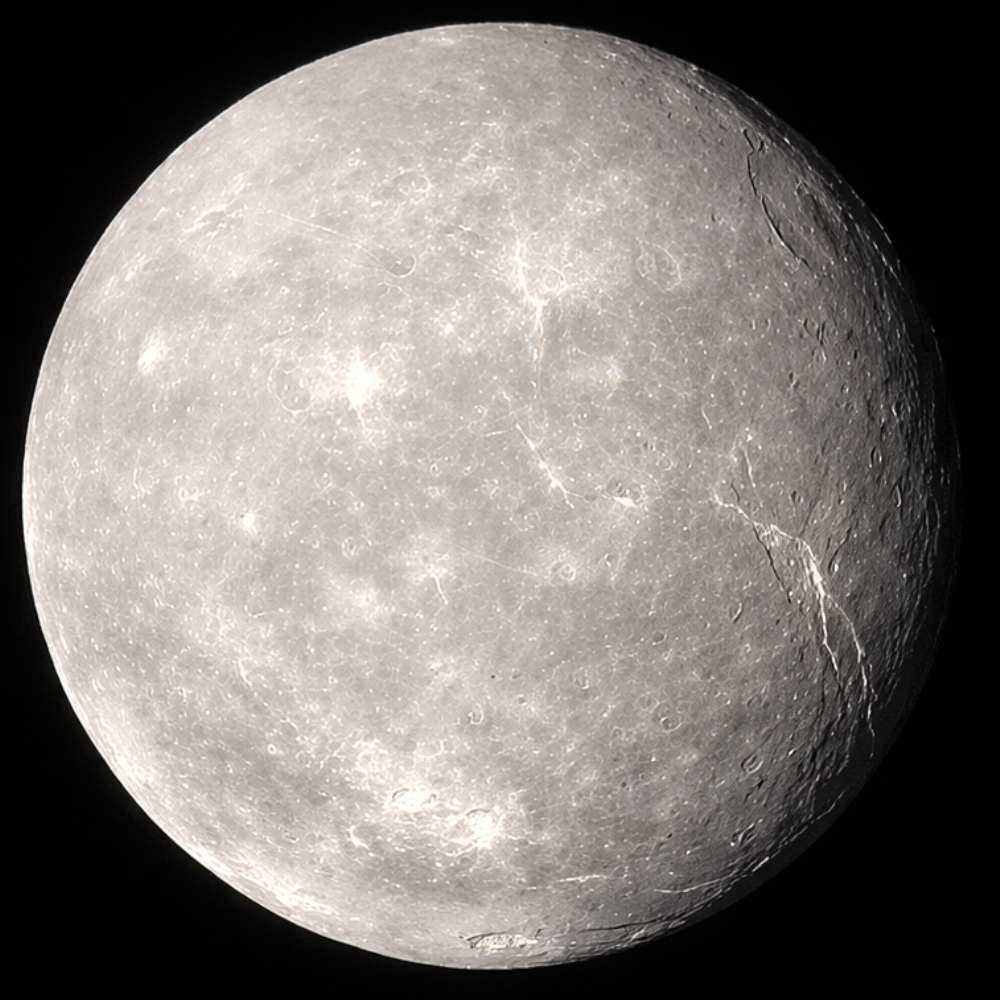
Voyager 2 images revealed:
Vast canyon systems
Fault scarps extending hundreds of kilometers
Regions resurfaced after major impacts
These features suggest Titania experienced internal expansion, likely caused by partial freezing of an early subsurface ocean.
Canyons and Tectonic Fractures
Titania hosts some of the largest known canyon systems among Uranian moons.
These canyons:
Cut deeply into the crust
Likely formed from extensional stress
Indicate global tectonic forces
Such features imply that Titania was once warm enough internally for large-scale structural change.
Titania Compared to Other Uranian Moons
Among Uranus’s major moons:
Titania is the largest
Oberon is slightly smaller but more heavily cratered
Ariel shows more resurfacing
Umbriel is darker and more ancient
Titania sits in the middle—neither the most active nor the most inert.
Why Titania Matters in Planetary Science
Titania is important because it:
Preserves early Uranian system history
Shows evidence of ancient internal evolution
Represents mid-sized icy moon behavior
Lacks strong tidal heating, isolating internal processes
By studying Titania, scientists can understand how icy moons evolve without strong external energy sources.
Why Titania Matters (Big-Picture Context)
Titania demonstrates that geological complexity does not require dramatic present-day activity. Even in quiet, distant systems, large moons can record ancient oceans, tectonic stress, and thermal evolution—providing a long-term archive of how icy worlds mature and cool over time.
Titania’s Internal Evolution – Did It Once Hide an Ocean?
Although Titania appears quiet today, multiple lines of evidence suggest it may once have hosted a subsurface ocean early in its history.
Key indicators include:
Large-scale extensional tectonics
Global canyon systems
Surface expansion consistent with internal freezing
As Titania cooled, a liquid water layer—possibly mixed with ammonia—may have gradually frozen. Because water expands as it freezes, this process would have cracked the crust, producing the canyon networks seen today.
The Role of Ammonia as an Antifreeze
Ammonia is a critical ingredient in icy moon evolution.
If present within Titania:
It would lower the freezing point of water
Allow liquid layers to persist longer
Enable tectonic activity at lower temperatures
Spectral hints of ammonia-bearing compounds strengthen the case that Titania’s internal evolution was chemically assisted, not purely thermal.
Why Titania Lacks Ongoing Activity
Unlike moons such as Europa or Enceladus, Titania lacks a continuous energy source.
Limiting factors include:
Minimal tidal heating from Uranus
A near-circular orbit
Gradual loss of internal heat
Once its internal ocean froze completely, Titania transitioned into a geologically dormant state, preserving ancient features rather than renewing them.
Impact Cratering and Surface Age
Titania’s surface shows a wide range of crater densities.
This implies:
Some regions are extremely ancient
Others were resurfaced after tectonic events
Major geological activity ended billions of years ago
Titania thus records both early bombardment history and later internal processes.
Titania vs Oberon – A Comparative View
Titania is often compared to Oberon, Uranus’s second-largest moon. While similar in size, their surfaces tell different stories.
| Feature | Titania | Oberon |
|---|---|---|
| Diameter | ~1,578 km | ~1,523 km |
| Geological Activity | Evidence of ancient tectonics | Mostly inert |
| Canyon Systems | Large and widespread | Limited |
| Surface Age | Mixed (ancient + resurfaced) | Predominantly ancient |
| Internal Evolution | Likely differentiated | Less evidence of differentiation |
Although both moons formed under similar conditions, Titania appears to have experienced greater internal change, possibly due to slightly higher initial heat or compositional differences.
Titania Among the Uranian Moons
Within Uranus’s moon system:
Ariel shows the strongest resurfacing
Umbriel is the darkest and most ancient
Oberon preserves early bombardment
Titania balances tectonic history with long-term stability
Titania occupies a middle evolutionary position, making it ideal for comparative studies.
Voyager 2 – A Limited but Crucial Snapshot
All current knowledge of Titania’s surface comes from Voyager 2’s 1986 flyby.
Limitations include:
Only one hemisphere imaged in detail
Low-resolution coverage of many regions
No long-term monitoring
As a result, large portions of Titania remain geologically unexplored.
Why Titania Still Holds Major Unknowns
Open questions include:
Did Titania truly host a subsurface ocean?
How long did internal activity persist?
What is the exact role of ammonia?
What lies on the unseen hemisphere?
These uncertainties make Titania a high-priority target for future Uranus missions.
Why Titania Matters (Interpretive Perspective)
Titania shows that icy moons do not need extreme tidal heating to evolve. Internal chemistry, size, and early thermal history alone can generate tectonic complexity—leaving behind frozen records that persist for billions of years.
The Long-Term Future of Titania
Titania’s future is defined by stability rather than change. With no significant tidal heating and limited internal energy, Titania is expected to remain geologically inactive for the rest of the Solar System’s lifetime.
Over very long timescales:
Its orbit around Uranus will remain stable
No new tectonic features will form
Existing canyons and fractures will slowly erode through impacts
Titania will continue to function as a preserved geological archive, not an evolving world.
Will Titania Ever Become Active Again?
There is no realistic mechanism that could restart geological activity on Titania.
Key reasons:
Uranus provides negligible tidal heating
Titania lacks strong orbital eccentricity
Internal heat has long dissipated
Any subsurface ocean that once existed is almost certainly frozen solid. Titania has crossed the threshold from evolution to preservation.
Titania vs Other Major Icy Moons (Contextual Comparison)
This comparison highlights where Titania fits among well-known icy moons.
| Feature | Titania | Europa | Enceladus | Triton |
|---|---|---|---|---|
| Parent Planet | Uranus | Jupiter | Saturn | Neptune |
| Diameter | ~1,578 km | ~3,122 km | ~504 km | ~2,706 km |
| Tidal Heating | Very weak | Strong | Very strong | Moderate (past) |
| Subsurface Ocean | Possible (past) | Confirmed | Confirmed | Possible (past) |
| Geological Activity Today | No | Yes | Yes | Limited |
| Surface Renewal | Ancient | Ongoing | Ongoing | Episodic |
Interpretation:
Titania represents what happens when a moon is large enough to evolve, but lacks the energy to remain active long-term.
Titania vs Oberon vs Ariel (Uranian Moons Comparison)
| Feature | Titania | Oberon | Ariel |
|---|---|---|---|
| Size Rank | Largest | Second-largest | Fourth |
| Surface Age | Mixed | Very old | Younger |
| Tectonic Features | Extensive | Limited | Strong |
| Resurfacing | Moderate (ancient) | Minimal | Significant |
| Geological Role | Transitional | Fossil record | Most active |
Titania sits between extremes, making it the most informative Uranian moon for studying internal evolution without extreme resurfacing.
Why Titania Is Important for Uranus Missions
Future missions to Uranus often focus on the planet itself—but Titania is a critical scientific target.
Studying Titania could:
Confirm or rule out ancient subsurface oceans
Reveal how Uranian moons formed together
Provide context for Uranus’s unusual axial tilt
Improve models of icy moon cooling
Titania is especially valuable because it preserves early conditions without later overprinting.
Frequently Asked Questions (FAQ)
What is Titania?
Titania is the largest moon of Uranus and one of the major icy moons of the outer Solar System.
Is Titania geologically active today?
No. Titania shows no evidence of present-day geological activity.
Did Titania once have an ocean?
Possibly. Geological features suggest Titania may have hosted a subsurface ocean early in its history, which later froze.
Why does Titania have giant canyons?
The canyons likely formed when Titania’s interior expanded as liquid water froze, cracking the icy crust.
Why is Titania less active than Europa or Enceladus?
Titania lacks strong tidal heating, which is the main energy source driving activity on Europa and Enceladus.
Has Titania been fully explored?
No. Only one hemisphere was imaged in detail by Voyager 2, leaving much of Titania unexplored.
Could Titania support life?
There is no evidence that Titania ever had conditions suitable for life, especially today.
Titania’s Place in the Universe Map
Within the Universe Map framework, Titania represents:
A large icy moon without ongoing tidal heating
A record of ancient internal evolution
A transitional body between active and inert moons
A key piece of the Uranian system puzzle
Titania helps explain how icy worlds cool, fracture, and stabilize over billions of years.
Final Thoughts
Titania is not dramatic—but it is deeply informative. Its frozen surface records a time when internal heat, chemistry, and size briefly aligned to shape a complex world. Today, those processes are silent, leaving behind a planetary archive written in ice and stone.
Far from the Sun, orbiting a sideways planet, Titania remains one of the Solar System’s most valuable quiet witnesses.