



Tonantzintla 618 (Most Massive Black Hole)
A Contender for the Most Massive Black Hole Ever Measured
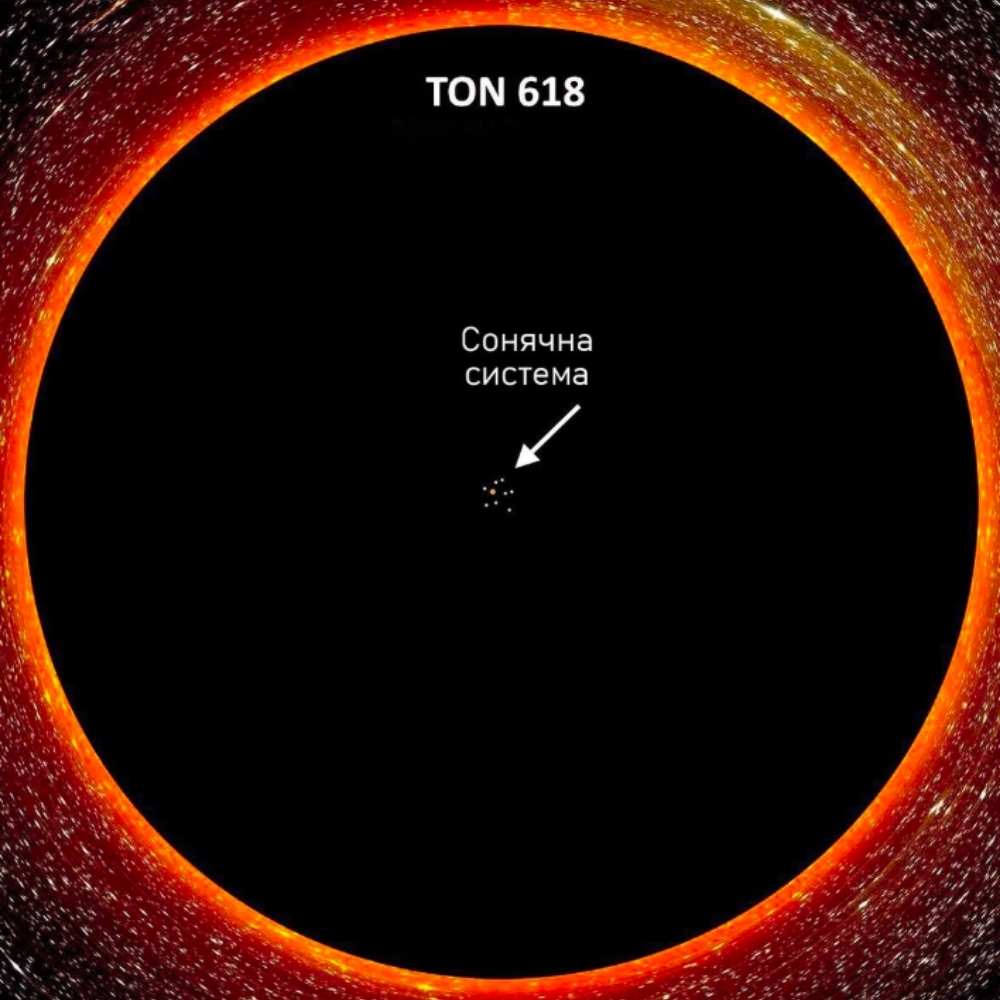
TON 618 3D Map
Explore a record-breaking black hole.
Step inside TON 618 with a fast, interactive 3D visualization built for learning and smooth navigation. Below is an animated illustration inspired by the system’s accretion disk and deep-space glow—then one click opens the full, interactive map.
Quick Reader
TON 618| Attribute | Details |
|---|---|
| Name | Tonantzintla 618 (also known as Ton 618) |
| Type | Hyperluminous quasar with ultramassive black hole |
| Object Class | Quasar (Active Galactic Nucleus) |
| Location (RA/Dec) | RA: 12h 28m 24.5s, Dec: +31° 28′ 38″ |
| Constellation | Canes Venatici |
| Distance from Earth | ~10.4 billion light-years |
| Redshift (z) | ~2.219 |
| Black Hole Mass | Estimated ~66 billion solar masses (M☉) |
| Host Galaxy | Not resolved; obscured by quasar brightness |
| Discovery | Identified as a quasar in the 1970s |
| Detection Methods | Optical spectra, emission line broadening, and quasar luminosity |
| Significance | Among the most massive black holes ever discovered |
| Observation Tools | Multiple optical telescopes and SDSS follow-ups |
| Mass Estimation Technique | Virial method using Hβ line and quasar continuum |
| Challenges | Brightness outshining host; distant and high-redshift |
Introduction – A Black Hole of Unimaginable Scale
The cosmos is filled with black holes — from the stellar remnants of collapsed stars to the supermassive giants lurking at galaxy centers. But few compare in sheer mass to Tonantzintla 618, or Ton 618 — a quasar powered by one of the largest black holes ever discovered.
With an estimated mass of around 66 billion times the mass of the Sun, Ton 618’s central black hole is not just supermassive — it's ultramassive, possibly exceeding the mass of entire galaxy groups. Its existence stretches the boundaries of what we thought black holes could become, especially considering it formed just a few billion years after the Big Bang.
What Is Tonantzintla 618?
Ton 618 is a hyperluminous quasar, meaning it is a type of active galactic nucleus (AGN) where a supermassive black hole is accreting vast amounts of material, emitting intense radiation across the electromagnetic spectrum.
-
Redshift z = 2.219
→ Seen as it was ~10.4 billion years ago - Apparent magnitude: ~15.9 (optical), very bright for such a distant object
- Luminosity: ~140 trillion times the Sun’s (L☉)
- Broad emission lines: Evidence of fast-moving gas near the black hole
- Continuum radiation: High UV output due to rapid accretion
Discovery and Classification
Ton 618 was originally cataloged in the Tonantzintla Survey in Mexico as a blue stellar object. But in the 1970s, spectroscopic follow-ups revealed broad emission lines and a high redshift — confirming it as a quasar.
- Hβ line broadening (emission line from hydrogen atoms near the black hole)
- Continuum luminosity at specific wavelengths
- Virial mass estimates using black hole mass scaling relations
Multi-Wavelength Insights
| Wavelength | What It Reveals |
|---|---|
| Optical | Morphology, disrupted arms, tidal tails |
| Infrared | Embedded star formation |
| Radio (HI, CO) | Gas content, intergalactic bridges |
| X-ray | Possible hot gas halo or merger shock fronts |
Together, these layers reveal the group's star-forming life cycle: gas-rich spirals are building stellar populations under gravitational stress, while lenticular galaxies like NGC 6771 represent the fading, passive phase of this cycle.
How Do Astronomers Estimate Its Mass?
The virial method is commonly used, which assumes:
- Gas near the black hole orbits it under gravitational force
- The velocity of gas is measured from the broadening of spectral lines (like Hβ)
- The distance of gas from the black hole is inferred from quasar brightness
- Combining these gives an estimate via the virial theorem
How Could Ton 618 Become So Massive?
One of the greatest mysteries surrounding Ton 618 is how it grew so large so early in the universe’s history. At z ~2.2, its light reaches us from a time when the universe was only ~3 billion years old.
Forming a 66-billion-solar-mass black hole in such a short cosmic time frame challenges even the most extreme growth models.
Possible Growth Scenarios:
Direct Collapse Black Hole (DCBH) Seed
Instead of forming from a stellar remnant, Ton 618’s black hole may have formed directly from a collapsing gas cloud, bypassing the initial small mass stage.
- Initial seed mass: ~10⁴–10⁵ M☉
- No fragmentation or star formation
- Collapse under special low-metallicity, high-UV background conditions
Super-Eddington Accretion
Typical black holes accrete at or below the Eddington Limit — the balance point between gravity and radiation pressure. But early black holes might have:
- Accreted above this limit for short periods
- Consumed massive inflows of gas from early galaxies
- Formed dense accretion disks that funneled material efficiently
Frequent Mergers in Proto-Clusters
In the dense environments of early galaxy clusters:
- Black holes may have merged frequently
- Galaxies may have funneled gas into their centers
- Ton 618 might sit at the heart of a massive proto-cluster that fed its growth
Is Ton 618 an Outlier or a Clue?
The existence of Ton 618 raises deeper questions:
- The extreme brightness of the quasar drowns out its host galaxy.
- Many such objects may be too redshifted or obscured to detect.
- Our current deep surveys only scratch the surface of the z > 2 quasar population.
What Would Ton 618 Look Like Up Close?
If we could observe Ton 618's environment in detail:
Could Ton 618 Be the Most Massive Black Hole Ever?
| Black Hole | Mass Estimate | Type | Notes |
|---|---|---|---|
| Ton 618 | ~66 billion M☉ | Quasar (AGN) | Highest confirmed via emission line scaling |
| Phoenix Cluster BCG | ~100 billion M☉ (model) | Brightest cluster galaxy | Indirect X-ray modeling, highly uncertain |
| SDSS J0100+2802 | ~12 billion M☉ | High-z quasar | Rapid growth, z = 6.3 |
| M87* (Event Horizon) | ~6.5 billion M☉ | Elliptical galaxy | First imaged black hole |
Ton 618’s mass is robustly estimated, giving it a special status — especially considering the clarity of the emission lines and the consistency across estimation methods.
Frequently Asked Questions (FAQ)
Fast answers about TON 618 — tap a question to expand.
What is Ton 618? Basics
Ton 618 is a hyperluminous quasar located over 10 billion light-years away. It hosts one of the largest black holes ever discovered, with a mass estimated at ~66 billion times that of the Sun.
How was the mass of Ton 618’s black hole measured? Method
The mass was estimated using the virial method, based on:
- The width of emission lines (especially the Hβ line)
- The luminosity of the quasar’s continuum
- The assumption that gas in the broad-line region is gravitationally bound to the black hole
Is Ton 618 the most massive black hole known? Ranking
It is one of the most massive confirmed black holes, and possibly the largest with relatively direct emission-line based evidence. Some indirect models suggest larger black holes exist, but Ton 618 remains a best-documented ultramassive case.
Why can't we see Ton 618’s host galaxy? Visibility
The quasar is so bright that it outshines its host galaxy. At a distance of over 10 billion light-years, resolving the faint host requires extremely deep, high-resolution infrared imaging that is difficult with current observations.
How could Ton 618’s black hole have grown so large? Theory
Several theoretical explanations are discussed:
- Direct-collapse seed formation rather than a small stellar remnant
- Super-Eddington accretion in early dense gas environments
- Frequent mergers and large gas inflows in a proto-cluster environment
Its rapid growth remains a major puzzle in astrophysics.
Final Thoughts – A Titan from the Early Universe
Ton 618 stands as a cosmic outlier, but perhaps it is more than that — perhaps it is a harbinger of a hidden population of ultramassive black holes that helped sculpt the early universe.
- It pushes the limits of black hole formation models
- It raises new questions about galaxy–black hole co-evolution
- It serves as a benchmark for quasar luminosity and black hole scaling relationships
- It reminds us that the early universe was more dynamic and extreme than once imagined