





Triton
Neptune’s Largest and Most Unusual Moon
Quick Reader
| Attribute | Details |
|---|---|
| Name | Triton |
| Parent Planet | Neptune |
| Moon Type | Large irregular satellite |
| Discovery Year | 1846 |
| Discoverer | William Lassell |
| Mean Diameter | ~2,710 km |
| Radius | ~1,353 km |
| Rank | 7th largest moon in the Solar System |
| Average Orbital Distance | ~354,800 km |
| Orbital Period | ~5.88 Earth days |
| Orbital Direction | Retrograde (opposite Neptune’s rotation) |
| Orbital Shape | Nearly circular |
| Surface Composition | Nitrogen ice, methane ice, water ice |
| Atmosphere | Thin, seasonal nitrogen atmosphere |
| Surface Temperature | ~−235 °C |
| Geological Activity | Active cryovolcanism (observed) |
| Likely Origin | Captured Kuiper Belt object |
Key Points at a Glance
- Triton is the only large moon in the Solar System with a retrograde orbit, strongly indicating capture
- Its size and composition closely resemble Kuiper Belt dwarf planets like Pluto
- Voyager 2 detected active geysers, making Triton one of the coldest geologically active worlds known
- Triton’s capture likely destroyed Neptune’s original regular moon system
Introduction – A Moon That Does Not Belong
Among all the major moons in the Solar System, Triton stands apart.
While most large moons formed quietly from disks of material surrounding their parent planets, Triton follows a very different path. It orbits Neptune in the opposite direction of the planet’s rotation, a clear sign that it did not form where it is today.
This single orbital feature immediately places Triton in a rare category:
it is a captured world, not a native satellite.
Because of this, Triton provides a direct link between Neptune and the distant Kuiper Belt, offering scientists a chance to study an object that originated far beyond its current home.
Discovery – Found Almost Immediately After Neptune
Triton was discovered in October 1846, just 17 days after Neptune itself was identified.
Discoverer: William Lassell
Method: Optical telescopic observation
Its rapid discovery suggested Triton was:
Relatively large
Bright compared to Neptune’s other moons
Gravitationally bound closely to Neptune
At the time, however, nothing was known about its unusual orbit or origin.
Orbit – The Clearest Evidence of Capture
Triton’s orbit is the strongest evidence that it did not form around Neptune.
Key Orbital Characteristics
Retrograde motion
Nearly circular orbit today
Inclined relative to Neptune’s equator
A captured object would initially follow:
A highly elongated
Highly inclined
Energetically unstable orbit
Over time, tidal interactions with Neptune would remove energy, slowly circularizing Triton’s path and generating heat inside the moon.
This process likely played a major role in shaping Triton’s surface.
The Consequences of Triton’s Capture
Capturing a large object like Triton is not a gentle event.
Dynamical simulations suggest that when Triton was captured:
Neptune likely possessed a regular system of moons
Triton’s gravity destabilized those satellites
Many original moons were ejected or destroyed
This explains why Neptune today lacks:
Large regular moons like those of Jupiter or Saturn
A well-ordered satellite system
Triton effectively reset Neptune’s moon system.
Size, Mass, and Internal Structure
Triton is large enough to be fully spherical, indicating internal differentiation.
Key physical traits:
Diameter comparable to Pluto
Mixture of rock and ice
Dense enough to suggest a rocky core
These properties align closely with known Kuiper Belt objects, supporting the idea that Triton formed far from Neptune before being captured.
In many respects, Triton resembles a dwarf planet that never became independent.
Surface Composition – Exotic Ices in Extreme Cold
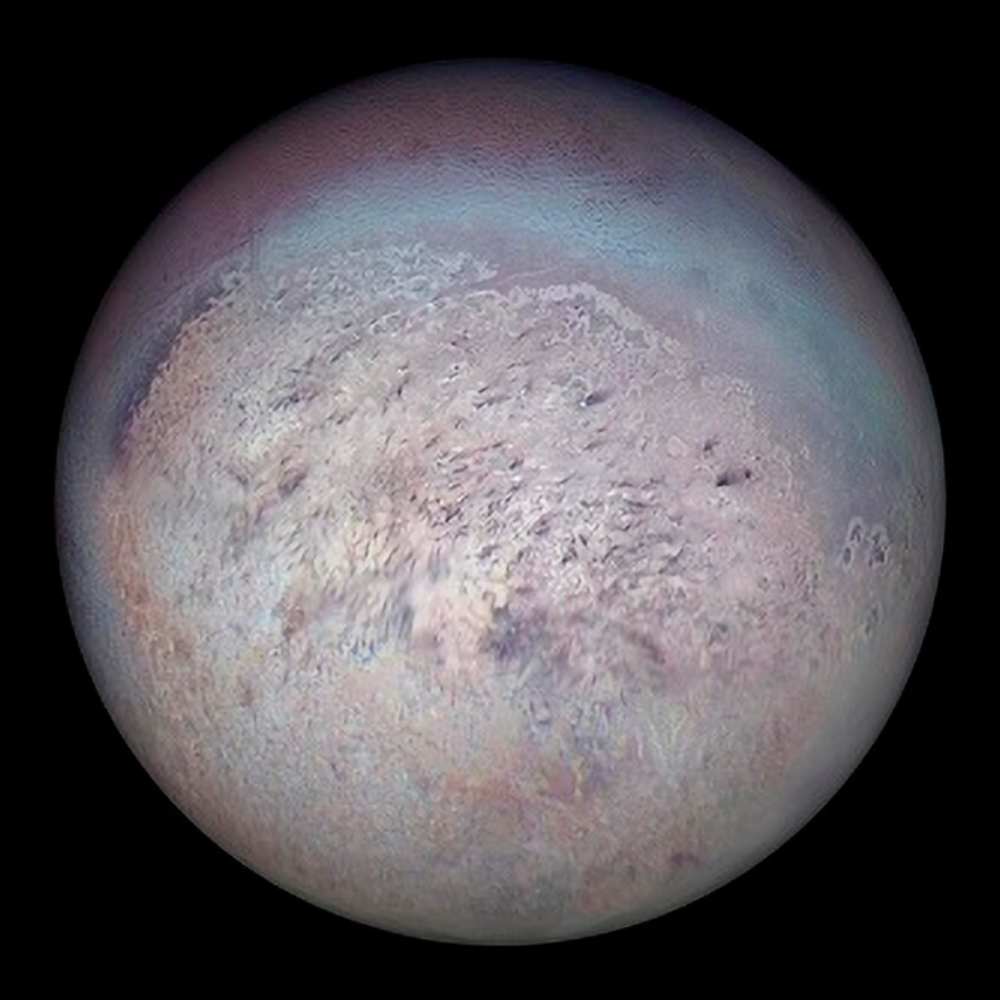
Triton’s surface is dominated by volatile ices rarely found on moons.
Observed materials include:
Nitrogen ice (dominant)
Methane ice
Carbon monoxide ice
Water ice forming the structural crust
These ices:
Sublimate seasonally
Shift across the surface
Drive atmospheric changes
As Triton orbits Neptune, its surface undergoes slow but continuous seasonal evolution.
Voyager 2 – Our Only Close Look
All detailed information about Triton comes from a single spacecraft: Voyager 2.
During its 1989 flyby, Voyager 2 revealed:
Vast smooth plains with few impact craters
Polar caps made largely of nitrogen ice
Dark streaks formed by active geysers
A thin, hazy atmosphere
These discoveries completely changed how scientists viewed icy moons.
Cryovolcanism – Geysers in Deep Freeze
One of Voyager 2’s most surprising findings was evidence of active geysers.
Plumes rose up to ~8 km above the surface
Dark material was deposited downwind
Activity was concentrated near the south polar region
These eruptions are thought to be driven by:
Solar heating beneath translucent nitrogen ice
Pressure buildup from sublimating gases
Sudden release through surface fractures
Despite its distance from the Sun, Triton remains geologically active.
Why Triton Is Scientifically Important
Triton helps scientists understand:
How planetary capture works
How large moons evolve after capture
Cryovolcanism driven by volatile ices
Connections between moons and Kuiper Belt objects
It occupies a unique position between:
Regular satellites
Dwarf planets
Trans-Neptunian objects
Triton’s Atmosphere – Thin, Seasonal, and Dynamic
Triton possesses a tenuous atmosphere, one of the most delicate known in the Solar System.
Basic Atmospheric Properties
Primary component: Nitrogen (N₂)
Trace gases: Methane (CH₄), Carbon monoxide (CO)
Surface pressure: Extremely low (microbar range)
Structure: Thin haze layers extending several kilometers
Unlike thick planetary atmospheres, Triton’s atmosphere exists in equilibrium with surface ice. When nitrogen ice sublimates, the atmosphere grows; when it freezes, the atmosphere collapses.
Seasonal Cycles – A Moon That “Breathes”
Triton experiences extreme seasons due to:
Neptune’s long orbital period (~165 Earth years)
Triton’s tilted rotational axis
Highly volatile surface ices
What Happens During Seasons
Nitrogen ice migrates from one hemisphere to the other
Polar caps grow and shrink
Atmospheric pressure rises and falls
Geyser activity may increase or decrease
In effect, Triton’s surface and atmosphere exchange material continuously, making it one of the most seasonally active icy bodies known.
Voyager 2’s Atmospheric Discoveries
Voyager 2 detected:
A thin atmospheric haze
Temperature gradients near the surface
Evidence of active sublimation
These findings confirmed that Triton is not a frozen relic, but a world undergoing slow, ongoing change.
Interior Structure – Where Does the Heat Come From?
One of the biggest puzzles about Triton is its internal heat.
Given its distance from the Sun, Triton should be geologically dead. Yet it is not.
Possible Heat Sources
Residual heat from capture
Enormous tidal heating during orbit circularization
Radioactive decay
Heat from rocky material in the core
Past tidal interactions
Strong early interactions with Neptune
Although tidal heating today is minimal, the aftereffects of Triton’s violent capture may still influence its interior.
Cryovolcanism Revisited – Why Triton Is Still Active
Triton’s geysers differ from volcanic eruptions on Earth.
Key Differences
Material erupted is nitrogen gas, not molten rock
Energy source is solar heating, not magma
Surface temperatures are among the coldest in the Solar System
These eruptions demonstrate that geological activity does not require warmth, only energy and volatile materials.
Surface Age – Surprisingly Young Terrain
Crater counts on Triton reveal something unexpected.
Large regions show very few impact craters
This implies surface ages of less than 100 million years
Some areas may be far younger
This makes Triton’s surface:
Younger than most moons
Comparable in age to active worlds like Europa
Such youth reinforces the idea that Triton has been resurfaced by internal or seasonal processes.
Triton Compared with Pluto – Close Relatives, Different Fates
Triton and Pluto share striking similarities.
| Feature | Triton | Pluto |
|---|---|---|
| Size | Slightly smaller | Slightly larger |
| Composition | Nitrogen, methane, water ice | Same |
| Atmosphere | Thin, seasonal | Thin, seasonal |
| Origin | Kuiper Belt | Kuiper Belt |
| Orbital Status | Captured moon | Dwarf planet |
The key difference is environment:
- Pluto remained independent
- Triton was captured and reshaped by Neptune
Triton shows what might happen to a Pluto-like world after capture by a giant planet.
Magnetic and Plasma Interactions
Triton interacts strongly with Neptune’s magnetosphere.
Effects include:
Atmospheric stripping
Ion pickup
Surface sputtering
These interactions may slowly remove atmospheric material over time, contributing to Triton’s evolving surface and thin atmosphere.
Why Triton Is Central to Outer Solar System Science
Triton provides insight into:
Kuiper Belt composition
Planetary capture mechanics
Volatile-driven geology
Atmospheric escape in cold environments
It connects multiple fields of planetary science into a single object.
Triton’s Orbital Future – A Slow but Inevitable Fate
Triton’s current orbit around Neptune is stable today, but it is not permanent on cosmic timescales.
Because Triton orbits Neptune in a retrograde direction, tidal interactions act very differently than they do for regular moons.
What Tides Are Doing
Neptune’s gravity is slowly draining orbital energy from Triton
Triton’s orbit is shrinking, not expanding
This decay is extremely slow—but continuous
Over hundreds of millions to billions of years, Triton will move steadily closer to Neptune.
Will Triton Eventually Be Destroyed?
Yes—according to current models, Triton’s long-term fate is likely catastrophic.
There are two main possibilities:
1. Tidal Disruption
As Triton approaches Neptune:
Tidal forces will increase dramatically
Triton may cross Neptune’s Roche limit
The moon could be torn apart
In this scenario, Triton would break up and form a temporary ring system around Neptune.
2. Direct Impact
If Triton remains intact long enough:
Its orbit could decay further
A collision with Neptune becomes possible
Such an impact would release enormous energy and permanently reshape Neptune’s atmosphere and interior.
Both outcomes are billions of years away, but they highlight how unusual Triton’s capture truly was.
Could Triton Have a Subsurface Ocean?
One of the most intriguing open questions is whether Triton may still contain a subsurface ocean.
Supporting Arguments
Triton has a differentiated interior
Past tidal heating was intense
Volatile-rich composition favors internal melting
Challenges
Present-day tidal heating is weak
Surface temperatures are extremely low
While no ocean has been confirmed, Triton remains a candidate icy ocean world, especially in its deeper past.
Triton and Astrobiological Interest
Triton is not considered a prime target for life today, but it is still relevant to astrobiology.
Why?
It demonstrates long-term chemistry driven by nitrogen and methane
It shows how energy can exist in cold environments
It preserves conditions similar to early Kuiper Belt objects
Triton helps scientists understand the limits of habitability, even when life is unlikely.
Frequently Asked Questions (FAQ)
Is Triton larger than Pluto?
No. Pluto is slightly larger in diameter, but Triton is comparable in size and density.
Why does Triton orbit backward?
Because it was captured by Neptune rather than forming in place.
Is Triton still geologically active?
Direct activity has not been observed since Voyager 2, but geological evidence suggests relatively recent resurfacing.
Could humans ever visit Triton?
A mission is technically possible, but no approved mission currently exists. Triton is considered a high-priority future target.
Is Triton unique?
Yes. It is the only large retrograde moon in the Solar System.
Triton’s Place in the Neptune System
Triton dominates Neptune’s moon system.
It contains the majority of the system’s mass
Smaller moons are likely remnants of post-capture debris
Neptune’s irregular satellite system reflects Triton’s violent arrival
Understanding Triton is essential to understanding Neptune itself.
Why Triton Matters in Planetary Science
Triton matters because it demonstrates that:
Giant planets can capture large planetary bodies
Such captures radically reshape moon systems
Kuiper Belt objects are not isolated relics
Triton connects:
Moons and dwarf planets
Planetary migration and capture
Surface geology and orbital dynamics
Few objects combine so many key processes in one world.
Related Topics for Universe Map
Neptune
Kuiper Belt
Pluto
Cryovolcanism
Retrograde moons
Planetary capture
These topics together explain how the outer Solar System became what it is today.
Final Perspective
Triton is a moon that should not exist—at least not in the way it does.
Captured, reversed, heated, and reshaped, Triton stands as evidence that the Solar System’s history was not calm or orderly. It was dynamic, violent, and full of unexpected outcomes.
Long after Triton’s surface activity fades and its orbit continues to decay, its scientific value will remain. It tells us that worlds can be stolen, transformed, and preserved all at once—and that even the coldest regions of the Solar System can hold stories of extreme change.