










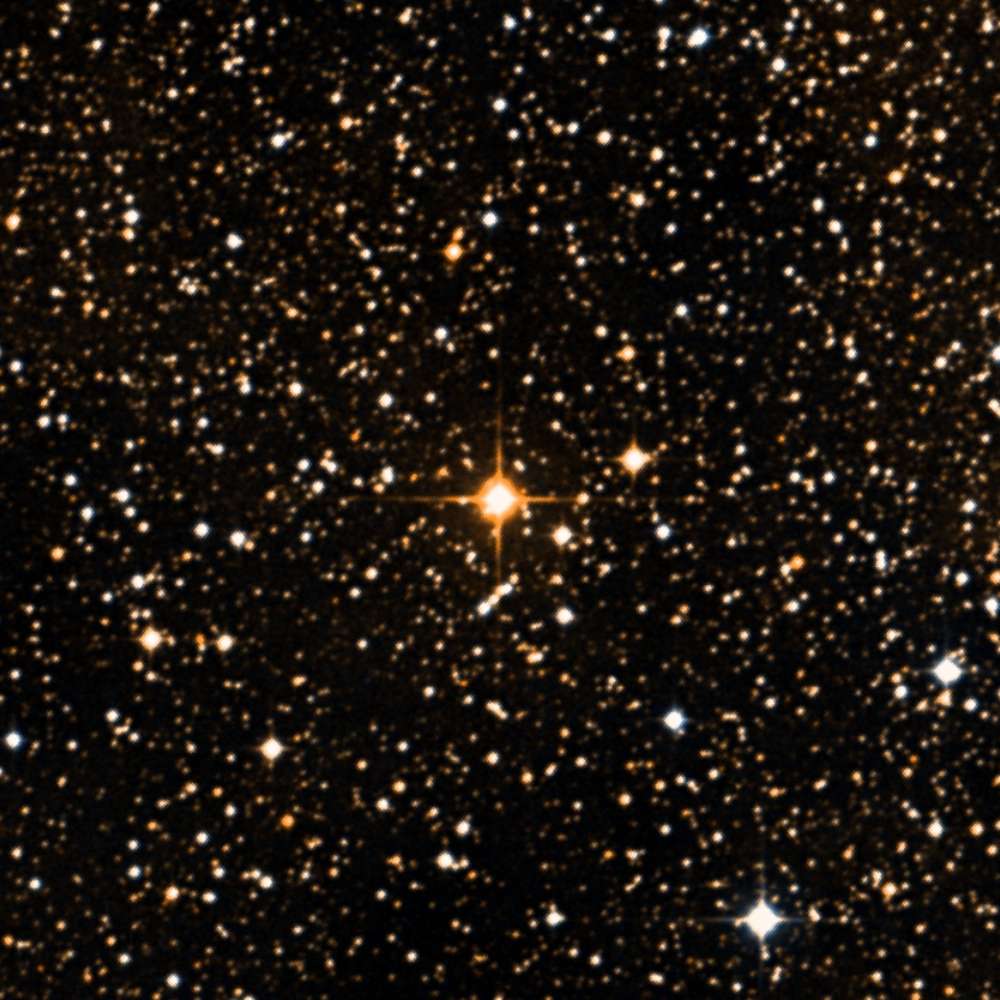
UY Scuti
One of the Largest Known Stars in the Milky Way
Quick Reader
| Attribute | Details |
|---|---|
| Name | UY Scuti |
| Type | Red Supergiant (RSG) |
| Spectral Class | M4 Ia–Iab |
| Constellation | Scutum |
| Distance from Earth | ~9,500 light-years |
| Radius | ~1,700 R☉ (approx.) |
| Diameter | ~2.4 billion km (variable) |
| Volume Compared to Sun | Nearly 5 billion times larger |
| Luminosity | ~340,000 L☉ |
| Temperature | ~3,365 K |
| Variability Type | Semiregular Variable Star (SRc) |
| Mass | 7–10 M☉ (estimated) |
| Mass Loss Rate | Extremely high; thick dust envelope |
| Evolutionary Stage | Late-stage red supergiant near end of life |
| Potential Fate | Likely a Type II Supernova |
| Discovery | Identified in 1860 (Bonn Observatory) |
| Best Viewing Months | June to September |
Introduction – A Red Supergiant at the Edge of Stellar Limits
UY Scuti is one of the largest known stars in the Milky Way, astonishing in radius and volume. Located approximately 9,500 light-years away in Scutum, this red supergiant is approaching the final stages of stellar evolution. Its estimated radius of 1,700 times the Sun places it among the most extreme stars ever measured.
Although not the most massive, its sheer physical size represents one of the upper limits of stellar expansion. UY Scuti’s unstable atmosphere and enormous mass loss rate make it an important object for studying how giant stars evolve before they end their lives as supernovae.
If placed at the center of our Solar System, its extended surface would reach beyond Jupiter and approach Saturn’s orbit — illustrating the extreme scale of this star.
The Immense Scale of UY Scuti
UY Scuti’s radius is so large that conventional comparisons with the Sun fail to express its true size. Numerically:
Radius of the Sun: 695,700 km
Estimated radius of UY Scuti: ~1.18 billion km
This gives it a volume nearly 5 billion times greater than the Sun. Its outer layers are loosely held, expanding and contracting due to low surface gravity and turbulent convection.
If positioned at the center of our Solar System, UY Scuti would engulf Mercury, Venus, Earth, Mars, and Jupiter. Its outer edge would stretch toward Saturn — defining one of the largest stellar envelopes known.
Variability and Pulsation Cycles
UY Scuti is a semiregular variable star, meaning that it undergoes rhythmic cycles of expansion and contraction. These pulsations cause noticeable changes in brightness and radius.
Pulsation period: roughly 740 days
Brightness variation: around one magnitude
Cause: unstable outer atmosphere and deep convection layers
These pulsations aid in driving mass loss by pushing material outward. As this material cools, it forms dust that contributes to the star’s extended envelope.
A Star Surrounded by Dust
UY Scuti is enveloped in a thick layer of dust produced by rapid mass loss. The dust absorbs visible light and re-emits energy primarily in the infrared, making infrared observations essential.
This dusty environment also introduces uncertainties in determining the star’s true size, because different wavelengths penetrate different depths of the extended atmosphere.
The heavy dust production signals that UY Scuti is approaching the end of its lifecycle, shedding vast amounts of material as it prepares for its collapse.
Importance in the Study of Massive Stars
UY Scuti serves as a rare example of extreme stellar evolution. Massive red supergiants like this star are key to understanding:
How large dying stars can grow
How mass loss shapes the paths leading to supernovae
How convection and pulsation affect stellar atmospheres
How heavy elements are dispersed into the galaxy
These insights help astronomers model the future of massive stars, predict supernova behavior, and understand chemical enrichment in the Milky Way.
Internal Structure of a Red Supergiant This Large
The internal structure of UY Scuti reflects the final, unstable stages of a massive star’s evolution. Deep inside, the core is no longer producing energy through hydrogen fusion. Instead, the star is progressively burning heavier elements in layered shells surrounding an increasingly compact core.
These layers may include hydrogen, helium, carbon, neon, oxygen, and even silicon-burning zones—though the exact structure depends on its mass, which remains uncertain. What is consistent, however, is the extreme instability created by these fusion shells. They push the outer atmosphere outward, forming the colossal radius for which UY Scuti is known.
The low surface gravity caused by this swollen envelope allows material to escape easily, stimulating the intense mass loss seen today.
Why UY Scuti’s Size Is Still Debated
Estimating the radius of red supergiants is notoriously difficult, and UY Scuti is no exception. Several factors complicate accurate measurements:
1. The extended atmosphere
The outer layers of UY Scuti are not sharp or well-defined. They are diffuse, filled with dust, and constantly shifting. Different wavelengths see different depths of the star, making a single radius difficult to assign.
2. Heavy dust obscuration
Visible light is almost entirely blocked by the dust around UY Scuti. Observations must rely on infrared and radio wavelengths, which introduce their own uncertainties.
3. Pulsation cycles
The star expands and contracts over a period of roughly 740 days. Depending on the observation date, its apparent radius can differ significantly.
4. Measurement techniques
Infrared interferometry, photometric models, and atmospheric simulations often produce slightly different results. Some measurements suggest a radius around 1,700 solar radii, while others imply somewhat smaller or larger values.
Despite these uncertainties, all modern studies agree that UY Scuti is among the largest stars known, even if not absolutely the largest at all times.
Comparison with Other Extreme Stars
Understanding UY Scuti requires placing it alongside other supergiants and hypergiants whose sizes, masses, and luminosities push the limits of stellar physics.
Stephenson 2-18 (St2-18)
One of the strongest contenders for the largest known star, with a radius possibly exceeding 2,000 times that of the Sun. In terms of size, St2-18 may surpass UY Scuti.
VY Canis Majoris
A red hypergiant known for its extreme mass loss and vast nebula. Its physical radius estimates vary widely but place it among the most extreme stars.
Betelgeuse
More familiar but significantly smaller than UY Scuti. Betelgeuse has a radius around 900–1,000 solar radii but is much more massive.
VV Cephei A
An eclipsing binary red supergiant with a radius close to UY Scuti’s scale during its expansion phase.
Antares
Another large red supergiant with a radius close to 700–850 solar radii, notable for its powerful winds and extended atmosphere.
In this context, UY Scuti remains one of the largest stars ever measured, though not necessarily the largest when comparing all extreme red supergiants. Its importance lies in the fact that it is both enormous and well-studied, providing a strong benchmark for stellar evolution models.
Mass Loss and the Expanding Nebula
UY Scuti’s mass-loss rate is exceptionally high. It is continuously shedding its outer layers at a speed and volume much greater than the Sun’s solar wind.
This outflow:
Envelops the star in a large molecular shell
Creates dense regions of dust
Alters the star’s visible size
Feeds the surrounding interstellar medium
Infrared observations reveal that this dust forms a thick circumstellar nebula. Such mass-loss behavior is a defining characteristic of stars nearing the end of their red supergiant phase, marking the transition toward the final collapse.
The mass-loss rate suggests that UY Scuti is rapidly losing material and may have already shed a significant portion of its initial mass. This will influence its final supernova type and the size of the remnant left behind.
What Will Happen When UY Scuti Dies?
UY Scuti is expected to end its life in a core-collapse supernova. As the core contracts and temperatures rise, the star will fuse heavier and heavier elements until iron is produced. Since iron fusion cannot release energy, the core will catastrophically collapse, triggering a violent explosion.
Expected outcomes include:
A bright Type II supernova
A strong shockwave that illuminates its dust shell
Formation of a neutron star, if the remaining core is small enough
Or formation of a black hole, if the core is above the critical mass limit
Because UY Scuti is around 9,500 light-years away, the supernova would be bright in Earth’s sky but not dangerous. It would likely be visible even during the day for several weeks.
Role in the Milky Way’s Chemical Evolution
Like all massive stars, UY Scuti plays a role in enriching the Milky Way with heavy elements. As it loses mass, it disperses:
Carbon
Nitrogen
Oxygen
Silicon
Dust grains
These materials become part of future generations of stars, planets, and potentially life-bearing environments.
The supernova will amplify this enrichment, expelling heavier elements produced during the star’s late stages.
How UY Scuti Was Discovered and Studied Over Time
UY Scuti was first cataloged in 1860 by astronomers at the Bonn Observatory during their survey of variable stars. At the time, its extraordinary size was not yet recognized. Early observations noted only that its brightness changed irregularly.
The true nature of UY Scuti became clearer in the late 20th and early 21st centuries, when infrared astronomy and interferometry enabled precise measurements. These technologies penetrated the heavy dust surrounding the star, revealing the enormous radius and extended atmosphere.
Major contributions came from:
Infrared surveys
Interferometric observations
High-resolution spectroscopy
Long-term photometric monitoring
Together, these methods created the modern understanding of UY Scuti as one of the galaxy’s most extreme red supergiants.
Location in the Constellation Scutum
UY Scuti lies within the faint constellation Scutum, near the dense star fields of the Milky Way. The region is rich in interstellar gas and dust, which makes optical observations difficult. Its location near the Galactic Plane is another reason why UY Scuti is heavily obscured in visible wavelengths.
Despite its physical brightness, the dust makes it appear much dimmer to the naked eye. This further emphasizes the importance of infrared observations for studying red supergiants in dusty environments.
UY Scuti in the Context of the Milky Way
Although enormous in size, UY Scuti is only one of many late-stage supergiants scattered throughout the Milky Way. What makes it notable is its combination of:
Extreme radius
Intense mass loss
Advanced evolutionary stage
Extensive dust shell
These characteristics make it one of the most important objects for understanding the upper limits of stellar expansion and the processes that lead to supernova explosions.
It also serves as a test case for modern theories about how red supergiants evolve and how their instabilities influence surrounding interstellar environments.
Scientific Questions That Remain Open
Even with modern infrared and interferometric tools, several questions about UY Scuti remain unresolved:
How large can a red supergiant become?
The atmosphere of UY Scuti is so diffuse that defining a true radius may require new measurement techniques.
What is the exact mass of its core?
The mass determines whether UY Scuti will form a neutron star or black hole after its supernova.
How fast is it losing mass?
Different observational methods give slightly different results, and the mass-loss rate may be accelerating.
How soon will it explode?
While a supernova is inevitable, the exact timeline remains unknown. It could be anywhere from tens of thousands to a few hundred thousand years.
These uncertainties highlight the complexity of modeling stars at the end of their lives.
Frequently Asked Questions (FAQ)
Why is UY Scuti considered one of the largest stars?
Because its radius is around 1,700 times the Sun’s, giving it a volume billions of times greater. Despite uncertain measurements, all studies confirm its extraordinary size.
Is UY Scuti the largest star known?
Not definitively. Stars like Stephenson 2-18 and VY CMa may exceed it, depending on measurement technique. But UY Scuti remains among the largest ever observed.
Can UY Scuti be seen with a small telescope?
Not easily. It lies in a dusty region near the Galactic Plane and is faint in visible light. Infrared observations are required for clear study.
What will happen when UY Scuti explodes?
It will produce a Type II supernova, briefly becoming extremely bright. The explosion will not harm Earth due to the large distance.
Will it form a neutron star or a black hole?
This depends on the remaining mass of the core. If the core is below the critical limit, a neutron star will form; otherwise, a black hole is possible.
Why does the star pulsate?
Because the outer layers are unstable, with convection and fusion-shell activity causing expansion and contraction cycles.
Related Objects and Further Reading
VY Canis Majoris – Red hypergiant with extreme mass loss
Stephenson 2-18 – Possibly the largest known star
Betelgeuse – Famous red supergiant nearing its own supernova phase
VV Cephei A – Massive red supergiant in an eclipsing binary
Antares – Red supergiant with detailed atmospheric mapping
These stars help place UY Scuti in context among the Milky Way’s most extreme objects.
Final Thoughts
UY Scuti stands as one of the most remarkable red supergiants in our galaxy. Its enormous size, unstable outer layers, variable brightness, and thick dust envelope make it a stellar archetype for understanding the final evolutionary phases of massive stars. While uncertainties remain—especially regarding its exact radius and mass-loss behavior—UY Scuti remains a crucial object for studying how stars die, how supernovae form, and how heavier elements enrich the Milky Way.
As observational techniques improve, especially in infrared and interferometric astronomy, our understanding of UY Scuti and similar giants will become clearer. Yet even with current knowledge, UY Scuti offers a compelling reminder of the extraordinary scale and diversity of stars within our galaxy.