





Van Maanen’s Star
One of the Nearest White Dwarfs to Earth
Quick Reader
| Attribute | Details |
|---|---|
| Name | Van Maanen’s Star |
| Catalog | Van Maanen 2, Gliese 35 |
| Star Type | White Dwarf |
| Spectral Class | DZ7 (metal-polluted white dwarf) |
| Constellation | Pisces |
| Distance from Earth | ~14.1 light-years |
| Radius | ~0.013 R☉ (about Earth-sized) |
| Mass | ~0.68 M☉ |
| Temperature | ~6,200 K |
| Luminosity | ~0.00017 L☉ |
| Age | Cooling age ~3 billion years |
| Notable Feature | One of the closest white dwarfs and the nearest known DZ-type |
| Composition | Helium-rich atmosphere contaminated by metals |
| Discovery | 1917 by Adriaan van Maanen |
| Best Viewing Months | October to January |
Introduction – A Faint, Nearby Relic of a Dead Sun-like Star
Van Maanen’s Star, also known as Van Maanen 2, is one of the closest white dwarfs to Earth and one of the faintest stars visible in the Sun’s neighborhood. At only 14.1 light-years away, it is the third-closest white dwarf after Sirius B and Procyon B.
Unlike bright, massive stars or colorful giants, Van Maanen’s Star appears extremely dim. It is a stellar remnant—the collapsed core of a Sun-like star that has already completed its full life cycle. What remains is an Earth-sized object with nearly the mass of the Sun, supported not by nuclear fusion, but by electron degeneracy pressure.
This quiet, faded star offers astronomers a valuable look into:
The long-term future of Sun-like stars
The physics of degenerate matter
Cooling ages in the solar neighborhood
Heavy metal pollution in white dwarf atmospheres (rare and scientifically important)
Van Maanen’s Star is one of the best-studied nearby remnants of stellar evolution, revealing what stars become billions of years after their nuclear reactions cease.
Physical Nature of Van Maanen’s Star
As a white dwarf, Van Maanen’s Star is incredibly dense and compact. Although its radius is comparable to Earth’s, it contains about two-thirds of the Sun’s mass. This density—hundreds of thousands of times that of water—creates physical conditions impossible in normal stars.
Its surface temperature of around 6,200 K makes it similar in temperature to the Sun, but because it is so small, its luminosity is a tiny fraction of solar output. To the naked eye, it is completely invisible.
The star’s atmosphere is helium-dominated, but surprisingly contains traces of heavier elements such as:
Magnesium
Iron
Calcium
These metals should sink rapidly in the intense gravity of a white dwarf, meaning they must have been recently accreted. Their presence identifies Van Maanen’s Star as a DZ-type, making it the closest known metal-polluted white dwarf.
Why Metal Pollution Matters
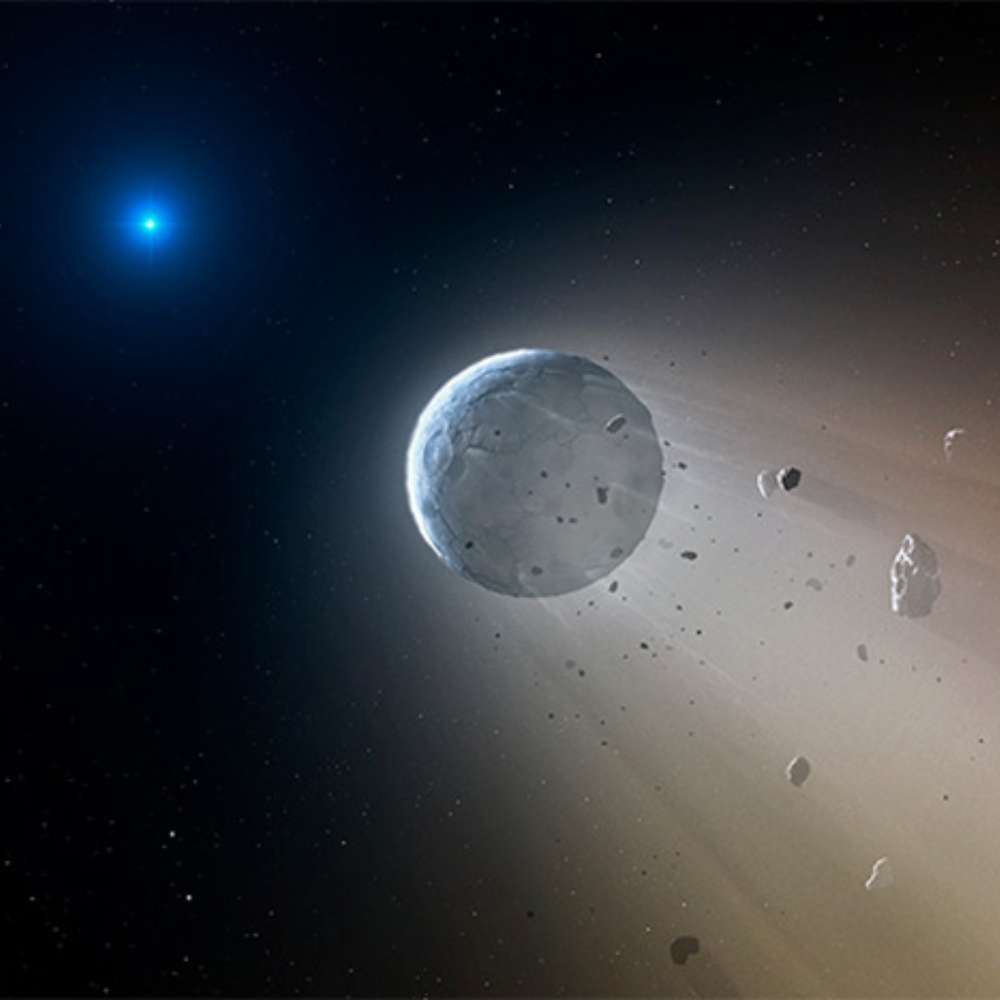
In most white dwarfs, heavy elements sink below the surface within days or years due to immense gravity. The presence of metals in Van Maanen’s Star’s atmosphere indicates recent accretion. The most likely source is:
Disrupted asteroids
Comet-like debris
Rocky planetary material
This suggests that the star may once have had a planetary system, and remnants of that system—asteroids or minor planets—still orbit the white dwarf, occasionally falling inward.
For astronomers, metal-polluted white dwarfs act as forensic archives, allowing reconstruction of the composition of ancient planetary bodies. Van Maanen’s Star, being nearby and bright in ultraviolet wavelengths, is an ideal target for such studies.
A Nearby Star That Is Surprisingly Hard to See
Despite being one of the closest stars to Earth, Van Maanen’s Star is surprisingly dim, with an apparent magnitude of about 12.3. This makes it visible only through telescopes.
Reasons for its faintness:
Very small radius (Earth-sized)
No fusion taking place
Emits light only from residual thermal energy
Low luminosity compared to main-sequence stars
Its faintness is precisely why it was only discovered in the early 20th century, despite its proximity.
From a Sun-Like Star to a White Dwarf
Van Maanen’s Star began its life as a star somewhat larger than the Sun, likely around 2 solar masses. Over billions of years, it passed through the main sequence and red giant phases, ultimately shedding its outer layers and leaving behind only its degenerate core.
Its evolutionary path:
Hydrogen fusion (main sequence)
Helium and heavy-element fusion (red giant)
Loss of outer layers (planetary nebula stage)
Collapse into a white dwarf
Slow cooling over billions of years
Today, Van Maanen’s Star continues to cool slowly and will eventually become a cold, dark black dwarf—an object no longer glowing from stored thermal energy. However, this final stage will take trillions of years, far longer than the current age of the universe.
The Cooling Process of a White Dwarf
Van Maanen’s Star is a textbook example of how white dwarfs cool over time. After a star becomes a white dwarf, it no longer produces energy through nuclear fusion. Instead, it radiates away stored thermal energy from its earlier evolutionary phases.
In the case of Van Maanen’s Star:
Its current temperature of ~6,200 K
Its low luminosity (~0.00017 L☉)
Its cooling age of around 3 billion years
…indicate that it has spent a long time fading from its much hotter origin. Newly formed white dwarfs begin at temperatures above 100,000 K, then cool steadily over billions of years. Van Maanen’s Star is already well along this cooling pathway.
Ultimately, in trillions of years, it will cool so much that it becomes a black dwarf—a hypothetical stage that has not yet occurred anywhere in the universe because the universe is not old enough.
How Astronomers Measure Its Properties
Van Maanen’s Star is close enough for astronomers to study with remarkable precision using multiple observational methods.
Parallax (Gaia Mission)
Gaia’s high-precision parallax measurements provide a distance of about 14.1 light-years. With an accurate distance, astronomers can calculate:
True luminosity
Radius
Temperature
Cooling age
Gaia’s data dramatically improved our understanding of this star.
Spectroscopy
Spectroscopy reveals metal absorption lines in the white dwarf’s atmosphere. Key elements detected include:
Iron
Calcium
Magnesium
Metal contamination confirms ongoing accretion of planetary material. Spectroscopy also provides temperature estimates and atmospheric composition.
Astrometry
Astrometric measurements show Van Maanen’s Star has a high proper motion, moving rapidly across the sky. This motion reflects both its proximity and its path through the galactic neighborhood.
Photometry
Photometric data help refine:
Surface temperature
Luminosity
Cooling time
Any variability
Van Maanen’s Star is stable, showing no significant pulsation.
Motion Through the Solar Neighborhood
Van Maanen’s Star has one of the highest proper motions of any nearby star. In other words, it appears to move across the sky more rapidly than most stars, shifting by over 3 arcseconds per year.
This rapid angular movement results from:
Its close distance
Its actual high space velocity relative to the Sun
It is moving through the local region of the Milky Way at considerable speed, which contributes to our understanding of stellar dynamics in the solar neighborhood.
Using measurements of its proper motion and radial velocity, astronomers can reconstruct its trajectory through the galaxy. It is not a member of any known local moving group, suggesting it may have drifted from a different part of the Milky Way.
Why Van Maanen’s Star Is a DZ-Type White Dwarf
White dwarfs are classified based on the appearance of elements in their spectra. Van Maanen’s Star is classified as DZ, which refers to:
A helium-dominated atmosphere
Presence of metal absorption lines
Absence of hydrogen or helium spectral features typical of other classes
The “Z” indicates metals. These metals are not produced by the star itself at this stage; they must originate from external material.
Possible sources include:
Disrupted asteroids
Rocky debris fields
Remnants of a broken planetary system
Infall from circumstellar dust clouds
The sinking timescales for metals in a white dwarf atmosphere are extremely short—sometimes years or even days—meaning the pollution must be continuously replenished. This makes Van Maanen’s Star one of the most important examples for studying the fate of planetary systems after their host stars die.
Evidence for a Lost Planetary System
The metals observed in the atmosphere strongly suggest that Van Maanen’s Star once hosted a system of planets, asteroids, or minor bodies. After the star evolved into a red giant, gravitational interactions and mass loss would have destabilized these bodies.
Common scenarios for metal-polluted white dwarfs include:
Asteroids perturbed into star-grazing orbits
Tidal disruption of rocky bodies
Accretion disks formed from planetary debris
Surviving outer planets influencing inner debris
Van Maanen’s Star may represent the final stage of a once active system, now slowly falling apart under gravitational stress.
Comparison with Other Nearby White Dwarfs
Van Maanen’s Star is one of several white dwarfs close to Earth, each with unique characteristics.
| Star | Distance | Type | Notes |
|---|---|---|---|
| Sirius B | ~8.6 ly | DA2 | Hot, massive, companion to Sirius A |
| Procyon B | ~11.5 ly | DQZ | Carbon features in spectrum |
| Van Maanen’s Star | ~14.1 ly | DZ7 | Closest DZ-type white dwarf |
| Wolf 359 (not a WD) | ~7.8 ly | M-dwarf | Often confused in proximity lists |
Van Maanen’s Star is uniquely valuable because it combines:
- Close distance
- Metal pollution
- Well-determined parameters
- No bright companion
This makes it a prime target for studying white dwarf atmospheres and remnant planetary material.
Its Significance in Modeling the Sun’s Future
Van Maanen’s Star is slightly heavier than the Sun but still follows the same ultimate evolutionary path. In many ways, it represents the Sun several billion years after the white dwarf transition.
Studying this star allows astronomers to predict:
How the Sun will cool
How long it will shine as a white dwarf
What happens to planetary systems afterward
How debris accretes onto stellar remnants
In this sense, Van Maanen’s Star acts as a preview of the Sun’s distant fate.
How Van Maanen’s Star Was Discovered
Van Maanen’s Star was identified in 1917 by Adriaan van Maanen, a Dutch-American astronomer known for his precision astrometry. While studying photographic plates, he noticed a faint star moving unusually fast across the sky. Its high proper motion immediately suggested it was nearby.
At the time, astronomers knew very little about white dwarfs. Yet Van Maanen’s discovery became historically significant because:
It was the first isolated white dwarf ever found (not part of a binary system)
It provided early evidence that some stars could fade into extremely dense remnants
It hinted at the existence of a group of very faint stars close to the Sun
This discovery helped expand the understanding of stellar evolution and opened the door to detailed white dwarf research in the 20th century.
Appearance and Observational Challenges
Even though Van Maanen’s Star is one of the closest stars to Earth, it is extraordinarily dim. Its faintness poses several challenges:
Why it appears so faint:
Very small radius (comparable to Earth)
No fusion; emits only leftover heat
Low luminosity (~0.02% of the Sun’s light)
Mostly emits in bluer light due to temperature but lacks surface area to shine brightly
As a result, the star is invisible to the naked eye and even challenging for small backyard telescopes. Most studies rely on large telescopes and precise instruments.
High Proper Motion – A Star Rushing Across the Sky
Van Maanen’s Star has one of the highest proper motions of all known stars. It shifts across the sky by more than 3 arcseconds per year, a noticeable drift when viewed across decades.
This rapid movement is due to a combination of:
Its close distance from Earth
Its true motion through the Milky Way
Its location in the local stellar neighborhood
Stars like this help astronomers understand the structure and motion of objects near the Sun. By tracking Van Maanen’s trajectory, scientists can reconstruct its past orbit and estimate its future path.
The Fate of Van Maanen’s Star
Van Maanen’s Star has already completed most of its evolution. What lies ahead is a long process of cooling:
Gradual temperature drop
It will slowly lose heat over billions of years.Decrease in luminosity
The star will become even fainter, eventually almost invisible in optical wavelengths.Transition to a black dwarf
After trillions of years, Van Maanen’s Star will cool enough that it no longer emits detectable light.
No black dwarfs currently exist because the universe is not old enough.
This is the ultimate fate of many Sun-like stars, including the Sun itself.
Frequently Asked Questions (FAQ)
Why does Van Maanen’s Star contain metals?
Because it is accreting rocky debris from an old planetary system. Metals should sink quickly, so their presence means fresh material is constantly falling in.
Is it dangerous to Earth?
No. At 14.1 light-years away, it is far too distant to affect the Solar System.
Was it ever as bright as the Sun?
Yes. Billions of years ago, during its main-sequence life, it likely shone more brightly than the Sun because it was originally more massive.
Will Van Maanen’s Star explode?
No. White dwarfs are stable remnants and do not undergo supernova explosions unless they are part of a binary system drawing mass—which Van Maanen’s Star is not.
Is Van Maanen’s Star the closest white dwarf?
No. Sirius B and Procyon B are closer, but they are in binary systems. Van Maanen’s Star is the closest isolated white dwarf.
Related Objects and Further Study
Sirius B – The brightest and nearest white dwarf
Procyon B – A well-studied white dwarf in a binary system
Ross 128 – A nearby red dwarf with high proper motion
Wolf 28 (Van Biesbroeck’s Star) – Another faint, nearby object known for its large motion
G29-38 – A white dwarf with an observed debris disk, similar to metal-polluted white dwarfs like Van Maanen’s
These nearby stars illustrate the range of remnants and low-luminosity stars in our part of the Milky Way.
Final Thoughts
Van Maanen’s Star, despite its faintness, is one of the most scientifically important nearby stars. As an isolated white dwarf only 14 light-years away, it represents the last visible stage in the evolution of a Sun-like star. Its metal-polluted atmosphere provides clear evidence of a disrupted planetary system, offering a rare glimpse into the long-term fate of worlds orbiting dying stars.
Studying Van Maanen’s Star helps astronomers understand:
How stars end their lives
How planetary systems behave after their suns die
How white dwarfs cool, accrete debris, and evolve over billions of years
It is a quiet but powerful reminder of what happens to stars long after their bright, main-sequence days are over—including, eventually, our own Sun.