






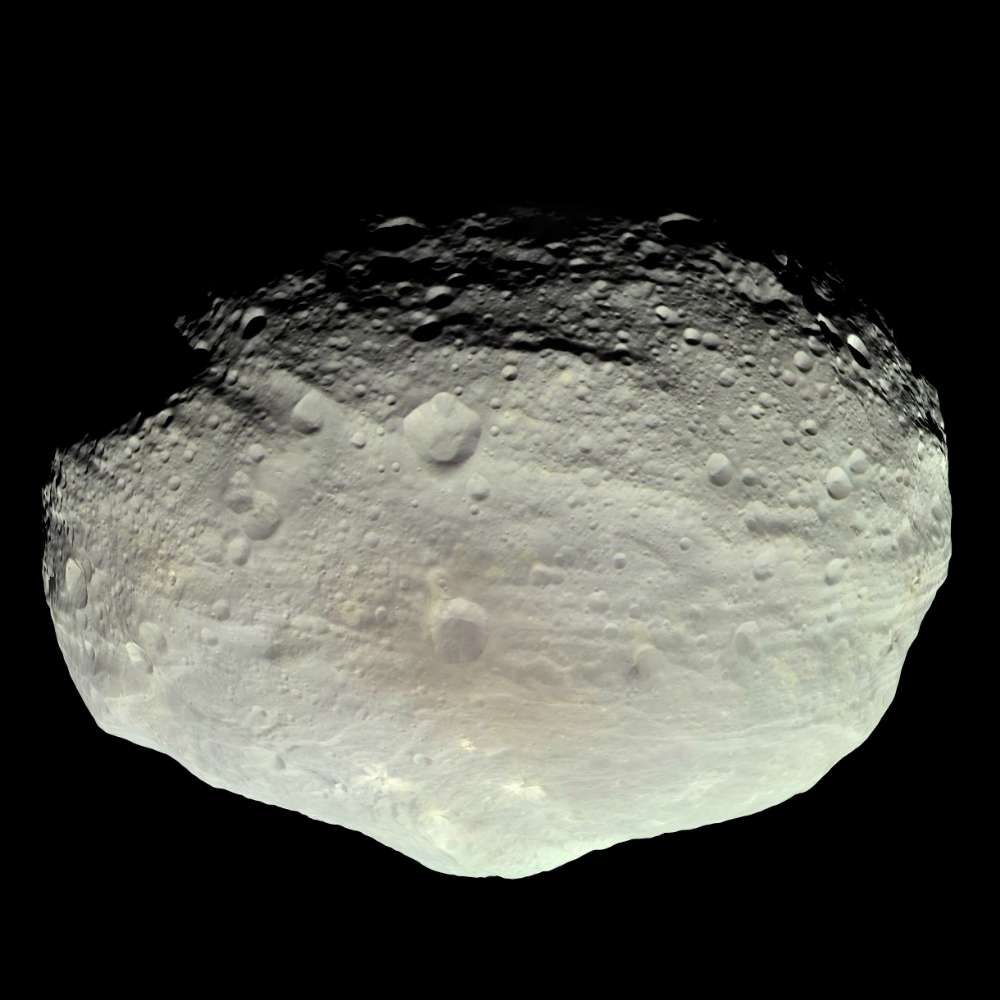
Vesta
The Protoplanet That Almost Became a Planet
Quick Reader
| Attribute | Details |
|---|---|
| Object Name | 4 Vesta |
| Object Type | Protoplanet / Large asteroid |
| Location | Main Asteroid Belt |
| Discovery | 1807 |
| Discoverer | Heinrich Wilhelm Olbers |
| Mean Diameter | ~525 km |
| Mass | ~9% of total asteroid belt mass |
| Shape | Slightly irregular, nearly spherical |
| Rotation Period | ~5.34 hours |
| Orbital Period | ~3.63 Earth years |
| Composition | Basaltic rock (igneous) |
| Differentiation | Fully differentiated |
| Core | Iron–nickel |
| Mantle | Silicate |
| Crust | Basaltic |
| Surface Age | Very ancient, heavily cratered |
| Notable Feature | Rheasilvia impact basin |
- Vesta is a fully differentiated protoplanet, not a rubble-pile asteroid
- It has a metallic core, rocky mantle, and basaltic crust
- Vesta preserves conditions from the earliest Solar System
- Many meteorites on Earth originated from Vesta
- It represents a failed planet-building process
Introduction – A World That Stopped Halfway
Vesta is not just a large asteroid.
It is a planetary embryo—a body that began evolving like a planet but never finished the process.
In the early Solar System, Vesta grew large enough to melt internally, separate into layers, and develop volcanic crust. Then, before it could grow further, its evolution was halted by Jupiter’s overwhelming gravitational influence.
Vesta shows us what happens when planetary formation is interrupted.
What Is Vesta?
Vesta is one of the largest objects in the asteroid belt and the second-most massive asteroid after Ceres.
Unlike most asteroids, which are loose collections of rock, Vesta is:
Solid
Geologically evolved
Structurally layered
Because of this, scientists classify Vesta as a protoplanet rather than a typical asteroid.
If it had formed slightly earlier or farther from Jupiter, Vesta might have become a small terrestrial planet.
Size and Structure – Small Planet, Big History
Vesta’s size places it at a critical threshold.
It is large enough to have experienced:
Internal melting
Differentiation
Volcanic activity
But not large enough to:
Maintain long-term tectonics
Retain an atmosphere
Continue accreting material
Its internal structure includes an iron-rich core, a silicate mantle, and a basaltic crust—remarkably similar to Earth’s layered structure, but frozen in time.
Differentiation – Why Vesta Is So Important
Vesta differentiated very early, within the first few million years after Solar System formation.
This occurred because:
Short-lived radioactive isotopes generated heat
Rapid accretion trapped that heat
The interior melted and separated
As a result, Vesta became one of the first geologically evolved bodies in the Solar System.
Most asteroids never reached this stage.
A Volcanic Past Locked in Stone
Vesta’s surface is dominated by basalt, an igneous rock formed from lava.
This tells us that:
Vesta once had active volcanism
Lava flowed across its surface
Its crust solidified early and remained stable
Unlike Earth, erosion and plate tectonics never erased these features.
Vesta’s crust is a permanent geological record.
The Dawn Mission – Seeing Vesta Up Close
NASA’s Dawn spacecraft transformed our understanding of Vesta.
Dawn revealed:
A surprisingly planet-like surface
Clear layering in exposed terrain
Massive impact scars exposing deep interior material
For the first time, scientists could study a protoplanet directly, not through meteorites alone.
Vesta vs Typical Asteroids – First Comparison
| Feature | Vesta | Typical Asteroid |
|---|---|---|
| Internal Structure | Layered | Rubble-pile or solid |
| Volcanic History | Yes (ancient) | No |
| Composition | Basaltic | Primitive |
| Differentiation | Full | None |
| Planetary Status | Protoplanet | Minor body |
This comparison explains why Vesta occupies a unique category.
Why Vesta Matters
Vesta matters because it:
Preserves early planetary processes
Bridges the gap between asteroids and planets
Explains the origin of many meteorites
Reveals why planet formation is not guaranteed
Vesta is not a leftover rock—it is a survivor of a failed planet.
The Giant Impact That Reshaped Vesta
Vesta’s history was permanently altered by one of the largest impacts in the asteroid belt.
Near its south pole lies Rheasilvia, a colossal impact basin roughly 500 km wide—almost as wide as Vesta itself. This single event excavated enormous amounts of material and reshaped the body’s gravity, topography, and rotation.
The impact was powerful enough to:
Penetrate deep into Vesta’s crust
Expose mantle material at the surface
Eject vast quantities of debris into space
Rheasilvia is not just a crater. It is a window into Vesta’s interior.
Rheasilvia Basin – A Scar from Planetary Violence
Rheasilvia is among the largest impact structures relative to body size in the entire Solar System.
Its features include:
A central peak rising several kilometers high
Concentric ridges caused by crustal rebound
Deep excavated regions revealing internal layers
Such a massive impact would have destroyed many asteroids outright.
Vesta survived because it is structurally strong and internally cohesive, more like a small planet than a loose asteroid.
How Vesta Meteorites Reached Earth
One of Vesta’s most remarkable contributions to science is its connection to meteorites found on Earth.
Many meteorites—specifically HED meteorites (howardites, eucrites, diogenites)—match Vesta’s surface composition almost perfectly.
The sequence is well understood:
Large impacts ejected debris from Vesta
Fragments entered resonant orbits
Jupiter’s gravity altered their trajectories
Some fragments crossed Earth’s path
As a result, laboratories on Earth contain physical samples of a protoplanet—a rare and invaluable resource.
Vesta as a Meteorite Parent Body
Because of this link, Vesta is one of the best-studied bodies in the Solar System.
Meteorite studies reveal:
Basaltic crust formed from lava flows
Mantle material crystallized slowly
Rapid early differentiation
These findings confirm that Vesta once behaved like a small terrestrial planet, complete with internal melting and magmatic activity.
Few Solar System objects are understood this directly.
Jupiter’s Role in Stopping Vesta’s Growth
Vesta’s evolution did not end naturally—it was interrupted.
Jupiter’s early formation and gravitational dominance:
Stirred the asteroid belt
Increased collision speeds
Prevented further accretion
Instead of growing larger, Vesta entered a violent environment where impacts dominated over growth.
In this sense, Vesta is a casualty of Jupiter’s success.
The same planet that stabilized the Solar System also halted the birth of smaller worlds.
Why Vesta Did Not Become a Planet
Planetary growth requires a calm environment and sustained accretion.
Vesta lacked both.
Key limiting factors included:
Strong gravitational perturbations from Jupiter
High-velocity impacts causing erosion instead of growth
Loss of surrounding material
Over time, Vesta transitioned from a growing protoplanet to a relic body, preserving early planetary conditions but frozen in development.
Vesta Compared to Ceres – Two Different Outcomes
| Feature | Vesta | Ceres |
|---|---|---|
| Composition | Rocky, basaltic | Ice-rich |
| Differentiation | Full | Partial |
| Volcanism | Yes (ancient) | Cryovolcanism |
| Density | High | Lower |
| Planetary Type | Protoplanet | Dwarf planet |
This contrast shows that not all large asteroids followed the same evolutionary path.
Why Vesta Is Central to Planetary Science
Vesta provides direct answers to questions that planets cannot.
It allows scientists to:
Study early differentiation directly
Examine preserved volcanic crust
Understand failed planet formation
Connect meteorites to a known source
Vesta is not an incomplete planet—it is a complete record of an incomplete process.
The Long-Term Future of Vesta
Vesta’s active history is long over.
Today, it exists in a relatively stable orbit within the main asteroid belt, and this is expected to remain true for billions of years. With no atmosphere, no internal heat source, and no tectonic activity, Vesta’s surface will continue to change only through impacts and slow space weathering.
Future evolution will involve:
Gradual accumulation of new craters
Micrometeorite erosion of surface features
Minor orbital perturbations driven by Jupiter
In essence, Vesta’s future mirrors its recent past—quiet, stable, and frozen in time.
Can Vesta Ever Change Again?
Major geological change is extremely unlikely.
For Vesta to become active again, it would require a condition that no longer exists in the Solar System:
sustained internal heating.
While large impacts can expose deeper layers, they cannot restart differentiation or volcanism. Vesta lost its internal heat source very early, and once that heat was gone, planetary evolution ended permanently.
Vesta is not dormant.
It is finished.
Why Vesta Is Still Scientifically Alive
Although geologically inactive, Vesta remains scientifically invaluable.
It continues to serve as:
A benchmark for early planetary differentiation
A reference body for interpreting meteorites
A test case for planet-formation models
Unlike planets, which recycle and erase early history, Vesta preserves it.
This makes it one of the clearest windows into the Solar System’s first few million years.
Frequently Asked Questions (FAQ)
Is Vesta a planet?
No. Vesta is classified as an asteroid, but scientifically it is a protoplanet—a planetary embryo that never completed growth.
Why is Vesta not a dwarf planet like Ceres?
Vesta lacks sufficient mass and gravitational dominance to qualify as a dwarf planet, despite its differentiated structure.
Did Vesta ever have an atmosphere?
Possibly very briefly during its volcanic phase, but it was quickly lost due to low gravity.
Are there other objects like Vesta?
Few. Some differentiated fragments may exist, but Vesta is the best-preserved and best-studied example.
Why do scientists care so much about Vesta?
Because it allows direct study of early planetary processes without relying on indirect models.
Vesta’s Role in Universe Map
Vesta connects several core Universe Map themes:
Planet formation and failure
Differentiation thresholds
Asteroid belt evolution
Jupiter’s system-wide influence
Related Universe Map topics include:
Ceres
Asteroid Belt
Protoplanets
Jupiter
Meteorites
Together, these objects explain how the Solar System decided which bodies became planets—and which did not.
Final Perspective
Vesta is a planet that never finished becoming one.
It crossed the critical threshold of differentiation, built a core and crust, and experienced volcanism—only to be stopped by the gravitational chaos of the early Solar System.
Where planets tell stories of continuous evolution, Vesta tells a different story:
how planetary growth can fail, yet still leave behind something scientifically priceless.
Vesta is not a remnant of failure.
It is a preserved chapter from the Solar System’s earliest and most violent era.