



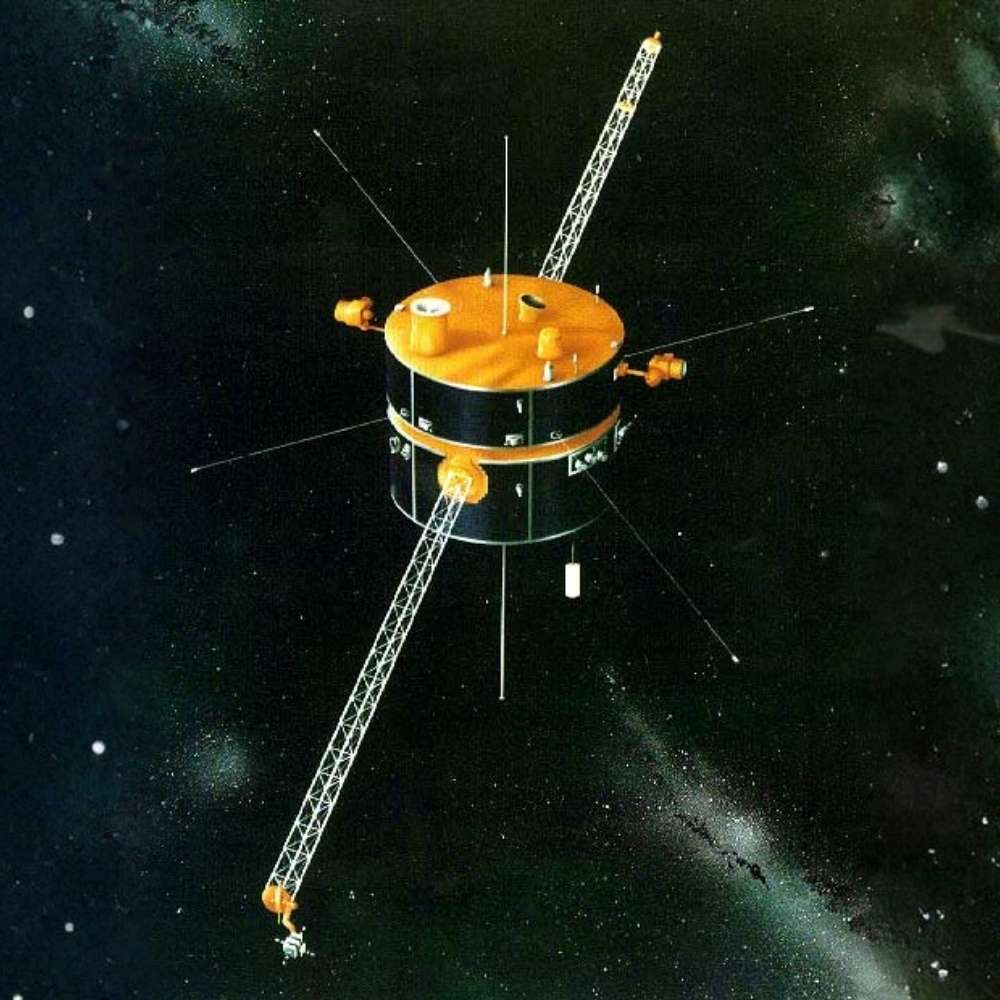
WIND
The Solar Wind Sentinel at Earth’s Frontier
Quick Reader
| Attribute | Details |
|---|---|
| Mission Name | WIND |
| Mission Type | Solar wind & space plasma observatory |
| Operating Agency | NASA |
| Launch Date | 1 November 1994 |
| Primary Orbit | Sun–Earth L₁ halo orbit / distant Earth orbits |
| Core Objective | Measure solar wind before it reaches Earth |
| Key Focus Areas | Plasma, magnetic fields, energetic particles |
| Mission Status | Active (extended mission) |
| Associated Program | Global Geospace Science (GGS) |
| Companion Missions | POLAR, GEOTAIL |
| Operational Lifetime | 30+ years (and counting) |
Why WIND Is Special (Quick Context)
WIND is one of the most important space weather missions ever flown. It functions as an early-warning system by measuring the solar wind hours before it impacts Earth.
These observations help scientists understand—and in some cases predict—geomagnetic storms that can affect satellites, power grids, navigation systems, and global communications.
Key Insight Snapshot
- One of the longest-operating heliophysics missions in history
- Primary upstream monitor of the solar wind near Earth
- Cornerstone mission for modern space weather science
- Essential reference for Sun–Earth interaction studies
- Still scientifically productive decades after launch
Introduction — Why the Solar Wind Matters
Earth does not sit in quiet space.
It is constantly immersed in a fast-moving stream of charged particles flowing outward from the Sun—the solar wind. This invisible wind shapes Earth’s magnetosphere, triggers auroras, disrupts satellites, and can even damage ground-based power infrastructure.
Understanding this wind requires measuring it before it reaches Earth.
That is exactly what the WIND mission was built to do.
What Is the Solar Wind? (Clear Physical Context)
The solar wind is a continuous outflow of:
Electrons
Protons
Alpha particles
Embedded magnetic fields
It originates in the Sun’s hot corona and travels at speeds ranging from 300 to over 800 km/s.
Key properties that matter to Earth include:
Density
Velocity
Temperature
Magnetic field orientation
Even small changes in these parameters can dramatically affect Earth’s space environment.
The Purpose of WIND — Watching the Wind Before It Arrives
WIND was designed to sit upstream of Earth, between the Sun and our planet.
From this position, it can:
Measure solar wind conditions in real time
Detect shock waves from solar eruptions
Observe changes in magnetic field direction
Provide advance warning of geomagnetic storms
This upstream vantage point allows scientists to see cause before effect—a crucial requirement in space weather science.
Mission Context — Part of a Bigger System
WIND was launched as part of NASA’s Global Geospace Science (GGS) program, alongside:
POLAR — studying Earth’s magnetosphere
GEOTAIL — examining Earth’s magnetotail
Together, these missions formed a coordinated system to trace how solar energy enters, moves through, and exits Earth’s space environment.
WIND’s role was to define the input conditions.
Orbit Strategy — Not Just One Place
Unlike many spacecraft, WIND did not stay in a single orbit throughout its life.
Over the years, it has operated in:
Highly elliptical Earth orbits
Lissajous or halo orbits around Sun–Earth L₁
Distant Earth-space trajectories
This flexibility allowed WIND to:
Sample different regions of the solar wind
Compare upstream conditions over long time periods
Support calibration for newer missions
Its changing orbit enhanced its long-term scientific value.
Why L₁ Is a Perfect Watchpoint
The Sun–Earth L₁ Lagrange point, about 1.5 million km from Earth, is ideal for solar wind monitoring.
From L₁:
The spacecraft remains between Earth and the Sun
Solar wind arrives there 30–60 minutes before Earth
Continuous, uninterrupted measurements are possible
WIND helped establish L₁ as the standard location for space weather sentinels.
Scientific Instruments — Measuring an Invisible Storm
WIND carries a sophisticated suite of plasma and field instruments, including:
Solar wind particle detectors
Magnetometers
Energetic particle analyzers
Radio and plasma wave instruments
Together, these instruments allow scientists to reconstruct:
Solar wind structure
Shock propagation
Magnetic reconnection conditions
Particle acceleration processes
This makes WIND not just a monitor, but a physics laboratory in space.
Why WIND Still Matters Today
Even after three decades, WIND remains essential because:
It provides long-term baseline solar wind data
It supports calibration of newer missions (ACE, DSCOVR, Parker Solar Probe)
It captures rare, extreme solar events
It helps distinguish short-term variability from long-term trends
Few missions offer such continuity in heliophysics.
WIND in the Bigger Scientific Picture
WIND connects multiple domains:
Solar physics
Magnetospheric science
Space weather forecasting
Planetary protection
Technological infrastructure safety
It bridges the Sun and Earth, turning invisible plasma flows into measurable, actionable science.
WIND’s Instrument Suite — Turning Plasma into Data
WIND was designed to do one thing exceptionally well: fully characterize the solar wind before it reaches Earth.
To achieve this, it carries a carefully balanced set of instruments that measure particles, fields, and waves simultaneously.
This multi-instrument approach is crucial because the solar wind is not just matter—it is matter plus magnetism plus energy.
Plasma Instruments — Measuring the Solar Wind Itself
WIND measures the basic building blocks of the solar wind using dedicated plasma analyzers.
These instruments determine:
Particle density
Flow speed
Temperature
Composition (electrons, protons, alpha particles)
From these measurements, scientists can reconstruct how much energy and momentum the solar wind is carrying toward Earth at any moment.
This information defines the baseline conditions for all downstream space weather effects.
Magnetometers — Tracking the Invisible Driver
The most critical parameter for geomagnetic storms is not speed or density—it is the orientation of the magnetic field embedded in the solar wind.
WIND’s magnetometers measure:
Magnetic field strength
Direction (especially north–south orientation)
Rapid fluctuations and turbulence
A southward-pointing magnetic field dramatically increases the chance of magnetic reconnection with Earth’s magnetosphere, leading to geomagnetic storms.
WIND made it possible to link specific magnetic configurations to specific space weather outcomes.
Energetic Particle Detectors — Shock and Storm Physics
Solar eruptions can accelerate particles to near-relativistic speeds.
WIND’s energetic particle instruments observe:
Solar energetic particles (SEPs)
Shock-accelerated ions
High-energy electrons
These measurements help scientists understand:
How particles gain extreme energies
How shocks propagate through interplanetary space
Why some solar events are far more dangerous than others
This data is essential for protecting astronauts and satellites.
Radio and Plasma Wave Instruments — Hearing the Solar Wind
WIND can also “listen” to space.
Its wave instruments detect:
Plasma oscillations
Radio emissions from solar eruptions
Shock-associated wave activity
These observations allow scientists to:
Trace shock fronts
Identify particle acceleration regions
Study turbulence in the solar wind
In many cases, waves reveal processes that particle detectors alone cannot.
Landmark Scientific Contributions
Over decades of operation, WIND has contributed to thousands of scientific studies.
Some of its most important contributions include:
Identifying the structure of interplanetary shocks
Clarifying how coronal mass ejections evolve en route to Earth
Quantifying solar wind turbulence across scales
Establishing statistical links between upstream conditions and geomagnetic storms
Many space weather “rules of thumb” used today are grounded in WIND data.
WIND and Space Weather Prediction
While WIND was not designed as an operational forecasting satellite, it became one of the most important data sources for prediction models.
Its real-time data has been used to:
Anticipate geomagnetic storm onset
Estimate storm intensity
Validate space weather simulations
WIND demonstrated that upstream monitoring is essential, shaping how later operational missions were designed.
WIND vs ACE vs DSCOVR — A Clear Comparison
WIND set the scientific and operational standard that later Sun–Earth monitoring missions followed.
| Mission | Role | Key Difference |
|---|---|---|
| WIND | Scientific benchmark | Long-term, multi-instrument research mission |
| ACE | Near-real-time monitoring | Focused on operational space weather forecasting |
| DSCOVR | Operational sentinel | Provides continuous real-time solar wind alerts |
ACE and DSCOVR exist largely because WIND proved the critical value of upstream solar wind measurements for both science and space weather operations.
Why Longevity Matters in Heliophysics
Solar activity follows an approximately 11-year cycle, but long-term trends require much longer datasets.
WIND’s decades-long record allows scientists to:
Compare multiple solar cycles
Identify rare extreme events
Separate short-term variability from long-term behavior
This continuity is rare and scientifically invaluable.
WIND as a Calibration Anchor
New missions frequently rely on WIND data to:
Cross-check instrument accuracy
Validate measurement techniques
Maintain consistency across generations of spacecraft
In this sense, WIND is not just a mission—it is a reference standard for heliophysics.
Why WIND Is Still Scientifically Relevant
Despite newer spacecraft, WIND remains important because:
Its instruments are well-understood
Its data archive is exceptionally clean
It provides historical context newer missions lack
Many current discoveries make sense only when placed against WIND’s long-term baseline.
WIND and Extreme Solar Events — When the Sun Gets Dangerous
Some of WIND’s most valuable contributions came during rare, extreme solar events—the kinds that test both scientific models and technological resilience.
During major solar eruptions, WIND has:
Detected interplanetary shocks hours before Earth impact
Measured abrupt magnetic field reversals that triggered geomagnetic storms
Tracked the evolution of coronal mass ejections (CMEs) across interplanetary space
Because WIND observes the solar wind before it interacts with Earth’s magnetosphere, it provides the cleanest possible view of the Sun’s direct influence—free from Earth-induced distortions.
This upstream perspective is critical for understanding cause-and-effect in space weather.
Why WIND Was Transformational for Sun–Earth Science
Before WIND, solar wind measurements were:
Fragmented
Short-term
Often indirect
WIND changed that by providing:
Continuous, multi-parameter measurements
Long-duration coverage across multiple solar cycles
A consistent reference frame for magnetospheric studies
As a result, Sun–Earth interaction became a quantitative science, not just a descriptive one.
Many of today’s heliophysics models trace their validation directly back to WIND datasets.
How WIND Reshaped Space Weather Thinking
WIND helped establish several core principles now taken for granted:
Solar wind magnetic orientation matters more than speed alone
Upstream monitoring is essential, not optional
Geomagnetic storms are driven by specific, measurable conditions
Space weather must be treated as a system, not isolated events
These insights influenced how agencies plan satellite operations, astronaut safety protocols, and even ground-based infrastructure protection.
Frequently Asked Questions (Expanded)
Is WIND still operational today?
Yes. Although long past its original mission lifetime, WIND continues to return valuable scientific data as part of an extended mission.
Does WIND provide real-time space weather alerts?
Not directly as an operational system, but its data supports and validates real-time forecasting missions like DSCOVR.
Why is the magnetic field direction so important?
A southward-pointing solar wind magnetic field allows efficient magnetic reconnection with Earth’s magnetosphere, dramatically increasing storm intensity.
How much warning time can WIND provide?
Typically 30 to 60 minutes, depending on solar wind speed—enough time to issue alerts and take protective actions.
Why hasn’t WIND been replaced?
It hasn’t been replaced—it has been supplemented. Newer missions build on WIND’s foundation rather than replacing its long-term value.
Can WIND detect solar flares directly?
No. WIND detects the plasma and magnetic consequences of solar eruptions after they leave the Sun, not the flare itself.
Why is WIND data still used in research papers today?
Because its long, consistent dataset allows scientists to compare events across decades—something newer missions cannot yet do.
WIND’s Legacy in Heliophysics
WIND’s true legacy is not any single discovery, but its role as a baseline mission.
It established:
How solar wind should be measured
Which parameters matter most
How long-term datasets enable real understanding
In heliophysics, continuity is as important as innovation—and WIND delivered continuity on an unprecedented scale.
WIND in the Universe Map Context
Within Universe Map, WIND connects directly to:
Solar wind physics
Sun–Earth interaction
Lagrange point observatories
Space weather monitoring
Magnetospheric dynamics
Together, these topics show how invisible solar processes shape both planetary environments and human technology.
Final Perspective
WIND does not take dramatic images or visit distant worlds.
Its importance lies in something quieter—and more powerful.
For over three decades, WIND has stood between Earth and the Sun, patiently measuring an invisible flow that governs auroras, satellite safety, and the very space environment our planet inhabits.
By turning the solar wind from an abstract concept into a measurable system, WIND transformed our understanding of Earth’s place in space.
It reminds us that exploration is not only about going far—but about understanding what constantly surrounds us.